Header And Logo

|

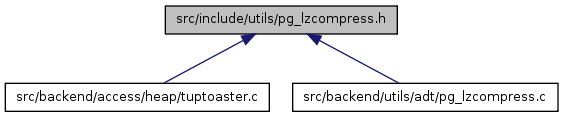
Go to the source code of this file.
Data Structures | |
| struct | PGLZ_Header |
| struct | PGLZ_Strategy |
Defines | |
| #define | PGLZ_MAX_OUTPUT(_dlen) ((_dlen) + 4 + sizeof(PGLZ_Header)) |
| #define | PGLZ_RAW_SIZE(_lzdata) ((_lzdata)->rawsize) |
Typedefs | |
| typedef struct PGLZ_Header | PGLZ_Header |
| typedef struct PGLZ_Strategy | PGLZ_Strategy |
Functions | |
| bool | pglz_compress (const char *source, int32 slen, PGLZ_Header *dest, const PGLZ_Strategy *strategy) |
| void | pglz_decompress (const PGLZ_Header *source, char *dest) |
Variables | |
| const PGLZ_Strategy *const | PGLZ_strategy_default |
| const PGLZ_Strategy *const | PGLZ_strategy_always |
| #define PGLZ_MAX_OUTPUT | ( | _dlen | ) | ((_dlen) + 4 + sizeof(PGLZ_Header)) |
Definition at line 34 of file pg_lzcompress.h.
Referenced by toast_compress_datum().
| #define PGLZ_RAW_SIZE | ( | _lzdata | ) | ((_lzdata)->rawsize) |
Definition at line 43 of file pg_lzcompress.h.
Referenced by heap_tuple_untoast_attr(), and heap_tuple_untoast_attr_slice().
| typedef struct PGLZ_Header PGLZ_Header |
| typedef struct PGLZ_Strategy PGLZ_Strategy |
| bool pglz_compress | ( | const char * | source, | |
| int32 | slen, | |||
| PGLZ_Header * | dest, | |||
| const PGLZ_Strategy * | strategy | |||
| ) |
Definition at line 482 of file pg_lzcompress.c.
References PGLZ_Strategy::first_success_by, PGLZ_Strategy::match_size_drop, PGLZ_Strategy::match_size_good, PGLZ_Strategy::max_input_size, PGLZ_Strategy::min_comp_rate, NULL, pglz_find_match(), pglz_hist_add, PGLZ_MAX_MATCH, pglz_out_literal, pglz_out_tag, PGLZ_Header::rawsize, and SET_VARSIZE_COMPRESSED.
Referenced by toast_compress_datum().
{
    unsigned char *bp = ((unsigned char *) dest) + sizeof(PGLZ_Header);
    unsigned char *bstart = bp;
    int         hist_next = 0;
    bool        hist_recycle = false;
    const char *dp = source;
    const char *dend = source + slen;
    unsigned char ctrl_dummy = 0;
    unsigned char *ctrlp = &ctrl_dummy;
    unsigned char ctrlb = 0;
    unsigned char ctrl = 0;
    bool        found_match = false;
    int32       match_len;
    int32       match_off;
    int32       good_match;
    int32       good_drop;
    int32       result_size;
    int32       result_max;
    int32       need_rate;

    /*
     * Our fallback strategy is the default.
     */
    if (strategy == NULL)
        strategy = PGLZ_strategy_default;

    /*
     * If the strategy forbids compression (at all or if source chunk size out
     * of range), fail.
     */
    if (strategy->match_size_good <= 0 ||
        slen < strategy->min_input_size ||
        slen > strategy->max_input_size)
        return false;

    /*
     * Save the original source size in the header.
     */
    dest->rawsize = slen;

    /*
     * Limit the match parameters to the supported range.
     */
    good_match = strategy->match_size_good;
    if (good_match > PGLZ_MAX_MATCH)
        good_match = PGLZ_MAX_MATCH;
    else if (good_match < 17)
        good_match = 17;

    good_drop = strategy->match_size_drop;
    if (good_drop < 0)
        good_drop = 0;
    else if (good_drop > 100)
        good_drop = 100;

    need_rate = strategy->min_comp_rate;
    if (need_rate < 0)
        need_rate = 0;
    else if (need_rate > 99)
        need_rate = 99;

    /*
     * Compute the maximum result size allowed by the strategy, namely the
     * input size minus the minimum wanted compression rate.  This had better
     * be <= slen, else we might overrun the provided output buffer.
     */
    if (slen > (INT_MAX / 100))
    {
        /* Approximate to avoid overflow */
        result_max = (slen / 100) * (100 - need_rate);
    }
    else
        result_max = (slen * (100 - need_rate)) / 100;

    /*
     * Initialize the history lists to empty.  We do not need to zero the
     * hist_entries[] array; its entries are initialized as they are used.
     */
    memset(hist_start, 0, sizeof(hist_start));

    /*
     * Compress the source directly into the output buffer.
     */
    while (dp < dend)
    {
        /*
         * If we already exceeded the maximum result size, fail.
         *
         * We check once per loop; since the loop body could emit as many as 4
         * bytes (a control byte and 3-byte tag), PGLZ_MAX_OUTPUT() had better
         * allow 4 slop bytes.
         */
        if (bp - bstart >= result_max)
            return false;

        /*
         * If we've emitted more than first_success_by bytes without finding
         * anything compressible at all, fail.  This lets us fall out
         * reasonably quickly when looking at incompressible input (such as
         * pre-compressed data).
         */
        if (!found_match && bp - bstart >= strategy->first_success_by)
            return false;

        /*
         * Try to find a match in the history
         */
        if (pglz_find_match(hist_start, dp, dend, &match_len,
                            &match_off, good_match, good_drop))
        {
            /*
             * Create the tag and add history entries for all matched
             * characters.
             */
            pglz_out_tag(ctrlp, ctrlb, ctrl, bp, match_len, match_off);
            while (match_len--)
            {
                pglz_hist_add(hist_start, hist_entries,
                              hist_next, hist_recycle,
                              dp, dend);
                dp++;           /* Do not do this ++ in the line above! */
                /* The macro would do it four times - Jan.  */
            }
            found_match = true;
        }
        else
        {
            /*
             * No match found. Copy one literal byte.
             */
            pglz_out_literal(ctrlp, ctrlb, ctrl, bp, *dp);
            pglz_hist_add(hist_start, hist_entries,
                          hist_next, hist_recycle,
                          dp, dend);
            dp++;               /* Do not do this ++ in the line above! */
            /* The macro would do it four times - Jan.  */
        }
    }

    /*
     * Write out the last control byte and check that we haven't overrun the
     * output size allowed by the strategy.
     */
    *ctrlp = ctrlb;
    result_size = bp - bstart;
    if (result_size >= result_max)
        return false;

    /*
     * Success - need only fill in the actual length of the compressed datum.
     */
    SET_VARSIZE_COMPRESSED(dest, result_size + sizeof(PGLZ_Header));

    return true;
}
| void pglz_decompress | ( | const PGLZ_Header * | source, | |
| char * | dest | |||
| ) |
Definition at line 648 of file pg_lzcompress.c.
References elog, ERROR, PGLZ_Header::rawsize, and VARSIZE.
Referenced by heap_tuple_untoast_attr(), and heap_tuple_untoast_attr_slice().
{
    const unsigned char *sp;
    const unsigned char *srcend;
    unsigned char *dp;
    unsigned char *destend;

    sp = ((const unsigned char *) source) + sizeof(PGLZ_Header);
    srcend = ((const unsigned char *) source) + VARSIZE(source);
    dp = (unsigned char *) dest;
    destend = dp + source->rawsize;

    while (sp < srcend && dp < destend)
    {
        /*
         * Read one control byte and process the next 8 items (or as many as
         * remain in the compressed input).
         */
        unsigned char ctrl = *sp++;
        int         ctrlc;

        for (ctrlc = 0; ctrlc < 8 && sp < srcend; ctrlc++)
        {
            if (ctrl & 1)
            {
                /*
                 * Otherwise it contains the match length minus 3 and the
                 * upper 4 bits of the offset. The next following byte
                 * contains the lower 8 bits of the offset. If the length is
                 * coded as 18, another extension tag byte tells how much
                 * longer the match really was (0-255).
                 */
                int32       len;
                int32       off;

                len = (sp[0] & 0x0f) + 3;
                off = ((sp[0] & 0xf0) << 4) | sp[1];
                sp += 2;
                if (len == 18)
                    len += *sp++;

                /*
                 * Check for output buffer overrun, to ensure we don't clobber
                 * memory in case of corrupt input.  Note: we must advance dp
                 * here to ensure the error is detected below the loop.  We
                 * don't simply put the elog inside the loop since that will
                 * probably interfere with optimization.
                 */
                if (dp + len > destend)
                {
                    dp += len;
                    break;
                }

                /*
                 * Now we copy the bytes specified by the tag from OUTPUT to
                 * OUTPUT. It is dangerous and platform dependent to use
                 * memcpy() here, because the copied areas could overlap
                 * extremely!
                 */
                while (len--)
                {
                    *dp = dp[-off];
                    dp++;
                }
            }
            else
            {
                /*
                 * An unset control bit means LITERAL BYTE. So we just copy
                 * one from INPUT to OUTPUT.
                 */
                if (dp >= destend)      /* check for buffer overrun */
                    break;      /* do not clobber memory */

                *dp++ = *sp++;
            }

            /*
             * Advance the control bit
             */
            ctrl >>= 1;
        }
    }

    /*
     * Check we decompressed the right amount.
     */
    if (dp != destend || sp != srcend)
        elog(ERROR, "compressed data is corrupt");

    /*
     * That's it.
     */
}
| const PGLZ_Strategy* const PGLZ_strategy_always |
Definition at line 237 of file pg_lzcompress.c.
| const PGLZ_Strategy* const PGLZ_strategy_default |
Definition at line 225 of file pg_lzcompress.c.
Referenced by toast_compress_datum().
 1.7.1
1.7.1