Header And Logo

|

#include "postgres.h"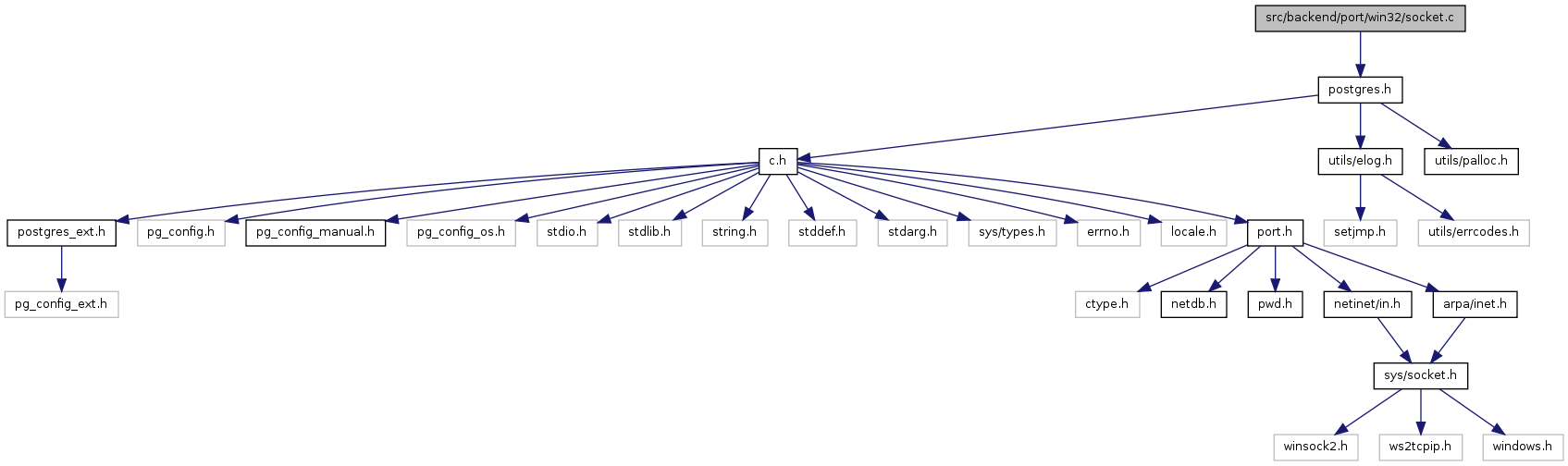
Go to the source code of this file.
Functions | |
| static void | TranslateSocketError (void) |
| static int | pgwin32_poll_signals (void) |
| static int | isDataGram (SOCKET s) |
| int | pgwin32_waitforsinglesocket (SOCKET s, int what, int timeout) |
| SOCKET | pgwin32_socket (int af, int type, int protocol) |
| SOCKET | pgwin32_accept (SOCKET s, struct sockaddr *addr, int *addrlen) |
| int | pgwin32_connect (SOCKET s, const struct sockaddr *addr, int addrlen) |
| int | pgwin32_recv (SOCKET s, char *buf, int len, int f) |
| int | pgwin32_send (SOCKET s, const void *buf, int len, int flags) |
| int | pgwin32_select (int nfds, fd_set *readfds, fd_set *writefds, fd_set *exceptfds, const struct timeval *timeout) |
| const char * | pgwin32_socket_strerror (int err) |
Variables | |
| int | pgwin32_noblock = 0 |
| static char | wserrbuf [256] |
| static int isDataGram | ( | SOCKET | s | ) | [static] |
Definition at line 120 of file socket.c.
Referenced by pgwin32_waitforsinglesocket().
{
    int         type;
    int         typelen = sizeof(type);

    if (getsockopt(s, SOL_SOCKET, SO_TYPE, (char *) &type, &typelen))
        return 1;

    return (type == SOCK_DGRAM) ? 1 : 0;
}
| SOCKET pgwin32_accept | ( | SOCKET | s, | |
| struct sockaddr * | addr, | |||
| int * | addrlen | |||
| ) |
Definition at line 266 of file socket.c.
References NULL, pgwin32_poll_signals(), and TranslateSocketError().
{
    SOCKET      rs;

    /*
     * Poll for signals, but don't return with EINTR, since we don't handle
     * that in pqcomm.c
     */
    pgwin32_poll_signals();

    rs = WSAAccept(s, addr, addrlen, NULL, 0);
    if (rs == INVALID_SOCKET)
    {
        TranslateSocketError();
        return INVALID_SOCKET;
    }
    return rs;
}
| int pgwin32_connect | ( | SOCKET | s, | |
| const struct sockaddr * | addr, | |||
| int | addrlen | |||
| ) |
Definition at line 288 of file socket.c.
References NULL, pgwin32_waitforsinglesocket(), and TranslateSocketError().
{
    int         r;

    r = WSAConnect(s, addr, addrlen, NULL, NULL, NULL, NULL);
    if (r == 0)
        return 0;

    if (WSAGetLastError() != WSAEWOULDBLOCK)
    {
        TranslateSocketError();
        return -1;
    }

    while (pgwin32_waitforsinglesocket(s, FD_CONNECT, INFINITE) == 0)
    {
        /* Loop endlessly as long as we are just delivering signals */
    }

    return 0;
}
| static int pgwin32_poll_signals | ( | void | ) | [static] |
Definition at line 108 of file socket.c.
References pgwin32_dispatch_queued_signals(), and UNBLOCKED_SIGNAL_QUEUE.
Referenced by pgwin32_accept(), pgwin32_recv(), pgwin32_select(), and pgwin32_send().
{
    if (UNBLOCKED_SIGNAL_QUEUE())
    {
        pgwin32_dispatch_queued_signals();
        errno = EINTR;
        return 1;
    }
    return 0;
}
| int pgwin32_recv | ( | SOCKET | s, | |
| char * | buf, | |||
| int | len, | |||
| int | f | |||
| ) |
Definition at line 311 of file socket.c.
References ereport, errmsg_internal(), NOTICE, NULL, pg_usleep(), pgwin32_noblock, pgwin32_poll_signals(), pgwin32_waitforsinglesocket(), and TranslateSocketError().
{
    WSABUF      wbuf;
    int         r;
    DWORD       b;
    DWORD       flags = f;
    int         n;

    if (pgwin32_poll_signals())
        return -1;

    wbuf.len = len;
    wbuf.buf = buf;

    r = WSARecv(s, &wbuf, 1, &b, &flags, NULL, NULL);
    if (r != SOCKET_ERROR && b > 0)
        /* Read succeeded right away */
        return b;

    if (r == SOCKET_ERROR &&
        WSAGetLastError() != WSAEWOULDBLOCK)
    {
        TranslateSocketError();
        return -1;
    }

    if (pgwin32_noblock)
    {
        /*
         * No data received, and we are in "emulated non-blocking mode", so
         * return indicating that we'd block if we were to continue.
         */
        errno = EWOULDBLOCK;
        return -1;
    }

    /* No error, zero bytes (win2000+) or error+WSAEWOULDBLOCK (<=nt4) */

    for (n = 0; n < 5; n++)
    {
        if (pgwin32_waitforsinglesocket(s, FD_READ | FD_CLOSE | FD_ACCEPT,
                                        INFINITE) == 0)
            return -1;          /* errno already set */

        r = WSARecv(s, &wbuf, 1, &b, &flags, NULL, NULL);
        if (r == SOCKET_ERROR)
        {
            if (WSAGetLastError() == WSAEWOULDBLOCK)
            {
                /*
                 * There seem to be cases on win2k (at least) where WSARecv
                 * can return WSAEWOULDBLOCK even when
                 * pgwin32_waitforsinglesocket claims the socket is readable.
                 * In this case, just sleep for a moment and try again. We try
                 * up to 5 times - if it fails more than that it's not likely
                 * to ever come back.
                 */
                pg_usleep(10000);
                continue;
            }
            TranslateSocketError();
            return -1;
        }
        return b;
    }
    ereport(NOTICE,
      (errmsg_internal("could not read from ready socket (after retries)")));
    errno = EWOULDBLOCK;
    return -1;
}
| int pgwin32_select | ( | int | nfds, | |
| fd_set * | readfds, | |||
| fd_set * | writefds, | |||
| fd_set * | exceptfds, | |||
| const struct timeval * | timeout | |||
| ) |
Definition at line 451 of file socket.c.
References Assert, buf, elog, ERROR, FALSE, i, NULL, pgwin32_dispatch_queued_signals(), pgwin32_poll_signals(), pgwin32_signal_event, TranslateSocketError(), and TRUE.
{
    WSAEVENT    events[FD_SETSIZE * 2]; /* worst case is readfds totally
                                         * different from writefds, so
                                         * 2*FD_SETSIZE sockets */
    SOCKET      sockets[FD_SETSIZE * 2];
    int         numevents = 0;
    int         i;
    int         r;
    DWORD       timeoutval = WSA_INFINITE;
    FD_SET      outreadfds;
    FD_SET      outwritefds;
    int         nummatches = 0;

    Assert(exceptfds == NULL);

    if (pgwin32_poll_signals())
        return -1;

    FD_ZERO(&outreadfds);
    FD_ZERO(&outwritefds);

    /*
     * Write FDs are different in the way that it is only flagged by
     * WSASelectEvent() if we have tried to write to them first. So try an
     * empty write
     */
    if (writefds)
    {
        for (i = 0; i < writefds->fd_count; i++)
        {
            char        c;
            WSABUF      buf;
            DWORD       sent;

            buf.buf = &c;
            buf.len = 0;

            r = WSASend(writefds->fd_array[i], &buf, 1, &sent, 0, NULL, NULL);
            if (r == 0)         /* Completed - means things are fine! */
                FD_SET(writefds->fd_array[i], &outwritefds);

            else
            {                   /* Not completed */
                if (WSAGetLastError() != WSAEWOULDBLOCK)

                    /*
                     * Not completed, and not just "would block", so an error
                     * occurred
                     */
                    FD_SET(writefds->fd_array[i], &outwritefds);
            }
        }
        if (outwritefds.fd_count > 0)
        {
            memcpy(writefds, &outwritefds, sizeof(fd_set));
            if (readfds)
                FD_ZERO(readfds);
            return outwritefds.fd_count;
        }
    }


    /* Now set up for an actual select */

    if (timeout != NULL)
    {
        /* timeoutval is in milliseconds */
        timeoutval = timeout->tv_sec * 1000 + timeout->tv_usec / 1000;
    }

    if (readfds != NULL)
    {
        for (i = 0; i < readfds->fd_count; i++)
        {
            events[numevents] = WSACreateEvent();
            sockets[numevents] = readfds->fd_array[i];
            numevents++;
        }
    }
    if (writefds != NULL)
    {
        for (i = 0; i < writefds->fd_count; i++)
        {
            if (!readfds ||
                !FD_ISSET(writefds->fd_array[i], readfds))
            {
                /* If the socket is not in the read list */
                events[numevents] = WSACreateEvent();
                sockets[numevents] = writefds->fd_array[i];
                numevents++;
            }
        }
    }

    for (i = 0; i < numevents; i++)
    {
        int         flags = 0;

        if (readfds && FD_ISSET(sockets[i], readfds))
            flags |= FD_READ | FD_ACCEPT | FD_CLOSE;

        if (writefds && FD_ISSET(sockets[i], writefds))
            flags |= FD_WRITE | FD_CLOSE;

        if (WSAEventSelect(sockets[i], events[i], flags) != 0)
        {
            TranslateSocketError();
            /* release already-assigned event objects */
            while (--i >= 0)
                WSAEventSelect(sockets[i], NULL, 0);
            for (i = 0; i < numevents; i++)
                WSACloseEvent(events[i]);
            return -1;
        }
    }

    events[numevents] = pgwin32_signal_event;
    r = WaitForMultipleObjectsEx(numevents + 1, events, FALSE, timeoutval, TRUE);
    if (r != WAIT_TIMEOUT && r != WAIT_IO_COMPLETION && r != (WAIT_OBJECT_0 + numevents))
    {
        /*
         * We scan all events, even those not signalled, in case more than one
         * event has been tagged but Wait.. can only return one.
         */
        WSANETWORKEVENTS resEvents;

        for (i = 0; i < numevents; i++)
        {
            ZeroMemory(&resEvents, sizeof(resEvents));
            if (WSAEnumNetworkEvents(sockets[i], events[i], &resEvents) != 0)
                elog(ERROR, "failed to enumerate network events: error code %u",
                     WSAGetLastError());
            /* Read activity? */
            if (readfds && FD_ISSET(sockets[i], readfds))
            {
                if ((resEvents.lNetworkEvents & FD_READ) ||
                    (resEvents.lNetworkEvents & FD_ACCEPT) ||
                    (resEvents.lNetworkEvents & FD_CLOSE))
                {
                    FD_SET(sockets[i], &outreadfds);

                    nummatches++;
                }
            }
            /* Write activity? */
            if (writefds && FD_ISSET(sockets[i], writefds))
            {
                if ((resEvents.lNetworkEvents & FD_WRITE) ||
                    (resEvents.lNetworkEvents & FD_CLOSE))
                {
                    FD_SET(sockets[i], &outwritefds);

                    nummatches++;
                }
            }
        }
    }

    /* Clean up all the event objects */
    for (i = 0; i < numevents; i++)
    {
        WSAEventSelect(sockets[i], NULL, 0);
        WSACloseEvent(events[i]);
    }

    if (r == WSA_WAIT_TIMEOUT)
    {
        if (readfds)
            FD_ZERO(readfds);
        if (writefds)
            FD_ZERO(writefds);
        return 0;
    }

    if (r == WAIT_OBJECT_0 + numevents)
    {
        pgwin32_dispatch_queued_signals();
        errno = EINTR;
        if (readfds)
            FD_ZERO(readfds);
        if (writefds)
            FD_ZERO(writefds);
        return -1;
    }

    /* Overwrite socket sets with our resulting values */
    if (readfds)
        memcpy(readfds, &outreadfds, sizeof(fd_set));
    if (writefds)
        memcpy(writefds, &outwritefds, sizeof(fd_set));
    return nummatches;
}
| int pgwin32_send | ( | SOCKET | s, | |
| const void * | buf, | |||
| int | len, | |||
| int | flags | |||
| ) |
Definition at line 393 of file socket.c.
References NULL, pgwin32_noblock, pgwin32_poll_signals(), pgwin32_waitforsinglesocket(), and TranslateSocketError().
{
    WSABUF      wbuf;
    int         r;
    DWORD       b;

    if (pgwin32_poll_signals())
        return -1;

    wbuf.len = len;
    wbuf.buf = (char *) buf;

    /*
     * Readiness of socket to send data to UDP socket may be not true: socket
     * can become busy again! So loop until send or error occurs.
     */
    for (;;)
    {
        r = WSASend(s, &wbuf, 1, &b, flags, NULL, NULL);
        if (r != SOCKET_ERROR && b > 0)
            /* Write succeeded right away */
            return b;

        if (r == SOCKET_ERROR &&
            WSAGetLastError() != WSAEWOULDBLOCK)
        {
            TranslateSocketError();
            return -1;
        }

        if (pgwin32_noblock)
        {
            /*
             * No data sent, and we are in "emulated non-blocking mode", so
             * return indicating that we'd block if we were to continue.
             */
            errno = EWOULDBLOCK;
            return -1;
        }

        /* No error, zero bytes (win2000+) or error+WSAEWOULDBLOCK (<=nt4) */

        if (pgwin32_waitforsinglesocket(s, FD_WRITE | FD_CLOSE, INFINITE) == 0)
            return -1;
    }

    return -1;
}
| SOCKET pgwin32_socket | ( | int | af, | |
| int | type, | |||
| int | protocol | |||
| ) |
Definition at line 242 of file socket.c.
References NULL, and TranslateSocketError().
{
    SOCKET      s;
    unsigned long on = 1;

    s = WSASocket(af, type, protocol, NULL, 0, WSA_FLAG_OVERLAPPED);
    if (s == INVALID_SOCKET)
    {
        TranslateSocketError();
        return INVALID_SOCKET;
    }

    if (ioctlsocket(s, FIONBIO, &on))
    {
        TranslateSocketError();
        return INVALID_SOCKET;
    }
    errno = 0;

    return s;
}
| const char* pgwin32_socket_strerror | ( | int | err | ) |
Definition at line 652 of file socket.c.
References ereport, errmsg_internal(), FATAL, NULL, and wserrbuf.
Referenced by useful_strerror().
{
    static HANDLE handleDLL = INVALID_HANDLE_VALUE;

    if (handleDLL == INVALID_HANDLE_VALUE)
    {
        handleDLL = LoadLibraryEx("netmsg.dll", NULL, DONT_RESOLVE_DLL_REFERENCES | LOAD_LIBRARY_AS_DATAFILE);
        if (handleDLL == NULL)
            ereport(FATAL,
                    (errmsg_internal("could not load netmsg.dll: error code %lu", GetLastError())));
    }

    ZeroMemory(&wserrbuf, sizeof(wserrbuf));
    if (FormatMessage(FORMAT_MESSAGE_IGNORE_INSERTS | FORMAT_MESSAGE_FROM_SYSTEM | FORMAT_MESSAGE_FROM_HMODULE,
                      handleDLL,
                      err,
                      MAKELANGID(LANG_ENGLISH, SUBLANG_DEFAULT),
                      wserrbuf,
                      sizeof(wserrbuf) - 1,
                      NULL) == 0)
    {
        /* Failed to get id */
        sprintf(wserrbuf, "unrecognized winsock error %d", err);
    }
    return wserrbuf;
}
| int pgwin32_waitforsinglesocket | ( | SOCKET | s, | |
| int | what, | |||
| int | timeout | |||
| ) |
Definition at line 132 of file socket.c.
References buf, ereport, errmsg_internal(), ERROR, FALSE, isDataGram(), NULL, pgwin32_dispatch_queued_signals(), pgwin32_signal_event, TranslateSocketError(), and TRUE.
Referenced by pgwin32_connect(), pgwin32_recv(), pgwin32_send(), secure_read(), and secure_write().
{
    static HANDLE waitevent = INVALID_HANDLE_VALUE;
    static SOCKET current_socket = -1;
    static int  isUDP = 0;
    HANDLE      events[2];
    int         r;

    /* Create an event object just once and use it on all future calls */
    if (waitevent == INVALID_HANDLE_VALUE)
    {
        waitevent = CreateEvent(NULL, TRUE, FALSE, NULL);

        if (waitevent == INVALID_HANDLE_VALUE)
            ereport(ERROR,
                    (errmsg_internal("could not create socket waiting event: error code %lu", GetLastError())));
    }
    else if (!ResetEvent(waitevent))
        ereport(ERROR,
                (errmsg_internal("could not reset socket waiting event: error code %lu", GetLastError())));

    /*
     * Track whether socket is UDP or not.  (NB: most likely, this is both
     * useless and wrong; there is no reason to think that the behavior of
     * WSAEventSelect is different for TCP and UDP.)
     */
    if (current_socket != s)
        isUDP = isDataGram(s);
    current_socket = s;

    /*
     * Attach event to socket.  NOTE: we must detach it again before
     * returning, since other bits of code may try to attach other events to
     * the socket.
     */
    if (WSAEventSelect(s, waitevent, what) != 0)
    {
        TranslateSocketError();
        return 0;
    }

    events[0] = pgwin32_signal_event;
    events[1] = waitevent;

    /*
     * Just a workaround of unknown locking problem with writing in UDP socket
     * under high load: Client's pgsql backend sleeps infinitely in
     * WaitForMultipleObjectsEx, pgstat process sleeps in pgwin32_select().
     * So, we will wait with small timeout(0.1 sec) and if sockect is still
     * blocked, try WSASend (see comments in pgwin32_select) and wait again.
     */
    if ((what & FD_WRITE) && isUDP)
    {
        for (;;)
        {
            r = WaitForMultipleObjectsEx(2, events, FALSE, 100, TRUE);

            if (r == WAIT_TIMEOUT)
            {
                char        c;
                WSABUF      buf;
                DWORD       sent;

                buf.buf = &c;
                buf.len = 0;

                r = WSASend(s, &buf, 1, &sent, 0, NULL, NULL);
                if (r == 0)     /* Completed - means things are fine! */
                {
                    WSAEventSelect(s, NULL, 0);
                    return 1;
                }
                else if (WSAGetLastError() != WSAEWOULDBLOCK)
                {
                    TranslateSocketError();
                    WSAEventSelect(s, NULL, 0);
                    return 0;
                }
            }
            else
                break;
        }
    }
    else
        r = WaitForMultipleObjectsEx(2, events, FALSE, timeout, TRUE);

    WSAEventSelect(s, NULL, 0);

    if (r == WAIT_OBJECT_0 || r == WAIT_IO_COMPLETION)
    {
        pgwin32_dispatch_queued_signals();
        errno = EINTR;
        return 0;
    }
    if (r == WAIT_OBJECT_0 + 1)
        return 1;
    if (r == WAIT_TIMEOUT)
    {
        errno = EWOULDBLOCK;
        return 0;
    }
    ereport(ERROR,
            (errmsg_internal("unrecognized return value from WaitForMultipleObjects: %d (error code %lu)", r, GetLastError())));
    return 0;
}
| static void TranslateSocketError | ( | void | ) | [static] |
Definition at line 46 of file socket.c.
References ereport, errmsg_internal(), and NOTICE.
Referenced by pgwin32_accept(), pgwin32_connect(), pgwin32_recv(), pgwin32_select(), pgwin32_send(), pgwin32_socket(), and pgwin32_waitforsinglesocket().
{
    switch (WSAGetLastError())
    {
        case WSANOTINITIALISED:
        case WSAENETDOWN:
        case WSAEINPROGRESS:
        case WSAEINVAL:
        case WSAESOCKTNOSUPPORT:
        case WSAEFAULT:
        case WSAEINVALIDPROVIDER:
        case WSAEINVALIDPROCTABLE:
        case WSAEMSGSIZE:
            errno = EINVAL;
            break;
        case WSAEAFNOSUPPORT:
            errno = EAFNOSUPPORT;
            break;
        case WSAEMFILE:
            errno = EMFILE;
            break;
        case WSAENOBUFS:
            errno = ENOBUFS;
            break;
        case WSAEPROTONOSUPPORT:
        case WSAEPROTOTYPE:
            errno = EPROTONOSUPPORT;
            break;
        case WSAECONNREFUSED:
            errno = ECONNREFUSED;
            break;
        case WSAEINTR:
            errno = EINTR;
            break;
        case WSAENOTSOCK:
            errno = EBADFD;
            break;
        case WSAEOPNOTSUPP:
            errno = EOPNOTSUPP;
            break;
        case WSAEWOULDBLOCK:
            errno = EWOULDBLOCK;
            break;
        case WSAEACCES:
            errno = EACCES;
            break;
        case WSAENOTCONN:
        case WSAENETRESET:
        case WSAECONNRESET:
        case WSAESHUTDOWN:
        case WSAECONNABORTED:
        case WSAEDISCON:
            errno = ECONNREFUSED;       /* ENOTCONN? */
            break;
        default:
            ereport(NOTICE,
                    (errmsg_internal("unrecognized win32 socket error code: %d", WSAGetLastError())));
            errno = EINVAL;
    }
}
| int pgwin32_noblock = 0 |
Definition at line 28 of file socket.c.
Referenced by PgstatCollectorMain(), pgwin32_recv(), pgwin32_send(), and pq_set_nonblocking().
char wserrbuf[256] [static] |
Definition at line 650 of file socket.c.
Referenced by pgwin32_socket_strerror().
 1.7.1
1.7.1