 |
TrinityCore
|
|
TrinityCore
|
#include <BumpMapPreprocess.h>
Public Member Functions | |
| BumpMapPreprocess () | |
| BumpMapPreprocess (const Any &any) | |
| Any | toAny () const |
| bool | operator== (const BumpMapPreprocess &other) const |
Public Attributes | |
| bool | lowPassFilter |
| float | zExtentPixels |
| bool | scaleZByNz |
Not in the BumpMap class to avoid a circular dependency between Texture and BumpMap. G3D::Image::computeNormalMap().
|
inline |
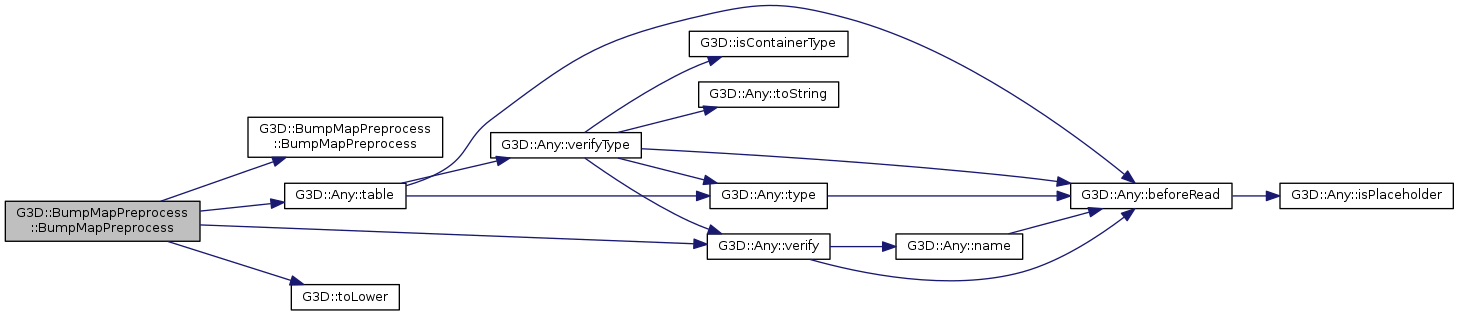
 Here is the caller graph for this function: Here is the call graph for this function:
|
inline |
| Any G3D::BumpMapPreprocess::toAny | ( | ) | const |
Here is the call graph for this function:| bool G3D::BumpMapPreprocess::lowPassFilter |
If true, the elevations are box filtered after computing normals and before uploading, which produces better results for parallax offset mapping Defaults to false.
| bool G3D::BumpMapPreprocess::scaleZByNz |
After computing normals, scale the height by |N.z|, a trick that reduces texture swim in steep areas for parallax offset mapping. Defaults to false.
| float G3D::BumpMapPreprocess::zExtentPixels |
Height of the maximum ("white") value, in pixels, for the purpose of computing normals. A value of 255 means that a 255 x 255 bump image with a full black-to-white gradient will produce a 45-degree ramp (this also results in "cubic" voxels). A negative value means to set zExtentPixels to -zExtentPixels * max(width, height). The default is -0.02.
 1.8.8
1.8.8