Oscar 0.6 release notes
| release: | 2014-01-08 |
|---|
It took a while but it’s finally here: welcome to Oscar 0.6!
These release notes cover the new features as well as backwards incompatible changes that you’ll want to be aware of when upgrading from Oscar 0.5 or earlier. This release contains some major changes to core APIs which means many old APIs are scheduled to be dropped - see the deprecation plan to avoid any nasty surprises.
When upgrading your Oscar site, make sure you study both the backwards incompatible changes and the deprecated features. If you encounter any undocumented issues, please let us know on the mailing list.
Table of contents:
Overview
The biggest change in Oscar 0.6 is the reworking of pricing and availability, which builds on top of the change to allow multiple stockrecords per product. The change is largely backwards compatible with the old system of “partner wrappers” but it is recommended to upgrade to the new system. Support for partner wrappers will be removed for Oscar 0.7.
Oscar 0.6 also introduces better support for marketplace-like functionality
with the so-called permission-based dashboard. It is now possible to give
non-staff users access to a subset of the dashboard’s views (products and
orders) by setting the new dashboard_access permission.
Oscar now supports Django 1.5 and its custom user model. This has been only tested in the context of starting a new Oscar project with a custom model. Switching from a separate “profile” model to the new system is not recommended at this point.
Oscar also supports Django 1.6 although this is considered experimental at this stage. It’s possible there are still some incompatibilities that haven’t been teased out just yet.
Other notable new features include:
- A feature-rich demo site that illustrates how Oscar can be customised. It uses several of Oscar’s many extensions such as django-oscar-paypal, django-oscar-datacash and django-oscar-stores. It is intended as a reference site for Oscar.
- Partners can now have addresses.
- Customer wishlists. Customers can how add products to wishlists and manage them within their account section.
- New helper methods in the
EventHandlerclass for order processing. - Reworked search app with support for easy faceting.
Also, to help justify Tangent’s sponsorship of Oscar, a simple tracking mechanism has been introduced to keep track of which sites use Oscar.
What’s new in Oscar 0.6?
Multiple stockrecords per product
Products can now have multiple stockrecords rather than just one. This is a key structural change that paves the way for many advanced features.
If a product can be fulfilled by multiple partners, a different stockrecord can be created for each partner. This is a common requirement for large-scale e-commerce sites selling millions of products that use many different fulfillment partners.
It also allows better support for international sites as stockrecords can be created for partners in different countries, who sell in different currencies.
See the documentation on pricing and availability for more details.
Warning
This changes means several APIs are deprecated as they assume there is only one stockrecord per product.
Pricing and availability
When products can have many stockrecords, a process needs to be in place to choose which one is selected for a given customer and product. To handle this, a new “strategy” class has been introduced, responsible for selecting the appropriate stockrecord for a given customer and product.
This change also paved the way for reworking how prices, taxes and availability are handled. Instead of using “partner wrappers”, the strategy class is responsible for returning availability details and prices for a particular product. New classes known as pricing and availability policies are used to cleanly encapsulate this information.
These changes allow Oscar to dynamically determine prices, partner and availability for a given customer and product. This enables several advanced features such as:
- Fulfilling a product from the partner that offers the best margin.
- Fulfilling a product from the partner geographically closest to the customer.
- Automatically switching to a new partner when when stock runs out.
- Supporting transactions in multiple currencies on the same site.
- Supporting different tax treatments on the same site (eg UK VAT and US sales tax)
- Having different pricing and availability policies for different customers.
More generally, it provides a structure for customising how pricing, availability work on a per-customer basis. This gives a great deal of flexibility.
See the guide to prices and availability for more information.
Permission-based dashboard
Three changes were necessary to better support marketplace scenarios within Oscar:
- Oscar’s core
Applicationclass now supports specifying permissions on a per-view basis. This is done via a new default decorator. Legacy behaviour is unchanged. - The dashboard’s menus are now built dynamically. If the current user does
not have access to some views in OSCAR_DASHBOARD_NAVIGATION, they will
be omitted in the menu returned by
oscar.apps.dashboard.nav.create_menu(). - The index, catalogue and order dashboard views have been modified to allow access to non-staff users. See the dashboard documentation for details.
- The relation
oscar.apps.partner.abstract_models.AbstractPartner.userswas not used by core Oscar prior 0.6. It is now used to model access for the permission-based dashboard.
Payment models have abstract versions
The models within the payment app have been split into abstract and concrete versions. This brings them inline with other Oscar apps and allows them to be customised in the normal way.
Wishlists
Wishlist functionality has finally landed. Signed in customers are now able to create multiple named wishlists and add products to them. There is a new section in the customer’s account where wishlists can be managed.
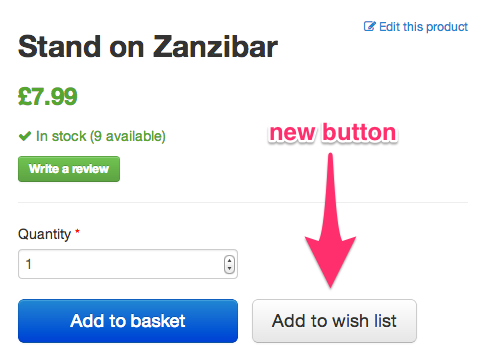
The add-to-wishlist button.
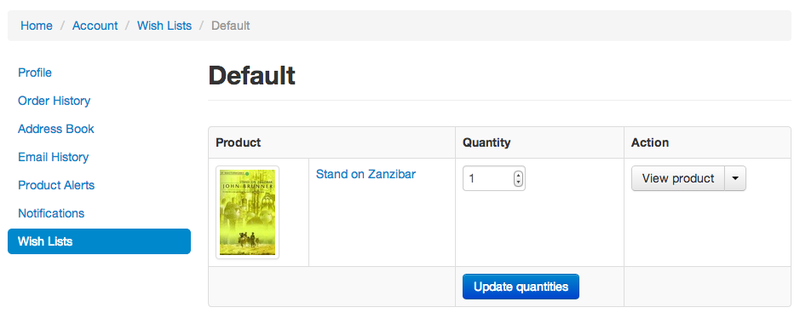
Editing a wishlist
See the wishlist documentation for more details.
Partner dashboard & addresses
Partners can now have addresses. These are useful for US sales tax where tax calculations need to know the origin of a product being shipped.
A dashboard to handle partners, their users and addresses has been added.
Checkout
The PaymentDetailsView checkout view has
been restructured for flexibility. There is a new
build_submission() method
which is responsible for building a dict of all data for passing to the
submit method. This includes the shipping address and shipping method
which were previously loaded indirectly within the submit method.
Warning
While not major, the changes to checkout are backwards incompatible. See the backwards compatibility notes for more details.
Demo site
Oscar now ships with a demo site along side the sandbox site. While the sandbox is a minimal Django project that uses Oscar with all its defaults, the demo site is a more realistic example of an Oscar project. It has a custom skin and makes many alterations to the default Oscar behaviour.
It’s features include:
- A range of different product types: books, downloads, clothing
- PayPal Express integration using django-oscar-paypal
- Datacash integration using django-oscar-datacash
See the sandbox and demo site documentation for more details. A publicly accessible version of the demo site is available at http://demo.oscarcommerce.com.
Django 1.5, 1.6 and custom user model support
Oscar now supports Django 1.5 and, experimentally, 1.6.
Specifically, Oscar supports custom user models, the headline new feature in Django 1.5. These can be used standalone or with a one-to-one profile model: Oscar’s account forms inspect the model fields to dynamically pick up the fields for editing and display.
There are some restrictions on what fields a custom user model must have. For instance, Oscar’s default auth backend requires the user model to have an email and password field. New Oscar projects are encouraged to use the provided abstract user model as the base for their users.
Support for Django 1.6 is considered experimental at the moment as there hasn’t been time to run thorough tests for all possible incompatibilities.
Further reading:
Accounts
The views and templates of the accounts section have been reworked to be clearer and easier to extend. There is no longer a generic frontpage for the accounts section - instead, each subsection has its own page. The navigation has also moved to the left-hand side.
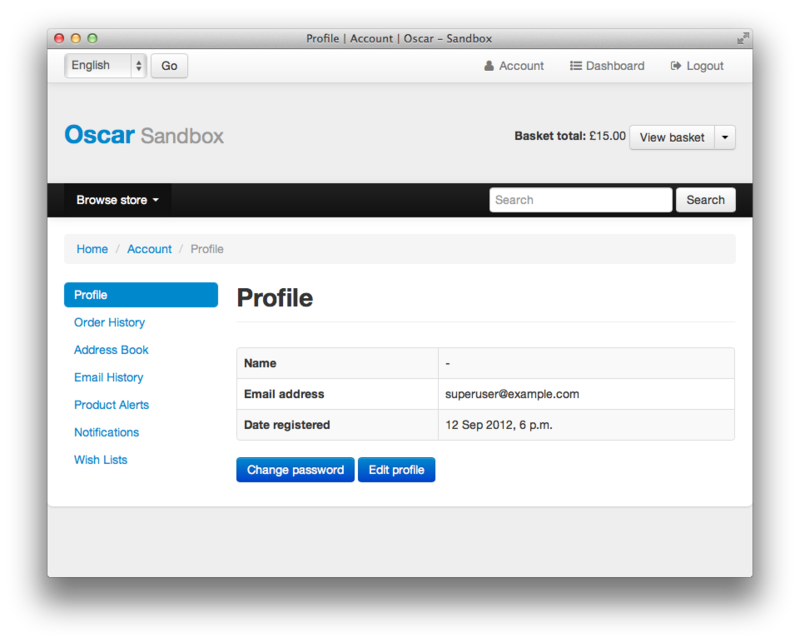
The new-look account section with navigation on the left-hand side.
Bootstrap-WYSIHTML5 replaced by TinyMCE
TinyMCE 4.0 is now used in the dashboard for all textareas with class
wysiwyg. This has better browser support and is easier to customise than
bootstrap-wysihtml5 (which has now been removed).
It is easy to configure or replace with the HTML editor of your choice.
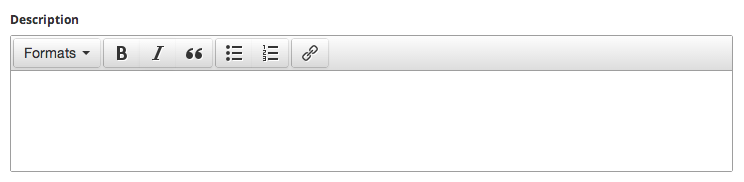
Textarea with class ``wysiwyg`` now use TinyMCE.
Improved address fields
The postcode and phone number fields have been improved.
- The postcode field is now validated in the model’s
clean()method to ensure it is valid for the selected country. - The phone number field now uses a specialist
PhoneNumberFieldfield class which validates and cleans the phone number.
Better bankcard handling
In 0.5, there were two classes that representing a bankcard. These have been
merged - the new version is
AbstractBankcard.
An instance of this model is returned by the bankcard property.
Customer-facing range pages
Ranges can now be flagged as public which means they get a customer-facing detail page which shows a range description and allows its products to be browsed.
In the dashboard, the display order of the range’s products can be controlled.
To this end, the core Range model has been
extended with a HTML description field.
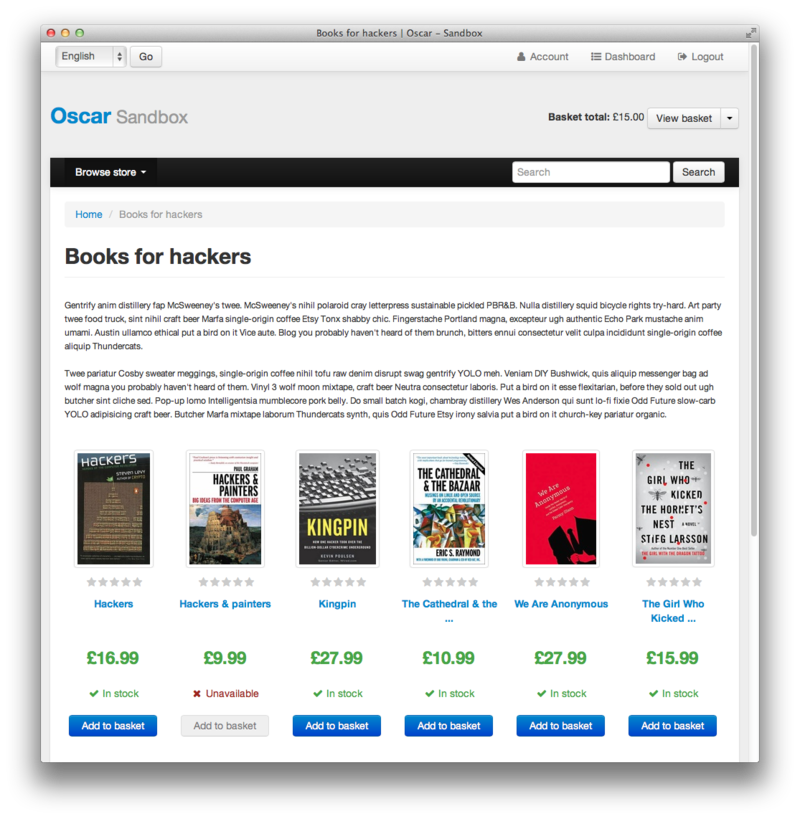
A customer-facing range page
Reworked search app
Oscar’s search app has been reviewed and simplified. The main view class
(now FacetedSearchView)
has been reworked to provide better support for faceting, which can be easily
specified using the OSCAR_SEARCH_FACETS setting.
The SuggestionsView has been removed as it wasn’t being used. A later
version of Oscar will include a replacement.
See the search app documentation for more details.
Order processing changes
The core EventHandler class has been
extended.
- The
handle_shipping_eventmethod now validates a proposed shipping event before saving it. - The
handle_payment_eventmethod now validates a proposed payment event before saving it.
See the EventHandler for the available
methods.
Tracking Oscar sites
Oscar’s dashboard now serves a single pixel image from one of Tangent’s servers. This is included to gather information on which sites use Oscar, which is an important metric for Tangent, who sponsor Oscar’s development.
It can easily be disabled by setting OSCAR_TRACKING=False. If you do opt
out, please email the mailing list with any production Oscar sites you are
running. This will help to ensure investment in Oscar’s future.
Minor changes
- detox is a new dependency, which allows running tox tests in parallel.
OSCAR_ALLOW_ANON_REVIEWShas been a documented setting since Oscar 0.4. But there’s never been any code to support this, which has been rectified with this release. Things should now work as expected.- Oscar uses a cookie to display recently displayed products. This cookie never
expired and wasn’t a
HttpOnlycookie. It is now aHttpOnlycookie and expires after 7 days. Additionally, two settings have been introduced to configure it analogues to the basket cookies:OSCAR_RECENTLY_VIEWED_COOKIE_LIFETIMEandOSCAR_RECENTLY_VIEWED_COOKIE_NAME.
Backwards incompatible changes in 0.6
There were quite a few backwards incompatible changes in Oscar 0.6. There shouldn’t be quite as many in future Oscar releases as we approach 1.0.
Additional apps
Four new apps are required in your INSTALLED_APPS:
INSTALLED_APPS = (
    ...
    'oscar.apps.wishlists',
    'oscar.apps.dashboard.pages',
    'oscar.apps.dashboard.partners',
    'oscar.apps.dashboard.reviews',
    ...
)
If you are using the get_core_apps helper function, then these new apps
will be added automatically. The new wishlists app contains database migrations,
so you will need to run the migrate management command.
Checkout app
Several changes have been made to the checkout in the name of simplification and making things easier to customise.
The PaymentDetailsView has been adjusted to explicitly pass variables
around rather than relying on methods that load them on demand. This makes
customisation easier and everything more explicit (a good thing).
The
submitmethod inPaymentDetailsViewhas a new signature. It now accepts the user, shipping address, shipping method and order total as required parameters The intention is that thebuild_submissionmethods returns a dict of kwargs forsubmitso that it can be called like:submission = self.build_submission() return self.submit(**submission)
If your payment or order submission process requires additional parameters (eg a bankcard instance), override the
build_submissionmethod to provide them. The dict returned from the newbuild_submissionmethod is also passed to the template.The
handle_paymentmethod inPaymentDetailsViewnow accepts aPriceinstance instead of a Decimal for the order total.The
handle_order_placementmethod inOrderPlacementMixinnow accepts the user, shipping address and shipping method in a different order consistent with thesubmitmethod fromPaymentDetailsView.The
place_ordermethod inOrderPlacementMixinhas a new signature. The parameters have been reordered and the shipping address, shipping method and billing address must be passed in explicitly (as unsaved instances).The
create_shipping_addressmethod inOrderPlacementMixinhas changed signature. Instead of being passed a basket, it is now passed the user and an unsaved shipping address instance.The
create_billing_addressmethod inOrderPlacementMixinhas changed signature. It is now passed an unsaved billing address instance as well as a shipping address instance.The
get_shipping_method(fromCheckoutSessionMixin) no longer defaults to returning free shipping if no shipping method can be looked up.The
OrderTotalCalculatornow returns aPriceinstance from a newcalculatemethod. The old methodsorder_total_incl_taxandorder_total_excl_taxhave been removed.
Other changes:
- The checkout gateway page has a new option “Register and continue” which allows a customer
to register before checking out. As part of this change, the option value
newinGatewayFormhas changed toguestasnewoption is used for this feature. - The checkout decorators
basket_requiredandprev_steps_must_be_completehave been removed as they were no longer used.
Shipping app changes
The default implementation of the
Repository class
has been adjusted to avoid thread-safety issues. If you define your own
shipping Repository class, ensure that your shipping methods are
instantiated per-request and not at compile time.
For example, avoid this:
from oscar.apps.shipping import repository

class Repository(repository.Repository)
    # Don't instantiate at compile time!
    methods = [SomeMethod(), AnotherMethod()]
Instead, instantiate the methods within get_shipping_methods:
from oscar.apps.shipping import repository

class Repository(repository.Repository)
    # Note, methods are not instantiated.  The get_shipping_methods
    # method will instantiate them.
    methods = [SomeMethod, AnotherMethod]
Warning
Beware of shipping methods that are configured via constructor parameters, like
FixedPrice. If you are using methods
that work this way, ensure you instantiate them at runtime.
Shipping methods will be reworked for Oscar 0.7 to avoid these issues.
Address model changes
- The
UserAddress.salutationandUserAddress.namemethods are now properties. - The
Countrymodel’sis_highlightedcolumn has been renamed todisplay_orderand is now an integer field to allow fine-grained country selection.
Basket app changes
Several properties of the basket Line model have been renamed:
Line.line_price_excl_tax_and_discountshas been renamed toLine.line_price_excl_tax_incl_discounts.Line.line_price_incl_tax_and_discountshas been renamed toLine.line_price_incl_tax_incl_discounts.
The basket_form() templatetag has been
altered to take the request as the first parameter, not request.basket.
Catalogue app changes
3 properties have been removed from
oscar.apps.catalogue.abstract_models.AbstractProductImage as they
were unused: resized_image_url, fullsize_url and thumbnail_url.
Thumbnailing is instead achieved in templates with Sorl.
- The function
add_category_from_breadcrumbswas not used and has been removed. - Alternative product class templates now use
slugfield instead ofname.lower()to determine their filename. If you have templates for specific product classes, please update your filenames accordingly
Customer app changes
The oscar.apps.customer.forms.EmailAuthenticationForm form now needs to
be instantated with a host name so prevent redirects to external sites.
Offer app changes
The ManyToManyField included_product of the
Range model was changed to use through
relationship:
- Use
Range.add_product(product)instead ofRange.included_product.add(product). - Use
Range.remove_product(product)instead ofRange.included_product.remove(product).
When adding a product into a range, position in the range can be specified
with display_order parameter:
Range.add_product(product, display_order=3)
Payment app changes
The balance method on the
AbstractSource model is now a property, not a method.
Reviews app changes
The two product review forms, SignedInUserProductReviewForm and
AnonymousUserProductReviewForm, have been replaced by a new
oscar.apps.catalogue.reviews.forms.ProductReviewForm.
Search app changes
Some of the names have been simplified.
- The
MultiFacetedSearchViewandSuggestionsViewview classes have been removed. TheMultiFacetedSeachViewclass is replaced byFacetedSearchView. - The
MultiFacetedSearchFormhas been removed in favour ofSearchForm.
Loading baskets
Now that products can have multiple stockrecords, several changes have been made to baskets to allow the appropriate stockrecord to be tracked for each basket line. The basket line model has a new field that links to the selected stockrecord and the basket itself requires an instance of the strategy class so that prices can be calculated for each line. Hence, if you loading baskets and manipulating baskets directly, you need to assign a strategy class in order for prices to calculate correctly:
from oscar.apps.basket import models

basket = models.Basket.objects.get(id=1)
basket.strategy = request.strategy
Without an assigned strategy class, a basket will raise a RuntimeError when
attempting to calculate totals.
Renamed templates
Some templates have been renamed for greater consistency. If you are overriding these templates, ensure you rename your corresponding project templates.
Many of the profile templates have been reorganised:
customer/address_list.htmlis renamed tocustomer/address/address_list.htmlcustomer/address_form.htmlis renamed tocustomer/address/address_form.htmlcustomer/address_delete.htmlis renamed tocustomer/address/address_delete.htmlcustomer/email.htmlis renamed tocustomer/email/email_detail.htmlcustomer/email_list.htmlis renamed tocustomer/email/email_list.htmlcustomer/order.htmlis renamed tocustomer/order/order_detail.htmlcustomer/order_list.htmlis renamed tocustomer/order/order_list.htmlcustomer/profile.htmlis renamed tocustomer/profile/profile.htmlcustomer/profile_form.htmlis renamed tocustomer/profile/profile_form.htmlcustomer/change_password_form.htmlis renamed tocustomer/profile/change_password_form.htmlpartials/nav_profile.htmlhas been removed.
Template block changes
- The template
dashboard/orders/order_detail.htmlhas been reorganised. Thetab_transactionsblock has been renamed topayment_transactions. - In
checkout/checkout.html, thecheckout-navblock has been renamedcheckout_nav.
Changes to Partner permissions
The following permissions on the
AbstractPartner model were not
used in Oscar and have been removed to avoid confusion with the newly
introduced permission-based dashboard:
can_edit_stock_recordscan_view_stock_recordscan_edit_product_rangecan_view_product_rangecan_edit_order_linescan_view_order_lines
The permission-based dashboard introduced a new permission:
dashboard_access
Migrations
There are rather a lot of new migrations in Oscar 0.6. They are all detailed below.
If you are upgrading and your project overrides one of these apps with
new migrations, then ensure you pick up the schema changes in a new migration
within your app. You can generally do this using manage.py schemamigration
$APP --auto but check the corresponding core migration to ensure there aren’t
any subtleties that are being overlooked.
Some of these migrations rename fields for consistency, while others ensure
CharField fields are not nullable.
Address:
0003: A new fielddisplay_orderis added to theCountrymodel. This is the first of 3 migrations that replace the booleanis_highlightedfield with an integer field that allows fine-grained control of the order of countries in dropdowns.0004: A data migration to ensure highlighted countries have a display order of 1.0005: Remove theis_highlightedfield from theCountrymodel as it is no longer necessary.0006: Add a uniqueness constraint acrossuser_idandhashfor theUserAddressmodel to prevent duplicate addresses.0007: Use a custom field for address postcodes.
Basket:
0004: Addstockrecordfield to theLinemodel to track which stockrecord has been selected to fulfill a particular line.0005: Addprice_currencyfield to theLinemodel.
Catalogue:
0011: Largermax_lengthon FileFields and ImageFields0012: UseNullBooleanFieldfor thevalue_booleanfield of theProductAttributeValuemodel.0013: Addvalue_fileandvalue_imagefields to theProductAttributeValuemodel to support file and image attributes.
Customer:
0005: Don’t allowsms_templatefield ofCommunicationEventTypemodel to be nullable.
Dashboard:
0002: Don’t allowerror_messagefield ofRangeProductFileUploadmodel to be nullable.
Offer app:
0020: Data migration to set null offer descriptions to empty string.0021: Don’t allow null offer descriptions or benefit types.0022: Add aslugfield to theRangemodel.0023: A data migration to populate the new range slug field.0024: Add ais_publicfield to theRangemodel.0025: Add adescriptionfield to theRangemodel.0026: Add aapplies_to_tax_exclusive_pricefield toConditionalOffermodel to try and handle offers that apply in bothe the US and UK (this field is later removed).0027: Create a joining table for the new M2M relationship between ranges and products.0028: Removeapplies_to_tax_exclusive_pricefield.
Order app:
0010: Allow postcodes for shipping- and billing addresses to be nullable.0011: Renamedatefield onCommunicationEvent,ShippingEventandPaymentEventmodels to bedate_created.0012: Addreferencefield toPaymentEventmodel.0013: Add a foreign key toShippingEventfromPaymentEventmodel.0014: Changepostcodefield onShippingAddressandBillingAddressmodels to useUppercaseCharFieldfield.0015: Removeis_requiredandsequence_numberfields fromShippingEventTypeandPaymentEventTypemodels.0016: Addcurrencyfield toOrder model. Add a foreign key to theStockRecordmodel from theLinemodel.0017: Add ashipping_codefield to theOrdermodel.0018:ShippingAddress‘sphone_numberis now aPhoneNumberFieldto allow better validation.
Partner app:
0008: Remove unnecessarypartner_abstractstockalerttable.0009: Create table for newPartnerAddressmodel.0010: Remove uniqueness constraint onproduct_idfor theStockRecordmodel. This allows a product to have more than one stockrecord.
Payment app:
0002: Ensure allCharFieldfields are not nullable. This migration handles both the data- and schema-migration in one.
Promotions app:
0002: Ensure allCharFieldfields are not nullable.0003: Extend themax_lengthof theimagefield.
Wishlist app:
0001: Initial table creation
Features deprecated in 0.6
Accessing a product’s stockrecords
Several properties and methods of the core
AbstractProduct class have been
deprecated following the change to allow multiple stockrecords per product.
- The
has_stockrecordproperty no longer makes sense when there can be more than one stockrecord. It is replaced byhas_stockrecords - The
stockrecordproperty is deprecated since it presumes there is only one stockrecord per product. Choosing the appropriate stockrecord is now the responsibility of the strategy class. A backward compatible version has been kept in place that selects the first stockrecord for a product. This will continue to work for sites that only have one stockrecord per product.
All availability logic has been moved to availability policies which are determined by the strategy class.
- The
is_available_to_buyproperty is deprecated. The functionality is now part of availability policies. - The
is_purchase_permitted()method is deprecated. The functionality is now part of availability policies.
Checkout session manager
The shipping_method method of the
CheckoutSessionData is now deprecated in
favour of using shipping_method_code. It is being removed as the
CheckoutSessionData class should only be responsible for retrieving data
from the session, not loading shipping method instances.
Checkout order placement mixin
The following methods within
OrderPlacementMixin are deprecated as the
flow of placing an order has been changed.
create_shipping_address_from_form_fields()create_shipping_address_from_user_address()create_user_address()
Bankcard model
The card_number
is deprecated in favour of using
number.
“Partner wrappers”
Before Oscar 0.6, availability and pricing logic was encapsulated in “partner
wrappers”. A partner wrapper was a class that provided availability and price
information for a particular partner, as specified by the
OSCAR_PARTNER_WRAPPERS setting. The stockrecord model had several
properties and methods
which delegated to the appropriate wrapper for the record’s partner.
This functionality is now deprecated in favour of using strategy classes. How prices and taxes are determined is not generally a function of the partner, and so this system was not a good model. Strategy classes are much more flexible and allow better modelling of taxes and availability.
The following properties and methods from StockRecord
are deprecated and will be removed for Oscar 0.7. These are all convenience
properties and methods that delegate to the appropriate partner wrapper.
AbstractStockRecord.is_available_to_buyAbstractStockRecord.is_purchase_permittedAbstractStockRecord.availability_codeAbstractStockRecord.availabilityAbstractStockRecord.max_purchase_quantityAbstractStockRecord.dispatch_dateAbstractStockRecord.lead_timeAbstractStockRecord.price_incl_taxAbstractStockRecord.price_tax
All the above properties and methods have effectively been moved to the availability and pricing policies that a strategy class is responsible for loading. To upgrade your codebase, replace your partner wrapper classes with equivalent availability and pricing policies.
Test support extension brought back into core
The Oscar test support library has been ported back into Oscar core. This
simplifies things and avoids circular dependency issues. If your project is
using this extension, you should remove it as a dependency and use the
analogous functionality from oscar/test/.