Header And Logo

|

#include "postgres_fe.h"#include <time.h>#include <math.h>#include <limits.h>#include "extern.h"#include "dt.h"#include "pgtypes_error.h"#include "pgtypes_interval.h"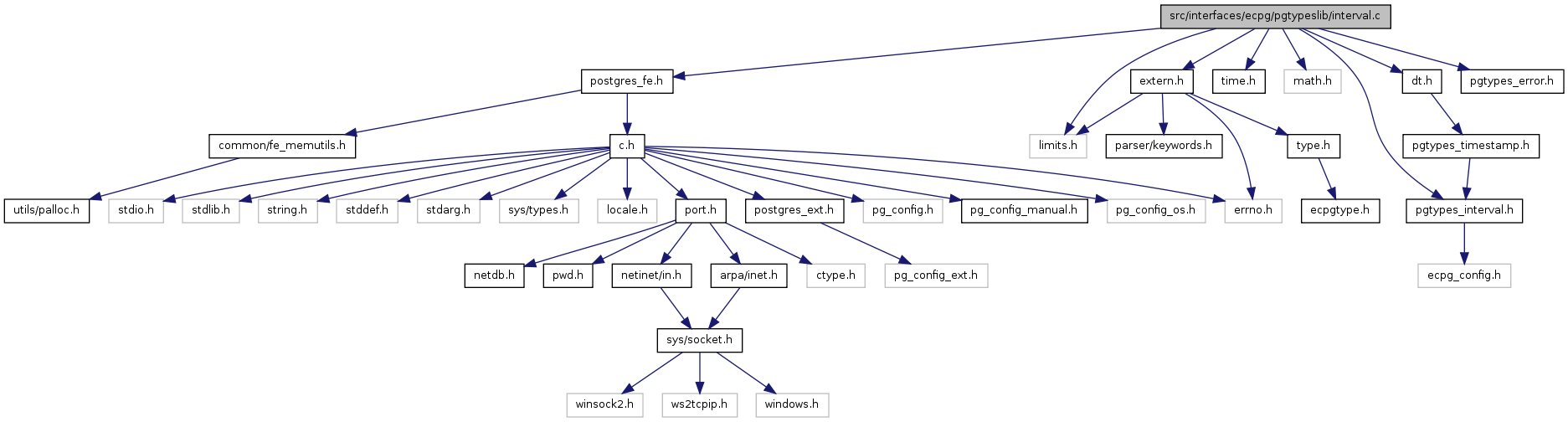
Go to the source code of this file.
Functions | |
| static int | strtoi (const char *nptr, char **endptr, int base) |
| static void | AdjustFractSeconds (double frac, structtm *tm, fsec_t *fsec, int scale) |
| static void | AdjustFractDays (double frac, structtm *tm, fsec_t *fsec, int scale) |
| static int | ParseISO8601Number (char *str, char **endptr, int *ipart, double *fpart) |
| static int | ISO8601IntegerWidth (char *fieldstart) |
| static void | ClearPgTm (structtm *tm, fsec_t *fsec) |
| static int | DecodeISO8601Interval (char *str, int *dtype, structtm *tm, fsec_t *fsec) |
| int | DecodeInterval (char **field, int *ftype, int nf, int *dtype, structtm *tm, fsec_t *fsec) |
| static char * | AddVerboseIntPart (char *cp, int value, const char *units, bool *is_zero, bool *is_before) |
| static char * | AddPostgresIntPart (char *cp, int value, const char *units, bool *is_zero, bool *is_before) |
| static char * | AddISO8601IntPart (char *cp, int value, char units) |
| static void | AppendSeconds (char *cp, int sec, fsec_t fsec, int precision, bool fillzeros) |
| int | EncodeInterval (structtm *tm, fsec_t fsec, int style, char *str) |
| static int | interval2tm (interval span, struct tm *tm, fsec_t *fsec) |
| static int | tm2interval (struct tm *tm, fsec_t fsec, interval *span) |
| interval * | PGTYPESinterval_new (void) |
| void | PGTYPESinterval_free (interval *intvl) |
| interval * | PGTYPESinterval_from_asc (char *str, char **endptr) |
| char * | PGTYPESinterval_to_asc (interval *span) |
| int | PGTYPESinterval_copy (interval *intvlsrc, interval *intvldest) |
| static char* AddISO8601IntPart | ( | char * | cp, | |
| int | value, | |||
| char | units | |||
| ) | [static] |
Definition at line 759 of file interval.c.
Referenced by EncodeInterval().
| static char* AddPostgresIntPart | ( | char * | cp, | |
| int | value, | |||
| const char * | units, | |||
| bool * | is_zero, | |||
| bool * | is_before | |||
| ) | [static] |
Definition at line 736 of file interval.c.
Referenced by EncodeInterval().
{
    if (value == 0)
        return cp;
    sprintf(cp, "%s%s%d %s%s",
            (!*is_zero) ? " " : "",
            (*is_before && value > 0) ? "+" : "",
            value,
            units,
            (value != 1) ? "s" : "");

    /*
     * Each nonzero field sets is_before for (only) the next one.  This is a
     * tad bizarre but it's how it worked before...
     */
    *is_before = (value < 0);
    *is_zero = FALSE;
    return cp + strlen(cp);
}
| static char* AddVerboseIntPart | ( | char * | cp, | |
| int | value, | |||
| const char * | units, | |||
| bool * | is_zero, | |||
| bool * | is_before | |||
| ) | [static] |
Definition at line 716 of file interval.c.
Referenced by EncodeInterval().
Definition at line 57 of file interval.c.
References AdjustFractSeconds(), and SECS_PER_DAY.
Referenced by DecodeInterval(), and DecodeISO8601Interval().
{
    int         extra_days;

    if (frac == 0)
        return;
    frac *= scale;
    extra_days = (int) frac;
    tm->tm_mday += extra_days;
    frac -= extra_days;
    AdjustFractSeconds(frac, tm, fsec, SECS_PER_DAY);
}
Definition at line 35 of file interval.c.
References rint().
Referenced by AdjustFractDays(), DecodeInterval(), and DecodeISO8601Interval().
| static void AppendSeconds | ( | char * | cp, | |
| int | sec, | |||
| fsec_t | fsec, | |||
| int | precision, | |||
| bool | fillzeros | |||
| ) | [static] |
Definition at line 769 of file interval.c.
References Abs, and TrimTrailingZeros().
Referenced by EncodeInterval().
{
    if (fsec == 0)
    {
        if (fillzeros)
            sprintf(cp, "%02d", abs(sec));
        else
            sprintf(cp, "%d", abs(sec));
    }
    else
    {
#ifdef HAVE_INT64_TIMESTAMP
        if (fillzeros)
            sprintf(cp, "%02d.%0*d", abs(sec), precision, (int) Abs(fsec));
        else
            sprintf(cp, "%d.%0*d", abs(sec), precision, (int) Abs(fsec));
#else
        if (fillzeros)
            sprintf(cp, "%0*.*f", precision + 3, precision, fabs(sec + fsec));
        else
            sprintf(cp, "%.*f", precision, fabs(sec + fsec));
#endif
        TrimTrailingZeros(cp);
    }
}
| int DecodeInterval | ( | char ** | field, | |
| int * | ftype, | |||
| int | nf, | |||
| int * | dtype, | |||
| struct tm * | tm, | |||
| fsec_t * | fsec | |||
| ) |
Definition at line 342 of file interval.c.
References AdjustFractDays(), AdjustFractSeconds(), AGO, ClearPgTm(), DAY, DAYS_PER_MONTH, DecodeTime(), DecodeUnits(), DTK_CENTURY, DTK_DATE, DTK_DATE_M, DTK_DAY, DTK_DECADE, DTK_HOUR, DTK_M, DTK_MICROSEC, DTK_MILLENNIUM, DTK_MILLISEC, DTK_MINUTE, DTK_MONTH, DTK_NUMBER, DTK_SECOND, DTK_SPECIAL, DTK_STRING, DTK_TIME, DTK_TZ, DTK_WEEK, DTK_YEAR, HOUR, i, IGNORE_DTF, INTERVAL_MASK, IntervalStyle, INTSTYLE_SQL_STANDARD, MICROSECOND, MILLISECOND, MINUTE, MONTH, MONTHS_PER_YEAR, NULL, range(), RESERV, rint(), SECOND, SECS_PER_DAY, SECS_PER_HOUR, SECS_PER_MINUTE, strtoi(), TMODULO, TZ, UNITS, val, and YEAR.
{
int IntervalStyle = INTSTYLE_POSTGRES_VERBOSE;
int range = INTERVAL_FULL_RANGE;
bool is_before = FALSE;
char *cp;
int fmask = 0,
tmask,
type;
int i;
int dterr;
int val;
double fval;
*dtype = DTK_DELTA;
type = IGNORE_DTF;
ClearPgTm(tm, fsec);
/* read through list backwards to pick up units before values */
for (i = nf - 1; i >= 0; i--)
{
switch (ftype[i])
{
case DTK_TIME:
dterr = DecodeTime(field[i], /* range, */
&tmask, tm, fsec);
if (dterr)
return dterr;
type = DTK_DAY;
break;
case DTK_TZ:
/*
* Timezone is a token with a leading sign character and at
* least one digit; there could be ':', '.', '-' embedded in
* it as well.
*/
/* Assert(*field[i] == '-' || *field[i] == '+'); */
/*
* Try for hh:mm or hh:mm:ss. If not, fall through to
* DTK_NUMBER case, which can handle signed float numbers and
* signed year-month values.
*/
if (strchr(field[i] + 1, ':') != NULL &&
DecodeTime(field[i] + 1, /* INTERVAL_FULL_RANGE, */
&tmask, tm, fsec) == 0)
{
if (*field[i] == '-')
{
/* flip the sign on all fields */
tm->tm_hour = -tm->tm_hour;
tm->tm_min = -tm->tm_min;
tm->tm_sec = -tm->tm_sec;
*fsec = -(*fsec);
}
/*
* Set the next type to be a day, if units are not
* specified. This handles the case of '1 +02:03' since we
* are reading right to left.
*/
type = DTK_DAY;
tmask = DTK_M(TZ);
break;
}
/* FALL THROUGH */
case DTK_DATE:
case DTK_NUMBER:
if (type == IGNORE_DTF)
{
/* use typmod to decide what rightmost field is */
switch (range)
{
case INTERVAL_MASK(YEAR):
type = DTK_YEAR;
break;
case INTERVAL_MASK(MONTH):
case INTERVAL_MASK(YEAR) | INTERVAL_MASK(MONTH):
type = DTK_MONTH;
break;
case INTERVAL_MASK(DAY):
type = DTK_DAY;
break;
case INTERVAL_MASK(HOUR):
case INTERVAL_MASK(DAY) | INTERVAL_MASK(HOUR):
case INTERVAL_MASK(DAY) | INTERVAL_MASK(HOUR) | INTERVAL_MASK(MINUTE):
case INTERVAL_MASK(DAY) | INTERVAL_MASK(HOUR) | INTERVAL_MASK(MINUTE) | INTERVAL_MASK(SECOND):
type = DTK_HOUR;
break;
case INTERVAL_MASK(MINUTE):
case INTERVAL_MASK(HOUR) | INTERVAL_MASK(MINUTE):
type = DTK_MINUTE;
break;
case INTERVAL_MASK(SECOND):
case INTERVAL_MASK(HOUR) | INTERVAL_MASK(MINUTE) | INTERVAL_MASK(SECOND):
case INTERVAL_MASK(MINUTE) | INTERVAL_MASK(SECOND):
type = DTK_SECOND;
break;
default:
type = DTK_SECOND;
break;
}
}
errno = 0;
val = strtoi(field[i], &cp, 10);
if (errno == ERANGE)
return DTERR_FIELD_OVERFLOW;
if (*cp == '-')
{
/* SQL "years-months" syntax */
int val2;
val2 = strtoi(cp + 1, &cp, 10);
if (errno == ERANGE || val2 < 0 || val2 >= MONTHS_PER_YEAR)
return DTERR_FIELD_OVERFLOW;
if (*cp != '\0')
return DTERR_BAD_FORMAT;
type = DTK_MONTH;
if (*field[i] == '-')
val2 = -val2;
val = val * MONTHS_PER_YEAR + val2;
fval = 0;
}
else if (*cp == '.')
{
errno = 0;
fval = strtod(cp, &cp);
if (*cp != '\0' || errno != 0)
return DTERR_BAD_FORMAT;
if (*field[i] == '-')
fval = -fval;
}
else if (*cp == '\0')
fval = 0;
else
return DTERR_BAD_FORMAT;
tmask = 0; /* DTK_M(type); */
switch (type)
{
case DTK_MICROSEC:
#ifdef HAVE_INT64_TIMESTAMP
*fsec += rint(val + fval);
#else
*fsec += (val + fval) * 1e-6;
#endif
tmask = DTK_M(MICROSECOND);
break;
case DTK_MILLISEC:
#ifdef HAVE_INT64_TIMESTAMP
*fsec += rint((val + fval) * 1000);
#else
*fsec += (val + fval) * 1e-3;
#endif
tmask = DTK_M(MILLISECOND);
break;
case DTK_SECOND:
tm->tm_sec += val;
#ifdef HAVE_INT64_TIMESTAMP
*fsec += rint(fval * 1000000);
#else
*fsec += fval;
#endif
/*
* If any subseconds were specified, consider this
* microsecond and millisecond input as well.
*/
if (fval == 0)
tmask = DTK_M(SECOND);
else
tmask = DTK_ALL_SECS_M;
break;
case DTK_MINUTE:
tm->tm_min += val;
AdjustFractSeconds(fval, tm, fsec, SECS_PER_MINUTE);
tmask = DTK_M(MINUTE);
break;
case DTK_HOUR:
tm->tm_hour += val;
AdjustFractSeconds(fval, tm, fsec, SECS_PER_HOUR);
tmask = DTK_M(HOUR);
type = DTK_DAY;
break;
case DTK_DAY:
tm->tm_mday += val;
AdjustFractSeconds(fval, tm, fsec, SECS_PER_DAY);
tmask = (fmask & DTK_M(DAY)) ? 0 : DTK_M(DAY);
break;
case DTK_WEEK:
tm->tm_mday += val * 7;
AdjustFractDays(fval, tm, fsec, 7);
tmask = (fmask & DTK_M(DAY)) ? 0 : DTK_M(DAY);
break;
case DTK_MONTH:
tm->tm_mon += val;
AdjustFractDays(fval, tm, fsec, DAYS_PER_MONTH);
tmask = DTK_M(MONTH);
break;
case DTK_YEAR:
tm->tm_year += val;
if (fval != 0)
tm->tm_mon += fval * MONTHS_PER_YEAR;
tmask = (fmask & DTK_M(YEAR)) ? 0 : DTK_M(YEAR);
break;
case DTK_DECADE:
tm->tm_year += val * 10;
if (fval != 0)
tm->tm_mon += fval * MONTHS_PER_YEAR * 10;
tmask = (fmask & DTK_M(YEAR)) ? 0 : DTK_M(YEAR);
break;
case DTK_CENTURY:
tm->tm_year += val * 100;
if (fval != 0)
tm->tm_mon += fval * MONTHS_PER_YEAR * 100;
tmask = (fmask & DTK_M(YEAR)) ? 0 : DTK_M(YEAR);
break;
case DTK_MILLENNIUM:
tm->tm_year += val * 1000;
if (fval != 0)
tm->tm_mon += fval * MONTHS_PER_YEAR * 1000;
tmask = (fmask & DTK_M(YEAR)) ? 0 : DTK_M(YEAR);
break;
default:
return DTERR_BAD_FORMAT;
}
break;
case DTK_STRING:
case DTK_SPECIAL:
type = DecodeUnits(i, field[i], &val);
if (type == IGNORE_DTF)
continue;
tmask = 0; /* DTK_M(type); */
switch (type)
{
case UNITS:
type = val;
break;
case AGO:
is_before = TRUE;
type = val;
break;
case RESERV:
tmask = (DTK_DATE_M | DTK_TIME_M);
*dtype = val;
break;
default:
return DTERR_BAD_FORMAT;
}
break;
default:
return DTERR_BAD_FORMAT;
}
if (tmask & fmask)
return DTERR_BAD_FORMAT;
fmask |= tmask;
}
/* ensure that at least one time field has been found */
if (fmask == 0)
return DTERR_BAD_FORMAT;
/* ensure fractional seconds are fractional */
if (*fsec != 0)
{
int sec;
#ifdef HAVE_INT64_TIMESTAMP
sec = *fsec / USECS_PER_SEC;
*fsec -= sec * USECS_PER_SEC;
#else
TMODULO(*fsec, sec, 1.0);
#endif
tm->tm_sec += sec;
}
/*----------
* The SQL standard defines the interval literal
* '-1 1:00:00'
* to mean "negative 1 days and negative 1 hours", while Postgres
* traditionally treats this as meaning "negative 1 days and positive
* 1 hours". In SQL_STANDARD intervalstyle, we apply the leading sign
* to all fields if there are no other explicit signs.
*
* We leave the signs alone if there are additional explicit signs.
* This protects us against misinterpreting postgres-style dump output,
* since the postgres-style output code has always put an explicit sign on
* all fields following a negative field. But note that SQL-spec output
* is ambiguous and can be misinterpreted on load! (So it's best practice
* to dump in postgres style, not SQL style.)
*----------
*/
if (IntervalStyle == INTSTYLE_SQL_STANDARD && *field[0] == '-')
{
/* Check for additional explicit signs */
bool more_signs = false;
for (i = 1; i < nf; i++)
{
if (*field[i] == '-' || *field[i] == '+')
{
more_signs = true;
break;
}
}
if (!more_signs)
{
/*
* Rather than re-determining which field was field[0], just force
* 'em all negative.
*/
if (*fsec > 0)
*fsec = -(*fsec);
if (tm->tm_sec > 0)
tm->tm_sec = -tm->tm_sec;
if (tm->tm_min > 0)
tm->tm_min = -tm->tm_min;
if (tm->tm_hour > 0)
tm->tm_hour = -tm->tm_hour;
if (tm->tm_mday > 0)
tm->tm_mday = -tm->tm_mday;
if (tm->tm_mon > 0)
tm->tm_mon = -tm->tm_mon;
if (tm->tm_year > 0)
tm->tm_year = -tm->tm_year;
}
}
/* finally, AGO negates everything */
if (is_before)
{
*fsec = -(*fsec);
tm->tm_sec = -tm->tm_sec;
tm->tm_min = -tm->tm_min;
tm->tm_hour = -tm->tm_hour;
tm->tm_mday = -tm->tm_mday;
tm->tm_mon = -tm->tm_mon;
tm->tm_year = -tm->tm_year;
}
return 0;
}
| static int DecodeISO8601Interval | ( | char * | str, | |
| int * | dtype, | |||
| struct tm * | tm, | |||
| fsec_t * | fsec | |||
| ) | [static] |
Definition at line 128 of file interval.c.
References AdjustFractDays(), AdjustFractSeconds(), ClearPgTm(), DAYS_PER_MONTH, ISO8601IntegerWidth(), ParseISO8601Number(), SECS_PER_DAY, SECS_PER_HOUR, SECS_PER_MINUTE, and val.
{
    bool        datepart = true;
    bool        havefield = false;

    *dtype = DTK_DELTA;
    ClearPgTm(tm, fsec);

    if (strlen(str) < 2 || str[0] != 'P')
        return DTERR_BAD_FORMAT;

    str++;
    while (*str)
    {
        char       *fieldstart;
        int         val;
        double      fval;
        char        unit;
        int         dterr;

        if (*str == 'T')        /* T indicates the beginning of the time part */
        {
            datepart = false;
            havefield = false;
            str++;
            continue;
        }

        fieldstart = str;
        dterr = ParseISO8601Number(str, &str, &val, &fval);
        if (dterr)
            return dterr;

        /*
         * Note: we could step off the end of the string here.  Code below
         * *must* exit the loop if unit == '\0'.
         */
        unit = *str++;

        if (datepart)
        {
            switch (unit)       /* before T: Y M W D */
            {
                case 'Y':
                    tm->tm_year += val;
                    tm->tm_mon += (fval * 12);
                    break;
                case 'M':
                    tm->tm_mon += val;
                    AdjustFractDays(fval, tm, fsec, DAYS_PER_MONTH);
                    break;
                case 'W':
                    tm->tm_mday += val * 7;
                    AdjustFractDays(fval, tm, fsec, 7);
                    break;
                case 'D':
                    tm->tm_mday += val;
                    AdjustFractSeconds(fval, tm, fsec, SECS_PER_DAY);
                    break;
                case 'T':       /* ISO 8601 4.4.3.3 Alternative Format / Basic */
                case '\0':
                    if (ISO8601IntegerWidth(fieldstart) == 8 && !havefield)
                    {
                        tm->tm_year += val / 10000;
                        tm->tm_mon += (val / 100) % 100;
                        tm->tm_mday += val % 100;
                        AdjustFractSeconds(fval, tm, fsec, SECS_PER_DAY);
                        if (unit == '\0')
                            return 0;
                        datepart = false;
                        havefield = false;
                        continue;
                    }
                    /* Else fall through to extended alternative format */
                case '-':       /* ISO 8601 4.4.3.3 Alternative Format,
                                 * Extended */
                    if (havefield)
                        return DTERR_BAD_FORMAT;

                    tm->tm_year += val;
                    tm->tm_mon += (fval * 12);
                    if (unit == '\0')
                        return 0;
                    if (unit == 'T')
                    {
                        datepart = false;
                        havefield = false;
                        continue;
                    }

                    dterr = ParseISO8601Number(str, &str, &val, &fval);
                    if (dterr)
                        return dterr;
                    tm->tm_mon += val;
                    AdjustFractDays(fval, tm, fsec, DAYS_PER_MONTH);
                    if (*str == '\0')
                        return 0;
                    if (*str == 'T')
                    {
                        datepart = false;
                        havefield = false;
                        continue;
                    }
                    if (*str != '-')
                        return DTERR_BAD_FORMAT;
                    str++;

                    dterr = ParseISO8601Number(str, &str, &val, &fval);
                    if (dterr)
                        return dterr;
                    tm->tm_mday += val;
                    AdjustFractSeconds(fval, tm, fsec, SECS_PER_DAY);
                    if (*str == '\0')
                        return 0;
                    if (*str == 'T')
                    {
                        datepart = false;
                        havefield = false;
                        continue;
                    }
                    return DTERR_BAD_FORMAT;
                default:
                    /* not a valid date unit suffix */
                    return DTERR_BAD_FORMAT;
            }
        }
        else
        {
            switch (unit)       /* after T: H M S */
            {
                case 'H':
                    tm->tm_hour += val;
                    AdjustFractSeconds(fval, tm, fsec, SECS_PER_HOUR);
                    break;
                case 'M':
                    tm->tm_min += val;
                    AdjustFractSeconds(fval, tm, fsec, SECS_PER_MINUTE);
                    break;
                case 'S':
                    tm->tm_sec += val;
                    AdjustFractSeconds(fval, tm, fsec, 1);
                    break;
                case '\0':      /* ISO 8601 4.4.3.3 Alternative Format */
                    if (ISO8601IntegerWidth(fieldstart) == 6 && !havefield)
                    {
                        tm->tm_hour += val / 10000;
                        tm->tm_min += (val / 100) % 100;
                        tm->tm_sec += val % 100;
                        AdjustFractSeconds(fval, tm, fsec, 1);
                        return 0;
                    }
                    /* Else fall through to extended alternative format */
                case ':':       /* ISO 8601 4.4.3.3 Alternative Format,
                                 * Extended */
                    if (havefield)
                        return DTERR_BAD_FORMAT;

                    tm->tm_hour += val;
                    AdjustFractSeconds(fval, tm, fsec, SECS_PER_HOUR);
                    if (unit == '\0')
                        return 0;

                    dterr = ParseISO8601Number(str, &str, &val, &fval);
                    if (dterr)
                        return dterr;
                    tm->tm_min += val;
                    AdjustFractSeconds(fval, tm, fsec, SECS_PER_MINUTE);
                    if (*str == '\0')
                        return 0;
                    if (*str != ':')
                        return DTERR_BAD_FORMAT;
                    str++;

                    dterr = ParseISO8601Number(str, &str, &val, &fval);
                    if (dterr)
                        return dterr;
                    tm->tm_sec += val;
                    AdjustFractSeconds(fval, tm, fsec, 1);
                    if (*str == '\0')
                        return 0;
                    return DTERR_BAD_FORMAT;

                default:
                    /* not a valid time unit suffix */
                    return DTERR_BAD_FORMAT;
            }
        }

        havefield = true;
    }

    return 0;
}
Definition at line 802 of file interval.c.
References AddISO8601IntPart(), AddPostgresIntPart(), AddVerboseIntPart(), AppendSeconds(), INTSTYLE_ISO_8601, INTSTYLE_POSTGRES, INTSTYLE_POSTGRES_VERBOSE, INTSTYLE_SQL_STANDARD, and MAX_INTERVAL_PRECISION.
{

    char       *cp = str;
    int         year = tm->tm_year;
    int         mon = tm->tm_mon;
    int         mday = tm->tm_mday;
    int         hour = tm->tm_hour;
    int         min = tm->tm_min;
    int         sec = tm->tm_sec;
    bool        is_before = FALSE;
    bool        is_zero = TRUE;

    /*
     * The sign of year and month are guaranteed to match, since they are
     * stored internally as "month". But we'll need to check for is_before and
     * is_zero when determining the signs of day and hour/minute/seconds
     * fields.
     */
    switch (style)
    {
            /* SQL Standard interval format */
        case INTSTYLE_SQL_STANDARD:
            {
                bool        has_negative = year < 0 || mon < 0 ||
                mday < 0 || hour < 0 ||
                min < 0 || sec < 0 || fsec < 0;
                bool        has_positive = year > 0 || mon > 0 ||
                mday > 0 || hour > 0 ||
                min > 0 || sec > 0 || fsec > 0;
                bool        has_year_month = year != 0 || mon != 0;
                bool        has_day_time = mday != 0 || hour != 0 ||
                min != 0 || sec != 0 || fsec != 0;
                bool        has_day = mday != 0;
                bool        sql_standard_value = !(has_negative && has_positive) &&
                !(has_year_month && has_day_time);

                /*
                 * SQL Standard wants only 1 "<sign>" preceding the whole
                 * interval ... but can't do that if mixed signs.
                 */
                if (has_negative && sql_standard_value)
                {
                    *cp++ = '-';
                    year = -year;
                    mon = -mon;
                    mday = -mday;
                    hour = -hour;
                    min = -min;
                    sec = -sec;
                    fsec = -fsec;
                }

                if (!has_negative && !has_positive)
                {
                    sprintf(cp, "0");
                }
                else if (!sql_standard_value)
                {
                    /*
                     * For non sql-standard interval values, force outputting
                     * the signs to avoid ambiguities with intervals with
                     * mixed sign components.
                     */
                    char        year_sign = (year < 0 || mon < 0) ? '-' : '+';
                    char        day_sign = (mday < 0) ? '-' : '+';
                    char        sec_sign = (hour < 0 || min < 0 ||
                                            sec < 0 || fsec < 0) ? '-' : '+';

                    sprintf(cp, "%c%d-%d %c%d %c%d:%02d:",
                            year_sign, abs(year), abs(mon),
                            day_sign, abs(mday),
                            sec_sign, abs(hour), abs(min));
                    cp += strlen(cp);
                    AppendSeconds(cp, sec, fsec, MAX_INTERVAL_PRECISION, true);
                }
                else if (has_year_month)
                {
                    sprintf(cp, "%d-%d", year, mon);
                }
                else if (has_day)
                {
                    sprintf(cp, "%d %d:%02d:", mday, hour, min);
                    cp += strlen(cp);
                    AppendSeconds(cp, sec, fsec, MAX_INTERVAL_PRECISION, true);
                }
                else
                {
                    sprintf(cp, "%d:%02d:", hour, min);
                    cp += strlen(cp);
                    AppendSeconds(cp, sec, fsec, MAX_INTERVAL_PRECISION, true);
                }
            }
            break;

            /* ISO 8601 "time-intervals by duration only" */
        case INTSTYLE_ISO_8601:
            /* special-case zero to avoid printing nothing */
            if (year == 0 && mon == 0 && mday == 0 &&
                hour == 0 && min == 0 && sec == 0 && fsec == 0)
            {
                sprintf(cp, "PT0S");
                break;
            }
            *cp++ = 'P';
            cp = AddISO8601IntPart(cp, year, 'Y');
            cp = AddISO8601IntPart(cp, mon, 'M');
            cp = AddISO8601IntPart(cp, mday, 'D');
            if (hour != 0 || min != 0 || sec != 0 || fsec != 0)
                *cp++ = 'T';
            cp = AddISO8601IntPart(cp, hour, 'H');
            cp = AddISO8601IntPart(cp, min, 'M');
            if (sec != 0 || fsec != 0)
            {
                if (sec < 0 || fsec < 0)
                    *cp++ = '-';
                AppendSeconds(cp, sec, fsec, MAX_INTERVAL_PRECISION, false);
                cp += strlen(cp);
                *cp++ = 'S';
                *cp = '\0';
            }
            break;

            /* Compatible with postgresql < 8.4 when DateStyle = 'iso' */
        case INTSTYLE_POSTGRES:
            cp = AddPostgresIntPart(cp, year, "year", &is_zero, &is_before);
            cp = AddPostgresIntPart(cp, mon, "mon", &is_zero, &is_before);
            cp = AddPostgresIntPart(cp, mday, "day", &is_zero, &is_before);
            if (is_zero || hour != 0 || min != 0 || sec != 0 || fsec != 0)
            {
                bool        minus = (hour < 0 || min < 0 || sec < 0 || fsec < 0);

                sprintf(cp, "%s%s%02d:%02d:",
                        is_zero ? "" : " ",
                        (minus ? "-" : (is_before ? "+" : "")),
                        abs(hour), abs(min));
                cp += strlen(cp);
                AppendSeconds(cp, sec, fsec, MAX_INTERVAL_PRECISION, true);
            }
            break;

            /* Compatible with postgresql < 8.4 when DateStyle != 'iso' */
        case INTSTYLE_POSTGRES_VERBOSE:
        default:
            strcpy(cp, "@");
            cp++;
            cp = AddVerboseIntPart(cp, year, "year", &is_zero, &is_before);
            cp = AddVerboseIntPart(cp, mon, "mon", &is_zero, &is_before);
            cp = AddVerboseIntPart(cp, mday, "day", &is_zero, &is_before);
            cp = AddVerboseIntPart(cp, hour, "hour", &is_zero, &is_before);
            cp = AddVerboseIntPart(cp, min, "min", &is_zero, &is_before);
            if (sec != 0 || fsec != 0)
            {
                *cp++ = ' ';
                if (sec < 0 || (sec == 0 && fsec < 0))
                {
                    if (is_zero)
                        is_before = TRUE;
                    else if (!is_before)
                        *cp++ = '-';
                }
                else if (is_before)
                    *cp++ = '-';
                AppendSeconds(cp, sec, fsec, MAX_INTERVAL_PRECISION, false);
                cp += strlen(cp);
                sprintf(cp, " sec%s",
                        (abs(sec) != 1 || fsec != 0) ? "s" : "");
                is_zero = FALSE;
            }
            /* identically zero? then put in a unitless zero... */
            if (is_zero)
                strcat(cp, " 0");
            if (is_before)
                strcat(cp, " ago");
            break;
    }

    return 0;
}   /* EncodeInterval() */
Definition at line 987 of file interval.c.
References interval::month, SECS_PER_DAY, SECS_PER_HOUR, SECS_PER_MINUTE, interval::time, TMODULO, and TSROUND.
{
#ifdef HAVE_INT64_TIMESTAMP
    int64       time;
#else
    double      time;
#endif

    if (span.month != 0)
    {
        tm->tm_year = span.month / MONTHS_PER_YEAR;
        tm->tm_mon = span.month % MONTHS_PER_YEAR;

    }
    else
    {
        tm->tm_year = 0;
        tm->tm_mon = 0;
    }

    time = span.time;

#ifdef HAVE_INT64_TIMESTAMP
    tm->tm_mday = time / USECS_PER_DAY;
    time -= tm->tm_mday * USECS_PER_DAY;
    tm->tm_hour = time / USECS_PER_HOUR;
    time -= tm->tm_hour * USECS_PER_HOUR;
    tm->tm_min = time / USECS_PER_MINUTE;
    time -= tm->tm_min * USECS_PER_MINUTE;
    tm->tm_sec = time / USECS_PER_SEC;
    *fsec = time - (tm->tm_sec * USECS_PER_SEC);
#else
recalc:
    TMODULO(time, tm->tm_mday, (double) SECS_PER_DAY);
    TMODULO(time, tm->tm_hour, (double) SECS_PER_HOUR);
    TMODULO(time, tm->tm_min, (double) SECS_PER_MINUTE);
    TMODULO(time, tm->tm_sec, 1.0);
    time = TSROUND(time);
    /* roundoff may need to propagate to higher-order fields */
    if (time >= 1.0)
    {
        time = ceil(span.time);
        goto recalc;
    }
    *fsec = time;
#endif

    return 0;
}   /* interval2tm() */
| static int ISO8601IntegerWidth | ( | char * | fieldstart | ) | [static] |
Definition at line 97 of file interval.c.
Referenced by DecodeISO8601Interval().
{
    /* We might have had a leading '-' */
    if (*fieldstart == '-')
        fieldstart++;
    return strspn(fieldstart, "0123456789");
}
| static int ParseISO8601Number | ( | char * | str, | |
| char ** | endptr, | |||
| int * | ipart, | |||
| double * | fpart | |||
| ) | [static] |
Definition at line 72 of file interval.c.
References val.
Referenced by DecodeISO8601Interval().
{
    double      val;

    if (!(isdigit((unsigned char) *str) || *str == '-' || *str == '.'))
        return DTERR_BAD_FORMAT;
    errno = 0;
    val = strtod(str, endptr);
    /* did we not see anything that looks like a double? */
    if (*endptr == str || errno != 0)
        return DTERR_BAD_FORMAT;
    /* watch out for overflow */
    if (val < INT_MIN || val > INT_MAX)
        return DTERR_FIELD_OVERFLOW;
    /* be very sure we truncate towards zero (cf dtrunc()) */
    if (val >= 0)
        *ipart = (int) floor(val);
    else
        *ipart = (int) -floor(-val);
    *fpart = val - *ipart;
    return 0;
}
Definition at line 1156 of file interval.c.
References interval::month, and interval::time.
Referenced by ecpg_get_data(), and main().
| void PGTYPESinterval_free | ( | interval * | intvl | ) |
| interval* PGTYPESinterval_from_asc | ( | char * | str, | |
| char ** | endptr | |||
| ) |
Definition at line 1073 of file interval.c.
References DecodeInterval(), DecodeISO8601Interval(), DTK_DELTA, free, MAXDATELEN, ParseDateTime(), pgtypes_alloc(), tm, tm2interval(), and pg_tm::tm_year.
Referenced by ecpg_get_data(), and main().
{
    interval   *result = NULL;
    fsec_t      fsec;
    struct tm   tt,
               *tm = &tt;
    int         dtype;
    int         nf;
    char       *field[MAXDATEFIELDS];
    int         ftype[MAXDATEFIELDS];
    char        lowstr[MAXDATELEN + MAXDATEFIELDS];
    char       *realptr;
    char      **ptr = (endptr != NULL) ? endptr : &realptr;

    tm->tm_year = 0;
    tm->tm_mon = 0;
    tm->tm_mday = 0;
    tm->tm_hour = 0;
    tm->tm_min = 0;
    tm->tm_sec = 0;
    fsec = 0;

    if (strlen(str) >= sizeof(lowstr))
    {
        errno = PGTYPES_INTVL_BAD_INTERVAL;
        return NULL;
    }

    if (ParseDateTime(str, lowstr, field, ftype, &nf, ptr) != 0 ||
        (DecodeInterval(field, ftype, nf, &dtype, tm, &fsec) != 0 &&
         DecodeISO8601Interval(str, &dtype, tm, &fsec) != 0))
    {
        errno = PGTYPES_INTVL_BAD_INTERVAL;
        return NULL;
    }

    result = (interval *) pgtypes_alloc(sizeof(interval));
    if (!result)
        return NULL;

    if (dtype != DTK_DELTA)
    {
        errno = PGTYPES_INTVL_BAD_INTERVAL;
        free(result);
        return NULL;
    }

    if (tm2interval(tm, fsec, result) != 0)
    {
        errno = PGTYPES_INTVL_BAD_INTERVAL;
        free(result);
        return NULL;
    }

    errno = 0;
    return result;
}
| interval* PGTYPESinterval_new | ( | void | ) |
Definition at line 1057 of file interval.c.
References pgtypes_alloc().
Referenced by main().
{
    interval   *result;

    result = (interval *) pgtypes_alloc(sizeof(interval));
    /* result can be NULL if we run out of memory */
    return result;
}
| char* PGTYPESinterval_to_asc | ( | interval * | span | ) |
Definition at line 1132 of file interval.c.
References buf, EncodeInterval(), interval2tm(), IntervalStyle, MAXDATELEN, pgtypes_strdup(), and tm.
Referenced by ecpg_store_input(), intoasc(), and main().
{
    struct tm   tt,
               *tm = &tt;
    fsec_t      fsec;
    char        buf[MAXDATELEN + 1];
    int         IntervalStyle = INTSTYLE_POSTGRES_VERBOSE;

    if (interval2tm(*span, tm, &fsec) != 0)
    {
        errno = PGTYPES_INTVL_BAD_INTERVAL;
        return NULL;
    }

    if (EncodeInterval(tm, fsec, IntervalStyle, buf) != 0)
    {
        errno = PGTYPES_INTVL_BAD_INTERVAL;
        return NULL;
    }

    return pgtypes_strdup(buf);
}
| static int strtoi | ( | const char * | nptr, | |
| char ** | endptr, | |||
| int | base | |||
| ) | [static] |
Definition at line 1038 of file interval.c.
References HOURS_PER_DAY, INT64CONST, interval::month, MONTHS_PER_YEAR, SECS_PER_MINUTE, and interval::time.
{
    span->month = tm->tm_year * MONTHS_PER_YEAR + tm->tm_mon;
#ifdef HAVE_INT64_TIMESTAMP
    span->time = (((((((tm->tm_mday * INT64CONST(24)) +
                       tm->tm_hour) * INT64CONST(60)) +
                     tm->tm_min) * INT64CONST(60)) +
                   tm->tm_sec) * USECS_PER_SEC) + fsec;
#else
    span->time = (((((tm->tm_mday * (double) HOURS_PER_DAY) +
                     tm->tm_hour) * (double) MINS_PER_HOUR) +
                   tm->tm_min) * (double) SECS_PER_MINUTE) +
        tm->tm_sec + fsec;
#endif

    return 0;
}   /* tm2interval() */
 1.7.1
1.7.1