Header And Logo

|

#include "datatype/timestamp.h"#include "executor/execdesc.h"#include "utils/plancache.h"#include "utils/resowner.h"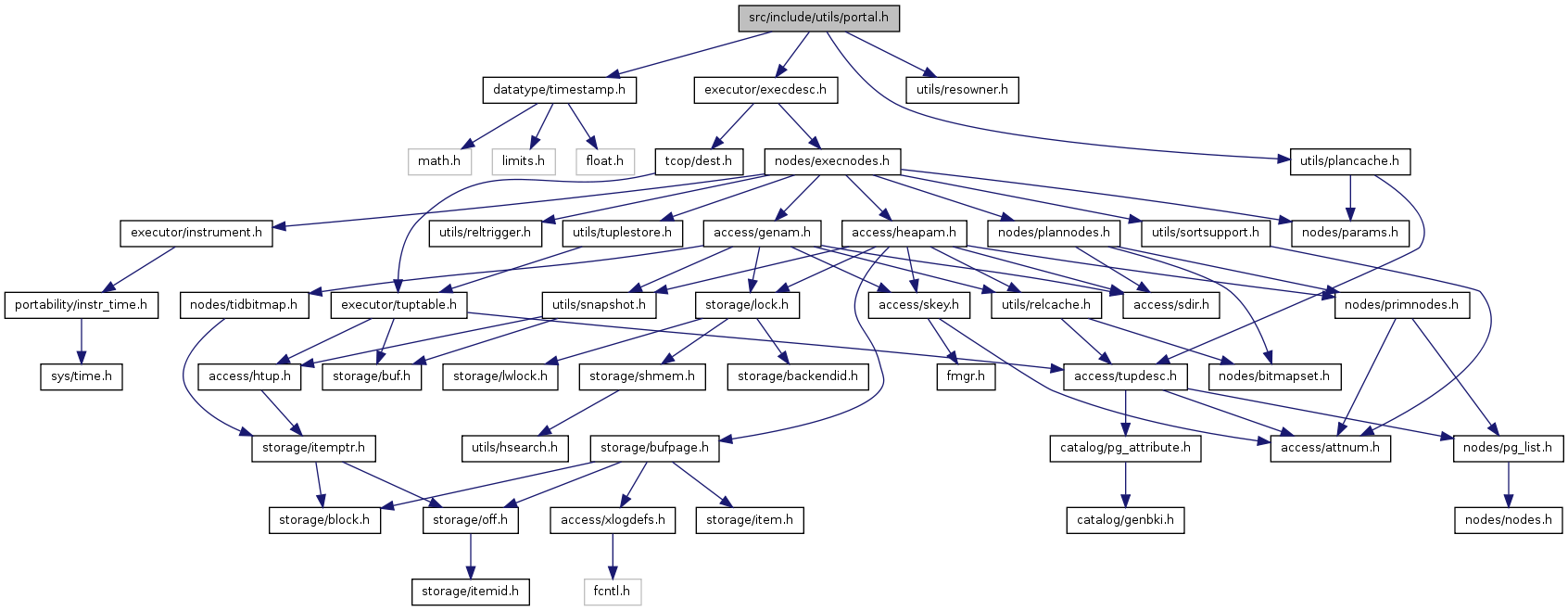

Go to the source code of this file.
| #define PortalGetHeapMemory | ( | portal | ) | ((portal)->heap) |
Definition at line 190 of file portal.h.
Referenced by AtAbort_Portals(), AtSubAbort_Portals(), exec_bind_message(), ExecuteQuery(), PerformCursorOpen(), PersistHoldablePortal(), PortalDrop(), PortalRun(), PortalRunFetch(), PortalRunMulti(), PortalRunUtility(), PortalSetResultFormat(), PortalStart(), and SPI_cursor_open_internal().
| #define PortalGetPrimaryStmt | ( | portal | ) | PortalListGetPrimaryStmt((portal)->stmts) |
Definition at line 191 of file portal.h.
Referenced by FetchPortalTargetList(), and PortalStart().
| #define PortalGetQueryDesc | ( | portal | ) | ((portal)->queryDesc) |
Definition at line 189 of file portal.h.
Referenced by DoPortalRewind(), execCurrentOf(), PersistHoldablePortal(), PortalCleanup(), and PortalRunSelect().
| #define PortalIsValid | ( | p | ) | PointerIsValid(p) |
Definition at line 184 of file portal.h.
Referenced by _SPI_cursor_operation(), CreatePortal(), exec_describe_portal_message(), exec_execute_message(), exec_simple_query(), execCurrentOf(), FetchStatementTargetList(), PerformPortalClose(), PerformPortalFetch(), PLy_cursor_close(), PLy_cursor_dealloc(), PLy_cursor_fetch(), PLy_cursor_iternext(), PortalCleanup(), PortalDefineQuery(), PortalDrop(), PortalRun(), PortalRunFetch(), PortalStart(), PostgresMain(), SPI_cursor_close(), UtilityReturnsTuples(), and UtilityTupleDescriptor().
| typedef struct PortalData* Portal |
| typedef struct PortalData PortalData |
| typedef enum PortalStatus PortalStatus |
| typedef enum PortalStrategy PortalStrategy |
| enum PortalStatus |
Definition at line 102 of file portal.h.
{
    PORTAL_NEW,                 /* freshly created */
    PORTAL_DEFINED,             /* PortalDefineQuery done */
    PORTAL_READY,               /* PortalStart complete, can run it */
    PORTAL_ACTIVE,              /* portal is running (can't delete it) */
    PORTAL_DONE,                /* portal is finished (don't re-run it) */
    PORTAL_FAILED               /* portal got error (can't re-run it) */
} PortalStatus;
| enum PortalStrategy |
| PORTAL_ONE_SELECT | |
| PORTAL_ONE_RETURNING | |
| PORTAL_ONE_MOD_WITH | |
| PORTAL_UTIL_SELECT | |
| PORTAL_MULTI_QUERY |
Definition at line 88 of file portal.h.
{
    PORTAL_ONE_SELECT,
    PORTAL_ONE_RETURNING,
    PORTAL_ONE_MOD_WITH,
    PORTAL_UTIL_SELECT,
    PORTAL_MULTI_QUERY
} PortalStrategy;
| void AtAbort_Portals | ( | void | ) |
Definition at line 736 of file portalmem.c.
References PortalData::cleanup, PortalData::createSubid, hash_seq_init(), hash_seq_search(), InvalidSubTransactionId, MarkPortalFailed(), MemoryContextDeleteChildren(), NULL, PointerIsValid, portalhashent::portal, PORTAL_ACTIVE, PORTAL_READY, PortalGetHeapMemory, PortalReleaseCachedPlan(), PortalData::resowner, and PortalData::status.
Referenced by AbortTransaction().
{
    HASH_SEQ_STATUS status;
    PortalHashEnt *hentry;

    hash_seq_init(&status, PortalHashTable);

    while ((hentry = (PortalHashEnt *) hash_seq_search(&status)) != NULL)
    {
        Portal      portal = hentry->portal;

        /* Any portal that was actually running has to be considered broken */
        if (portal->status == PORTAL_ACTIVE)
            MarkPortalFailed(portal);

        /*
         * Do nothing else to cursors held over from a previous transaction.
         */
        if (portal->createSubid == InvalidSubTransactionId)
            continue;

        /*
         * If it was created in the current transaction, we can't do normal
         * shutdown on a READY portal either; it might refer to objects
         * created in the failed transaction.  See comments in
         * AtSubAbort_Portals.
         */
        if (portal->status == PORTAL_READY)
            MarkPortalFailed(portal);

        /*
         * Allow portalcmds.c to clean up the state it knows about, if we
         * haven't already.
         */
        if (PointerIsValid(portal->cleanup))
        {
            (*portal->cleanup) (portal);
            portal->cleanup = NULL;
        }

        /* drop cached plan reference, if any */
        PortalReleaseCachedPlan(portal);

        /*
         * Any resources belonging to the portal will be released in the
         * upcoming transaction-wide cleanup; they will be gone before we run
         * PortalDrop.
         */
        portal->resowner = NULL;

        /*
         * Although we can't delete the portal data structure proper, we can
         * release any memory in subsidiary contexts, such as executor state.
         * The cleanup hook was the last thing that might have needed data
         * there.
         */
        MemoryContextDeleteChildren(PortalGetHeapMemory(portal));
    }
}
| void AtCleanup_Portals | ( | void | ) |
Definition at line 801 of file portalmem.c.
References Assert, PortalData::cleanup, PortalData::createSubid, hash_seq_init(), hash_seq_search(), InvalidSubTransactionId, NULL, portalhashent::portal, PORTAL_ACTIVE, PortalDrop(), PortalData::portalPinned, PortalData::resowner, and PortalData::status.
Referenced by CleanupTransaction().
{
    HASH_SEQ_STATUS status;
    PortalHashEnt *hentry;

    hash_seq_init(&status, PortalHashTable);

    while ((hentry = (PortalHashEnt *) hash_seq_search(&status)) != NULL)
    {
        Portal      portal = hentry->portal;

        /* Do nothing to cursors held over from a previous transaction */
        if (portal->createSubid == InvalidSubTransactionId)
        {
            Assert(portal->status != PORTAL_ACTIVE);
            Assert(portal->resowner == NULL);
            continue;
        }

        /*
         * If a portal is still pinned, forcibly unpin it. PortalDrop will not
         * let us drop the portal otherwise. Whoever pinned the portal was
         * interrupted by the abort too and won't try to use it anymore.
         */
        if (portal->portalPinned)
            portal->portalPinned = false;

        /* We had better not be calling any user-defined code here */
        Assert(portal->cleanup == NULL);

        /* Zap it. */
        PortalDrop(portal, false);
    }
}
| void AtSubAbort_Portals | ( | SubTransactionId | mySubid, | |
| SubTransactionId | parentSubid, | |||
| ResourceOwner | parentXactOwner | |||
| ) |
Definition at line 875 of file portalmem.c.
References PortalData::cleanup, PortalData::createSubid, hash_seq_init(), hash_seq_search(), MarkPortalFailed(), MemoryContextDeleteChildren(), NULL, PointerIsValid, portalhashent::portal, PORTAL_ACTIVE, PORTAL_READY, PortalGetHeapMemory, PortalReleaseCachedPlan(), PortalData::resowner, and PortalData::status.
Referenced by AbortSubTransaction().
{
    HASH_SEQ_STATUS status;
    PortalHashEnt *hentry;

    hash_seq_init(&status, PortalHashTable);

    while ((hentry = (PortalHashEnt *) hash_seq_search(&status)) != NULL)
    {
        Portal      portal = hentry->portal;

        if (portal->createSubid != mySubid)
            continue;

        /*
         * Force any live portals of my own subtransaction into FAILED state.
         * We have to do this because they might refer to objects created or
         * changed in the failed subtransaction, leading to crashes if
         * execution is resumed, or even if we just try to run ExecutorEnd.
         * (Note we do NOT do this to upper-level portals, since they cannot
         * have such references and hence may be able to continue.)
         */
        if (portal->status == PORTAL_READY ||
            portal->status == PORTAL_ACTIVE)
            MarkPortalFailed(portal);

        /*
         * Allow portalcmds.c to clean up the state it knows about, if we
         * haven't already.
         */
        if (PointerIsValid(portal->cleanup))
        {
            (*portal->cleanup) (portal);
            portal->cleanup = NULL;
        }

        /* drop cached plan reference, if any */
        PortalReleaseCachedPlan(portal);

        /*
         * Any resources belonging to the portal will be released in the
         * upcoming transaction-wide cleanup; they will be gone before we run
         * PortalDrop.
         */
        portal->resowner = NULL;

        /*
         * Although we can't delete the portal data structure proper, we can
         * release any memory in subsidiary contexts, such as executor state.
         * The cleanup hook was the last thing that might have needed data
         * there.
         */
        MemoryContextDeleteChildren(PortalGetHeapMemory(portal));
    }
}
| void AtSubCleanup_Portals | ( | SubTransactionId | mySubid | ) |
Definition at line 940 of file portalmem.c.
References Assert, PortalData::cleanup, PortalData::createSubid, hash_seq_init(), hash_seq_search(), NULL, portalhashent::portal, PortalDrop(), and PortalData::portalPinned.
Referenced by CleanupSubTransaction().
{
    HASH_SEQ_STATUS status;
    PortalHashEnt *hentry;

    hash_seq_init(&status, PortalHashTable);

    while ((hentry = (PortalHashEnt *) hash_seq_search(&status)) != NULL)
    {
        Portal      portal = hentry->portal;

        if (portal->createSubid != mySubid)
            continue;

        /*
         * If a portal is still pinned, forcibly unpin it. PortalDrop will not
         * let us drop the portal otherwise. Whoever pinned the portal was
         * interrupted by the abort too and won't try to use it anymore.
         */
        if (portal->portalPinned)
            portal->portalPinned = false;

        /* We had better not be calling any user-defined code here */
        Assert(portal->cleanup == NULL);

        /* Zap it. */
        PortalDrop(portal, false);
    }
}
| void AtSubCommit_Portals | ( | SubTransactionId | mySubid, | |
| SubTransactionId | parentSubid, | |||
| ResourceOwner | parentXactOwner | |||
| ) |
Definition at line 843 of file portalmem.c.
References PortalData::createSubid, hash_seq_init(), hash_seq_search(), NULL, portalhashent::portal, ResourceOwnerNewParent(), and PortalData::resowner.
Referenced by CommitSubTransaction().
{
    HASH_SEQ_STATUS status;
    PortalHashEnt *hentry;

    hash_seq_init(&status, PortalHashTable);

    while ((hentry = (PortalHashEnt *) hash_seq_search(&status)) != NULL)
    {
        Portal      portal = hentry->portal;

        if (portal->createSubid == mySubid)
        {
            portal->createSubid = parentSubid;
            if (portal->resowner)
                ResourceOwnerNewParent(portal->resowner, parentXactOwner);
        }
    }
}
| Portal CreateNewPortal | ( | void | ) |
Definition at line 253 of file portalmem.c.
References CreatePortal(), GetPortalByName(), and NULL.
Referenced by ExecuteQuery(), and SPI_cursor_open_internal().
{
    static unsigned int unnamed_portal_count = 0;

    char        portalname[MAX_PORTALNAME_LEN];

    /* Select a nonconflicting name */
    for (;;)
    {
        unnamed_portal_count++;
        sprintf(portalname, "<unnamed portal %u>", unnamed_portal_count);
        if (GetPortalByName(portalname) == NULL)
            break;
    }

    return CreatePortal(portalname, false, false);
}
Definition at line 196 of file portalmem.c.
References ALLOCSET_SMALL_INITSIZE, ALLOCSET_SMALL_MAXSIZE, ALLOCSET_SMALL_MINSIZE, AllocSetContextCreate(), AssertArg, PortalData::atEnd, PortalData::atStart, PortalData::cleanup, PortalData::createSubid, PortalData::creation_time, PortalData::cursorOptions, CurTransactionResourceOwner, ereport, errcode(), errmsg(), ERROR, GetCurrentStatementStartTimestamp(), GetCurrentSubTransactionId(), GetPortalByName(), PortalData::heap, MemoryContextAllocZero(), PointerIsValid, PortalDrop(), PortalHashTableInsert, PortalIsValid, ResourceOwnerCreate(), PortalData::resowner, PortalData::status, PortalData::strategy, PortalData::visible, and WARNING.
Referenced by CreateNewPortal(), exec_bind_message(), exec_simple_query(), PerformCursorOpen(), and SPI_cursor_open_internal().
{
    Portal      portal;

    AssertArg(PointerIsValid(name));

    portal = GetPortalByName(name);
    if (PortalIsValid(portal))
    {
        if (!allowDup)
            ereport(ERROR,
                    (errcode(ERRCODE_DUPLICATE_CURSOR),
                     errmsg("cursor \"%s\" already exists", name)));
        if (!dupSilent)
            ereport(WARNING,
                    (errcode(ERRCODE_DUPLICATE_CURSOR),
                     errmsg("closing existing cursor \"%s\"",
                            name)));
        PortalDrop(portal, false);
    }

    /* make new portal structure */
    portal = (Portal) MemoryContextAllocZero(PortalMemory, sizeof *portal);

    /* initialize portal heap context; typically it won't store much */
    portal->heap = AllocSetContextCreate(PortalMemory,
                                         "PortalHeapMemory",
                                         ALLOCSET_SMALL_MINSIZE,
                                         ALLOCSET_SMALL_INITSIZE,
                                         ALLOCSET_SMALL_MAXSIZE);

    /* create a resource owner for the portal */
    portal->resowner = ResourceOwnerCreate(CurTransactionResourceOwner,
                                           "Portal");

    /* initialize portal fields that don't start off zero */
    portal->status = PORTAL_NEW;
    portal->cleanup = PortalCleanup;
    portal->createSubid = GetCurrentSubTransactionId();
    portal->strategy = PORTAL_MULTI_QUERY;
    portal->cursorOptions = CURSOR_OPT_NO_SCROLL;
    portal->atStart = true;
    portal->atEnd = true;       /* disallow fetches until query is set */
    portal->visible = true;
    portal->creation_time = GetCurrentStatementStartTimestamp();

    /* put portal in table (sets portal->name) */
    PortalHashTableInsert(portal, name);

    return portal;
}
| void EnablePortalManager | ( | void | ) |
Definition at line 102 of file portalmem.c.
References ALLOCSET_DEFAULT_INITSIZE, ALLOCSET_DEFAULT_MAXSIZE, ALLOCSET_DEFAULT_MINSIZE, AllocSetContextCreate(), Assert, HASHCTL::entrysize, hash_create(), HASH_ELEM, HASHCTL::keysize, NULL, PORTALS_PER_USER, and TopMemoryContext.
Referenced by InitPostgres().
{
    HASHCTL     ctl;

    Assert(PortalMemory == NULL);

    PortalMemory = AllocSetContextCreate(TopMemoryContext,
                                         "PortalMemory",
                                         ALLOCSET_DEFAULT_MINSIZE,
                                         ALLOCSET_DEFAULT_INITSIZE,
                                         ALLOCSET_DEFAULT_MAXSIZE);

    ctl.keysize = MAX_PORTALNAME_LEN;
    ctl.entrysize = sizeof(PortalHashEnt);

    /*
     * use PORTALS_PER_USER as a guess of how many hash table entries to
     * create, initially
     */
    PortalHashTable = hash_create("Portal hash", PORTALS_PER_USER,
                                  &ctl, HASH_ELEM);
}
| Portal GetPortalByName | ( | const char * | name | ) |
Definition at line 130 of file portalmem.c.
References PointerIsValid, and PortalHashTableLookup.
Referenced by CreateNewPortal(), CreatePortal(), exec_describe_portal_message(), exec_execute_message(), exec_simple_query(), execCurrentOf(), FetchStatementTargetList(), PerformPortalClose(), PerformPortalFetch(), PLy_cursor_close(), PLy_cursor_dealloc(), PLy_cursor_fetch(), PLy_cursor_iternext(), PostgresMain(), SPI_cursor_find(), UtilityReturnsTuples(), and UtilityTupleDescriptor().
{
    Portal      portal;

    if (PointerIsValid(name))
        PortalHashTableLookup(name, portal);
    else
        portal = NULL;

    return portal;
}
| void MarkPortalDone | ( | Portal | portal | ) |
Definition at line 412 of file portalmem.c.
References Assert, PortalData::cleanup, PointerIsValid, PORTAL_ACTIVE, and PortalData::status.
Referenced by PortalRun().
{
    /* Perform the state transition */
    Assert(portal->status == PORTAL_ACTIVE);
    portal->status = PORTAL_DONE;

    /*
     * Allow portalcmds.c to clean up the state it knows about.  We might as
     * well do that now, since the portal can't be executed any more.
     *
     * In some cases involving execution of a ROLLBACK command in an already
     * aborted transaction, this prevents an assertion failure caused by
     * reaching AtCleanup_Portals with the cleanup hook still unexecuted.
     */
    if (PointerIsValid(portal->cleanup))
    {
        (*portal->cleanup) (portal);
        portal->cleanup = NULL;
    }
}
| void MarkPortalFailed | ( | Portal | portal | ) |
Definition at line 440 of file portalmem.c.
References Assert, PortalData::cleanup, PointerIsValid, PORTAL_DONE, and PortalData::status.
Referenced by AtAbort_Portals(), AtSubAbort_Portals(), PersistHoldablePortal(), PortalRun(), PortalRunFetch(), and PortalStart().
{
    /* Perform the state transition */
    Assert(portal->status != PORTAL_DONE);
    portal->status = PORTAL_FAILED;

    /*
     * Allow portalcmds.c to clean up the state it knows about.  We might as
     * well do that now, since the portal can't be executed any more.
     *
     * In some cases involving cleanup of an already aborted transaction, this
     * prevents an assertion failure caused by reaching AtCleanup_Portals with
     * the cleanup hook still unexecuted.
     */
    if (PointerIsValid(portal->cleanup))
    {
        (*portal->cleanup) (portal);
        portal->cleanup = NULL;
    }
}
| void PinPortal | ( | Portal | portal | ) |
Definition at line 388 of file portalmem.c.
References elog, ERROR, and PortalData::portalPinned.
Referenced by exec_for_query().
{
    if (portal->portalPinned)
        elog(ERROR, "portal already pinned");

    portal->portalPinned = true;
}
| void PortalCreateHoldStore | ( | Portal | portal | ) |
Definition at line 347 of file portalmem.c.
References ALLOCSET_DEFAULT_INITSIZE, ALLOCSET_DEFAULT_MAXSIZE, ALLOCSET_DEFAULT_MINSIZE, AllocSetContextCreate(), Assert, CURSOR_OPT_SCROLL, PortalData::cursorOptions, PortalData::holdContext, PortalData::holdStore, MemoryContextSwitchTo(), NULL, tuplestore_begin_heap(), and work_mem.
Referenced by FillPortalStore(), and PreCommit_Portals().
{
    MemoryContext oldcxt;

    Assert(portal->holdContext == NULL);
    Assert(portal->holdStore == NULL);

    /*
     * Create the memory context that is used for storage of the tuple set.
     * Note this is NOT a child of the portal's heap memory.
     */
    portal->holdContext =
        AllocSetContextCreate(PortalMemory,
                              "PortalHoldContext",
                              ALLOCSET_DEFAULT_MINSIZE,
                              ALLOCSET_DEFAULT_INITSIZE,
                              ALLOCSET_DEFAULT_MAXSIZE);

    /*
     * Create the tuple store, selecting cross-transaction temp files, and
     * enabling random access only if cursor requires scrolling.
     *
     * XXX: Should maintenance_work_mem be used for the portal size?
     */
    oldcxt = MemoryContextSwitchTo(portal->holdContext);

    portal->holdStore =
        tuplestore_begin_heap(portal->cursorOptions & CURSOR_OPT_SCROLL,
                              true, work_mem);

    MemoryContextSwitchTo(oldcxt);
}
| void PortalDefineQuery | ( | Portal | portal, | |
| const char * | prepStmtName, | |||
| const char * | sourceText, | |||
| const char * | commandTag, | |||
| List * | stmts, | |||
| CachedPlan * | cplan | |||
| ) |
Definition at line 300 of file portalmem.c.
References AssertArg, AssertState, PortalData::commandTag, PortalData::cplan, NIL, NULL, PORTAL_NEW, PortalIsValid, PortalData::prepStmtName, PortalData::sourceText, PortalData::status, and PortalData::stmts.
Referenced by exec_bind_message(), exec_simple_query(), ExecuteQuery(), PerformCursorOpen(), and SPI_cursor_open_internal().
{
    AssertArg(PortalIsValid(portal));
    AssertState(portal->status == PORTAL_NEW);

    AssertArg(sourceText != NULL);
    AssertArg(commandTag != NULL || stmts == NIL);

    portal->prepStmtName = prepStmtName;
    portal->sourceText = sourceText;
    portal->commandTag = commandTag;
    portal->stmts = stmts;
    portal->cplan = cplan;
    portal->status = PORTAL_DEFINED;
}
Definition at line 466 of file portalmem.c.
References AssertArg, PortalData::cleanup, ereport, errcode(), errmsg(), ERROR, PortalData::holdContext, PortalData::holdStore, MemoryContextDelete(), MemoryContextSwitchTo(), PortalData::name, pfree(), PointerIsValid, PORTAL_ACTIVE, PORTAL_FAILED, PortalGetHeapMemory, PortalHashTableDelete, PortalIsValid, PortalData::portalPinned, PortalReleaseCachedPlan(), RESOURCE_RELEASE_AFTER_LOCKS, RESOURCE_RELEASE_BEFORE_LOCKS, RESOURCE_RELEASE_LOCKS, ResourceOwnerDelete(), ResourceOwnerRelease(), PortalData::resowner, PortalData::status, and tuplestore_end().
Referenced by AtCleanup_Portals(), AtSubCleanup_Portals(), CreatePortal(), exec_simple_query(), ExecuteQuery(), PerformPortalClose(), PortalHashTableDeleteAll(), PostgresMain(), PreCommit_Portals(), and SPI_cursor_close().
{
    AssertArg(PortalIsValid(portal));

    /*
     * Don't allow dropping a pinned portal, it's still needed by whoever
     * pinned it. Not sure if the PORTAL_ACTIVE case can validly happen or
     * not...
     */
    if (portal->portalPinned ||
        portal->status == PORTAL_ACTIVE)
        ereport(ERROR,
                (errcode(ERRCODE_INVALID_CURSOR_STATE),
                 errmsg("cannot drop active portal \"%s\"", portal->name)));

    /*
     * Allow portalcmds.c to clean up the state it knows about, in particular
     * shutting down the executor if still active.  This step potentially runs
     * user-defined code so failure has to be expected.  It's the cleanup
     * hook's responsibility to not try to do that more than once, in the case
     * that failure occurs and then we come back to drop the portal again
     * during transaction abort.
     *
     * Note: in most paths of control, this will have been done already in
     * MarkPortalDone or MarkPortalFailed.  We're just making sure.
     */
    if (PointerIsValid(portal->cleanup))
    {
        (*portal->cleanup) (portal);
        portal->cleanup = NULL;
    }

    /*
     * Remove portal from hash table.  Because we do this here, we will not
     * come back to try to remove the portal again if there's any error in the
     * subsequent steps.  Better to leak a little memory than to get into an
     * infinite error-recovery loop.
     */
    PortalHashTableDelete(portal);

    /* drop cached plan reference, if any */
    PortalReleaseCachedPlan(portal);

    /*
     * Release any resources still attached to the portal.  There are several
     * cases being covered here:
     *
     * Top transaction commit (indicated by isTopCommit): normally we should
     * do nothing here and let the regular end-of-transaction resource
     * releasing mechanism handle these resources too.  However, if we have a
     * FAILED portal (eg, a cursor that got an error), we'd better clean up
     * its resources to avoid resource-leakage warning messages.
     *
     * Sub transaction commit: never comes here at all, since we don't kill
     * any portals in AtSubCommit_Portals().
     *
     * Main or sub transaction abort: we will do nothing here because
     * portal->resowner was already set NULL; the resources were already
     * cleaned up in transaction abort.
     *
     * Ordinary portal drop: must release resources.  However, if the portal
     * is not FAILED then we do not release its locks.  The locks become the
     * responsibility of the transaction's ResourceOwner (since it is the
     * parent of the portal's owner) and will be released when the transaction
     * eventually ends.
     */
    if (portal->resowner &&
        (!isTopCommit || portal->status == PORTAL_FAILED))
    {
        bool        isCommit = (portal->status != PORTAL_FAILED);

        ResourceOwnerRelease(portal->resowner,
                             RESOURCE_RELEASE_BEFORE_LOCKS,
                             isCommit, false);
        ResourceOwnerRelease(portal->resowner,
                             RESOURCE_RELEASE_LOCKS,
                             isCommit, false);
        ResourceOwnerRelease(portal->resowner,
                             RESOURCE_RELEASE_AFTER_LOCKS,
                             isCommit, false);
        ResourceOwnerDelete(portal->resowner);
    }
    portal->resowner = NULL;

    /*
     * Delete tuplestore if present.  We should do this even under error
     * conditions; since the tuplestore would have been using cross-
     * transaction storage, its temp files need to be explicitly deleted.
     */
    if (portal->holdStore)
    {
        MemoryContext oldcontext;

        oldcontext = MemoryContextSwitchTo(portal->holdContext);
        tuplestore_end(portal->holdStore);
        MemoryContextSwitchTo(oldcontext);
        portal->holdStore = NULL;
    }

    /* delete tuplestore storage, if any */
    if (portal->holdContext)
        MemoryContextDelete(portal->holdContext);

    /* release subsidiary storage */
    MemoryContextDelete(PortalGetHeapMemory(portal));

    /* release portal struct (it's in PortalMemory) */
    pfree(portal);
}
| void PortalHashTableDeleteAll | ( | void | ) |
Definition at line 582 of file portalmem.c.
References hash_seq_init(), hash_seq_search(), hash_seq_term(), NULL, portalhashent::portal, PORTAL_ACTIVE, PortalDrop(), and PortalData::status.
Referenced by DiscardAll(), and PerformPortalClose().
{
    HASH_SEQ_STATUS status;
    PortalHashEnt *hentry;

    if (PortalHashTable == NULL)
        return;

    hash_seq_init(&status, PortalHashTable);
    while ((hentry = hash_seq_search(&status)) != NULL)
    {
        Portal      portal = hentry->portal;

        /* Can't close the active portal (the one running the command) */
        if (portal->status == PORTAL_ACTIVE)
            continue;

        PortalDrop(portal, false);

        /* Restart the iteration in case that led to other drops */
        hash_seq_term(&status);
        hash_seq_init(&status, PortalHashTable);
    }
}
Definition at line 158 of file portalmem.c.
References IsA, lfirst, and list_length().
Referenced by CachedPlanGetTargetList(), and PlanCacheComputeResultDesc().
{
    ListCell   *lc;

    foreach(lc, stmts)
    {
        Node       *stmt = (Node *) lfirst(lc);

        if (IsA(stmt, PlannedStmt))
        {
            if (((PlannedStmt *) stmt)->canSetTag)
                return stmt;
        }
        else if (IsA(stmt, Query))
        {
            if (((Query *) stmt)->canSetTag)
                return stmt;
        }
        else
        {
            /* Utility stmts are assumed canSetTag if they're the only stmt */
            if (list_length(stmts) == 1)
                return stmt;
        }
    }
    return NULL;
}
Definition at line 621 of file portalmem.c.
References PortalData::createSubid, CURSOR_OPT_HOLD, PortalData::cursorOptions, elog, ereport, errcode(), errmsg(), ERROR, hash_seq_init(), hash_seq_search(), hash_seq_term(), InvalidSubTransactionId, NULL, PersistHoldablePortal(), portalhashent::portal, PORTAL_ACTIVE, PORTAL_READY, PortalCreateHoldStore(), PortalDrop(), PortalData::portalPinned, PortalReleaseCachedPlan(), PortalData::resowner, and PortalData::status.
Referenced by CommitTransaction(), and PrepareTransaction().
{
    bool        result = false;
    HASH_SEQ_STATUS status;
    PortalHashEnt *hentry;

    hash_seq_init(&status, PortalHashTable);

    while ((hentry = (PortalHashEnt *) hash_seq_search(&status)) != NULL)
    {
        Portal      portal = hentry->portal;

        /*
         * There should be no pinned portals anymore. Complain if someone
         * leaked one.
         */
        if (portal->portalPinned)
            elog(ERROR, "cannot commit while a portal is pinned");

        /*
         * Do not touch active portals --- this can only happen in the case of
         * a multi-transaction utility command, such as VACUUM.
         *
         * Note however that any resource owner attached to such a portal is
         * still going to go away, so don't leave a dangling pointer.
         */
        if (portal->status == PORTAL_ACTIVE)
        {
            portal->resowner = NULL;
            continue;
        }

        /* Is it a holdable portal created in the current xact? */
        if ((portal->cursorOptions & CURSOR_OPT_HOLD) &&
            portal->createSubid != InvalidSubTransactionId &&
            portal->status == PORTAL_READY)
        {
            /*
             * We are exiting the transaction that created a holdable cursor.
             * Instead of dropping the portal, prepare it for access by later
             * transactions.
             *
             * However, if this is PREPARE TRANSACTION rather than COMMIT,
             * refuse PREPARE, because the semantics seem pretty unclear.
             */
            if (isPrepare)
                ereport(ERROR,
                        (errcode(ERRCODE_FEATURE_NOT_SUPPORTED),
                         errmsg("cannot PREPARE a transaction that has created a cursor WITH HOLD")));

            /*
             * Note that PersistHoldablePortal() must release all resources
             * used by the portal that are local to the creating transaction.
             */
            PortalCreateHoldStore(portal);
            PersistHoldablePortal(portal);

            /* drop cached plan reference, if any */
            PortalReleaseCachedPlan(portal);

            /*
             * Any resources belonging to the portal will be released in the
             * upcoming transaction-wide cleanup; the portal will no longer
             * have its own resources.
             */
            portal->resowner = NULL;

            /*
             * Having successfully exported the holdable cursor, mark it as
             * not belonging to this transaction.
             */
            portal->createSubid = InvalidSubTransactionId;

            /* Report we changed state */
            result = true;
        }
        else if (portal->createSubid == InvalidSubTransactionId)
        {
            /*
             * Do nothing to cursors held over from a previous transaction
             * (including ones we just froze in a previous cycle of this loop)
             */
            continue;
        }
        else
        {
            /* Zap all non-holdable portals */
            PortalDrop(portal, true);

            /* Report we changed state */
            result = true;
        }

        /*
         * After either freezing or dropping a portal, we have to restart the
         * iteration, because we could have invoked user-defined code that
         * caused a drop of the next portal in the hash chain.
         */
        hash_seq_term(&status);
        hash_seq_init(&status, PortalHashTable);
    }

    return result;
}
| bool ThereAreNoReadyPortals | ( | void | ) |
Definition at line 1060 of file portalmem.c.
References hash_seq_init(), hash_seq_search(), NULL, portalhashent::portal, PORTAL_READY, and PortalData::status.
Referenced by CopyFrom().
{
    HASH_SEQ_STATUS status;
    PortalHashEnt *hentry;

    hash_seq_init(&status, PortalHashTable);

    while ((hentry = (PortalHashEnt *) hash_seq_search(&status)) != NULL)
    {
        Portal      portal = hentry->portal;

        if (portal->status == PORTAL_READY)
            return false;
    }

    return true;
}
| void UnpinPortal | ( | Portal | portal | ) |
Definition at line 397 of file portalmem.c.
References elog, ERROR, and PortalData::portalPinned.
Referenced by exec_for_query().
{
    if (!portal->portalPinned)
        elog(ERROR, "portal not pinned");

    portal->portalPinned = false;
}
 1.7.1
1.7.1