Header And Logo

|

#include "postgres.h"#include <time.h>#include <unistd.h>#include "storage/s_lock.h"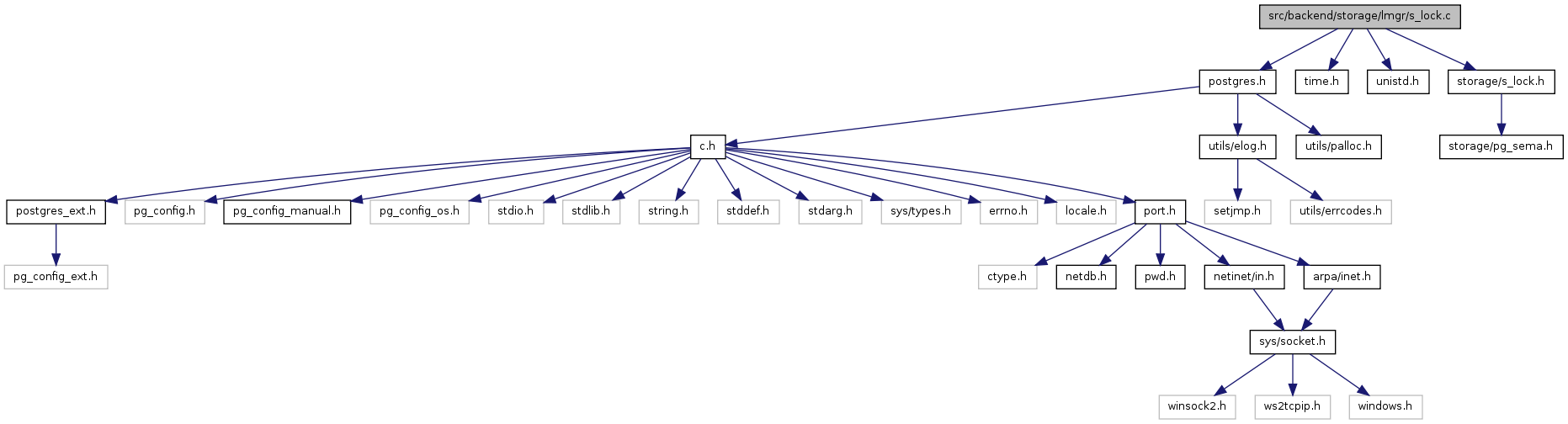
Go to the source code of this file.
Defines | |
| #define | MIN_SPINS_PER_DELAY 10 |
| #define | MAX_SPINS_PER_DELAY 1000 |
| #define | NUM_DELAYS 1000 |
| #define | MIN_DELAY_MSEC 1 |
| #define | MAX_DELAY_MSEC 1000 |
Functions | |
| static void | s_lock_stuck (volatile slock_t *lock, const char *file, int line) |
| int | s_lock (volatile slock_t *lock, const char *file, int line) |
| void | set_spins_per_delay (int shared_spins_per_delay) |
| int | update_spins_per_delay (int shared_spins_per_delay) |
Variables | |
| slock_t | dummy_spinlock |
| static int | spins_per_delay = DEFAULT_SPINS_PER_DELAY |
| #define MAX_DELAY_MSEC 1000 |
Referenced by s_lock().
| #define MAX_SPINS_PER_DELAY 1000 |
Referenced by s_lock().
| #define MIN_DELAY_MSEC 1 |
| #define MIN_SPINS_PER_DELAY 10 |
Referenced by s_lock().
| #define NUM_DELAYS 1000 |
Referenced by s_lock().
| int s_lock | ( | volatile slock_t * | lock, | |
| const char * | file, | |||
| int | line | |||
| ) |
Definition at line 50 of file s_lock.c.
References Max, MAX_DELAY_MSEC, MAX_RANDOM_VALUE, MAX_SPINS_PER_DELAY, Min, MIN_SPINS_PER_DELAY, NUM_DELAYS, pg_usleep(), random(), s_lock_stuck(), SPIN_DELAY, spins_per_delay, and TAS_SPIN.
{
    /*
     * We loop tightly for awhile, then delay using pg_usleep() and try again.
     * Preferably, "awhile" should be a small multiple of the maximum time we
     * expect a spinlock to be held.  100 iterations seems about right as an
     * initial guess.  However, on a uniprocessor the loop is a waste of
     * cycles, while in a multi-CPU scenario it's usually better to spin a bit
     * longer than to call the kernel, so we try to adapt the spin loop count
     * depending on whether we seem to be in a uniprocessor or multiprocessor.
     *
     * Note: you might think MIN_SPINS_PER_DELAY should be just 1, but you'd
     * be wrong; there are platforms where that can result in a "stuck
     * spinlock" failure.  This has been seen particularly on Alphas; it seems
     * that the first TAS after returning from kernel space will always fail
     * on that hardware.
     *
     * Once we do decide to block, we use randomly increasing pg_usleep()
     * delays. The first delay is 1 msec, then the delay randomly increases to
     * about one second, after which we reset to 1 msec and start again.  The
     * idea here is that in the presence of heavy contention we need to
     * increase the delay, else the spinlock holder may never get to run and
     * release the lock.  (Consider situation where spinlock holder has been
     * nice'd down in priority by the scheduler --- it will not get scheduled
     * until all would-be acquirers are sleeping, so if we always use a 1-msec
     * sleep, there is a real possibility of starvation.)  But we can't just
     * clamp the delay to an upper bound, else it would take a long time to
     * make a reasonable number of tries.
     *
     * We time out and declare error after NUM_DELAYS delays (thus, exactly
     * that many tries).  With the given settings, this will usually take 2 or
     * so minutes.  It seems better to fix the total number of tries (and thus
     * the probability of unintended failure) than to fix the total time
     * spent.
     *
     * The pg_usleep() delays are measured in milliseconds because 1 msec is a
     * common resolution limit at the OS level for newer platforms. On older
     * platforms the resolution limit is usually 10 msec, in which case the
     * total delay before timeout will be a bit more.
     */
#define MIN_SPINS_PER_DELAY 10
#define MAX_SPINS_PER_DELAY 1000
#define NUM_DELAYS          1000
#define MIN_DELAY_MSEC      1
#define MAX_DELAY_MSEC      1000

    int         spins = 0;
    int         delays = 0;
    int         cur_delay = 0;

    while (TAS_SPIN(lock))
    {
        /* CPU-specific delay each time through the loop */
        SPIN_DELAY();

        /* Block the process every spins_per_delay tries */
        if (++spins >= spins_per_delay)
        {
            if (++delays > NUM_DELAYS)
                s_lock_stuck(lock, file, line);

            if (cur_delay == 0) /* first time to delay? */
                cur_delay = MIN_DELAY_MSEC;

            pg_usleep(cur_delay * 1000L);

#if defined(S_LOCK_TEST)
            fprintf(stdout, "*");
            fflush(stdout);
#endif

            /* increase delay by a random fraction between 1X and 2X */
            cur_delay += (int) (cur_delay *
                      ((double) random() / (double) MAX_RANDOM_VALUE) + 0.5);
            /* wrap back to minimum delay when max is exceeded */
            if (cur_delay > MAX_DELAY_MSEC)
                cur_delay = MIN_DELAY_MSEC;

            spins = 0;
        }
    }

    /*
     * If we were able to acquire the lock without delaying, it's a good
     * indication we are in a multiprocessor.  If we had to delay, it's a sign
     * (but not a sure thing) that we are in a uniprocessor. Hence, we
     * decrement spins_per_delay slowly when we had to delay, and increase it
     * rapidly when we didn't.  It's expected that spins_per_delay will
     * converge to the minimum value on a uniprocessor and to the maximum
     * value on a multiprocessor.
     *
     * Note: spins_per_delay is local within our current process. We want to
     * average these observations across multiple backends, since it's
     * relatively rare for this function to even get entered, and so a single
     * backend might not live long enough to converge on a good value.  That
     * is handled by the two routines below.
     */
    if (cur_delay == 0)
    {
        /* we never had to delay */
        if (spins_per_delay < MAX_SPINS_PER_DELAY)
            spins_per_delay = Min(spins_per_delay + 100, MAX_SPINS_PER_DELAY);
    }
    else
    {
        if (spins_per_delay > MIN_SPINS_PER_DELAY)
            spins_per_delay = Max(spins_per_delay - 1, MIN_SPINS_PER_DELAY);
    }
    return delays;
}
| static void s_lock_stuck | ( | volatile slock_t * | lock, | |
| const char * | file, | |||
| int | line | |||
| ) | [static] |
| void set_spins_per_delay | ( | int | shared_spins_per_delay | ) |
Definition at line 168 of file s_lock.c.
References spins_per_delay.
Referenced by InitAuxiliaryProcess(), and InitProcess().
{
    spins_per_delay = shared_spins_per_delay;
}
| int update_spins_per_delay | ( | int | shared_spins_per_delay | ) |
Definition at line 179 of file s_lock.c.
References spins_per_delay.
Referenced by AuxiliaryProcKill(), and ProcKill().
{
    /*
     * We use an exponential moving average with a relatively slow adaption
     * rate, so that noise in any one backend's result won't affect the shared
     * value too much.  As long as both inputs are within the allowed range,
     * the result must be too, so we need not worry about clamping the result.
     *
     * We deliberately truncate rather than rounding; this is so that single
     * adjustments inside a backend can affect the shared estimate (see the
     * asymmetric adjustment rules above).
     */
    return (shared_spins_per_delay * 15 + spins_per_delay) / 16;
}
int spins_per_delay = DEFAULT_SPINS_PER_DELAY [static] |
Definition at line 25 of file s_lock.c.
Referenced by s_lock(), set_spins_per_delay(), and update_spins_per_delay().
 1.7.1
1.7.1