Header And Logo

|

#include "postgres.h"#include <signal.h>#include <unistd.h>#include <sys/file.h>#include <sys/mman.h>#include <sys/stat.h>#include "miscadmin.h"#include "storage/ipc.h"#include "storage/pg_shmem.h"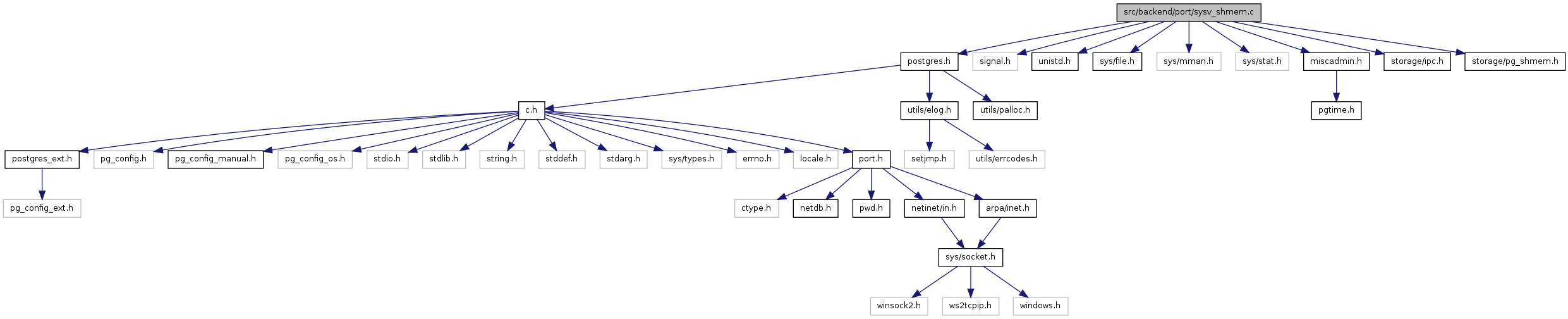
Go to the source code of this file.
Defines | |
| #define | IPCProtection (0600) |
| #define | PG_SHMAT_FLAGS 0 |
| #define | MAP_ANONYMOUS MAP_ANON |
| #define | MAP_HASSEMAPHORE 0 |
| #define | PG_MMAP_FLAGS (MAP_SHARED|MAP_ANONYMOUS|MAP_HASSEMAPHORE) |
| #define | MAP_FAILED ((void *) -1) |
Typedefs | |
| typedef key_t | IpcMemoryKey |
| typedef int | IpcMemoryId |
Functions | |
| static void * | InternalIpcMemoryCreate (IpcMemoryKey memKey, Size size) |
| static void | IpcMemoryDetach (int status, Datum shmaddr) |
| static void | IpcMemoryDelete (int status, Datum shmId) |
| static PGShmemHeader * | PGSharedMemoryAttach (IpcMemoryKey key, IpcMemoryId *shmid) |
| bool | PGSharedMemoryIsInUse (unsigned long id1, unsigned long id2) |
| PGShmemHeader * | PGSharedMemoryCreate (Size size, bool makePrivate, int port) |
| void | PGSharedMemoryDetach (void) |
Variables | |
| unsigned long | UsedShmemSegID = 0 |
| void * | UsedShmemSegAddr = NULL |
| static Size | AnonymousShmemSize |
| static void * | AnonymousShmem |
| #define IPCProtection (0600) |
Definition at line 39 of file sysv_shmem.c.
Referenced by InternalIpcMemoryCreate().
| #define MAP_ANONYMOUS MAP_ANON |
Definition at line 49 of file sysv_shmem.c.
| #define MAP_FAILED ((void *) -1) |
Definition at line 61 of file sysv_shmem.c.
Referenced by PGSharedMemoryCreate().
| #define MAP_HASSEMAPHORE 0 |
Definition at line 54 of file sysv_shmem.c.
| #define PG_MMAP_FLAGS (MAP_SHARED|MAP_ANONYMOUS|MAP_HASSEMAPHORE) |
Definition at line 57 of file sysv_shmem.c.
Referenced by PGSharedMemoryCreate().
| #define PG_SHMAT_FLAGS 0 |
Definition at line 44 of file sysv_shmem.c.
Referenced by InternalIpcMemoryCreate(), PGSharedMemoryAttach(), and PGSharedMemoryIsInUse().
| typedef int IpcMemoryId |
Definition at line 37 of file sysv_shmem.c.
| typedef key_t IpcMemoryKey |
Definition at line 36 of file sysv_shmem.c.
| static void * InternalIpcMemoryCreate | ( | IpcMemoryKey | memKey, | |
| Size | size | |||
| ) | [static] |
Definition at line 90 of file sysv_shmem.c.
References AddToDataDirLockFile(), EIDRM, elog, ereport, errdetail(), errhint(), errmsg(), FATAL, Int32GetDatum, IPC_CREAT, IPC_EXCL, IPC_RMID, IpcMemoryDelete(), IpcMemoryDetach(), IPCProtection, LOCK_FILE_LINE_SHMEM_KEY, LOG, NULL, on_shmem_exit(), PG_SHMAT_FLAGS, and PointerGetDatum.
Referenced by PGSharedMemoryCreate().
{
    IpcMemoryId shmid;
    void       *memAddress;

    shmid = shmget(memKey, size, IPC_CREAT | IPC_EXCL | IPCProtection);

    if (shmid < 0)
    {
        /*
         * Fail quietly if error indicates a collision with existing segment.
         * One would expect EEXIST, given that we said IPC_EXCL, but perhaps
         * we could get a permission violation instead?  Also, EIDRM might
         * occur if an old seg is slated for destruction but not gone yet.
         */
        if (errno == EEXIST || errno == EACCES
#ifdef EIDRM
            || errno == EIDRM
#endif
            )
            return NULL;

        /*
         * Some BSD-derived kernels are known to return EINVAL, not EEXIST, if
         * there is an existing segment but it's smaller than "size" (this is
         * a result of poorly-thought-out ordering of error tests). To
         * distinguish between collision and invalid size in such cases, we
         * make a second try with size = 0.  These kernels do not test size
         * against SHMMIN in the preexisting-segment case, so we will not get
         * EINVAL a second time if there is such a segment.
         */
        if (errno == EINVAL)
        {
            int         save_errno = errno;

            shmid = shmget(memKey, 0, IPC_CREAT | IPC_EXCL | IPCProtection);

            if (shmid < 0)
            {
                /* As above, fail quietly if we verify a collision */
                if (errno == EEXIST || errno == EACCES
#ifdef EIDRM
                    || errno == EIDRM
#endif
                    )
                    return NULL;
                /* Otherwise, fall through to report the original error */
            }
            else
            {
                /*
                 * On most platforms we cannot get here because SHMMIN is
                 * greater than zero.  However, if we do succeed in creating a
                 * zero-size segment, free it and then fall through to report
                 * the original error.
                 */
                if (shmctl(shmid, IPC_RMID, NULL) < 0)
                    elog(LOG, "shmctl(%d, %d, 0) failed: %m",
                         (int) shmid, IPC_RMID);
            }

            errno = save_errno;
        }

        /*
         * Else complain and abort.
         *
         * Note: at this point EINVAL should mean that either SHMMIN or SHMMAX
         * is violated.  SHMALL violation might be reported as either ENOMEM
         * (BSDen) or ENOSPC (Linux); the Single Unix Spec fails to say which
         * it should be.  SHMMNI violation is ENOSPC, per spec.  Just plain
         * not-enough-RAM is ENOMEM.
         */
        ereport(FATAL,
                (errmsg("could not create shared memory segment: %m"),
          errdetail("Failed system call was shmget(key=%lu, size=%lu, 0%o).",
                    (unsigned long) memKey, (unsigned long) size,
                    IPC_CREAT | IPC_EXCL | IPCProtection),
                 (errno == EINVAL) ?
                 errhint("This error usually means that PostgreSQL's request for a shared memory "
          "segment exceeded your kernel's SHMMAX parameter, or possibly that "
                         "it is less than "
                         "your kernel's SHMMIN parameter.\n"
        "The PostgreSQL documentation contains more information about shared "
                         "memory configuration.") : 0,
                 (errno == ENOMEM) ?
                 errhint("This error usually means that PostgreSQL's request for a shared "
                   "memory segment exceeded your kernel's SHMALL parameter.  You may need "
                         "to reconfigure the kernel with larger SHMALL.\n"
        "The PostgreSQL documentation contains more information about shared "
                         "memory configuration.") : 0,
                 (errno == ENOSPC) ?
                 errhint("This error does *not* mean that you have run out of disk space.  "
                         "It occurs either if all available shared memory IDs have been taken, "
                         "in which case you need to raise the SHMMNI parameter in your kernel, "
          "or because the system's overall limit for shared memory has been "
                 "reached.\n"
        "The PostgreSQL documentation contains more information about shared "
                         "memory configuration.") : 0));
    }

    /* Register on-exit routine to delete the new segment */
    on_shmem_exit(IpcMemoryDelete, Int32GetDatum(shmid));

    /* OK, should be able to attach to the segment */
    memAddress = shmat(shmid, NULL, PG_SHMAT_FLAGS);

    if (memAddress == (void *) -1)
        elog(FATAL, "shmat(id=%d) failed: %m", shmid);

    /* Register on-exit routine to detach new segment before deleting */
    on_shmem_exit(IpcMemoryDetach, PointerGetDatum(memAddress));

    /*
     * Store shmem key and ID in data directory lockfile.  Format to try to
     * keep it the same length always (trailing junk in the lockfile won't
     * hurt, but might confuse humans).
     */
    {
        char        line[64];

        sprintf(line, "%9lu %9lu",
                (unsigned long) memKey, (unsigned long) shmid);
        AddToDataDirLockFile(LOCK_FILE_LINE_SHMEM_KEY, line);
    }

    return memAddress;
}
| static void IpcMemoryDelete | ( | int | status, | |
| Datum | shmId | |||
| ) | [static] |
Definition at line 241 of file sysv_shmem.c.
References DatumGetInt32, elog, IPC_RMID, LOG, and NULL.
Referenced by InternalIpcMemoryCreate().
{
    if (shmctl(DatumGetInt32(shmId), IPC_RMID, NULL) < 0)
        elog(LOG, "shmctl(%d, %d, 0) failed: %m",
             DatumGetInt32(shmId), IPC_RMID);
}
| static void IpcMemoryDetach | ( | int | status, | |
| Datum | shmaddr | |||
| ) | [static] |
Definition at line 225 of file sysv_shmem.c.
References AnonymousShmem, AnonymousShmemSize, DatumGetPointer, elog, LOG, and NULL.
Referenced by InternalIpcMemoryCreate().
{
    /* Detach System V shared memory block. */
    if (shmdt(DatumGetPointer(shmaddr)) < 0)
        elog(LOG, "shmdt(%p) failed: %m", DatumGetPointer(shmaddr));
    /* Release anonymous shared memory block, if any. */
    if (AnonymousShmem != NULL
        && munmap(AnonymousShmem, AnonymousShmemSize) < 0)
        elog(LOG, "munmap(%p) failed: %m", AnonymousShmem);
}
| static PGShmemHeader * PGSharedMemoryAttach | ( | IpcMemoryKey | key, | |
| IpcMemoryId * | shmid | |||
| ) | [static] |
Definition at line 611 of file sysv_shmem.c.
References PGShmemHeader::magic, NULL, PG_SHMAT_FLAGS, PGShmemMagic, and UsedShmemSegAddr.
Referenced by PGSharedMemoryCreate().
{
    PGShmemHeader *hdr;

    if ((*shmid = shmget(key, sizeof(PGShmemHeader), 0)) < 0)
        return NULL;

    hdr = (PGShmemHeader *) shmat(*shmid, UsedShmemSegAddr, PG_SHMAT_FLAGS);

    if (hdr == (PGShmemHeader *) -1)
        return NULL;            /* failed: must be some other app's */

    if (hdr->magic != PGShmemMagic)
    {
        shmdt((void *) hdr);
        return NULL;            /* segment belongs to a non-Postgres app */
    }

    return hdr;
}
| PGShmemHeader* PGSharedMemoryCreate | ( | Size | size, | |
| bool | makePrivate, | |||
| int | port | |||
| ) |
Definition at line 364 of file sysv_shmem.c.
Referenced by CreateSharedMemoryAndSemaphores(), and main().
{
    IpcMemoryKey NextShmemSegID;
    void       *memAddress;
    PGShmemHeader *hdr;
    IpcMemoryId shmid;
    struct stat statbuf;
    Size        sysvsize = size;

    /* Room for a header? */
    Assert(size > MAXALIGN(sizeof(PGShmemHeader)));

    /*
     * As of PostgreSQL 9.3, we normally allocate only a very small amount of
     * System V shared memory, and only for the purposes of providing an
     * interlock to protect the data directory.  The real shared memory block
     * is allocated using mmap().  This works around the problem that many
     * systems have very low limits on the amount of System V shared memory
     * that can be allocated.  Even a limit of a few megabytes will be enough
     * to run many copies of PostgreSQL without needing to adjust system
     * settings.
     *
     * However, we disable this logic in the EXEC_BACKEND case, and fall back
     * to the old method of allocating the entire segment using System V shared
     * memory, because there's no way to attach an mmap'd segment to a process
     * after exec().  Since EXEC_BACKEND is intended only for developer use,
     * this shouldn't be a big problem.
     */
#ifndef EXEC_BACKEND
    {
        long    pagesize = sysconf(_SC_PAGE_SIZE);

        /*
         * Ensure request size is a multiple of pagesize.
         *
         * pagesize will, for practical purposes, always be a power of two.
         * But just in case it isn't, we do it this way instead of using
         * TYPEALIGN().
         */
        if (pagesize > 0 && size % pagesize != 0)
            size += pagesize - (size % pagesize);

        /*
         * We assume that no one will attempt to run PostgreSQL 9.3 or later
         * on systems that are ancient enough that anonymous shared memory is
         * not supported, such as pre-2.4 versions of Linux.  If that turns out
         * to be false, we might need to add a run-time test here and do this
         * only if the running kernel supports it.
         */
        AnonymousShmem = mmap(NULL, size, PROT_READ|PROT_WRITE, PG_MMAP_FLAGS,
                              -1, 0);
        if (AnonymousShmem == MAP_FAILED)
            ereport(FATAL,
             (errmsg("could not map anonymous shared memory: %m"),
              (errno == ENOMEM) ?
               errhint("This error usually means that PostgreSQL's request "
                       "for a shared memory segment exceeded available memory "
                       "or swap space. To reduce the request size (currently "
                       "%lu bytes), reduce PostgreSQL's shared memory usage, "
                       "perhaps by reducing shared_buffers or "
                       "max_connections.",
                       (unsigned long) size) : 0));
        AnonymousShmemSize = size;

        /* Now we need only allocate a minimal-sized SysV shmem block. */
        sysvsize = sizeof(PGShmemHeader);
    }
#endif

    /* Make sure PGSharedMemoryAttach doesn't fail without need */
    UsedShmemSegAddr = NULL;

    /* Loop till we find a free IPC key */
    NextShmemSegID = port * 1000;

    for (NextShmemSegID++;; NextShmemSegID++)
    {
        /* Try to create new segment */
        memAddress = InternalIpcMemoryCreate(NextShmemSegID, sysvsize);
        if (memAddress)
            break;              /* successful create and attach */

        /* Check shared memory and possibly remove and recreate */

        if (makePrivate)        /* a standalone backend shouldn't do this */
            continue;

        if ((memAddress = PGSharedMemoryAttach(NextShmemSegID, &shmid)) == NULL)
            continue;           /* can't attach, not one of mine */

        /*
         * If I am not the creator and it belongs to an extant process,
         * continue.
         */
        hdr = (PGShmemHeader *) memAddress;
        if (hdr->creatorPID != getpid())
        {
            if (kill(hdr->creatorPID, 0) == 0 || errno != ESRCH)
            {
                shmdt(memAddress);
                continue;       /* segment belongs to a live process */
            }
        }

        /*
         * The segment appears to be from a dead Postgres process, or from a
         * previous cycle of life in this same process.  Zap it, if possible.
         * This probably shouldn't fail, but if it does, assume the segment
         * belongs to someone else after all, and continue quietly.
         */
        shmdt(memAddress);
        if (shmctl(shmid, IPC_RMID, NULL) < 0)
            continue;

        /*
         * Now try again to create the segment.
         */
        memAddress = InternalIpcMemoryCreate(NextShmemSegID, sysvsize);
        if (memAddress)
            break;              /* successful create and attach */

        /*
         * Can only get here if some other process managed to create the same
         * shmem key before we did.  Let him have that one, loop around to try
         * next key.
         */
    }

    /*
     * OK, we created a new segment.  Mark it as created by this process. The
     * order of assignments here is critical so that another Postgres process
     * can't see the header as valid but belonging to an invalid PID!
     */
    hdr = (PGShmemHeader *) memAddress;
    hdr->creatorPID = getpid();
    hdr->magic = PGShmemMagic;

    /* Fill in the data directory ID info, too */
    if (stat(DataDir, &statbuf) < 0)
        ereport(FATAL,
                (errcode_for_file_access(),
                 errmsg("could not stat data directory \"%s\": %m",
                        DataDir)));
    hdr->device = statbuf.st_dev;
    hdr->inode = statbuf.st_ino;

    /*
     * Initialize space allocation status for segment.
     */
    hdr->totalsize = size;
    hdr->freeoffset = MAXALIGN(sizeof(PGShmemHeader));

    /* Save info for possible future use */
    UsedShmemSegAddr = memAddress;
    UsedShmemSegID = (unsigned long) NextShmemSegID;

    /*
     * If AnonymousShmem is NULL here, then we're not using anonymous shared
     * memory, and should return a pointer to the System V shared memory block.
     * Otherwise, the System V shared memory block is only a shim, and we must
     * return a pointer to the real block.
     */
    if (AnonymousShmem == NULL)
        return hdr;
    memcpy(AnonymousShmem, hdr, sizeof(PGShmemHeader));
    return (PGShmemHeader *) AnonymousShmem;
}
| void PGSharedMemoryDetach | ( | void | ) |
Definition at line 584 of file sysv_shmem.c.
Referenced by pgarch_start(), pgstat_start(), pgwin32_SharedMemoryDelete(), and SysLogger_Start().
{
    if (UsedShmemSegAddr != NULL)
    {
        if ((shmdt(UsedShmemSegAddr) < 0)
#if defined(EXEC_BACKEND) && defined(__CYGWIN__)
        /* Work-around for cygipc exec bug */
            && shmdt(NULL) < 0
#endif
            )
            elog(LOG, "shmdt(%p) failed: %m", UsedShmemSegAddr);
        UsedShmemSegAddr = NULL;
    }

    /* Release anonymous shared memory block, if any. */
    if (AnonymousShmem != NULL
        && munmap(AnonymousShmem, AnonymousShmemSize) < 0)
        elog(LOG, "munmap(%p) failed: %m", AnonymousShmem);
}
| bool PGSharedMemoryIsInUse | ( | unsigned long | id1, | |
| unsigned long | id2 | |||
| ) |
Definition at line 260 of file sysv_shmem.c.
Referenced by CreateLockFile().
{
    IpcMemoryId shmId = (IpcMemoryId) id2;
    struct shmid_ds shmStat;
    struct stat statbuf;
    PGShmemHeader *hdr;

    /*
     * We detect whether a shared memory segment is in use by seeing whether
     * it (a) exists and (b) has any processes attached to it.
     */
    if (shmctl(shmId, IPC_STAT, &shmStat) < 0)
    {
        /*
         * EINVAL actually has multiple possible causes documented in the
         * shmctl man page, but we assume it must mean the segment no longer
         * exists.
         */
        if (errno == EINVAL)
            return false;

        /*
         * EACCES implies that the segment belongs to some other userid, which
         * means it is not a Postgres shmem segment (or at least, not one that
         * is relevant to our data directory).
         */
        if (errno == EACCES)
            return false;

        /*
         * Some Linux kernel versions (in fact, all of them as of July 2007)
         * sometimes return EIDRM when EINVAL is correct.  The Linux kernel
         * actually does not have any internal state that would justify
         * returning EIDRM, so we can get away with assuming that EIDRM is
         * equivalent to EINVAL on that platform.
         */
#ifdef HAVE_LINUX_EIDRM_BUG
        if (errno == EIDRM)
            return false;
#endif

        /*
         * Otherwise, we had better assume that the segment is in use. The
         * only likely case is EIDRM, which implies that the segment has been
         * IPC_RMID'd but there are still processes attached to it.
         */
        return true;
    }

    /* If it has no attached processes, it's not in use */
    if (shmStat.shm_nattch == 0)
        return false;

    /*
     * Try to attach to the segment and see if it matches our data directory.
     * This avoids shmid-conflict problems on machines that are running
     * several postmasters under the same userid.
     */
    if (stat(DataDir, &statbuf) < 0)
        return true;            /* if can't stat, be conservative */

    hdr = (PGShmemHeader *) shmat(shmId, NULL, PG_SHMAT_FLAGS);

    if (hdr == (PGShmemHeader *) -1)
        return true;            /* if can't attach, be conservative */

    if (hdr->magic != PGShmemMagic ||
        hdr->device != statbuf.st_dev ||
        hdr->inode != statbuf.st_ino)
    {
        /*
         * It's either not a Postgres segment, or not one for my data
         * directory.  In either case it poses no threat.
         */
        shmdt((void *) hdr);
        return false;
    }

    /* Trouble --- looks a lot like there's still live backends */
    shmdt((void *) hdr);

    return true;
}
void* AnonymousShmem [static] |
Definition at line 68 of file sysv_shmem.c.
Referenced by IpcMemoryDetach(), PGSharedMemoryCreate(), and PGSharedMemoryDetach().
Size AnonymousShmemSize [static] |
Definition at line 67 of file sysv_shmem.c.
Referenced by IpcMemoryDetach(), PGSharedMemoryCreate(), and PGSharedMemoryDetach().
| void* UsedShmemSegAddr = NULL |
Definition at line 66 of file sysv_shmem.c.
Referenced by PGSharedMemoryAttach(), PGSharedMemoryCreate(), PGSharedMemoryDetach(), PGSharedMemoryReAttach(), and pgwin32_ReserveSharedMemoryRegion().
| unsigned long UsedShmemSegID = 0 |
Definition at line 65 of file sysv_shmem.c.
Referenced by PGSharedMemoryCreate(), and PGSharedMemoryReAttach().
 1.7.1
1.7.1