Header And Logo

|

#include "postgres_fe.h"#include "extern.h"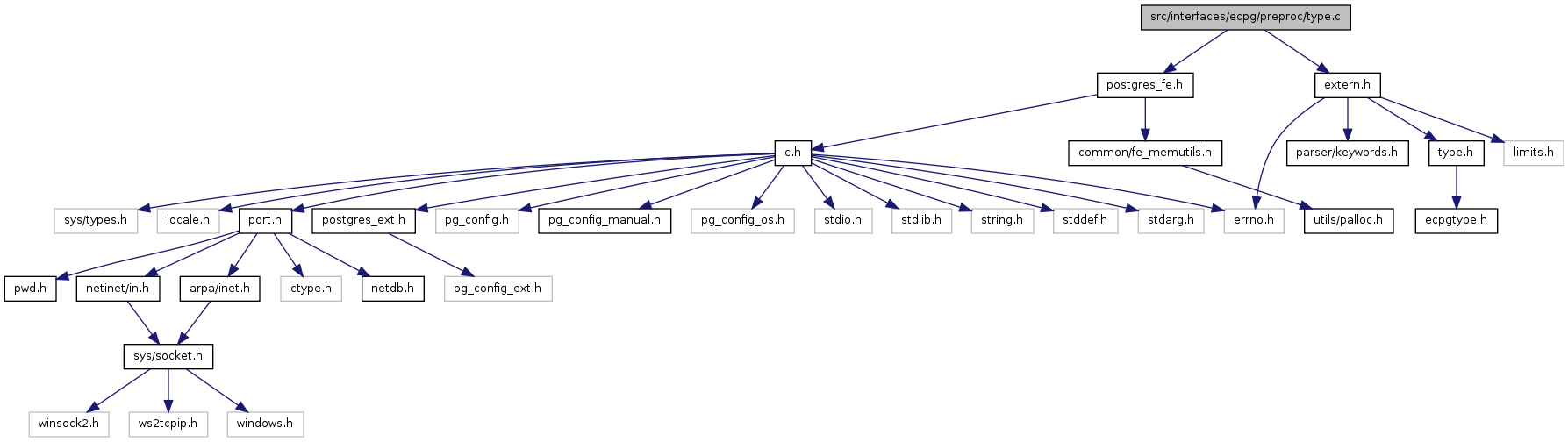
Go to the source code of this file.
Defines | |
| #define | indicator_set ind_type != NULL && ind_type->type != ECPGt_NO_INDICATOR |
Functions | |
| void * | mm_alloc (size_t size) |
| char * | mm_strdup (const char *string) |
| struct ECPGstruct_member * | ECPGstruct_member_dup (struct ECPGstruct_member *rm) |
| void | ECPGmake_struct_member (char *name, struct ECPGtype *type, struct ECPGstruct_member **start) |
| struct ECPGtype * | ECPGmake_simple_type (enum ECPGttype type, char *size, int counter) |
| struct ECPGtype * | ECPGmake_array_type (struct ECPGtype *type, char *size) |
| struct ECPGtype * | ECPGmake_struct_type (struct ECPGstruct_member *rm, enum ECPGttype type, char *type_name, char *struct_sizeof) |
| static const char * | get_type (enum ECPGttype type) |
| static void | ECPGdump_a_simple (FILE *o, const char *name, enum ECPGttype type, char *varcharsize, char *arrsiz, const char *siz, const char *prefix, int) |
| static void | ECPGdump_a_struct (FILE *o, const char *name, const char *ind_name, char *arrsiz, struct ECPGtype *type, struct ECPGtype *ind_type, const char *prefix, const char *ind_prefix) |
| void | ECPGdump_a_type (FILE *o, const char *name, struct ECPGtype *type, const int brace_level, const char *ind_name, struct ECPGtype *ind_type, const int ind_brace_level, const char *prefix, const char *ind_prefix, char *arr_str_siz, const char *struct_sizeof, const char *ind_struct_sizeof) |
| void | ECPGfree_struct_member (struct ECPGstruct_member *rm) |
| void | ECPGfree_type (struct ECPGtype *type) |
| const char * | get_dtype (enum ECPGdtype type) |
Variables | |
| static struct ECPGstruct_member | struct_no_indicator = {"no_indicator", &ecpg_no_indicator, NULL} |
| #define indicator_set ind_type != NULL && ind_type->type != ECPGt_NO_INDICATOR |
Definition at line 7 of file type.c.
Referenced by ECPGdump_a_type().
| static void ECPGdump_a_simple | ( | FILE * | o, | |
| const char * | name, | |||
| enum ECPGttype | type, | |||
| char * | varcharsize, | |||
| char * | arrsiz, | |||
| const char * | siz, | |||
| const char * | prefix, | |||
| int | counter | |||
| ) | [static] |
Definition at line 360 of file type.c.
References ecpg_type_name(), ECPGt_char, ECPGt_char_variable, ECPGt_const, ECPGt_date, ECPGt_descriptor, ECPGt_interval, ECPGt_NO_INDICATOR, ECPGt_numeric, ECPGt_sqlda, ECPGt_string, ECPGt_timestamp, ECPGt_unsigned_char, ECPGt_varchar, free, get_type(), mm_alloc(), NULL, and variable::offset.
Referenced by ECPGdump_a_type().
{
    if (type == ECPGt_NO_INDICATOR)
        fprintf(o, "\n\tECPGt_NO_INDICATOR, NULL , 0L, 0L, 0L, ");
    else if (type == ECPGt_descriptor)
        /* remember that name here already contains quotes (if needed) */
        fprintf(o, "\n\tECPGt_descriptor, %s, 0L, 0L, 0L, ", name);
    else if (type == ECPGt_sqlda)
        fprintf(o, "\n\tECPGt_sqlda, &%s, 0L, 0L, 0L, ", name);
    else
    {
        char       *variable = (char *) mm_alloc(strlen(name) + ((prefix == NULL) ? 0 : strlen(prefix)) + 4);
        char       *offset = (char *) mm_alloc(strlen(name) + strlen("sizeof(struct varchar_)") + 1 + strlen(varcharsize) + sizeof(int) * CHAR_BIT * 10 / 3);

        switch (type)
        {
                /*
                 * we have to use the & operator except for arrays and
                 * pointers
                 */

            case ECPGt_varchar:

                /*
                 * we have to use the pointer except for arrays with given
                 * bounds
                 */
                if (((atoi(arrsize) > 0) ||
                     (atoi(arrsize) == 0 && strcmp(arrsize, "0") != 0)) &&
                    siz == NULL)
                    sprintf(variable, "(%s%s)", prefix ? prefix : "", name);
                else
                    sprintf(variable, "&(%s%s)", prefix ? prefix : "", name);

                /*
                 * If we created a varchar structure atomatically, counter is
                 * greater than 0.
                 */
                if (counter)
                    sprintf(offset, "sizeof(struct varchar_%d)", counter);
                else
                    sprintf(offset, "sizeof(struct varchar)");
                break;
            case ECPGt_char:
            case ECPGt_unsigned_char:
            case ECPGt_char_variable:
            case ECPGt_string:

                /*
                 * we have to use the pointer except for arrays with given
                 * bounds, ecpglib will distinguish between * and []
                 */
                if ((atoi(varcharsize) > 1 ||
                     (atoi(arrsize) > 0) ||
                 (atoi(varcharsize) == 0 && strcmp(varcharsize, "0") != 0) ||
                     (atoi(arrsize) == 0 && strcmp(arrsize, "0") != 0))
                    && siz == NULL)
                    sprintf(variable, "(%s%s)", prefix ? prefix : "", name);
                else
                    sprintf(variable, "&(%s%s)", prefix ? prefix : "", name);

                sprintf(offset, "(%s)*sizeof(char)", strcmp(varcharsize, "0") == 0 ? "1" : varcharsize);
                break;
            case ECPGt_numeric:

                /*
                 * we have to use a pointer here
                 */
                sprintf(variable, "&(%s%s)", prefix ? prefix : "", name);
                sprintf(offset, "sizeof(numeric)");
                break;
            case ECPGt_interval:

                /*
                 * we have to use a pointer here
                 */
                sprintf(variable, "&(%s%s)", prefix ? prefix : "", name);
                sprintf(offset, "sizeof(interval)");
                break;
            case ECPGt_date:

                /*
                 * we have to use a pointer and translate the variable type
                 */
                sprintf(variable, "&(%s%s)", prefix ? prefix : "", name);
                sprintf(offset, "sizeof(date)");
                break;
            case ECPGt_timestamp:

                /*
                 * we have to use a pointer and translate the variable type
                 */
                sprintf(variable, "&(%s%s)", prefix ? prefix : "", name);
                sprintf(offset, "sizeof(timestamp)");
                break;
            case ECPGt_const:

                /*
                 * just dump the const as string
                 */
                sprintf(variable, "\"%s\"", name);
                sprintf(offset, "strlen(\"%s\")", name);
                break;
            default:

                /*
                 * we have to use the pointer except for arrays with given
                 * bounds
                 */
                if (((atoi(arrsize) > 0) ||
                     (atoi(arrsize) == 0 && strcmp(arrsize, "0") != 0)) &&
                    siz == NULL)
                    sprintf(variable, "(%s%s)", prefix ? prefix : "", name);
                else
                    sprintf(variable, "&(%s%s)", prefix ? prefix : "", name);

                sprintf(offset, "sizeof(%s)", ecpg_type_name(type));
                break;
        }

        if (atoi(arrsize) < 0)
            strcpy(arrsize, "1");

        if (siz == NULL || strlen(siz) == 0 || strcmp(arrsize, "0") == 0 || strcmp(arrsize, "1") == 0)
            fprintf(o, "\n\t%s,%s,(long)%s,(long)%s,%s, ", get_type(type), variable, varcharsize, arrsize, offset);
        else
            fprintf(o, "\n\t%s,%s,(long)%s,(long)%s,%s, ", get_type(type), variable, varcharsize, arrsize, siz);

        free(variable);
        free(offset);
    }
}
| static void ECPGdump_a_struct | ( | FILE * | o, | |
| const char * | name, | |||
| const char * | ind_name, | |||
| char * | arrsiz, | |||
| struct ECPGtype * | type, | |||
| struct ECPGtype * | ind_type, | |||
| const char * | prefix, | |||
| const char * | ind_prefix | |||
| ) | [static] |
Definition at line 501 of file type.c.
References ecpg_no_indicator, ECPGdump_a_type(), free, ECPGtype::members, mm_alloc(), ECPGstruct_member::name, ECPGstruct_member::next, NULL, ECPGtype::struct_sizeof, ECPGstruct_member::type, and ECPGtype::u.
Referenced by ECPGdump_a_type().
{
    /*
     * If offset is NULL, then this is the first recursive level. If not then
     * we are in a struct in a struct and the offset is used as offset.
     */
    struct ECPGstruct_member *p,
               *ind_p = NULL;
    char        *pbuf = (char *) mm_alloc(strlen(name) + ((prefix == NULL) ? 0 : strlen(prefix)) + 3);
    char        *ind_pbuf = (char *) mm_alloc(strlen(ind_name) + ((ind_prefix == NULL) ? 0 : strlen(ind_prefix)) + 3);

    if (atoi(arrsiz) == 1)
        sprintf(pbuf, "%s%s.", prefix ? prefix : "", name);
    else
        sprintf(pbuf, "%s%s->", prefix ? prefix : "", name);

    prefix = pbuf;

    if (ind_type == &ecpg_no_indicator)
        ind_p = &struct_no_indicator;
    else if (ind_type != NULL)
    {
        if (atoi(arrsiz) == 1)
            sprintf(ind_pbuf, "%s%s.", ind_prefix ? ind_prefix : "", ind_name);
        else
            sprintf(ind_pbuf, "%s%s->", ind_prefix ? ind_prefix : "", ind_name);

        ind_prefix = ind_pbuf;
        ind_p = ind_type->u.members;
    }

    for (p = type->u.members; p; p = p->next)
    {
        ECPGdump_a_type(o, p->name, p->type, -1,
                        (ind_p != NULL) ? ind_p->name : NULL,
                        (ind_p != NULL) ? ind_p->type : NULL,
                        -1,
                        prefix, ind_prefix, arrsiz, type->struct_sizeof,
                        (ind_p != NULL) ? ind_type->struct_sizeof : NULL);
        if (ind_p != NULL && ind_p != &struct_no_indicator)
            ind_p = ind_p->next;
    }

    free(pbuf);
    free(ind_pbuf);
}
| void ECPGdump_a_type | ( | FILE * | o, | |
| const char * | name, | |||
| struct ECPGtype * | type, | |||
| const int | brace_level, | |||
| const char * | ind_name, | |||
| struct ECPGtype * | ind_type, | |||
| const int | ind_brace_level, | |||
| const char * | prefix, | |||
| const char * | ind_prefix, | |||
| char * | arr_str_siz, | |||
| const char * | struct_sizeof, | |||
| const char * | ind_struct_sizeof | |||
| ) |
Definition at line 239 of file type.c.
References base_yyerror(), variable::brace_level, ECPGtype::counter, ECPGdump_a_simple(), ECPGdump_a_struct(), ECPGt_array, ECPGt_char_variable, ECPGt_const, ECPGt_descriptor, ECPGt_NO_INDICATOR, ECPGt_sqlda, ECPGt_struct, ECPGt_union, ECPGtype::element, ET_ERROR, ET_FATAL, ET_WARNING, find_variable(), free, INDICATOR_NOT_ARRAY, INDICATOR_NOT_SIMPLE, INDICATOR_NOT_STRUCT, indicator_set, IS_SIMPLE_TYPE, mm_strdup(), mmerror(), NULL, PARSE_ERROR, ECPGtype::size, variable::type, ECPGtype::type, ECPGtype::type_name, and ECPGtype::u.
Referenced by dump_variables(), ECPGdump_a_struct(), output_get_descr(), and output_set_descr().
{
    struct variable *var;

    if (type->type != ECPGt_descriptor && type->type != ECPGt_sqlda &&
        type->type != ECPGt_char_variable && type->type != ECPGt_const &&
        brace_level >= 0)
    {
        char       *str;

        str = mm_strdup(name);
        var = find_variable(str);
        free(str);

        if ((var->type->type != type->type) ||
            (var->type->type_name && !type->type_name) ||
            (!var->type->type_name && type->type_name) ||
            (var->type->type_name && type->type_name && strcmp(var->type->type_name, type->type_name) != 0))
            mmerror(PARSE_ERROR, ET_ERROR, "variable \"%s\" is hidden by a local variable of a different type", name);
        else if (var->brace_level != brace_level)
            mmerror(PARSE_ERROR, ET_WARNING, "variable \"%s\" is hidden by a local variable", name);

        if (ind_name && ind_type && ind_type->type != ECPGt_NO_INDICATOR && ind_brace_level >= 0)
        {
            str = mm_strdup(ind_name);
            var = find_variable(str);
            free(str);

            if ((var->type->type != ind_type->type) ||
                (var->type->type_name && !ind_type->type_name) ||
                (!var->type->type_name && ind_type->type_name) ||
                (var->type->type_name && ind_type->type_name && strcmp(var->type->type_name, ind_type->type_name) != 0))
                mmerror(PARSE_ERROR, ET_ERROR, "indicator variable \"%s\" is hidden by a local variable of a different type", ind_name);
            else if (var->brace_level != ind_brace_level)
                mmerror(PARSE_ERROR, ET_WARNING, "indicator variable \"%s\" is hidden by a local variable", ind_name);
        }
    }

    switch (type->type)
    {
        case ECPGt_array:
            if (indicator_set && ind_type->type != ECPGt_array)
                mmerror(INDICATOR_NOT_ARRAY, ET_FATAL, "indicator for array/pointer has to be array/pointer");
            switch (type->u.element->type)
            {
                case ECPGt_array:
                    mmerror(PARSE_ERROR, ET_ERROR, "nested arrays are not supported (except strings)"); /* array of array */
                    break;
                case ECPGt_struct:
                case ECPGt_union:
                    ECPGdump_a_struct(o, name,
                                      ind_name,
                                      type->size,
                                      type->u.element,
                                      (ind_type == NULL) ? NULL : ((ind_type->type == ECPGt_NO_INDICATOR) ? ind_type : ind_type->u.element),
                                      prefix, ind_prefix);
                    break;
                default:
                    if (!IS_SIMPLE_TYPE(type->u.element->type))
                        base_yyerror("internal error: unknown datatype, please report this to <[email protected]>");

                    ECPGdump_a_simple(o, name,
                                      type->u.element->type,
                                      type->u.element->size, type->size, NULL, prefix, type->u.element->counter);

                    if (ind_type != NULL)
                    {
                        if (ind_type->type == ECPGt_NO_INDICATOR)
                            ECPGdump_a_simple(o, ind_name, ind_type->type, ind_type->size, mm_strdup("-1"), NULL, ind_prefix, 0);
                        else
                        {
                            ECPGdump_a_simple(o, ind_name, ind_type->u.element->type,
                                              ind_type->u.element->size, ind_type->size, NULL, ind_prefix, 0);
                        }
                    }
            }
            break;
        case ECPGt_struct:
            if (indicator_set && ind_type->type != ECPGt_struct)
                mmerror(INDICATOR_NOT_STRUCT, ET_FATAL, "indicator for struct has to be a struct");

            ECPGdump_a_struct(o, name, ind_name, mm_strdup("1"), type, ind_type, prefix, ind_prefix);
            break;
        case ECPGt_union:       /* cannot dump a complete union */
            base_yyerror("type of union has to be specified");
            break;
        case ECPGt_char_variable:
            if (indicator_set && (ind_type->type == ECPGt_struct || ind_type->type == ECPGt_array))
                mmerror(INDICATOR_NOT_SIMPLE, ET_FATAL, "indicator for simple data type has to be simple");

            ECPGdump_a_simple(o, name, type->type, mm_strdup("1"), (arr_str_siz && strcmp(arr_str_siz, "0") != 0) ? arr_str_siz : mm_strdup("1"), struct_sizeof, prefix, 0);
            if (ind_type != NULL)
                ECPGdump_a_simple(o, ind_name, ind_type->type, ind_type->size, (arr_str_siz && strcmp(arr_str_siz, "0") != 0) ? arr_str_siz : mm_strdup("-1"), ind_struct_sizeof, ind_prefix, 0);
            break;
        case ECPGt_descriptor:
            if (indicator_set && (ind_type->type == ECPGt_struct || ind_type->type == ECPGt_array))
                mmerror(INDICATOR_NOT_SIMPLE, ET_FATAL, "indicator for simple data type has to be simple");

            ECPGdump_a_simple(o, name, type->type, NULL, mm_strdup("-1"), NULL, prefix, 0);
            if (ind_type != NULL)
                ECPGdump_a_simple(o, ind_name, ind_type->type, ind_type->size, mm_strdup("-1"), NULL, ind_prefix, 0);
            break;
        default:
            if (indicator_set && (ind_type->type == ECPGt_struct || ind_type->type == ECPGt_array))
                mmerror(INDICATOR_NOT_SIMPLE, ET_FATAL, "indicator for simple data type has to be simple");

            ECPGdump_a_simple(o, name, type->type, type->size, (arr_str_siz && strcmp(arr_str_siz, "0") != 0) ? arr_str_siz : mm_strdup("-1"), struct_sizeof, prefix, type->counter);
            if (ind_type != NULL)
                ECPGdump_a_simple(o, ind_name, ind_type->type, ind_type->size, (arr_str_siz && strcmp(arr_str_siz, "0") != 0) ? arr_str_siz : mm_strdup("-1"), ind_struct_sizeof, ind_prefix, 0);
            break;
    }
}
| void ECPGfree_struct_member | ( | struct ECPGstruct_member * | rm | ) |
Definition at line 549 of file type.c.
References free, ECPGstruct_member::name, ECPGstruct_member::next, and ECPGstruct_member::type.
Referenced by ECPGfree_type(), and main().
| void ECPGfree_type | ( | struct ECPGtype * | type | ) |
Definition at line 563 of file type.c.
References base_yyerror(), ECPGfree_struct_member(), ECPGt_array, ECPGt_struct, ECPGt_union, ECPGtype::element, ET_ERROR, free, IS_SIMPLE_TYPE, ECPGtype::members, mmerror(), PARSE_ERROR, ECPGtype::type, and ECPGtype::u.
Referenced by remove_variables().
{
    if (!IS_SIMPLE_TYPE(type->type))
    {
        switch (type->type)
        {
            case ECPGt_array:
                switch (type->u.element->type)
                {
                    case ECPGt_array:
                        base_yyerror("internal error: found multidimensional array\n");
                        break;
                    case ECPGt_struct:
                    case ECPGt_union:
                        /* Array of structs. */
                        ECPGfree_struct_member(type->u.element->u.members);
                        free(type->u.element);
                        break;
                    default:
                        if (!IS_SIMPLE_TYPE(type->u.element->type))
                            base_yyerror("internal error: unknown datatype, please report this to <[email protected]>");

                        free(type->u.element);
                }
                break;
            case ECPGt_struct:
            case ECPGt_union:
                ECPGfree_struct_member(type->u.members);
                break;
            default:
                mmerror(PARSE_ERROR, ET_ERROR, "unrecognized variable type code %d", type->type);
                break;
        }
    }
    free(type);
}
Definition at line 111 of file type.c.
References ECPGmake_simple_type(), ECPGt_array, ECPGtype::element, and ECPGtype::u.
Referenced by ECPGstruct_member_dup(), find_struct_member(), and find_variable().
{
    struct ECPGtype *ne = ECPGmake_simple_type(ECPGt_array, size, 0);

    ne->u.element = type;

    return ne;
}
Definition at line 96 of file type.c.
References ECPGtype::counter, ECPGtype::element, mm_alloc(), ECPGtype::size, ECPGtype::struct_sizeof, ECPGtype::type, ECPGtype::type_name, and ECPGtype::u.
Referenced by ECPGmake_array_type(), ECPGmake_struct_type(), ECPGstruct_member_dup(), find_struct_member(), and find_variable().
| void ECPGmake_struct_member | ( | char * | name, | |
| struct ECPGtype * | type, | |||
| struct ECPGstruct_member ** | start | |||
| ) |
Definition at line 77 of file type.c.
References mm_alloc(), mm_strdup(), ECPGstruct_member::name, ECPGstruct_member::next, and ECPGstruct_member::type.
Referenced by ECPGstruct_member_dup().
{
    struct ECPGstruct_member *ptr,
               *ne =
    (struct ECPGstruct_member *) mm_alloc(sizeof(struct ECPGstruct_member));

    ne->name = mm_strdup(name);
    ne->type = type;
    ne->next = NULL;

    for (ptr = *start; ptr && ptr->next; ptr = ptr->next);

    if (ptr)
        ptr->next = ne;
    else
        *start = ne;
}
| struct ECPGtype* ECPGmake_struct_type | ( | struct ECPGstruct_member * | rm, | |
| enum ECPGttype | type, | |||
| char * | type_name, | |||
| char * | struct_sizeof | |||
| ) | [read] |
Definition at line 121 of file type.c.
References ECPGmake_simple_type(), ECPGstruct_member_dup(), ECPGtype::members, mm_strdup(), ECPGtype::struct_sizeof, ECPGtype::type_name, and ECPGtype::u.
Referenced by ECPGstruct_member_dup(), find_struct_member(), and find_variable().
{
    struct ECPGtype *ne = ECPGmake_simple_type(type, mm_strdup("1"), 0);

    ne->type_name = mm_strdup(type_name);
    ne->u.members = ECPGstruct_member_dup(rm);
    ne->struct_sizeof = struct_sizeof;

    return ne;
}
| struct ECPGstruct_member* ECPGstruct_member_dup | ( | struct ECPGstruct_member * | rm | ) | [read] |
Definition at line 37 of file type.c.
References ECPGtype::counter, ECPGmake_array_type(), ECPGmake_simple_type(), ECPGmake_struct_member(), ECPGmake_struct_type(), ECPGt_array, ECPGt_struct, ECPGt_union, ECPGtype::element, ECPGtype::members, ECPGstruct_member::name, ECPGstruct_member::next, ECPGtype::size, ECPGtype::struct_sizeof, ECPGstruct_member::type, ECPGtype::type, ECPGtype::type_name, and ECPGtype::u.
Referenced by ECPGmake_struct_type().
{
    struct ECPGstruct_member *new = NULL;

    while (rm)
    {
        struct ECPGtype *type;

        switch (rm->type->type)
        {
            case ECPGt_struct:
            case ECPGt_union:
                type = ECPGmake_struct_type(rm->type->u.members, rm->type->type, rm->type->type_name, rm->type->struct_sizeof);
                break;
            case ECPGt_array:

                /*
                 * if this array does contain a struct again, we have to
                 * create the struct too
                 */
                if (rm->type->u.element->type == ECPGt_struct || rm->type->u.element->type == ECPGt_union)
                    type = ECPGmake_struct_type(rm->type->u.element->u.members, rm->type->u.element->type, rm->type->u.element->type_name, rm->type->u.element->struct_sizeof);
                else
                    type = ECPGmake_array_type(ECPGmake_simple_type(rm->type->u.element->type, rm->type->u.element->size, rm->type->u.element->counter), rm->type->size);
                break;
            default:
                type = ECPGmake_simple_type(rm->type->type, rm->type->size, rm->type->counter);
                break;
        }

        ECPGmake_struct_member(rm->name, type, &new);

        rm = rm->next;
    }

    return (new);
}
| const char* get_dtype | ( | enum ECPGdtype | type | ) |
Definition at line 601 of file type.c.
References ECPGd_cardinality, ECPGd_count, ECPGd_data, ECPGd_di_code, ECPGd_di_precision, ECPGd_indicator, ECPGd_key_member, ECPGd_length, ECPGd_name, ECPGd_nullable, ECPGd_octet, ECPGd_precision, ECPGd_ret_length, ECPGd_ret_octet, ECPGd_scale, ECPGd_type, ET_ERROR, mmerror(), and PARSE_ERROR.
Referenced by output_get_descr(), and output_set_descr().
{
    switch (type)
    {
        case ECPGd_count:
            return ("ECPGd_countr");
            break;
        case ECPGd_data:
            return ("ECPGd_data");
            break;
        case ECPGd_di_code:
            return ("ECPGd_di_code");
            break;
        case ECPGd_di_precision:
            return ("ECPGd_di_precision");
            break;
        case ECPGd_indicator:
            return ("ECPGd_indicator");
            break;
        case ECPGd_key_member:
            return ("ECPGd_key_member");
            break;
        case ECPGd_length:
            return ("ECPGd_length");
            break;
        case ECPGd_name:
            return ("ECPGd_name");
            break;
        case ECPGd_nullable:
            return ("ECPGd_nullable");
            break;
        case ECPGd_octet:
            return ("ECPGd_octet");
            break;
        case ECPGd_precision:
            return ("ECPGd_precision");
            break;
        case ECPGd_ret_length:
            return ("ECPGd_ret_length");
        case ECPGd_ret_octet:
            return ("ECPGd_ret_octet");
            break;
        case ECPGd_scale:
            return ("ECPGd_scale");
            break;
        case ECPGd_type:
            return ("ECPGd_type");
            break;
        case ECPGd_cardinality:
            return ("ECPGd_cardinality");
        default:
            mmerror(PARSE_ERROR, ET_ERROR, "unrecognized descriptor item code %d", type);
    }

    return NULL;
}
| static const char* get_type | ( | enum ECPGttype | type | ) | [static] |
Definition at line 133 of file type.c.
References ECPGt_bool, ECPGt_char, ECPGt_char_variable, ECPGt_const, ECPGt_date, ECPGt_decimal, ECPGt_descriptor, ECPGt_double, ECPGt_float, ECPGt_int, ECPGt_interval, ECPGt_long, ECPGt_long_long, ECPGt_NO_INDICATOR, ECPGt_numeric, ECPGt_short, ECPGt_sqlda, ECPGt_string, ECPGt_timestamp, ECPGt_unsigned_char, ECPGt_unsigned_int, ECPGt_unsigned_long, ECPGt_unsigned_long_long, ECPGt_unsigned_short, ECPGt_varchar, ET_ERROR, mmerror(), and PARSE_ERROR.
Referenced by ECPGdump_a_simple().
{
    switch (type)
    {
        case ECPGt_char:
            return ("ECPGt_char");
            break;
        case ECPGt_unsigned_char:
            return ("ECPGt_unsigned_char");
            break;
        case ECPGt_short:
            return ("ECPGt_short");
            break;
        case ECPGt_unsigned_short:
            return ("ECPGt_unsigned_short");
            break;
        case ECPGt_int:
            return ("ECPGt_int");
            break;
        case ECPGt_unsigned_int:
            return ("ECPGt_unsigned_int");
            break;
        case ECPGt_long:
            return ("ECPGt_long");
            break;
        case ECPGt_unsigned_long:
            return ("ECPGt_unsigned_long");
            break;
        case ECPGt_long_long:
            return ("ECPGt_long_long");
            break;
        case ECPGt_unsigned_long_long:
            return ("ECPGt_unsigned_long_long");
            break;
        case ECPGt_float:
            return ("ECPGt_float");
            break;
        case ECPGt_double:
            return ("ECPGt_double");
            break;
        case ECPGt_bool:
            return ("ECPGt_bool");
            break;
        case ECPGt_varchar:
            return ("ECPGt_varchar");
        case ECPGt_NO_INDICATOR:        /* no indicator */
            return ("ECPGt_NO_INDICATOR");
            break;
        case ECPGt_char_variable:       /* string that should not be quoted */
            return ("ECPGt_char_variable");
            break;
        case ECPGt_const:       /* constant string quoted */
            return ("ECPGt_const");
            break;
        case ECPGt_decimal:
            return ("ECPGt_decimal");
            break;
        case ECPGt_numeric:
            return ("ECPGt_numeric");
            break;
        case ECPGt_interval:
            return ("ECPGt_interval");
            break;
        case ECPGt_descriptor:
            return ("ECPGt_descriptor");
            break;
        case ECPGt_sqlda:
            return ("ECPGt_sqlda");
            break;
        case ECPGt_date:
            return ("ECPGt_date");
            break;
        case ECPGt_timestamp:
            return ("ECPGt_timestamp");
            break;
        case ECPGt_string:
            return ("ECPGt_string");
            break;
        default:
            mmerror(PARSE_ERROR, ET_ERROR, "unrecognized variable type code %d", type);
    }

    return NULL;
}
| void* mm_alloc | ( | size_t | size | ) |
| char* mm_strdup | ( | const char * | string | ) |
Definition at line 25 of file type.c.
References ET_FATAL, mmerror(), NULL, and OUT_OF_MEMORY.
Referenced by add_preprocessor_define(), adjust_array(), dump_variables(), ECPGdump_a_type(), ECPGmake_struct_member(), ECPGmake_struct_type(), new_variable(), output_get_descr(), output_set_descr(), and sqlda_variable().
{
    char       *new = strdup(string);

    if (new == NULL)
        mmerror(OUT_OF_MEMORY, ET_FATAL, "out of memory");

    return new;
}
struct ECPGstruct_member struct_no_indicator = {"no_indicator", &ecpg_no_indicator, NULL} [static] |
 1.7.1
1.7.1