 |
TrinityCore
|
|
TrinityCore
|
#include <PointHashGrid.h>
Classes | |
| class | CellObject |
Public Member Functions | |
| const CellObject & | operator* () const |
| const CellObject * | operator-> () const |
| operator CellObject * () const | |
| bool | operator!= (const CellIterator &other) const |
| bool | operator== (const CellIterator &other) const |
| CellIterator & | operator++ () |
| CellIterator | operator++ (int) |
| bool | hasMore () const |
| bool | isValid () const |
Private Member Functions | |
| Cell & | cell () |
| CellIterator () | |
| CellIterator (const ThisType *grid) | |
| CellIterator & | operator= (const CellIterator &) |
Private Attributes | |
| bool | m_isEnd |
| const ThisType * | m_grid |
| CellTable::Iterator | m_tableIterator |
| const int | m_epoch |
| CellObject | m_indirection |
Friends | |
| class | ThisType |
Dereference to access the bounds() and size() [element count] of the underlying cell object.
Example:
for(PointHashGrid<Vector3>::CellIterator iter = grid.beginCells(); iter != grid.endCells(); ++iter) {
entriesFound += iter->size();
}
|
inlineprivate |
End iterator. Note that the m_tableIterator is initialized to the end iterator of a temporary value! This is ok because we'll never look at the value of the m_tableIterator, since we're initializing the "end" Iterator.
|
inlineprivate |
 Here is the call graph for this function:
|
inlineprivate |
|
inline |
|
inline |
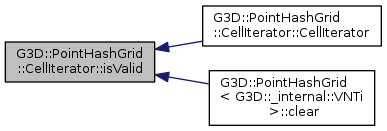
Here is the caller graph for this function:
|
inline |
|
inline |
|
inline |
|
inline |
Preincrement
|
inline |
|
inline |
|
private |
|
inline |
|
friend |
|
private |
|
private |
|
private |
Used to make the indirection work.
|
private |
|
private |
 1.8.8
1.8.8