


LDAP Data Interchange Format (LDIF) is a draft Internet standard for dumping the contents of an LDAP directory tree to a plain text file. Using a suitable LDIF utility, it is possible to export the contents of a directory tree or subtree to a file and then re-import the directory tree at a later time. Alternatively, you can use an LDIF file to recreate a directory tree in a different directory server instance.
To recreate the directory tree for the LDAP tutorial, perform the following steps in Apache Directory Studio:
Copy the contents of the LDIF from Example B.1 and paste into a text file,
activemq.ldif, in any convenient location.![[Important]](imagesdb/important.gif)
Important Make sure to include a blank line at the end of the file, otherwise Apache Directory Studio will throw an error as it tries to read the last record.
Ensure that the X.500 directory server is running.
Start up Apache Directory Studio and open a connection to the directory server.
In the LDAP Browser view, expand the
DITnode. Right-click on theRoot DSEnode and select |.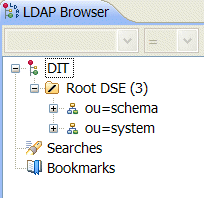
The LDIF Import dialog appears. In the
LDIF Filefield, enter the location of the LDIF file to import or use the Browse button. Click Finish.
Example B.1 gives the complete LDIF for recreating the directory tree of the LDAP tutorial.
Example B.1. LDIF for the LDAP Tutorial
## ---------------------------------------------------------------------------
## Licensed to the Apache Software Foundation (ASF) under one or more
## contributor license agreements.  See the NOTICE file distributed with
## this work for additional information regarding copyright ownership.
## The ASF licenses this file to You under the Apache License, Version 2.0
## (the "License"); you may not use this file except in compliance with
## the License.  You may obtain a copy of the License at
##
## http://www.apache.org/licenses/LICENSE-2.0
##
## Unless required by applicable law or agreed to in writing, software
## distributed under the License is distributed on an "AS IS" BASIS,
## WITHOUT WARRANTIES OR CONDITIONS OF ANY KIND, either express or implied.
## See the License for the specific language governing permissions and
## limitations under the License.
## ---------------------------------------------------------------------------


##########################
## Define basic objects ##
##########################

# Uncomment if adding to open ldap
#dn: ou=system
#objectclass: organizationalUnit
#objectclass: top
#ou: system

dn: ou=ActiveMQ,ou=system
objectClass: organizationalUnit
objectClass: top
ou: ActiveMQ

dn: ou=Services,ou=system
ou: Services
objectClass: organizationalUnit
objectClass: top

dn: cn=mqbroker,ou=Services,ou=system
cn: mqbroker
objectClass: organizationalRole
objectClass: top
objectClass: simpleSecurityObject
userPassword: {SSHA}YvMAkkd66cDecNoejo8jnw5uUUBziyl0
description: Bind user for MQ broker


###################
## Define groups ##
###################


dn: ou=Group,ou=ActiveMQ,ou=system
objectClass: organizationalUnit
objectClass: top
ou: Group

dn: cn=admins,ou=Group,ou=ActiveMQ,ou=system
cn: admins
member: uid=admin
objectClass: groupOfNames
objectClass: top

dn: cn=users,ou=Group,ou=ActiveMQ,ou=system
cn: users
member: uid=jdoe
objectClass: groupOfNames
objectClass: top


##################
## Define users ##
##################


dn: ou=User,ou=ActiveMQ,ou=system
objectClass: organizationalUnit
objectClass: top
ou: User

dn: uid=admin,ou=User,ou=ActiveMQ,ou=system
uid: admin
userPassword: {SSHA}YvMAkkd66cDecNoejo8jnw5uUUBziyl0
objectClass: account
objectClass: simpleSecurityObject
objectClass: top


dn: uid=jdoe,ou=User,ou=ActiveMQ,ou=system
uid: jdoe
userPassword: {SSHA}YvMAkkd66cDecNoejo8jnw5uUUBziyl0
objectclass: inetOrgPerson
objectclass: organizationalPerson
objectclass: person
objectclass: top
cn: Jane Doe
sn: Doe


#########################
## Define destinations ##
#########################

dn: ou=Destination,ou=ActiveMQ,ou=system
objectClass: organizationalUnit
objectClass: top
ou: Destination

dn: ou=Topic,ou=Destination,ou=ActiveMQ,ou=system
objectClass: organizationalUnit
objectClass: top
ou: Topic

dn: ou=Queue,ou=Destination,ou=ActiveMQ,ou=system
objectClass: organizationalUnit
objectClass: top
ou: Queue

## TEST.FOO

dn: cn=TEST.FOO,ou=Queue,ou=Destination,ou=ActiveMQ,ou=system
cn: TEST.FOO
description: A queue
objectClass: applicationProcess
objectClass: top

dn: cn=admin,cn=TEST.FOO,ou=Queue,ou=Destination,ou=ActiveMQ,ou=system
cn: admin
description: Admin privilege group, members are roles
member: cn=admins
member: cn=users
objectClass: groupOfNames
objectClass: top

dn: cn=read,cn=TEST.FOO,ou=Queue,ou=Destination,ou=ActiveMQ,ou=system
cn: read
member: cn=users
member: cn=admins
objectClass: groupOfNames
objectClass: top

dn: cn=write,cn=TEST.FOO,ou=Queue,ou=Destination,ou=ActiveMQ,ou=system
cn: write
objectClass: groupOfNames
objectClass: top
member: cn=users
member: cn=admins


#######################
## Define advisories ##
#######################

dn: cn=ActiveMQ.Advisory,ou=Topic,ou=Destination,ou=ActiveMQ,ou=system
cn: ActiveMQ.Advisory
objectClass: applicationProcess
objectClass: top
description: Advisory topics

dn: cn=read,cn=ActiveMQ.Advisory,ou=Topic,ou=Destination,ou=ActiveMQ,ou=system
cn: read
member: cn=admins
member: cn=users
objectClass: groupOfNames
objectClass: top

dn: cn=write,cn=ActiveMQ.Advisory,ou=Topic,ou=Destination,ou=ActiveMQ,ou=system
cn: write
member: cn=admins
member: cn=users
objectClass: groupOfNames
objectClass: top

dn: cn=admin,cn=ActiveMQ.Advisory,ou=Topic,ou=Destination,ou=ActiveMQ,ou=system
cn: admin
member: cn=admins
member: cn=users
objectClass: groupOfNames
objectClass: top

######################
## Define temporary ##
######################

dn: cn=ActiveMQ.Temp,ou=Topic,ou=Destination,ou=ActiveMQ,ou=system
cn: ActiveMQ.Temp
objectClass: applicationProcess
objectClass: top
description: Temporary destinations

dn: cn=read,cn=ActiveMQ.Temp,ou=Topic,ou=Destination,ou=ActiveMQ,ou=system
cn: read
member: cn=admins
member: cn=users
objectClass: groupOfNames
objectClass: top

dn: cn=write,cn=ActiveMQ.Temp,ou=Topic,ou=Destination,ou=ActiveMQ,ou=system
cn: write
member: cn=admins
member: cn=users
objectClass: groupOfNames
objectClass: top

dn: cn=admin,cn=ActiveMQ.Temp,ou=Topic,ou=Destination,ou=ActiveMQ,ou=system
cn: admin
member: cn=admins
member: cn=users
objectClass: groupOfNames
objectClass: top

## Important: Leave a blank line after the last record! |  |  |
 |

