MacWindow Class Reference#include <macWindow.h>
Inheritance diagram for MacWindow: 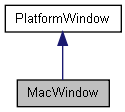
Constructor & Destructor Documentation
Member Function Documentation
Return a pointer to the GFX device this window is bound to. A GFX device may use many windows, but a window can only be used by a single GFX device. Implements PlatformWindow.
Return a pointer to this window's render target. By setting window targets from different windows, we can effect rendering to multiple windows from a single device. Implements PlatformWindow.
Get our current video mode - if the window has been resized, it will reflect this.
Implements PlatformWindow.
Get the ID that uniquely identifies this window in the context of its window manager.
Reimplemented from PlatformWindow.
If we're fullscreen, this function returns us to desktop mode. This will be either the last mode that we had that was not fullscreen, or the equivalent mode, windowed. Implements PlatformWindow.
Implements PlatformWindow. Lock the mouse to this window. When this is set, the mouse will always be returned to the center of the client area after every mouse event. The mouse will also be hidden while it is locked. The mouse cannot be moved out of the bounds of the window, but the window may lose focus (for instance by an alt-tab or other event). While the window lacks focus, no mouse events will be reported. Implements PlatformWindow.
Should the mouse be locked at the next opportunity ? This flag is set to the current state of the mouse lock on a window, to specify the preferred lock status of the mouse in a platform window. This is important for situations where a call is made to setMouseLocked, and the window is not in a state that it can be cleanly locked. Take for example if it was called while the window is in the background, then it is not appropriate to lock the window, but rather the window should query this state at it's next opportunity and lock the mouse if requested. Implements PlatformWindow. Set the Client Area Extent (Resolution) of this window. This does not include the area occupied by a title-bar, menu, borders or other non-client elements. Implements PlatformWindow.
Resize the window to have some new bounds. This includes the area needed for a title-bar, menu, borders, and other non-client elements. Implements PlatformWindow.
Set the position of this window. This means that saying setPosition at 0,0 will put the position of the window title-bar (if one exists) at 0,0 and the Client area will be offset from that point by the space needed for the Non-Client area. Implements PlatformWindow.
Reimplemented from PlatformWindow.
Get the platform specific object needed to create or attach an accelerated graohics drawing context on or to the window Win32 D3D and OpenGL typically needs an HWND Mac Cocoa OpenGL typically needs an NSOpenGLView Mac Carbon OpenGL typically needs a WindowRef.
Implements PlatformWindow.
Does the work of actually locking or unlocking the mouse, based on the value of shouldLockMouse(). Disassociates the cursor movement from the mouse input and hides the mouse when locking. Re-associates cursor movement with mouse input and shows the mouse when unlocking. Returns true if we locked or unlocked the mouse. Returns false if the mouse was already in the correct state.
Reimplemented from PlatformWindow.
Friends And Related Function Documentation
Member Data Documentation
|
||||||||||||||||||||||||||||||||||||||||||||||||||||||||||||||||||||||||||||||||||||||||||||||||||||||||||||||||||||||||||||||||||||||||||||||||||||||||||||||||||||||||||||||||||||||||||||||||||||||||||||||||||||||||||||||||||||||||||||||||||||||||||||||||||||||||||||||||||||||||||||||||||||||||||||||||||||||||||||||||||||||||||||||||||||||||||||||||||||||||||||||||||||||||||||||||||||||||||||||||||||||||||||||||||||||||||||||||||||||||