Header And Logo

|

#include "nodes/execnodes.h"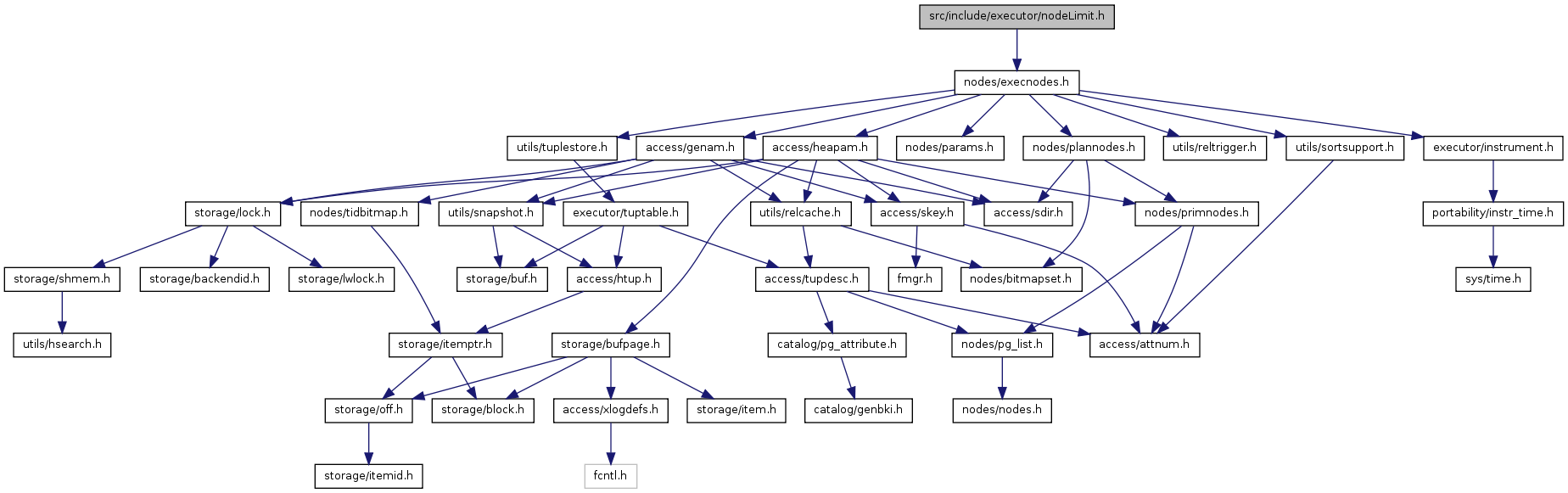

Go to the source code of this file.
Functions | |
| LimitState * | ExecInitLimit (Limit *node, EState *estate, int eflags) |
| TupleTableSlot * | ExecLimit (LimitState *node) |
| void | ExecEndLimit (LimitState *node) |
| void | ExecReScanLimit (LimitState *node) |
| void ExecEndLimit | ( | LimitState * | node | ) |
Definition at line 435 of file nodeLimit.c.
References ExecEndNode(), ExecFreeExprContext(), outerPlanState, and LimitState::ps.
Referenced by ExecEndNode().
{
    ExecFreeExprContext(&node->ps);
    ExecEndNode(outerPlanState(node));
}
| LimitState* ExecInitLimit | ( | Limit * | node, | |
| EState * | estate, | |||
| int | eflags | |||
| ) |
Definition at line 373 of file nodeLimit.c.
References Assert, EXEC_FLAG_MARK, ExecAssignExprContext(), ExecAssignResultTypeFromTL(), ExecInitExpr(), ExecInitNode(), ExecInitResultTupleSlot(), Limit::limitCount, Limit::limitOffset, LimitState::limitOffset, LimitState::lstate, makeNode, outerPlan, outerPlanState, PlanState::plan, LimitState::ps, PlanState::ps_ProjInfo, and PlanState::state.
Referenced by ExecInitNode().
{
    LimitState *limitstate;
    Plan       *outerPlan;

    /* check for unsupported flags */
    Assert(!(eflags & EXEC_FLAG_MARK));

    /*
     * create state structure
     */
    limitstate = makeNode(LimitState);
    limitstate->ps.plan = (Plan *) node;
    limitstate->ps.state = estate;

    limitstate->lstate = LIMIT_INITIAL;

    /*
     * Miscellaneous initialization
     *
     * Limit nodes never call ExecQual or ExecProject, but they need an
     * exprcontext anyway to evaluate the limit/offset parameters in.
     */
    ExecAssignExprContext(estate, &limitstate->ps);

    /*
     * initialize child expressions
     */
    limitstate->limitOffset = ExecInitExpr((Expr *) node->limitOffset,
                                           (PlanState *) limitstate);
    limitstate->limitCount = ExecInitExpr((Expr *) node->limitCount,
                                          (PlanState *) limitstate);

    /*
     * Tuple table initialization (XXX not actually used...)
     */
    ExecInitResultTupleSlot(estate, &limitstate->ps);

    /*
     * then initialize outer plan
     */
    outerPlan = outerPlan(node);
    outerPlanState(limitstate) = ExecInitNode(outerPlan, estate, eflags);

    /*
     * limit nodes do no projections, so initialize projection info for this
     * node appropriately
     */
    ExecAssignResultTypeFromTL(&limitstate->ps);
    limitstate->ps.ps_ProjInfo = NULL;

    return limitstate;
}
| TupleTableSlot* ExecLimit | ( | LimitState * | node | ) |
Definition at line 40 of file nodeLimit.c.
References Assert, LimitState::count, elog, ERROR, EState::es_direction, ExecProcNode(), LIMIT_EMPTY, LIMIT_INITIAL, LIMIT_INWINDOW, LIMIT_RESCAN, LIMIT_SUBPLANEOF, LIMIT_WINDOWEND, LIMIT_WINDOWSTART, LimitState::lstate, LimitState::noCount, LimitState::offset, outerPlanState, LimitState::position, LimitState::ps, recompute_limits(), ScanDirectionIsForward, PlanState::state, LimitState::subSlot, and TupIsNull.
Referenced by ExecProcNode().
{
    ScanDirection direction;
    TupleTableSlot *slot;
    PlanState  *outerPlan;

    /*
     * get information from the node
     */
    direction = node->ps.state->es_direction;
    outerPlan = outerPlanState(node);

    /*
     * The main logic is a simple state machine.
     */
    switch (node->lstate)
    {
        case LIMIT_INITIAL:

            /*
             * First call for this node, so compute limit/offset. (We can't do
             * this any earlier, because parameters from upper nodes will not
             * be set during ExecInitLimit.)  This also sets position = 0 and
             * changes the state to LIMIT_RESCAN.
             */
            recompute_limits(node);

            /* FALL THRU */

        case LIMIT_RESCAN:

            /*
             * If backwards scan, just return NULL without changing state.
             */
            if (!ScanDirectionIsForward(direction))
                return NULL;

            /*
             * Check for empty window; if so, treat like empty subplan.
             */
            if (node->count <= 0 && !node->noCount)
            {
                node->lstate = LIMIT_EMPTY;
                return NULL;
            }

            /*
             * Fetch rows from subplan until we reach position > offset.
             */
            for (;;)
            {
                slot = ExecProcNode(outerPlan);
                if (TupIsNull(slot))
                {
                    /*
                     * The subplan returns too few tuples for us to produce
                     * any output at all.
                     */
                    node->lstate = LIMIT_EMPTY;
                    return NULL;
                }
                node->subSlot = slot;
                if (++node->position > node->offset)
                    break;
            }

            /*
             * Okay, we have the first tuple of the window.
             */
            node->lstate = LIMIT_INWINDOW;
            break;

        case LIMIT_EMPTY:

            /*
             * The subplan is known to return no tuples (or not more than
             * OFFSET tuples, in general).  So we return no tuples.
             */
            return NULL;

        case LIMIT_INWINDOW:
            if (ScanDirectionIsForward(direction))
            {
                /*
                 * Forwards scan, so check for stepping off end of window. If
                 * we are at the end of the window, return NULL without
                 * advancing the subplan or the position variable; but change
                 * the state machine state to record having done so.
                 */
                if (!node->noCount &&
                    node->position - node->offset >= node->count)
                {
                    node->lstate = LIMIT_WINDOWEND;
                    return NULL;
                }

                /*
                 * Get next tuple from subplan, if any.
                 */
                slot = ExecProcNode(outerPlan);
                if (TupIsNull(slot))
                {
                    node->lstate = LIMIT_SUBPLANEOF;
                    return NULL;
                }
                node->subSlot = slot;
                node->position++;
            }
            else
            {
                /*
                 * Backwards scan, so check for stepping off start of window.
                 * As above, change only state-machine status if so.
                 */
                if (node->position <= node->offset + 1)
                {
                    node->lstate = LIMIT_WINDOWSTART;
                    return NULL;
                }

                /*
                 * Get previous tuple from subplan; there should be one!
                 */
                slot = ExecProcNode(outerPlan);
                if (TupIsNull(slot))
                    elog(ERROR, "LIMIT subplan failed to run backwards");
                node->subSlot = slot;
                node->position--;
            }
            break;

        case LIMIT_SUBPLANEOF:
            if (ScanDirectionIsForward(direction))
                return NULL;

            /*
             * Backing up from subplan EOF, so re-fetch previous tuple; there
             * should be one!  Note previous tuple must be in window.
             */
            slot = ExecProcNode(outerPlan);
            if (TupIsNull(slot))
                elog(ERROR, "LIMIT subplan failed to run backwards");
            node->subSlot = slot;
            node->lstate = LIMIT_INWINDOW;
            /* position does not change 'cause we didn't advance it before */
            break;

        case LIMIT_WINDOWEND:
            if (ScanDirectionIsForward(direction))
                return NULL;

            /*
             * Backing up from window end: simply re-return the last tuple
             * fetched from the subplan.
             */
            slot = node->subSlot;
            node->lstate = LIMIT_INWINDOW;
            /* position does not change 'cause we didn't advance it before */
            break;

        case LIMIT_WINDOWSTART:
            if (!ScanDirectionIsForward(direction))
                return NULL;

            /*
             * Advancing after having backed off window start: simply
             * re-return the last tuple fetched from the subplan.
             */
            slot = node->subSlot;
            node->lstate = LIMIT_INWINDOW;
            /* position does not change 'cause we didn't change it before */
            break;

        default:
            elog(ERROR, "impossible LIMIT state: %d",
                 (int) node->lstate);
            slot = NULL;        /* keep compiler quiet */
            break;
    }

    /* Return the current tuple */
    Assert(!TupIsNull(slot));

    return slot;
}
| void ExecReScanLimit | ( | LimitState * | node | ) |
Definition at line 443 of file nodeLimit.c.
References PlanState::chgParam, ExecReScan(), PlanState::lefttree, NULL, LimitState::ps, and recompute_limits().
Referenced by ExecReScan().
{
    /*
     * Recompute limit/offset in case parameters changed, and reset the state
     * machine.  We must do this before rescanning our child node, in case
     * it's a Sort that we are passing the parameters down to.
     */
    recompute_limits(node);

    /*
     * if chgParam of subnode is not null then plan will be re-scanned by
     * first ExecProcNode.
     */
    if (node->ps.lefttree->chgParam == NULL)
        ExecReScan(node->ps.lefttree);
}
 1.7.1
1.7.1