Header And Logo

|

#include "access/xlog.h"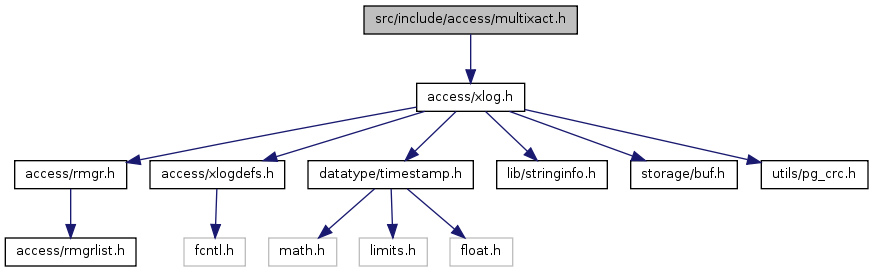

Go to the source code of this file.
| #define FirstMultiXactId ((MultiXactId) 1) |
Definition at line 23 of file multixact.h.
Referenced by do_start_worker(), ExtendMultiXactOffset(), GetMultiXactIdMembers(), GetNewMultiXactId(), GetOldestMultiXactId(), main(), MultiXactIdSetOldestMember(), MultiXactIdSetOldestVisible(), pg_get_multixact_members(), ReadNextMultiXactId(), relation_needs_vacanalyze(), SetMultiXactIdLimit(), and vacuum_set_xid_limits().
| #define InvalidMultiXactId ((MultiXactId) 0) |
Definition at line 22 of file multixact.h.
Referenced by CreateMultiXactId(), do_analyze_rel(), lazy_cleanup_index(), mXactCacheGetBySet(), reindex_index(), ResetSequence(), and swap_relation_files().
| #define MaxMultiXactId ((MultiXactId) 0xFFFFFFFF) |
Definition at line 24 of file multixact.h.
Referenced by SetMultiXactIdLimit().
| #define MaxMultiXactStatus MultiXactStatusUpdate |
Definition at line 49 of file multixact.h.
| #define MultiXactIdIsValid | ( | multi | ) | ((multi) != InvalidMultiXactId) |
Definition at line 26 of file multixact.h.
Referenced by AtPrepare_MultiXact(), CreateMultiXactId(), GetMultiXactIdMembers(), GetNewMultiXactId(), GetOldestMultiXactId(), heap_freeze_tuple(), MultiXactIdExpand(), MultiXactIdSetOldestMember(), MultiXactIdSetOldestVisible(), PostPrepare_MultiXact(), RelationSetNewRelfilenode(), SetMultiXactIdLimit(), swap_relation_files(), vac_truncate_clog(), vac_update_datfrozenxid(), and vac_update_relstats().
| #define NUM_MXACTMEMBER_BUFFERS 16 |
Definition at line 30 of file multixact.h.
Referenced by MultiXactShmemInit(), and MultiXactShmemSize().
| #define NUM_MXACTOFFSET_BUFFERS 8 |
Definition at line 29 of file multixact.h.
Referenced by MultiXactShmemInit(), MultiXactShmemSize(), and NumLWLocks().
| #define SizeOfMultiXactCreate (offsetof(xl_multixact_create, members)) |
Definition at line 76 of file multixact.h.
| #define XLOG_MULTIXACT_CREATE_ID 0x20 |
Definition at line 66 of file multixact.h.
Referenced by CreateMultiXactId(), multixact_desc(), and multixact_redo().
| #define XLOG_MULTIXACT_ZERO_MEM_PAGE 0x10 |
Definition at line 65 of file multixact.h.
Referenced by multixact_desc(), multixact_redo(), and ZeroMultiXactMemberPage().
| #define XLOG_MULTIXACT_ZERO_OFF_PAGE 0x00 |
Definition at line 64 of file multixact.h.
Referenced by multixact_desc(), multixact_redo(), and ZeroMultiXactOffsetPage().
| typedef struct MultiXactMember MultiXactMember |
| typedef struct xl_multixact_create xl_multixact_create |
| enum MultiXactStatus |
| MultiXactStatusForKeyShare | |
| MultiXactStatusForShare | |
| MultiXactStatusForNoKeyUpdate | |
| MultiXactStatusForUpdate | |
| MultiXactStatusNoKeyUpdate | |
| MultiXactStatusUpdate |
Definition at line 37 of file multixact.h.
{
    MultiXactStatusForKeyShare = 0x00,
    MultiXactStatusForShare = 0x01,
    MultiXactStatusForNoKeyUpdate = 0x02,
    MultiXactStatusForUpdate = 0x03,
    /* an update that doesn't touch "key" columns */
    MultiXactStatusNoKeyUpdate = 0x04,
    /* other updates, and delete */
    MultiXactStatusUpdate = 0x05
} MultiXactStatus;
| void AtEOXact_MultiXact | ( | void | ) |
Definition at line 1455 of file multixact.c.
References MyBackendId, OldestMemberMXactId, and OldestVisibleMXactId.
Referenced by AbortTransaction(), and CommitTransaction().
{
    /*
     * Reset our OldestMemberMXactId and OldestVisibleMXactId values, both of
     * which should only be valid while within a transaction.
     *
     * We assume that storing a MultiXactId is atomic and so we need not take
     * MultiXactGenLock to do this.
     */
    OldestMemberMXactId[MyBackendId] = InvalidMultiXactId;
    OldestVisibleMXactId[MyBackendId] = InvalidMultiXactId;

    /*
     * Discard the local MultiXactId cache.  Since MXactContext was created as
     * a child of TopTransactionContext, we needn't delete it explicitly.
     */
    MXactContext = NULL;
    MXactCache = NULL;
}
| void AtPrepare_MultiXact | ( | void | ) |
Definition at line 1483 of file multixact.c.
References MultiXactIdIsValid, MyBackendId, OldestMemberMXactId, RegisterTwoPhaseRecord(), and TWOPHASE_RM_MULTIXACT_ID.
Referenced by PrepareTransaction().
{
    MultiXactId myOldestMember = OldestMemberMXactId[MyBackendId];

    if (MultiXactIdIsValid(myOldestMember))
        RegisterTwoPhaseRecord(TWOPHASE_RM_MULTIXACT_ID, 0,
                               &myOldestMember, sizeof(MultiXactId));
}
| void BootStrapMultiXact | ( | void | ) |
Definition at line 1654 of file multixact.c.
References Assert, LW_EXCLUSIVE, LWLockAcquire(), LWLockRelease(), MultiXactMemberControlLock, MultiXactMemberCtl, MultiXactOffsetControlLock, MultiXactOffsetCtl, SimpleLruWritePage(), ZeroMultiXactMemberPage(), and ZeroMultiXactOffsetPage().
Referenced by BootStrapXLOG().
{
    int         slotno;

    LWLockAcquire(MultiXactOffsetControlLock, LW_EXCLUSIVE);

    /* Create and zero the first page of the offsets log */
    slotno = ZeroMultiXactOffsetPage(0, false);

    /* Make sure it's written out */
    SimpleLruWritePage(MultiXactOffsetCtl, slotno);
    Assert(!MultiXactOffsetCtl->shared->page_dirty[slotno]);

    LWLockRelease(MultiXactOffsetControlLock);

    LWLockAcquire(MultiXactMemberControlLock, LW_EXCLUSIVE);

    /* Create and zero the first page of the members log */
    slotno = ZeroMultiXactMemberPage(0, false);

    /* Make sure it's written out */
    SimpleLruWritePage(MultiXactMemberCtl, slotno);
    Assert(!MultiXactMemberCtl->shared->page_dirty[slotno]);

    LWLockRelease(MultiXactMemberControlLock);
}
| void CheckPointMultiXact | ( | void | ) |
Definition at line 1847 of file multixact.c.
References MultiXactMemberCtl, MultiXactOffsetCtl, and SimpleLruFlush().
Referenced by CheckPointGuts().
{
    TRACE_POSTGRESQL_MULTIXACT_CHECKPOINT_START(true);

    /* Flush dirty MultiXact pages to disk */
    SimpleLruFlush(MultiXactOffsetCtl, true);
    SimpleLruFlush(MultiXactMemberCtl, true);

    TRACE_POSTGRESQL_MULTIXACT_CHECKPOINT_DONE(true);
}
| int GetMultiXactIdMembers | ( | MultiXactId | multi, | |
| MultiXactMember ** | xids, | |||
| bool | allow_old | |||
| ) |
Definition at line 1030 of file multixact.c.
References Assert, DEBUG1, DEBUG2, debug_elog3, ereport, errcode(), errmsg(), ERROR, FirstMultiXactId, i, LW_EXCLUSIVE, LW_SHARED, LWLockAcquire(), LWLockRelease(), MultiXactGenLock, MultiXactIdIsValid, MultiXactIdPrecedes(), MultiXactIdSetOldestVisible(), MultiXactIdToOffsetEntry, MultiXactIdToOffsetPage, MultiXactMemberControlLock, MultiXactMemberCtl, MultiXactOffsetControlLock, MultiXactOffsetCtl, MXACT_MEMBER_XACT_BITMASK, mXactCacheGetById(), mXactCachePut(), mxid_to_string(), MXOffsetToFlagsBitShift, MXOffsetToFlagsOffset, MXOffsetToMemberOffset, MXOffsetToMemberPage, MultiXactStateData::nextMXact, MultiXactStateData::nextOffset, MultiXactStateData::oldestMultiXactId, palloc(), pg_usleep(), SimpleLruReadPage(), MultiXactMember::status, TransactionIdIsValid, and MultiXactMember::xid.
Referenced by Do_MultiXactIdWait(), GetMultiXactIdHintBits(), heap_lock_tuple(), MultiXactIdExpand(), MultiXactIdGetUpdateXid(), MultiXactIdIsRunning(), pg_get_multixact_members(), and pgrowlocks().
{
    int         pageno;
    int         prev_pageno;
    int         entryno;
    int         slotno;
    MultiXactOffset *offptr;
    MultiXactOffset offset;
    int         length;
    int         truelength;
    int         i;
    MultiXactId oldestMXact;
    MultiXactId nextMXact;
    MultiXactId tmpMXact;
    MultiXactOffset nextOffset;
    MultiXactMember *ptr;

    debug_elog3(DEBUG2, "GetMembers: asked for %u", multi);

    Assert(MultiXactIdIsValid(multi));

    /* See if the MultiXactId is in the local cache */
    length = mXactCacheGetById(multi, members);
    if (length >= 0)
    {
        debug_elog3(DEBUG2, "GetMembers: found %s in the cache",
                    mxid_to_string(multi, length, *members));
        return length;
    }

    /* Set our OldestVisibleMXactId[] entry if we didn't already */
    MultiXactIdSetOldestVisible();

    /*
     * We check known limits on MultiXact before resorting to the SLRU area.
     *
     * An ID older than MultiXactState->oldestMultiXactId cannot possibly be
     * useful; it should have already been frozen by vacuum.  We've truncated
     * the on-disk structures anyway.  Returning the wrong values could lead to
     * an incorrect visibility result.  However, to support pg_upgrade we need
     * to allow an empty set to be returned regardless, if the caller is
     * willing to accept it; the caller is expected to check that it's an
     * allowed condition (such as ensuring that the infomask bits set on the
     * tuple are consistent with the pg_upgrade scenario).  If the caller is
     * expecting this to be called only on recently created multis, then we
     * raise an error.
     *
     * Conversely, an ID >= nextMXact shouldn't ever be seen here; if it is
     * seen, it implies undetected ID wraparound has occurred.  This raises
     * a hard error.
     *
     * Shared lock is enough here since we aren't modifying any global state.
     * Acquire it just long enough to grab the current counter values.  We may
     * need both nextMXact and nextOffset; see below.
     */
    LWLockAcquire(MultiXactGenLock, LW_SHARED);

    oldestMXact = MultiXactState->oldestMultiXactId;
    nextMXact = MultiXactState->nextMXact;
    nextOffset = MultiXactState->nextOffset;

    LWLockRelease(MultiXactGenLock);

    if (MultiXactIdPrecedes(multi, oldestMXact))
    {
        ereport(allow_old ? DEBUG1 : ERROR,
                (errcode(ERRCODE_INTERNAL_ERROR),
                 errmsg("MultiXactId %u does no longer exist -- apparent wraparound",
                        multi)));
        return -1;
    }

    if (!MultiXactIdPrecedes(multi, nextMXact))
        ereport(ERROR,
                (errcode(ERRCODE_INTERNAL_ERROR),
                 errmsg("MultiXactId %u has not been created yet -- apparent wraparound",
                        multi)));

    /*
     * Find out the offset at which we need to start reading MultiXactMembers
     * and the number of members in the multixact.  We determine the latter as
     * the difference between this multixact's starting offset and the next
     * one's.  However, there are some corner cases to worry about:
     *
     * 1. This multixact may be the latest one created, in which case there is
     * no next one to look at.  In this case the nextOffset value we just
     * saved is the correct endpoint.
     *
     * 2. The next multixact may still be in process of being filled in: that
     * is, another process may have done GetNewMultiXactId but not yet written
     * the offset entry for that ID.  In that scenario, it is guaranteed that
     * the offset entry for that multixact exists (because GetNewMultiXactId
     * won't release MultiXactGenLock until it does) but contains zero
     * (because we are careful to pre-zero offset pages). Because
     * GetNewMultiXactId will never return zero as the starting offset for a
     * multixact, when we read zero as the next multixact's offset, we know we
     * have this case.  We sleep for a bit and try again.
     *
     * 3. Because GetNewMultiXactId increments offset zero to offset one to
     * handle case #2, there is an ambiguity near the point of offset
     * wraparound.  If we see next multixact's offset is one, is that our
     * multixact's actual endpoint, or did it end at zero with a subsequent
     * increment?  We handle this using the knowledge that if the zero'th
     * member slot wasn't filled, it'll contain zero, and zero isn't a valid
     * transaction ID so it can't be a multixact member.  Therefore, if we
     * read a zero from the members array, just ignore it.
     *
     * This is all pretty messy, but the mess occurs only in infrequent corner
     * cases, so it seems better than holding the MultiXactGenLock for a long
     * time on every multixact creation.
     */
retry:
    LWLockAcquire(MultiXactOffsetControlLock, LW_EXCLUSIVE);

    pageno = MultiXactIdToOffsetPage(multi);
    entryno = MultiXactIdToOffsetEntry(multi);

    slotno = SimpleLruReadPage(MultiXactOffsetCtl, pageno, true, multi);
    offptr = (MultiXactOffset *) MultiXactOffsetCtl->shared->page_buffer[slotno];
    offptr += entryno;
    offset = *offptr;

    Assert(offset != 0);

    /*
     * Use the same increment rule as GetNewMultiXactId(), that is, don't
     * handle wraparound explicitly until needed.
     */
    tmpMXact = multi + 1;

    if (nextMXact == tmpMXact)
    {
        /* Corner case 1: there is no next multixact */
        length = nextOffset - offset;
    }
    else
    {
        MultiXactOffset nextMXOffset;

        /* handle wraparound if needed */
        if (tmpMXact < FirstMultiXactId)
            tmpMXact = FirstMultiXactId;

        prev_pageno = pageno;

        pageno = MultiXactIdToOffsetPage(tmpMXact);
        entryno = MultiXactIdToOffsetEntry(tmpMXact);

        if (pageno != prev_pageno)
            slotno = SimpleLruReadPage(MultiXactOffsetCtl, pageno, true, tmpMXact);

        offptr = (MultiXactOffset *) MultiXactOffsetCtl->shared->page_buffer[slotno];
        offptr += entryno;
        nextMXOffset = *offptr;

        if (nextMXOffset == 0)
        {
            /* Corner case 2: next multixact is still being filled in */
            LWLockRelease(MultiXactOffsetControlLock);
            pg_usleep(1000L);
            goto retry;
        }

        length = nextMXOffset - offset;
    }

    LWLockRelease(MultiXactOffsetControlLock);

    ptr = (MultiXactMember *) palloc(length * sizeof(MultiXactMember));
    *members = ptr;

    /* Now get the members themselves. */
    LWLockAcquire(MultiXactMemberControlLock, LW_EXCLUSIVE);

    truelength = 0;
    prev_pageno = -1;
    for (i = 0; i < length; i++, offset++)
    {
        TransactionId *xactptr;
        uint32     *flagsptr;
        int         flagsoff;
        int         bshift;
        int         memberoff;

        pageno = MXOffsetToMemberPage(offset);
        memberoff = MXOffsetToMemberOffset(offset);

        if (pageno != prev_pageno)
        {
            slotno = SimpleLruReadPage(MultiXactMemberCtl, pageno, true, multi);
            prev_pageno = pageno;
        }

        xactptr = (TransactionId *)
            (MultiXactMemberCtl->shared->page_buffer[slotno] + memberoff);

        if (!TransactionIdIsValid(*xactptr))
        {
            /* Corner case 3: we must be looking at unused slot zero */
            Assert(offset == 0);
            continue;
        }

        flagsoff = MXOffsetToFlagsOffset(offset);
        bshift = MXOffsetToFlagsBitShift(offset);
        flagsptr = (uint32 *) (MultiXactMemberCtl->shared->page_buffer[slotno] + flagsoff);

        ptr[truelength].xid = *xactptr;
        ptr[truelength].status = (*flagsptr >> bshift) & MXACT_MEMBER_XACT_BITMASK;
        truelength++;
    }

    LWLockRelease(MultiXactMemberControlLock);

    /*
     * Copy the result into the local cache.
     */
    mXactCachePut(multi, truelength, ptr);

    debug_elog3(DEBUG2, "GetMembers: no cache for %s",
                mxid_to_string(multi, truelength, ptr));
    return truelength;
}
| MultiXactId GetOldestMultiXactId | ( | void | ) |
Definition at line 2128 of file multixact.c.
References FirstMultiXactId, i, LW_SHARED, LWLockAcquire(), LWLockRelease(), MultiXactGenLock, MultiXactIdIsValid, MultiXactIdPrecedes(), MultiXactStateData::nextMXact, OldestMemberMXactId, and OldestVisibleMXactId.
Referenced by AddNewRelationTuple(), ExecuteTruncate(), vac_update_datfrozenxid(), and vacuum_set_xid_limits().
{
    MultiXactId     oldestMXact;
    MultiXactId     nextMXact;
    int             i;

    /*
     * This is the oldest valid value among all the OldestMemberMXactId[] and
     * OldestVisibleMXactId[] entries, or nextMXact if none are valid.
     */
    LWLockAcquire(MultiXactGenLock, LW_SHARED);

    /*
     * We have to beware of the possibility that nextMXact is in the
     * wrapped-around state.  We don't fix the counter itself here, but we
     * must be sure to use a valid value in our calculation.
     */
    nextMXact = MultiXactState->nextMXact;
    if (nextMXact < FirstMultiXactId)
        nextMXact = FirstMultiXactId;

    oldestMXact = nextMXact;
    for (i = 1; i <= MaxOldestSlot; i++)
    {
        MultiXactId thisoldest;

        thisoldest = OldestMemberMXactId[i];
        if (MultiXactIdIsValid(thisoldest) &&
            MultiXactIdPrecedes(thisoldest, oldestMXact))
            oldestMXact = thisoldest;
        thisoldest = OldestVisibleMXactId[i];
        if (MultiXactIdIsValid(thisoldest) &&
            MultiXactIdPrecedes(thisoldest, oldestMXact))
            oldestMXact = thisoldest;
    }

    LWLockRelease(MultiXactGenLock);

    return oldestMXact;
}
| void multixact_desc | ( | StringInfo | buf, | |
| uint8 | xl_info, | |||
| char * | rec | |||
| ) |
Definition at line 50 of file mxactdesc.c.
References appendStringInfo(), i, xl_multixact_create::members, xl_multixact_create::mid, xl_multixact_create::moff, xl_multixact_create::nmembers, out_member(), XLOG_MULTIXACT_CREATE_ID, XLOG_MULTIXACT_ZERO_MEM_PAGE, and XLOG_MULTIXACT_ZERO_OFF_PAGE.
{
    uint8       info = xl_info & ~XLR_INFO_MASK;

    if (info == XLOG_MULTIXACT_ZERO_OFF_PAGE)
    {
        int         pageno;

        memcpy(&pageno, rec, sizeof(int));
        appendStringInfo(buf, "zero offsets page: %d", pageno);
    }
    else if (info == XLOG_MULTIXACT_ZERO_MEM_PAGE)
    {
        int         pageno;

        memcpy(&pageno, rec, sizeof(int));
        appendStringInfo(buf, "zero members page: %d", pageno);
    }
    else if (info == XLOG_MULTIXACT_CREATE_ID)
    {
        xl_multixact_create *xlrec = (xl_multixact_create *) rec;
        int         i;

        appendStringInfo(buf, "create mxid %u offset %u nmembers %d: ", xlrec->mid,
                         xlrec->moff, xlrec->nmembers);
        for (i = 0; i < xlrec->nmembers; i++)
            out_member(buf, &xlrec->members[i]);
    }
    else
        appendStringInfo(buf, "UNKNOWN");
}
| void multixact_redo | ( | XLogRecPtr | lsn, | |
| XLogRecord * | record | |||
| ) |
Definition at line 2343 of file multixact.c.
References Assert, elog, i, LW_EXCLUSIVE, LWLockAcquire(), LWLockRelease(), xl_multixact_create::members, xl_multixact_create::mid, xl_multixact_create::moff, MultiXactAdvanceNextMXact(), MultiXactMemberControlLock, MultiXactMemberCtl, MultiXactOffsetControlLock, MultiXactOffsetCtl, VariableCacheData::nextXid, xl_multixact_create::nmembers, PANIC, RecordNewMultiXact(), ShmemVariableCache, SimpleLruWritePage(), TransactionIdAdvance, TransactionIdFollowsOrEquals(), TransactionIdPrecedes(), MultiXactMember::xid, XidGenLock, XLogRecord::xl_info, XLogRecord::xl_xid, XLOG_MULTIXACT_CREATE_ID, XLOG_MULTIXACT_ZERO_MEM_PAGE, XLOG_MULTIXACT_ZERO_OFF_PAGE, XLogRecGetData, XLR_BKP_BLOCK_MASK, ZeroMultiXactMemberPage(), and ZeroMultiXactOffsetPage().
{
    uint8       info = record->xl_info & ~XLR_INFO_MASK;

    /* Backup blocks are not used in multixact records */
    Assert(!(record->xl_info & XLR_BKP_BLOCK_MASK));

    if (info == XLOG_MULTIXACT_ZERO_OFF_PAGE)
    {
        int         pageno;
        int         slotno;

        memcpy(&pageno, XLogRecGetData(record), sizeof(int));

        LWLockAcquire(MultiXactOffsetControlLock, LW_EXCLUSIVE);

        slotno = ZeroMultiXactOffsetPage(pageno, false);
        SimpleLruWritePage(MultiXactOffsetCtl, slotno);
        Assert(!MultiXactOffsetCtl->shared->page_dirty[slotno]);

        LWLockRelease(MultiXactOffsetControlLock);
    }
    else if (info == XLOG_MULTIXACT_ZERO_MEM_PAGE)
    {
        int         pageno;
        int         slotno;

        memcpy(&pageno, XLogRecGetData(record), sizeof(int));

        LWLockAcquire(MultiXactMemberControlLock, LW_EXCLUSIVE);

        slotno = ZeroMultiXactMemberPage(pageno, false);
        SimpleLruWritePage(MultiXactMemberCtl, slotno);
        Assert(!MultiXactMemberCtl->shared->page_dirty[slotno]);

        LWLockRelease(MultiXactMemberControlLock);
    }
    else if (info == XLOG_MULTIXACT_CREATE_ID)
    {
        xl_multixact_create *xlrec =
            (xl_multixact_create *) XLogRecGetData(record);
        TransactionId max_xid;
        int         i;

        /* Store the data back into the SLRU files */
        RecordNewMultiXact(xlrec->mid, xlrec->moff, xlrec->nmembers,
                           xlrec->members);

        /* Make sure nextMXact/nextOffset are beyond what this record has */
        MultiXactAdvanceNextMXact(xlrec->mid + 1,
                                  xlrec->moff + xlrec->nmembers);

        /*
         * Make sure nextXid is beyond any XID mentioned in the record. This
         * should be unnecessary, since any XID found here ought to have other
         * evidence in the XLOG, but let's be safe.
         */
        max_xid = record->xl_xid;
        for (i = 0; i < xlrec->nmembers; i++)
        {
            if (TransactionIdPrecedes(max_xid, xlrec->members[i].xid))
                max_xid = xlrec->members[i].xid;
        }

        /*
         * We don't expect anyone else to modify nextXid, hence startup
         * process doesn't need to hold a lock while checking this. We still
         * acquire the lock to modify it, though.
         */
        if (TransactionIdFollowsOrEquals(max_xid,
                                         ShmemVariableCache->nextXid))
        {
            LWLockAcquire(XidGenLock, LW_EXCLUSIVE);
            ShmemVariableCache->nextXid = max_xid;
            TransactionIdAdvance(ShmemVariableCache->nextXid);
            LWLockRelease(XidGenLock);
        }
    }
    else
        elog(PANIC, "multixact_redo: unknown op code %u", info);
}
| void multixact_twophase_postabort | ( | TransactionId | xid, | |
| uint16 | info, | |||
| void * | recdata, | |||
| uint32 | len | |||
| ) |
Definition at line 1582 of file multixact.c.
References multixact_twophase_postcommit().
{
    multixact_twophase_postcommit(xid, info, recdata, len);
}
| void multixact_twophase_postcommit | ( | TransactionId | xid, | |
| uint16 | info, | |||
| void * | recdata, | |||
| uint32 | len | |||
| ) |
Definition at line 1567 of file multixact.c.
References Assert, OldestMemberMXactId, and TwoPhaseGetDummyBackendId().
Referenced by multixact_twophase_postabort().
{
    BackendId   dummyBackendId = TwoPhaseGetDummyBackendId(xid);

    Assert(len == sizeof(MultiXactId));

    OldestMemberMXactId[dummyBackendId] = InvalidMultiXactId;
}
| void multixact_twophase_recover | ( | TransactionId | xid, | |
| uint16 | info, | |||
| void * | recdata, | |||
| uint32 | len | |||
| ) |
Definition at line 1546 of file multixact.c.
References Assert, OldestMemberMXactId, and TwoPhaseGetDummyBackendId().
{
    BackendId   dummyBackendId = TwoPhaseGetDummyBackendId(xid);
    MultiXactId oldestMember;

    /*
     * Get the oldest member XID from the state file record, and set it in the
     * OldestMemberMXactId slot reserved for this prepared transaction.
     */
    Assert(len == sizeof(MultiXactId));
    oldestMember = *((MultiXactId *) recdata);

    OldestMemberMXactId[dummyBackendId] = oldestMember;
}
| void MultiXactAdvanceNextMXact | ( | MultiXactId | minMulti, | |
| MultiXactOffset | minMultiOffset | |||
| ) |
Definition at line 2008 of file multixact.c.
References DEBUG2, debug_elog3, LW_EXCLUSIVE, LWLockAcquire(), LWLockRelease(), MultiXactGenLock, MultiXactIdPrecedes(), MultiXactOffsetPrecedes(), MultiXactStateData::nextMXact, and MultiXactStateData::nextOffset.
Referenced by multixact_redo(), and xlog_redo().
{
    LWLockAcquire(MultiXactGenLock, LW_EXCLUSIVE);
    if (MultiXactIdPrecedes(MultiXactState->nextMXact, minMulti))
    {
        debug_elog3(DEBUG2, "MultiXact: setting next multi to %u", minMulti);
        MultiXactState->nextMXact = minMulti;
    }
    if (MultiXactOffsetPrecedes(MultiXactState->nextOffset, minMultiOffset))
    {
        debug_elog3(DEBUG2, "MultiXact: setting next offset to %u",
                    minMultiOffset);
        MultiXactState->nextOffset = minMultiOffset;
    }
    LWLockRelease(MultiXactGenLock);
}
| void MultiXactAdvanceOldest | ( | MultiXactId | oldestMulti, | |
| Oid | oldestMultiDB | |||
| ) |
Definition at line 2031 of file multixact.c.
References MultiXactIdPrecedes(), MultiXactStateData::oldestMultiXactId, and SetMultiXactIdLimit().
Referenced by vac_truncate_clog(), and xlog_redo().
{
    if (MultiXactIdPrecedes(MultiXactState->oldestMultiXactId, oldestMulti))
        SetMultiXactIdLimit(oldestMulti, oldestMultiDB);
}
| void MultiXactGetCheckptMulti | ( | bool | is_shutdown, | |
| MultiXactId * | nextMulti, | |||
| MultiXactOffset * | nextMultiOffset, | |||
| MultiXactId * | oldestMulti, | |||
| Oid * | oldestMultiDB | |||
| ) |
Definition at line 1825 of file multixact.c.
References DEBUG2, debug_elog6, LW_SHARED, LWLockAcquire(), LWLockRelease(), MultiXactGenLock, MultiXactStateData::nextMXact, MultiXactStateData::nextOffset, MultiXactStateData::oldestMultiXactDB, and MultiXactStateData::oldestMultiXactId.
Referenced by CreateCheckPoint().
{
    LWLockAcquire(MultiXactGenLock, LW_SHARED);
    *nextMulti = MultiXactState->nextMXact;
    *nextMultiOffset = MultiXactState->nextOffset;
    *oldestMulti = MultiXactState->oldestMultiXactId;
    *oldestMultiDB = MultiXactState->oldestMultiXactDB;
    LWLockRelease(MultiXactGenLock);

    debug_elog6(DEBUG2,
                "MultiXact: checkpoint is nextMulti %u, nextOffset %u, oldestMulti %u in DB %u",
                *nextMulti, *nextMultiOffset, *oldestMulti, *oldestMultiDB);
}
| MultiXactId MultiXactIdCreate | ( | TransactionId | xid1, | |
| MultiXactStatus | status1, | |||
| TransactionId | xid2, | |||
| MultiXactStatus | status2 | |||
| ) |
Definition at line 324 of file multixact.c.
References Assert, AssertArg, CreateMultiXactId(), DEBUG2, debug_elog3, mXactCacheEnt::members, mxid_to_string(), MultiXactMember::status, TransactionIdEquals, TransactionIdIsValid, and MultiXactMember::xid.
Referenced by compute_new_xmax_infomask().
{
    MultiXactId newMulti;
    MultiXactMember members[2];

    AssertArg(TransactionIdIsValid(xid1));
    AssertArg(TransactionIdIsValid(xid2));

    Assert(!TransactionIdEquals(xid1, xid2) || (status1 != status2));

    /*
     * Note: unlike MultiXactIdExpand, we don't bother to check that both XIDs
     * are still running.  In typical usage, xid2 will be our own XID and the
     * caller just did a check on xid1, so it'd be wasted effort.
     */

    members[0].xid = xid1;
    members[0].status = status1;
    members[1].xid = xid2;
    members[1].status = status2;

    newMulti = CreateMultiXactId(2, members);

    debug_elog3(DEBUG2, "Create: %s",
                mxid_to_string(newMulti, 2, members));

    return newMulti;
}
| MultiXactId MultiXactIdExpand | ( | MultiXactId | multi, | |
| TransactionId | xid, | |||
| MultiXactStatus | status | |||
| ) |
Definition at line 374 of file multixact.c.
References AssertArg, CreateMultiXactId(), DEBUG2, debug_elog3, debug_elog4, debug_elog5, GetMultiXactIdMembers(), i, mXactCacheEnt::members, MultiXactIdIsValid, mxstatus_to_string(), mXactCacheEnt::nmembers, palloc(), pfree(), MultiXactMember::status, TransactionIdDidCommit(), TransactionIdEquals, TransactionIdIsInProgress(), TransactionIdIsValid, and MultiXactMember::xid.
Referenced by compute_new_xmax_infomask().
{
    MultiXactId newMulti;
    MultiXactMember *members;
    MultiXactMember *newMembers;
    int         nmembers;
    int         i;
    int         j;

    AssertArg(MultiXactIdIsValid(multi));
    AssertArg(TransactionIdIsValid(xid));

    debug_elog5(DEBUG2, "Expand: received multi %u, xid %u status %s",
                multi, xid, mxstatus_to_string(status));

    /*
     * Note: we don't allow for old multis here.  The reason is that the
     * only caller of this function does a check that the multixact is
     * no longer running.
     */
    nmembers = GetMultiXactIdMembers(multi, &members, false);

    if (nmembers < 0)
    {
        MultiXactMember     member;

        /*
         * The MultiXactId is obsolete.  This can only happen if all the
         * MultiXactId members stop running between the caller checking and
         * passing it to us.  It would be better to return that fact to the
         * caller, but it would complicate the API and it's unlikely to happen
         * too often, so just deal with it by creating a singleton MultiXact.
         */
        member.xid = xid;
        member.status = status;
        newMulti = CreateMultiXactId(1, &member);

        debug_elog4(DEBUG2, "Expand: %u has no members, create singleton %u",
                    multi, newMulti);
        return newMulti;
    }

    /*
     * If the TransactionId is already a member of the MultiXactId with the
     * same status, just return the existing MultiXactId.
     */
    for (i = 0; i < nmembers; i++)
    {
        if (TransactionIdEquals(members[i].xid, xid) &&
            (members[i].status == status))
        {
            debug_elog4(DEBUG2, "Expand: %u is already a member of %u",
                        xid, multi);
            pfree(members);
            return multi;
        }
    }

    /*
     * Determine which of the members of the MultiXactId are still of interest.
     * This is any running transaction, and also any transaction that grabbed
     * something stronger than just a lock and was committed.  (An update that
     * aborted is of no interest here.)
     *
     * (Removing dead members is just an optimization, but a useful one.
     * Note we have the same race condition here as above: j could be 0 at the
     * end of the loop.)
     */
    newMembers = (MultiXactMember *)
        palloc(sizeof(MultiXactMember) * (nmembers + 1));

    for (i = 0, j = 0; i < nmembers; i++)
    {
        if (TransactionIdIsInProgress(members[i].xid) ||
            ((members[i].status > MultiXactStatusForUpdate) &&
             TransactionIdDidCommit(members[i].xid)))
        {
            newMembers[j].xid = members[i].xid;
            newMembers[j++].status = members[i].status;
        }
    }

    newMembers[j].xid = xid;
    newMembers[j++].status = status;
    newMulti = CreateMultiXactId(j, newMembers);

    pfree(members);
    pfree(newMembers);

    debug_elog3(DEBUG2, "Expand: returning new multi %u", newMulti);

    return newMulti;
}
| bool MultiXactIdIsRunning | ( | MultiXactId | multi | ) |
Definition at line 480 of file multixact.c.
References DEBUG2, debug_elog2, debug_elog3, debug_elog4, GetMultiXactIdMembers(), i, mXactCacheEnt::members, mXactCacheEnt::nmembers, pfree(), TransactionIdIsCurrentTransactionId(), and TransactionIdIsInProgress().
Referenced by compute_new_xmax_infomask(), HeapTupleSatisfiesUpdate(), and HeapTupleSatisfiesVacuum().
{
    MultiXactMember *members;
    int         nmembers;
    int         i;

    debug_elog3(DEBUG2, "IsRunning %u?", multi);

    /*
     * "false" here means we assume our callers have checked that the given
     * multi cannot possibly come from a pg_upgraded database.
     */
    nmembers = GetMultiXactIdMembers(multi, &members, false);

    if (nmembers < 0)
    {
        debug_elog2(DEBUG2, "IsRunning: no members");
        return false;
    }

    /*
     * Checking for myself is cheap compared to looking in shared memory;
     * return true if any live subtransaction of the current top-level
     * transaction is a member.
     *
     * This is not needed for correctness, it's just a fast path.
     */
    for (i = 0; i < nmembers; i++)
    {
        if (TransactionIdIsCurrentTransactionId(members[i].xid))
        {
            debug_elog3(DEBUG2, "IsRunning: I (%d) am running!", i);
            pfree(members);
            return true;
        }
    }

    /*
     * This could be made faster by having another entry point in procarray.c,
     * walking the PGPROC array only once for all the members.  But in most
     * cases nmembers should be small enough that it doesn't much matter.
     */
    for (i = 0; i < nmembers; i++)
    {
        if (TransactionIdIsInProgress(members[i].xid))
        {
            debug_elog4(DEBUG2, "IsRunning: member %d (%u) is running",
                        i, members[i].xid);
            pfree(members);
            return true;
        }
    }

    pfree(members);

    debug_elog3(DEBUG2, "IsRunning: %u is not running", multi);

    return false;
}
| bool MultiXactIdPrecedes | ( | MultiXactId | multi1, | |
| MultiXactId | multi2 | |||
| ) |
Definition at line 2305 of file multixact.c.
Referenced by do_start_worker(), GetMultiXactIdMembers(), GetNewMultiXactId(), GetOldestMultiXactId(), heap_freeze_tuple(), heap_tuple_needs_freeze(), MultiXactAdvanceNextMXact(), MultiXactAdvanceOldest(), MultiXactIdSetOldestVisible(), MultiXactOffsetPagePrecedes(), relation_needs_vacanalyze(), SetMultiXactIdLimit(), TruncateMultiXact(), vac_truncate_clog(), vac_update_datfrozenxid(), and vac_update_relstats().
{
    int32       diff = (int32) (multi1 - multi2);

    return (diff < 0);
}
| void MultiXactIdSetOldestMember | ( | void | ) |
Definition at line 554 of file multixact.c.
References DEBUG2, debug_elog4, FirstMultiXactId, LW_EXCLUSIVE, LWLockAcquire(), LWLockRelease(), MultiXactGenLock, MultiXactIdIsValid, MyBackendId, MultiXactStateData::nextMXact, and OldestMemberMXactId.
Referenced by heap_delete(), heap_lock_tuple(), heap_lock_updated_tuple(), and heap_update().
{
    if (!MultiXactIdIsValid(OldestMemberMXactId[MyBackendId]))
    {
        MultiXactId nextMXact;

        /*
         * You might think we don't need to acquire a lock here, since
         * fetching and storing of TransactionIds is probably atomic, but in
         * fact we do: suppose we pick up nextMXact and then lose the CPU for
         * a long time.  Someone else could advance nextMXact, and then
         * another someone else could compute an OldestVisibleMXactId that
         * would be after the value we are going to store when we get control
         * back.  Which would be wrong.
         */
        LWLockAcquire(MultiXactGenLock, LW_EXCLUSIVE);

        /*
         * We have to beware of the possibility that nextMXact is in the
         * wrapped-around state.  We don't fix the counter itself here, but we
         * must be sure to store a valid value in our array entry.
         */
        nextMXact = MultiXactState->nextMXact;
        if (nextMXact < FirstMultiXactId)
            nextMXact = FirstMultiXactId;

        OldestMemberMXactId[MyBackendId] = nextMXact;

        LWLockRelease(MultiXactGenLock);

        debug_elog4(DEBUG2, "MultiXact: setting OldestMember[%d] = %u",
                    MyBackendId, nextMXact);
    }
}
| void MultiXactSetNextMXact | ( | MultiXactId | nextMulti, | |
| MultiXactOffset | nextMultiOffset | |||
| ) |
Definition at line 1867 of file multixact.c.
References DEBUG2, debug_elog4, LW_EXCLUSIVE, LWLockAcquire(), LWLockRelease(), MultiXactGenLock, MultiXactStateData::nextMXact, and MultiXactStateData::nextOffset.
Referenced by BootStrapXLOG(), StartupXLOG(), and xlog_redo().
{
    debug_elog4(DEBUG2, "MultiXact: setting next multi to %u offset %u",
                nextMulti, nextMultiOffset);
    LWLockAcquire(MultiXactGenLock, LW_EXCLUSIVE);
    MultiXactState->nextMXact = nextMulti;
    MultiXactState->nextOffset = nextMultiOffset;
    LWLockRelease(MultiXactGenLock);
}
| void MultiXactShmemInit | ( | void | ) |
Definition at line 1610 of file multixact.c.
References Assert, DEBUG2, debug_elog2, IsUnderPostmaster, MemSet, MultiXactMemberControlLock, MultiXactMemberCtl, MultiXactOffsetControlLock, MultiXactOffsetCtl, NUM_MXACTMEMBER_BUFFERS, NUM_MXACTOFFSET_BUFFERS, OldestMemberMXactId, OldestVisibleMXactId, MultiXactStateData::perBackendXactIds, SHARED_MULTIXACT_STATE_SIZE, ShmemInitStruct(), and SimpleLruInit().
Referenced by CreateSharedMemoryAndSemaphores().
{
    bool        found;

    debug_elog2(DEBUG2, "Shared Memory Init for MultiXact");

    MultiXactOffsetCtl->PagePrecedes = MultiXactOffsetPagePrecedes;
    MultiXactMemberCtl->PagePrecedes = MultiXactMemberPagePrecedes;

    SimpleLruInit(MultiXactOffsetCtl,
                  "MultiXactOffset Ctl", NUM_MXACTOFFSET_BUFFERS, 0,
                  MultiXactOffsetControlLock, "pg_multixact/offsets");
    SimpleLruInit(MultiXactMemberCtl,
                  "MultiXactMember Ctl", NUM_MXACTMEMBER_BUFFERS, 0,
                  MultiXactMemberControlLock, "pg_multixact/members");

    /* Initialize our shared state struct */
    MultiXactState = ShmemInitStruct("Shared MultiXact State",
                                     SHARED_MULTIXACT_STATE_SIZE,
                                     &found);
    if (!IsUnderPostmaster)
    {
        Assert(!found);

        /* Make sure we zero out the per-backend state */
        MemSet(MultiXactState, 0, SHARED_MULTIXACT_STATE_SIZE);
    }
    else
        Assert(found);

    /*
     * Set up array pointers.  Note that perBackendXactIds[0] is wasted space
     * since we only use indexes 1..MaxOldestSlot in each array.
     */
    OldestMemberMXactId = MultiXactState->perBackendXactIds;
    OldestVisibleMXactId = OldestMemberMXactId + MaxOldestSlot;
}
| Size MultiXactShmemSize | ( | void | ) |
Definition at line 1594 of file multixact.c.
References add_size(), NUM_MXACTMEMBER_BUFFERS, NUM_MXACTOFFSET_BUFFERS, and SimpleLruShmemSize().
Referenced by CreateSharedMemoryAndSemaphores().
{
    Size        size;

#define SHARED_MULTIXACT_STATE_SIZE \
    add_size(sizeof(MultiXactStateData), \
             mul_size(sizeof(MultiXactId) * 2, MaxOldestSlot))

    size = SHARED_MULTIXACT_STATE_SIZE;
    size = add_size(size, SimpleLruShmemSize(NUM_MXACTOFFSET_BUFFERS, 0));
    size = add_size(size, SimpleLruShmemSize(NUM_MXACTMEMBER_BUFFERS, 0));

    return size;
}
| char* mxid_to_string | ( | MultiXactId | multi, | |
| int | nmembers, | |||
| MultiXactMember * | members | |||
| ) |
Definition at line 1424 of file multixact.c.
References appendStringInfo(), appendStringInfoChar(), buf, StringInfoData::data, i, initStringInfo(), MemoryContextStrdup(), mxstatus_to_string(), NULL, pfree(), status(), and TopMemoryContext.
Referenced by CreateMultiXactId(), GetMultiXactIdMembers(), MultiXactIdCreate(), mXactCacheGetById(), mXactCacheGetBySet(), and mXactCachePut().
{
    static char    *str = NULL;
    StringInfoData  buf;
    int         i;

    if (str != NULL)
        pfree(str);

    initStringInfo(&buf);

    appendStringInfo(&buf, "%u %d[%u (%s)", multi, nmembers, members[0].xid,
                     mxstatus_to_string(members[0].status));

    for (i = 1; i < nmembers; i++)
        appendStringInfo(&buf, ", %u (%s)", members[i].xid,
                         mxstatus_to_string(members[i].status));

    appendStringInfoChar(&buf, ']');
    str = MemoryContextStrdup(TopMemoryContext, buf.data);
    pfree(buf.data);
    return str;
}
| void PostPrepare_MultiXact | ( | TransactionId | xid | ) |
Definition at line 1497 of file multixact.c.
References LW_EXCLUSIVE, LWLockAcquire(), LWLockRelease(), MultiXactGenLock, MultiXactIdIsValid, MyBackendId, OldestMemberMXactId, OldestVisibleMXactId, and TwoPhaseGetDummyBackendId().
Referenced by PrepareTransaction().
{
    MultiXactId myOldestMember;

    /*
     * Transfer our OldestMemberMXactId value to the slot reserved for the
     * prepared transaction.
     */
    myOldestMember = OldestMemberMXactId[MyBackendId];
    if (MultiXactIdIsValid(myOldestMember))
    {
        BackendId   dummyBackendId = TwoPhaseGetDummyBackendId(xid);

        /*
         * Even though storing MultiXactId is atomic, acquire lock to make
         * sure others see both changes, not just the reset of the slot of the
         * current backend. Using a volatile pointer might suffice, but this
         * isn't a hot spot.
         */
        LWLockAcquire(MultiXactGenLock, LW_EXCLUSIVE);

        OldestMemberMXactId[dummyBackendId] = myOldestMember;
        OldestMemberMXactId[MyBackendId] = InvalidMultiXactId;

        LWLockRelease(MultiXactGenLock);
    }

    /*
     * We don't need to transfer OldestVisibleMXactId value, because the
     * transaction is not going to be looking at any more multixacts once it's
     * prepared.
     *
     * We assume that storing a MultiXactId is atomic and so we need not take
     * MultiXactGenLock to do this.
     */
    OldestVisibleMXactId[MyBackendId] = InvalidMultiXactId;

    /*
     * Discard the local MultiXactId cache like in AtEOX_MultiXact
     */
    MXactContext = NULL;
    MXactCache = NULL;
}
| MultiXactId ReadNextMultiXactId | ( | void | ) |
Definition at line 647 of file multixact.c.
References FirstMultiXactId, LW_SHARED, LWLockAcquire(), LWLockRelease(), MultiXactGenLock, and MultiXactStateData::nextMXact.
Referenced by ATRewriteTables(), AutoVacWorkerMain(), do_start_worker(), and ExecRefreshMatView().
{
    MultiXactId     mxid;

    /* XXX we could presumably do this without a lock. */
    LWLockAcquire(MultiXactGenLock, LW_SHARED);
    mxid = MultiXactState->nextMXact;
    LWLockRelease(MultiXactGenLock);

    if (mxid < FirstMultiXactId)
        mxid = FirstMultiXactId;

    return mxid;
}
| void SetMultiXactIdLimit | ( | MultiXactId | oldest_datminmxid, | |
| Oid | oldest_datoid | |||
| ) |
Definition at line 1884 of file multixact.c.
References Assert, DEBUG1, ereport, errhint(), errmsg(), FirstMultiXactId, get_database_name(), InRecovery, IsTransactionState(), IsUnderPostmaster, LW_EXCLUSIVE, LWLockAcquire(), LWLockRelease(), MaxMultiXactId, MultiXactStateData::multiStopLimit, MultiXactStateData::multiVacLimit, MultiXactStateData::multiWarnLimit, MultiXactStateData::multiWrapLimit, MultiXactGenLock, MultiXactIdIsValid, MultiXactIdPrecedes(), MultiXactStateData::nextMXact, MultiXactStateData::oldestMultiXactDB, MultiXactStateData::oldestMultiXactId, PMSIGNAL_START_AUTOVAC_LAUNCHER, SendPostmasterSignal(), and WARNING.
Referenced by BootStrapXLOG(), MultiXactAdvanceOldest(), StartupXLOG(), and xlog_redo().
{
    MultiXactId multiVacLimit;
    MultiXactId multiWarnLimit;
    MultiXactId multiStopLimit;
    MultiXactId multiWrapLimit;
    MultiXactId curMulti;

    Assert(MultiXactIdIsValid(oldest_datminmxid));

    /*
     * The place where we actually get into deep trouble is halfway around
     * from the oldest potentially-existing XID/multi.  (This calculation is
     * probably off by one or two counts for Xids, because the special XIDs
     * reduce the size of the loop a little bit.  But we throw in plenty of
     * slop below, so it doesn't matter.)
     */
    multiWrapLimit = oldest_datminmxid + (MaxMultiXactId >> 1);
    if (multiWrapLimit < FirstMultiXactId)
        multiWrapLimit += FirstMultiXactId;

    /*
     * We'll refuse to continue assigning MultiXactIds once we get within 100
     * multi of data loss.
     */
    multiStopLimit = multiWrapLimit - 100;
    if (multiStopLimit < FirstMultiXactId)
        multiStopLimit -= FirstMultiXactId;

    /*
     * We'll start complaining loudly when we get within 10M multis of the stop
     * point.   This is kind of arbitrary, but if you let your gas gauge get
     * down to 1% of full, would you be looking for the next gas station?  We
     * need to be fairly liberal about this number because there are lots of
     * scenarios where most transactions are done by automatic clients that
     * won't pay attention to warnings. (No, we're not gonna make this
     * configurable.  If you know enough to configure it, you know enough to
     * not get in this kind of trouble in the first place.)
     */
    multiWarnLimit = multiStopLimit - 10000000;
    if (multiWarnLimit < FirstMultiXactId)
        multiWarnLimit -= FirstMultiXactId;

    /*
     * We'll start trying to force autovacuums when oldest_datminmxid gets
     * to be more than 200 million transactions old.
     */
    multiVacLimit = oldest_datminmxid + 200000000;
    if (multiVacLimit < FirstMultiXactId)
        multiVacLimit += FirstMultiXactId;

    /* Grab lock for just long enough to set the new limit values */
    LWLockAcquire(MultiXactGenLock, LW_EXCLUSIVE);
    MultiXactState->oldestMultiXactId = oldest_datminmxid;
    MultiXactState->oldestMultiXactDB = oldest_datoid;
    MultiXactState->multiVacLimit = multiVacLimit;
    MultiXactState->multiWarnLimit = multiWarnLimit;
    MultiXactState->multiStopLimit = multiStopLimit;
    MultiXactState->multiWrapLimit = multiWrapLimit;
    curMulti = MultiXactState->nextMXact;
    LWLockRelease(MultiXactGenLock);

    /* Log the info */
    ereport(DEBUG1,
            (errmsg("MultiXactId wrap limit is %u, limited by database with OID %u",
                    multiWrapLimit, oldest_datoid)));

    /*
     * If past the autovacuum force point, immediately signal an autovac
     * request.  The reason for this is that autovac only processes one
     * database per invocation.  Once it's finished cleaning up the oldest
     * database, it'll call here, and we'll signal the postmaster to start
     * another iteration immediately if there are still any old databases.
     */
    if (MultiXactIdPrecedes(multiVacLimit, curMulti) &&
        IsUnderPostmaster && !InRecovery)
        SendPostmasterSignal(PMSIGNAL_START_AUTOVAC_LAUNCHER);

    /* Give an immediate warning if past the wrap warn point */
    if (MultiXactIdPrecedes(multiWarnLimit, curMulti) && !InRecovery)
    {
        char       *oldest_datname;

        /*
         * We can be called when not inside a transaction, for example during
         * StartupXLOG().  In such a case we cannot do database access, so we
         * must just report the oldest DB's OID.
         *
         * Note: it's also possible that get_database_name fails and returns
         * NULL, for example because the database just got dropped.  We'll
         * still warn, even though the warning might now be unnecessary.
         */
        if (IsTransactionState())
            oldest_datname = get_database_name(oldest_datoid);
        else
            oldest_datname = NULL;

        if (oldest_datname)
            ereport(WARNING,
                    (errmsg("database \"%s\" must be vacuumed before %u more MultiXactIds are used",
                            oldest_datname,
                            multiWrapLimit - curMulti),
                     errhint("To avoid a database shutdown, execute a database-wide VACUUM in that database.\n"
                             "You might also need to commit or roll back old prepared transactions.")));
        else
            ereport(WARNING,
                    (errmsg("database with OID %u must be vacuumed before %u more MultiXactIds are used",
                            oldest_datoid,
                            multiWrapLimit - curMulti),
                     errhint("To avoid a database shutdown, execute a database-wide VACUUM in that database.\n"
                             "You might also need to commit or roll back old prepared transactions.")));
    }
}
| void ShutdownMultiXact | ( | void | ) |
Definition at line 1812 of file multixact.c.
References MultiXactMemberCtl, MultiXactOffsetCtl, and SimpleLruFlush().
Referenced by ShutdownXLOG().
{
    /* Flush dirty MultiXact pages to disk */
    TRACE_POSTGRESQL_MULTIXACT_CHECKPOINT_START(false);
    SimpleLruFlush(MultiXactOffsetCtl, false);
    SimpleLruFlush(MultiXactMemberCtl, false);
    TRACE_POSTGRESQL_MULTIXACT_CHECKPOINT_DONE(false);
}
| void StartupMultiXact | ( | void | ) |
Definition at line 1731 of file multixact.c.
References LW_EXCLUSIVE, LWLockAcquire(), LWLockRelease(), MemSet, mXactCacheEnt::multi, MultiXactIdToOffsetEntry, MultiXactIdToOffsetPage, MultiXactMemberControlLock, MultiXactMemberCtl, MultiXactOffsetControlLock, MultiXactOffsetCtl, MXOffsetToFlagsOffset, MXOffsetToMemberOffset, MXOffsetToMemberPage, MultiXactStateData::nextMXact, MultiXactStateData::nextOffset, and SimpleLruReadPage().
Referenced by StartupXLOG().
{
    MultiXactId multi = MultiXactState->nextMXact;
    MultiXactOffset offset = MultiXactState->nextOffset;
    int         pageno;
    int         entryno;
    int         flagsoff;

    /* Clean up offsets state */
    LWLockAcquire(MultiXactOffsetControlLock, LW_EXCLUSIVE);

    /*
     * Initialize our idea of the latest page number.
     */
    pageno = MultiXactIdToOffsetPage(multi);
    MultiXactOffsetCtl->shared->latest_page_number = pageno;

    /*
     * Zero out the remainder of the current offsets page.  See notes in
     * StartupCLOG() for motivation.
     */
    entryno = MultiXactIdToOffsetEntry(multi);
    if (entryno != 0)
    {
        int         slotno;
        MultiXactOffset *offptr;

        slotno = SimpleLruReadPage(MultiXactOffsetCtl, pageno, true, multi);
        offptr = (MultiXactOffset *) MultiXactOffsetCtl->shared->page_buffer[slotno];
        offptr += entryno;

        MemSet(offptr, 0, BLCKSZ - (entryno * sizeof(MultiXactOffset)));

        MultiXactOffsetCtl->shared->page_dirty[slotno] = true;
    }

    LWLockRelease(MultiXactOffsetControlLock);

    /* And the same for members */
    LWLockAcquire(MultiXactMemberControlLock, LW_EXCLUSIVE);

    /*
     * Initialize our idea of the latest page number.
     */
    pageno = MXOffsetToMemberPage(offset);
    MultiXactMemberCtl->shared->latest_page_number = pageno;

    /*
     * Zero out the remainder of the current members page.  See notes in
     * TrimCLOG() for motivation.
     */
    flagsoff = MXOffsetToFlagsOffset(offset);
    if (flagsoff != 0)
    {
        int         slotno;
        TransactionId *xidptr;
        int         memberoff;

        memberoff = MXOffsetToMemberOffset(offset);
        slotno = SimpleLruReadPage(MultiXactMemberCtl, pageno, true, offset);
        xidptr = (TransactionId *)
            (MultiXactMemberCtl->shared->page_buffer[slotno] + memberoff);

        MemSet(xidptr, 0, BLCKSZ - memberoff);

        /*
         * Note: we don't need to zero out the flag bits in the remaining
         * members of the current group, because they are always reset before
         * writing.
         */

        MultiXactMemberCtl->shared->page_dirty[slotno] = true;
    }

    LWLockRelease(MultiXactMemberControlLock);
}
| void TruncateMultiXact | ( | MultiXactId | cutoff_multi | ) |
Definition at line 2201 of file multixact.c.
References mxtruncinfo::earliestExistingPage, LWLockRelease(), MultiXactIdPrecedes(), MultiXactIdToOffsetEntry, MultiXactIdToOffsetPage, MultiXactMemberCtl, MultiXactOffsetControlLock, MultiXactOffsetCtl, MXOffsetToMemberPage, SimpleLruReadPage_ReadOnly(), SimpleLruTruncate(), SlruScanDirCbFindEarliest(), and SlruScanDirectory().
Referenced by vac_truncate_clog().
{
    MultiXactOffset oldestOffset;
    mxtruncinfo     trunc;
    MultiXactId     earliest;

    /*
     * Note we can't just plow ahead with the truncation; it's possible that
     * there are no segments to truncate, which is a problem because we are
     * going to attempt to read the offsets page to determine where to truncate
     * the members SLRU.  So we first scan the directory to determine the
     * earliest offsets page number that we can read without error.
     */
    trunc.earliestExistingPage = -1;
    SlruScanDirectory(MultiXactOffsetCtl, SlruScanDirCbFindEarliest, &trunc);
    earliest = trunc.earliestExistingPage * MULTIXACT_OFFSETS_PER_PAGE;

    /* nothing to do */
    if (MultiXactIdPrecedes(oldestMXact, earliest))
        return;

    /*
     * First, compute the safe truncation point for MultiXactMember.
     * This is the starting offset of the multixact we were passed
     * as MultiXactOffset cutoff.
     */
    {
        int         pageno;
        int         slotno;
        int         entryno;
        MultiXactOffset *offptr;

        /* lock is acquired by SimpleLruReadPage_ReadOnly */

        pageno = MultiXactIdToOffsetPage(oldestMXact);
        entryno = MultiXactIdToOffsetEntry(oldestMXact);

        slotno = SimpleLruReadPage_ReadOnly(MultiXactOffsetCtl, pageno,
                                            oldestMXact);
        offptr = (MultiXactOffset *)
            MultiXactOffsetCtl->shared->page_buffer[slotno];
        offptr += entryno;
        oldestOffset = *offptr;

        LWLockRelease(MultiXactOffsetControlLock);
    }

    /* truncate MultiXactOffset */
    SimpleLruTruncate(MultiXactOffsetCtl,
                      MultiXactIdToOffsetPage(oldestMXact));

    /* truncate MultiXactMembers and we're done */
    SimpleLruTruncate(MultiXactMemberCtl,
                      MXOffsetToMemberPage(oldestOffset));
}
 1.7.1
1.7.1