#include "ConstantFold.h"#include "llvm/ADT/SmallVector.h"#include "llvm/IR/Constants.h"#include "llvm/IR/DerivedTypes.h"#include "llvm/IR/Function.h"#include "llvm/IR/GetElementPtrTypeIterator.h"#include "llvm/IR/GlobalAlias.h"#include "llvm/IR/GlobalVariable.h"#include "llvm/IR/Instructions.h"#include "llvm/IR/Operator.h"#include "llvm/Support/Compiler.h"#include "llvm/Support/ErrorHandling.h"#include "llvm/Support/ManagedStatic.h"#include "llvm/Support/MathExtras.h"#include <limits>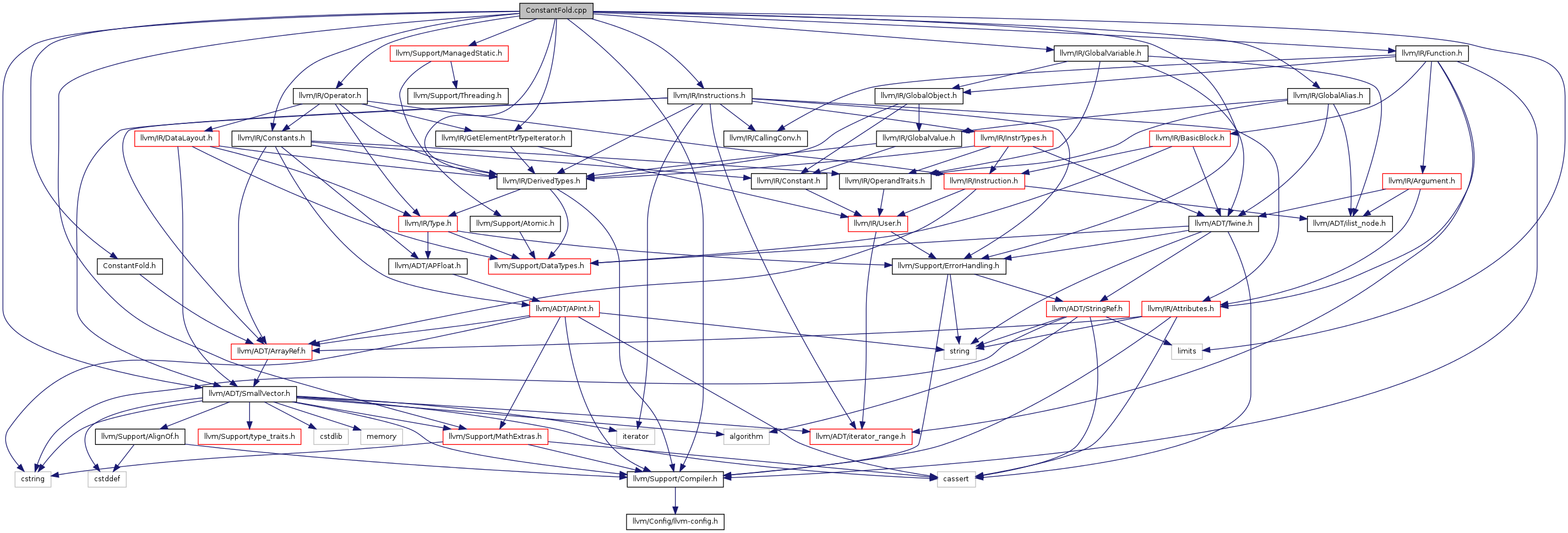
Go to the source code of this file.
Functions | |
| static Constant * | BitCastConstantVector (Constant *CV, VectorType *DstTy) |
| static unsigned | foldConstantCastPair (unsigned opc, ConstantExpr *Op, Type *DstTy) |
| Determine if it is valid to fold a cast of a cast. | |
| static Constant * | FoldBitCast (Constant *V, Type *DestTy) |
| static Constant * | ExtractConstantBytes (Constant *C, unsigned ByteStart, unsigned ByteSize) |
| static Constant * | getFoldedSizeOf (Type *Ty, Type *DestTy, bool Folded) |
| static Constant * | getFoldedAlignOf (Type *Ty, Type *DestTy, bool Folded) |
| static Constant * | getFoldedOffsetOf (Type *Ty, Constant *FieldNo, Type *DestTy, bool Folded) |
| static bool | isMaybeZeroSizedType (Type *Ty) |
| static int | IdxCompare (Constant *C1, Constant *C2, Type *ElTy) |
| static FCmpInst::Predicate | evaluateFCmpRelation (Constant *V1, Constant *V2) |
| static ICmpInst::Predicate | areGlobalsPotentiallyEqual (const GlobalValue *GV1, const GlobalValue *GV2) |
| static ICmpInst::Predicate | evaluateICmpRelation (Constant *V1, Constant *V2, bool isSigned) |
| template<typename IndexTy > | |
| static bool | isInBoundsIndices (ArrayRef< IndexTy > Idxs) |
| static bool | isIndexInRangeOfSequentialType (const SequentialType *STy, const ConstantInt *CI) |
| Test whether a given ConstantInt is in-range for a SequentialType. | |
| template<typename IndexTy > | |
| static Constant * | ConstantFoldGetElementPtrImpl (Constant *C, bool inBounds, ArrayRef< IndexTy > Idxs) |
Function Documentation
| static ICmpInst::Predicate areGlobalsPotentiallyEqual | ( | const GlobalValue * | GV1, |
| const GlobalValue * | GV2 | ||
| ) | [static] |
Definition at line 1340 of file ConstantFold.cpp.
References llvm::CmpInst::BAD_ICMP_PREDICATE, llvm::GlobalValue::hasExternalWeakLinkage(), and llvm::CmpInst::ICMP_NE.
Referenced by evaluateICmpRelation().
| static Constant* BitCastConstantVector | ( | Constant * | CV, |
| VectorType * | DstTy | ||
| ) | [static] |
BitCastConstantVector - Convert the specified vector Constant node to the specified vector type. At this point, we know that the elements of the input vector constant are all simple integer or FP values.
Definition at line 44 of file ConstantFold.cpp.
References llvm::CallingConv::C, llvm::IntegerType::get(), llvm::ConstantInt::get(), llvm::ConstantVector::get(), llvm::Constant::getAllOnesValue(), llvm::ConstantExpr::getBitCast(), llvm::Value::getContext(), llvm::SequentialType::getElementType(), llvm::ConstantExpr::getExtractElement(), llvm::Constant::getNullValue(), llvm::VectorType::getNumElements(), llvm::Value::getType(), llvm::Type::getVectorNumElements(), llvm::Constant::isAllOnesValue(), llvm::Constant::isNullValue(), and llvm::SmallVectorTemplateBase< T, isPodLike< T >::value >::push_back().
Referenced by FoldBitCast().
| static Constant* ConstantFoldGetElementPtrImpl | ( | Constant * | C, |
| bool | inBounds, | ||
| ArrayRef< IndexTy > | Idxs | ||
| ) | [static] |
Definition at line 1964 of file ConstantFold.cpp.
References llvm::SmallVectorImpl< T >::append(), llvm::ArrayRef< T >::begin(), llvm::CallingConv::C, llvm::WinEH::CE, llvm::dyn_cast(), llvm::SmallVectorBase::empty(), llvm::ArrayRef< T >::empty(), llvm::ArrayRef< T >::end(), llvm::gep_type_begin(), llvm::gep_type_end(), llvm::ConstantInt::get(), llvm::PointerType::get(), llvm::ConstantPointerNull::get(), llvm::ConstantExpr::get(), llvm::UndefValue::get(), llvm::ConstantExpr::getAdd(), llvm::PointerType::getAddressSpace(), llvm::Type::getContext(), llvm::SequentialType::getElementType(), llvm::ConstantExpr::getGetElementPtr(), llvm::ConstantExpr::getInBoundsGetElementPtr(), llvm::GetElementPtrInst::getIndexedType(), llvm::Type::getInt64Ty(), llvm::ConstantExpr::getSDiv(), llvm::ConstantExpr::getSExt(), llvm::ConstantExpr::getSExtOrBitCast(), llvm::ConstantExpr::getSRem(), llvm::Value::getType(), I, isInBoundsIndices(), isIndexInRangeOfSequentialType(), llvm::Type::isIntegerTy(), llvm::yaml::isNull(), llvm::Constant::isNullValue(), llvm::SmallVectorTemplateBase< T, isPodLike >::push_back(), llvm::SmallVectorImpl< T >::reserve(), llvm::SmallVectorImpl< T >::resize(), llvm::ArrayRef< T >::size(), and llvm::Unknown.
Referenced by llvm::ConstantFoldGetElementPtr().
| static FCmpInst::Predicate evaluateFCmpRelation | ( | Constant * | V1, |
| Constant * | V2 | ||
| ) | [static] |
evaluateFCmpRelation - This function determines if there is anything we can decide about the two constants provided. This doesn't need to handle simple things like ConstantFP comparisons, but should instead handle ConstantExprs. If we can determine that the two constants have a particular relation to each other, we should return the corresponding FCmpInst predicate, otherwise return FCmpInst::BAD_FCMP_PREDICATE. This is used below in ConstantFoldCompareInstruction.
To simplify this code we canonicalize the relation so that the first operand is always the most "complex" of the two. We consider ConstantFP to be the simplest, and ConstantExprs to be the most complex.
Definition at line 1288 of file ConstantFold.cpp.
References llvm::CmpInst::BAD_FCMP_PREDICATE, llvm::dyn_cast(), llvm::CmpInst::FCMP_OEQ, llvm::CmpInst::FCMP_OGT, llvm::CmpInst::FCMP_OLT, llvm::FPExt, llvm::ConstantExpr::getFCmp(), llvm::ConstantExpr::getOpcode(), llvm::CmpInst::getSwappedPredicate(), llvm::Value::getType(), llvm::ConstantInt::isZero(), and llvm::SIToFP.
Referenced by llvm::ConstantFoldCompareInstruction().
| static ICmpInst::Predicate evaluateICmpRelation | ( | Constant * | V1, |
| Constant * | V2, | ||
| bool | isSigned | ||
| ) | [static] |
evaluateICmpRelation - This function determines if there is anything we can decide about the two constants provided. This doesn't need to handle simple things like integer comparisons, but should instead handle ConstantExprs and GlobalValues. If we can determine that the two constants have a particular relation to each other, we should return the corresponding ICmp predicate, otherwise return ICmpInst::BAD_ICMP_PREDICATE.
To simplify this code we canonicalize the relation so that the first operand is always the most "complex" of the two. We consider simple constants (like ConstantInt) to be the simplest, followed by GlobalValues, followed by ConstantExpr's (the most complex).
Definition at line 1361 of file ConstantFold.cpp.
References areGlobalsPotentiallyEqual(), llvm::CmpInst::BAD_ICMP_PREDICATE, llvm::dyn_cast(), llvm::FPExt, llvm::FPToSI, llvm::gep_type_begin(), llvm::ConstantExpr::getICmp(), llvm::generic_gep_type_iterator< ItTy >::getIndexedType(), llvm::Constant::getNullValue(), llvm::User::getNumOperands(), llvm::ConstantExpr::getOpcode(), llvm::User::getOperand(), llvm::CmpInst::getSwappedPredicate(), llvm::Value::getType(), llvm::GEPOperator::hasAllZeroIndices(), llvm::CmpInst::ICMP_EQ, llvm::CmpInst::ICMP_NE, llvm::CmpInst::ICMP_SGE, llvm::CmpInst::ICMP_SGT, llvm::CmpInst::ICMP_SLE, llvm::CmpInst::ICMP_SLT, llvm::CmpInst::ICMP_UGE, llvm::CmpInst::ICMP_UGT, llvm::CmpInst::ICMP_ULE, llvm::CmpInst::ICMP_ULT, IdxCompare(), llvm::ConstantExpr::isGEPWithNoNotionalOverIndexing(), llvm::Type::isIntegerTy(), llvm::Constant::isNullValue(), llvm::Type::isPointerTy(), llvm::ConstantInt::isZero(), llvm::SExt, llvm::SIToFP, llvm::Trunc, and llvm::NVPTX::PTXLdStInstCode::V2.
Referenced by llvm::ConstantFoldCompareInstruction().
| static Constant* ExtractConstantBytes | ( | Constant * | C, |
| unsigned | ByteStart, | ||
| unsigned | ByteSize | ||
| ) | [static] |
ExtractConstantBytes - V is an integer constant which only has a subset of its bytes used. The bytes used are indicated by ByteStart (which is the first byte used, counting from the least significant byte) and ByteSize, which is the number of bytes used.
This function analyzes the specified constant to see if the specified byte range can be returned as a simplified constant. If so, the constant is returned, otherwise null is returned.
Definition at line 197 of file ConstantFold.cpp.
References llvm::APIntOps::And(), llvm::CallingConv::C, llvm::WinEH::CE, llvm::dyn_cast(), llvm::IntegerType::get(), llvm::ConstantInt::get(), llvm::ConstantExpr::getAnd(), getBitWidth(), llvm::Value::getContext(), llvm::ConstantExpr::getLShr(), llvm::Constant::getNullValue(), llvm::ConstantExpr::getOpcode(), llvm::User::getOperand(), llvm::ConstantExpr::getOr(), llvm::ConstantExpr::getTrunc(), llvm::Value::getType(), llvm::ConstantInt::getZExtValue(), llvm::Type::isIntegerTy(), llvm::Constant::isNullValue(), llvm::LShr, llvm::APInt::lshr(), llvm::APIntOps::Or(), and llvm::APInt::trunc().
Referenced by llvm::ConstantFoldCastInstruction().
| static Constant* FoldBitCast | ( | Constant * | V, |
| Type * | DestTy | ||
| ) | [static] |
Definition at line 100 of file ConstantFold.cpp.
References llvm::lltok::APFloat, BitCastConstantVector(), llvm::ConstantInt::get(), llvm::ConstantFP::get(), llvm::ConstantVector::get(), llvm::ConstantPointerNull::get(), llvm::ConstantExpr::getBitCast(), llvm::Type::getContext(), llvm::Type::getFltSemantics(), llvm::ConstantExpr::getInBoundsGetElementPtr(), llvm::Type::getInt32Ty(), llvm::Constant::getNullValue(), llvm::Value::getType(), llvm::Type::isFloatingPointTy(), llvm::Type::isIntegerTy(), llvm::Type::isPointerTy(), and llvm::SmallVectorTemplateBase< T, isPodLike< T >::value >::push_back().
Referenced by llvm::ConstantFoldCastInstruction().
| static unsigned foldConstantCastPair | ( | unsigned | opc, |
| ConstantExpr * | Op, | ||
| Type * | DstTy | ||
| ) | [static] |
Determine if it is valid to fold a cast of a cast.
This function determines which opcode to use to fold two constant cast expressions together. It uses CastInst::isEliminableCastPair to determine the opcode. Consequently its just a wrapper around that function.
- Parameters:
-
opc opcode of the second cast constant expression Op the first cast constant expression DstTy destination type of the first cast
Definition at line 75 of file ConstantFold.cpp.
References llvm::Type::getContext(), llvm::Type::getInt64Ty(), llvm::ConstantExpr::getOpcode(), llvm::User::getOperand(), llvm::Value::getType(), llvm::Instruction::isCast(), llvm::ConstantExpr::isCast(), llvm::CastInst::isEliminableCastPair(), and llvm::Type::isFirstClassType().
Referenced by llvm::ConstantFoldCastInstruction().
| static Constant* getFoldedAlignOf | ( | Type * | Ty, |
| Type * | DestTy, | ||
| bool | Folded | ||
| ) | [static] |
getFoldedAlignOf - Return a ConstantExpr with type DestTy for alignof on Ty, with any known factors factored out. If Folded is false, return null if no factoring was possible, to avoid endlessly bouncing an unfoldable expression back into the top-level folder.
Definition at line 394 of file ConstantFold.cpp.
References llvm::CallingConv::C, llvm::IntegerType::get(), llvm::ConstantInt::get(), llvm::PointerType::get(), llvm::ConstantExpr::getAlignOf(), llvm::ConstantExpr::getCast(), and llvm::CastInst::getCastOpcode().
Referenced by llvm::ConstantFoldCastInstruction().
| static Constant* getFoldedOffsetOf | ( | Type * | Ty, |
| Constant * | FieldNo, | ||
| Type * | DestTy, | ||
| bool | Folded | ||
| ) | [static] |
getFoldedOffsetOf - Return a ConstantExpr with type DestTy for offsetof on Ty and FieldNo, with any known factors factored out. If Folded is false, return null if no factoring was possible, to avoid endlessly bouncing an unfoldable expression back into the top-level folder.
Definition at line 460 of file ConstantFold.cpp.
References llvm::CallingConv::C, llvm::ConstantExpr::getCast(), llvm::CastInst::getCastOpcode(), getFoldedSizeOf(), llvm::ConstantExpr::getNUWMul(), llvm::ConstantExpr::getOffsetOf(), and N.
Referenced by llvm::ConstantFoldCastInstruction().
| static Constant* getFoldedSizeOf | ( | Type * | Ty, |
| Type * | DestTy, | ||
| bool | Folded | ||
| ) | [static] |
getFoldedSizeOf - Return a ConstantExpr with type DestTy for sizeof on Ty, with any known factors factored out. If Folded is false, return null if no factoring was possible, to avoid endlessly bouncing an unfoldable expression back into the top-level folder.
Definition at line 337 of file ConstantFold.cpp.
References llvm::CallingConv::C, llvm::IntegerType::get(), llvm::ConstantInt::get(), llvm::PointerType::get(), llvm::ConstantExpr::getCast(), llvm::CastInst::getCastOpcode(), llvm::Constant::getNullValue(), llvm::ConstantExpr::getNUWMul(), llvm::ConstantExpr::getSizeOf(), and N.
Referenced by llvm::ConstantFoldCastInstruction(), and getFoldedOffsetOf().
| static int IdxCompare | ( | Constant * | C1, |
| Constant * | C2, | ||
| Type * | ElTy | ||
| ) | [static] |
IdxCompare - Compare the two constants as though they were getelementptr indices. This allows coersion of the types to be the same thing.
If the two constants are the "same" (after coersion), return 0. If the first is less than the second, return -1, if the second is less than the first, return 1. If the constants are not integral, return -2.
Definition at line 1245 of file ConstantFold.cpp.
References llvm::Value::getContext(), llvm::Type::getInt64Ty(), llvm::ConstantExpr::getSExt(), llvm::Value::getType(), llvm::Type::isIntegerTy(), and isMaybeZeroSizedType().
Referenced by evaluateICmpRelation().
| static bool isInBoundsIndices | ( | ArrayRef< IndexTy > | Idxs | ) | [static] |
isInBoundsIndices - Test whether the given sequence of *normalized* indices is "inbounds".
Definition at line 1915 of file ConstantFold.cpp.
References llvm::ArrayRef< T >::empty(), and llvm::ArrayRef< T >::size().
Referenced by ConstantFoldGetElementPtrImpl().
| static bool isIndexInRangeOfSequentialType | ( | const SequentialType * | STy, |
| const ConstantInt * | CI | ||
| ) | [static] |
Test whether a given ConstantInt is in-range for a SequentialType.
Definition at line 1933 of file ConstantFold.cpp.
References llvm::APInt::getActiveBits(), llvm::ConstantInt::getSExtValue(), and llvm::ConstantInt::getValue().
Referenced by ConstantFoldGetElementPtrImpl().
| static bool isMaybeZeroSizedType | ( | Type * | Ty | ) | [static] |
isZeroSizedType - This type is zero sized if its an array or structure of zero sized types. The only leaf zero sized type is an empty structure.
Definition at line 1223 of file ConstantFold.cpp.
Referenced by IdxCompare().
 1.7.6.1