Header And Logo

|

#include "nodes/plannodes.h"#include "nodes/relation.h"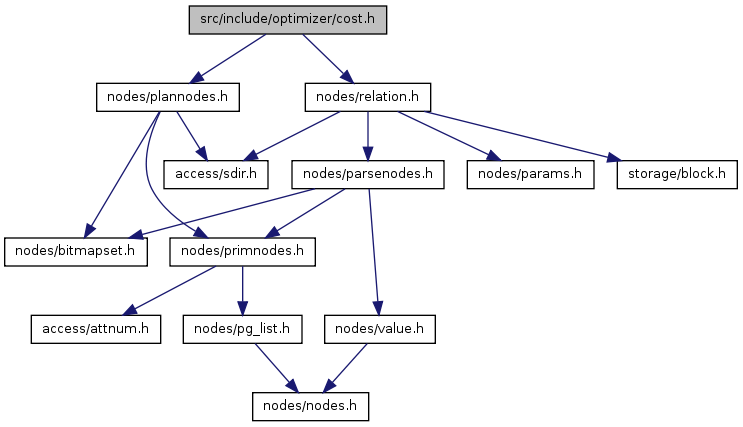

Go to the source code of this file.
Definition at line 32 of file cost.h.
{
    CONSTRAINT_EXCLUSION_OFF,   /* do not use c_e */
    CONSTRAINT_EXCLUSION_ON,    /* apply c_e to all rels */
    CONSTRAINT_EXCLUSION_PARTITION      /* apply c_e to otherrels only */
}   ConstraintExclusionType;
| double clamp_row_est | ( | double | nrows | ) |
Definition at line 154 of file costsize.c.
References rint().
Referenced by approx_tuple_count(), calc_joinrel_size_estimate(), cost_bitmap_heap_scan(), cost_index(), create_bitmap_subplan(), estimate_path_cost_size(), estimate_size(), expression_returns_set_rows(), final_cost_hashjoin(), get_parameterized_baserel_size(), initial_cost_mergejoin(), make_limit(), and set_baserel_size_estimates().
{
    /*
     * Force estimate to be at least one row, to make explain output look
     * better and to avoid possible divide-by-zero when interpolating costs.
     * Make it an integer, too.
     */
    if (nrows <= 1.0)
        nrows = 1.0;
    else
        nrows = rint(nrows);

    return nrows;
}
| Selectivity clause_selectivity | ( | PlannerInfo * | root, | |
| Node * | clause, | |||
| int | varRelid, | |||
| JoinType | jointype, | |||
| SpecialJoinInfo * | sjinfo | |||
| ) |
Definition at line 484 of file clausesel.c.
References and_clause(), arg, OpExpr::args, bms_is_subset_singleton(), BooleanEqualOperator, booltestsel(), RestrictInfo::clause, RestrictInfo::clause_relids, clause_selectivity(), clauselist_selectivity(), Const::constisnull, Const::constvalue, CurrentOfExpr::cvarno, DatumGetBool, DEBUG4, elog, estimate_expression_value(), find_base_rel(), get_notclausearg(), OpExpr::inputcollid, InvalidOid, is_funcclause, is_opclause, IsA, JOIN_INNER, join_selectivity(), lfirst, list_make2, makeBoolConst(), RestrictInfo::norm_selec, not_clause(), NULL, nulltestsel(), OpExpr::opno, or_clause(), RestrictInfo::orclause, RestrictInfo::outer_selec, RestrictInfo::pseudoconstant, restriction_selectivity(), rowcomparesel(), s1, s2, scalararraysel(), treat_as_join_clause(), RelOptInfo::tuples, RangeQueryClause::var, Var::varlevelsup, and Var::varno.
Referenced by approx_tuple_count(), booltestsel(), clause_selectivity(), clauselist_selectivity(), and create_or_index_quals().
{
    Selectivity s1 = 0.5;       /* default for any unhandled clause type */
    RestrictInfo *rinfo = NULL;
    bool        cacheable = false;

    if (clause == NULL)         /* can this still happen? */
        return s1;

    if (IsA(clause, RestrictInfo))
    {
        rinfo = (RestrictInfo *) clause;

        /*
         * If the clause is marked pseudoconstant, then it will be used as a
         * gating qual and should not affect selectivity estimates; hence
         * return 1.0.  The only exception is that a constant FALSE may be
         * taken as having selectivity 0.0, since it will surely mean no rows
         * out of the plan.  This case is simple enough that we need not
         * bother caching the result.
         */
        if (rinfo->pseudoconstant)
        {
            if (!IsA(rinfo->clause, Const))
                return (Selectivity) 1.0;
        }

        /*
         * If the clause is marked redundant, always return 1.0.
         */
        if (rinfo->norm_selec > 1)
            return (Selectivity) 1.0;

        /*
         * If possible, cache the result of the selectivity calculation for
         * the clause.  We can cache if varRelid is zero or the clause
         * contains only vars of that relid --- otherwise varRelid will affect
         * the result, so mustn't cache.  Outer join quals might be examined
         * with either their join's actual jointype or JOIN_INNER, so we need
         * two cache variables to remember both cases.  Note: we assume the
         * result won't change if we are switching the input relations or
         * considering a unique-ified case, so we only need one cache variable
         * for all non-JOIN_INNER cases.
         */
        if (varRelid == 0 ||
            bms_is_subset_singleton(rinfo->clause_relids, varRelid))
        {
            /* Cacheable --- do we already have the result? */
            if (jointype == JOIN_INNER)
            {
                if (rinfo->norm_selec >= 0)
                    return rinfo->norm_selec;
            }
            else
            {
                if (rinfo->outer_selec >= 0)
                    return rinfo->outer_selec;
            }
            cacheable = true;
        }

        /*
         * Proceed with examination of contained clause.  If the clause is an
         * OR-clause, we want to look at the variant with sub-RestrictInfos,
         * so that per-subclause selectivities can be cached.
         */
        if (rinfo->orclause)
            clause = (Node *) rinfo->orclause;
        else
            clause = (Node *) rinfo->clause;
    }

    if (IsA(clause, Var))
    {
        Var        *var = (Var *) clause;

        /*
         * We probably shouldn't ever see an uplevel Var here, but if we do,
         * return the default selectivity...
         */
        if (var->varlevelsup == 0 &&
            (varRelid == 0 || varRelid == (int) var->varno))
        {
            /*
             * A Var at the top of a clause must be a bool Var. This is
             * equivalent to the clause reln.attribute = 't', so we compute
             * the selectivity as if that is what we have.
             */
            s1 = restriction_selectivity(root,
                                         BooleanEqualOperator,
                                         list_make2(var,
                                                    makeBoolConst(true,
                                                                  false)),
                                         InvalidOid,
                                         varRelid);
        }
    }
    else if (IsA(clause, Const))
    {
        /* bool constant is pretty easy... */
        Const      *con = (Const *) clause;

        s1 = con->constisnull ? 0.0 :
            DatumGetBool(con->constvalue) ? 1.0 : 0.0;
    }
    else if (IsA(clause, Param))
    {
        /* see if we can replace the Param */
        Node       *subst = estimate_expression_value(root, clause);

        if (IsA(subst, Const))
        {
            /* bool constant is pretty easy... */
            Const      *con = (Const *) subst;

            s1 = con->constisnull ? 0.0 :
                DatumGetBool(con->constvalue) ? 1.0 : 0.0;
        }
        else
        {
            /* XXX any way to do better than default? */
        }
    }
    else if (not_clause(clause))
    {
        /* inverse of the selectivity of the underlying clause */
        s1 = 1.0 - clause_selectivity(root,
                                  (Node *) get_notclausearg((Expr *) clause),
                                      varRelid,
                                      jointype,
                                      sjinfo);
    }
    else if (and_clause(clause))
    {
        /* share code with clauselist_selectivity() */
        s1 = clauselist_selectivity(root,
                                    ((BoolExpr *) clause)->args,
                                    varRelid,
                                    jointype,
                                    sjinfo);
    }
    else if (or_clause(clause))
    {
        /*
         * Selectivities for an OR clause are computed as s1+s2 - s1*s2 to
         * account for the probable overlap of selected tuple sets.
         *
         * XXX is this too conservative?
         */
        ListCell   *arg;

        s1 = 0.0;
        foreach(arg, ((BoolExpr *) clause)->args)
        {
            Selectivity s2 = clause_selectivity(root,
                                                (Node *) lfirst(arg),
                                                varRelid,
                                                jointype,
                                                sjinfo);

            s1 = s1 + s2 - s1 * s2;
        }
    }
    else if (is_opclause(clause) || IsA(clause, DistinctExpr))
    {
        OpExpr     *opclause = (OpExpr *) clause;
        Oid         opno = opclause->opno;

        if (treat_as_join_clause(clause, rinfo, varRelid, sjinfo))
        {
            /* Estimate selectivity for a join clause. */
            s1 = join_selectivity(root, opno,
                                  opclause->args,
                                  opclause->inputcollid,
                                  jointype,
                                  sjinfo);
        }
        else
        {
            /* Estimate selectivity for a restriction clause. */
            s1 = restriction_selectivity(root, opno,
                                         opclause->args,
                                         opclause->inputcollid,
                                         varRelid);
        }

        /*
         * DistinctExpr has the same representation as OpExpr, but the
         * contained operator is "=" not "<>", so we must negate the result.
         * This estimation method doesn't give the right behavior for nulls,
         * but it's better than doing nothing.
         */
        if (IsA(clause, DistinctExpr))
            s1 = 1.0 - s1;
    }
    else if (is_funcclause(clause))
    {
        /*
         * This is not an operator, so we guess at the selectivity. THIS IS A
         * HACK TO GET V4 OUT THE DOOR.  FUNCS SHOULD BE ABLE TO HAVE
         * SELECTIVITIES THEMSELVES.       -- JMH 7/9/92
         */
        s1 = (Selectivity) 0.3333333;
    }
#ifdef NOT_USED
    else if (IsA(clause, SubPlan) ||
             IsA(clause, AlternativeSubPlan))
    {
        /*
         * Just for the moment! FIX ME! - vadim 02/04/98
         */
        s1 = (Selectivity) 0.5;
    }
#endif
    else if (IsA(clause, ScalarArrayOpExpr))
    {
        /* Use node specific selectivity calculation function */
        s1 = scalararraysel(root,
                            (ScalarArrayOpExpr *) clause,
                            treat_as_join_clause(clause, rinfo,
                                                 varRelid, sjinfo),
                            varRelid,
                            jointype,
                            sjinfo);
    }
    else if (IsA(clause, RowCompareExpr))
    {
        /* Use node specific selectivity calculation function */
        s1 = rowcomparesel(root,
                           (RowCompareExpr *) clause,
                           varRelid,
                           jointype,
                           sjinfo);
    }
    else if (IsA(clause, NullTest))
    {
        /* Use node specific selectivity calculation function */
        s1 = nulltestsel(root,
                         ((NullTest *) clause)->nulltesttype,
                         (Node *) ((NullTest *) clause)->arg,
                         varRelid,
                         jointype,
                         sjinfo);
    }
    else if (IsA(clause, BooleanTest))
    {
        /* Use node specific selectivity calculation function */
        s1 = booltestsel(root,
                         ((BooleanTest *) clause)->booltesttype,
                         (Node *) ((BooleanTest *) clause)->arg,
                         varRelid,
                         jointype,
                         sjinfo);
    }
    else if (IsA(clause, CurrentOfExpr))
    {
        /* CURRENT OF selects at most one row of its table */
        CurrentOfExpr *cexpr = (CurrentOfExpr *) clause;
        RelOptInfo *crel = find_base_rel(root, cexpr->cvarno);

        if (crel->tuples > 0)
            s1 = 1.0 / crel->tuples;
    }
    else if (IsA(clause, RelabelType))
    {
        /* Not sure this case is needed, but it can't hurt */
        s1 = clause_selectivity(root,
                                (Node *) ((RelabelType *) clause)->arg,
                                varRelid,
                                jointype,
                                sjinfo);
    }
    else if (IsA(clause, CoerceToDomain))
    {
        /* Not sure this case is needed, but it can't hurt */
        s1 = clause_selectivity(root,
                                (Node *) ((CoerceToDomain *) clause)->arg,
                                varRelid,
                                jointype,
                                sjinfo);
    }

    /* Cache the result if possible */
    if (cacheable)
    {
        if (jointype == JOIN_INNER)
            rinfo->norm_selec = s1;
        else
            rinfo->outer_selec = s1;
    }

#ifdef SELECTIVITY_DEBUG
    elog(DEBUG4, "clause_selectivity: s1 %f", s1);
#endif   /* SELECTIVITY_DEBUG */

    return s1;
}
| Selectivity clauselist_selectivity | ( | PlannerInfo * | root, | |
| List * | clauses, | |||
| int | varRelid, | |||
| JoinType | jointype, | |||
| SpecialJoinInfo * | sjinfo | |||
| ) |
Definition at line 93 of file clausesel.c.
References addRangeClause(), OpExpr::args, bms_membership(), RestrictInfo::clause, RestrictInfo::clause_relids, clause_selectivity(), DEFAULT_INEQ_SEL, get_oprrest(), RangeQueryClause::have_hibound, RangeQueryClause::have_lobound, RangeQueryClause::hibound, IS_NULL, is_opclause, is_pseudo_constant_clause(), is_pseudo_constant_clause_relids(), IsA, RestrictInfo::left_relids, lfirst, linitial, list_length(), RangeQueryClause::lobound, lsecond, RangeQueryClause::next, NULL, nulltestsel(), NumRelids(), OpExpr::opno, pfree(), RestrictInfo::pseudoconstant, RestrictInfo::right_relids, s1, s2, and RangeQueryClause::var.
Referenced by btcostestimate(), calc_joinrel_size_estimate(), clause_selectivity(), compute_semi_anti_join_factors(), estimate_size(), genericcostestimate(), get_parameterized_baserel_size(), gincostestimate(), postgresGetForeignRelSize(), and set_baserel_size_estimates().
{
    Selectivity s1 = 1.0;
    RangeQueryClause *rqlist = NULL;
    ListCell   *l;

    /*
     * If there's exactly one clause, then no use in trying to match up pairs,
     * so just go directly to clause_selectivity().
     */
    if (list_length(clauses) == 1)
        return clause_selectivity(root, (Node *) linitial(clauses),
                                  varRelid, jointype, sjinfo);

    /*
     * Initial scan over clauses.  Anything that doesn't look like a potential
     * rangequery clause gets multiplied into s1 and forgotten. Anything that
     * does gets inserted into an rqlist entry.
     */
    foreach(l, clauses)
    {
        Node       *clause = (Node *) lfirst(l);
        RestrictInfo *rinfo;
        Selectivity s2;

        /* Always compute the selectivity using clause_selectivity */
        s2 = clause_selectivity(root, clause, varRelid, jointype, sjinfo);

        /*
         * Check for being passed a RestrictInfo.
         *
         * If it's a pseudoconstant RestrictInfo, then s2 is either 1.0 or
         * 0.0; just use that rather than looking for range pairs.
         */
        if (IsA(clause, RestrictInfo))
        {
            rinfo = (RestrictInfo *) clause;
            if (rinfo->pseudoconstant)
            {
                s1 = s1 * s2;
                continue;
            }
            clause = (Node *) rinfo->clause;
        }
        else
            rinfo = NULL;

        /*
         * See if it looks like a restriction clause with a pseudoconstant on
         * one side.  (Anything more complicated than that might not behave in
         * the simple way we are expecting.)  Most of the tests here can be
         * done more efficiently with rinfo than without.
         */
        if (is_opclause(clause) && list_length(((OpExpr *) clause)->args) == 2)
        {
            OpExpr     *expr = (OpExpr *) clause;
            bool        varonleft = true;
            bool        ok;

            if (rinfo)
            {
                ok = (bms_membership(rinfo->clause_relids) == BMS_SINGLETON) &&
                    (is_pseudo_constant_clause_relids(lsecond(expr->args),
                                                      rinfo->right_relids) ||
                     (varonleft = false,
                      is_pseudo_constant_clause_relids(linitial(expr->args),
                                                       rinfo->left_relids)));
            }
            else
            {
                ok = (NumRelids(clause) == 1) &&
                    (is_pseudo_constant_clause(lsecond(expr->args)) ||
                     (varonleft = false,
                      is_pseudo_constant_clause(linitial(expr->args))));
            }

            if (ok)
            {
                /*
                 * If it's not a "<" or ">" operator, just merge the
                 * selectivity in generically.  But if it's the right oprrest,
                 * add the clause to rqlist for later processing.
                 */
                switch (get_oprrest(expr->opno))
                {
                    case F_SCALARLTSEL:
                        addRangeClause(&rqlist, clause,
                                       varonleft, true, s2);
                        break;
                    case F_SCALARGTSEL:
                        addRangeClause(&rqlist, clause,
                                       varonleft, false, s2);
                        break;
                    default:
                        /* Just merge the selectivity in generically */
                        s1 = s1 * s2;
                        break;
                }
                continue;       /* drop to loop bottom */
            }
        }

        /* Not the right form, so treat it generically. */
        s1 = s1 * s2;
    }

    /*
     * Now scan the rangequery pair list.
     */
    while (rqlist != NULL)
    {
        RangeQueryClause *rqnext;

        if (rqlist->have_lobound && rqlist->have_hibound)
        {
            /* Successfully matched a pair of range clauses */
            Selectivity s2;

            /*
             * Exact equality to the default value probably means the
             * selectivity function punted.  This is not airtight but should
             * be good enough.
             */
            if (rqlist->hibound == DEFAULT_INEQ_SEL ||
                rqlist->lobound == DEFAULT_INEQ_SEL)
            {
                s2 = DEFAULT_RANGE_INEQ_SEL;
            }
            else
            {
                s2 = rqlist->hibound + rqlist->lobound - 1.0;

                /* Adjust for double-exclusion of NULLs */
                s2 += nulltestsel(root, IS_NULL, rqlist->var,
                                  varRelid, jointype, sjinfo);

                /*
                 * A zero or slightly negative s2 should be converted into a
                 * small positive value; we probably are dealing with a very
                 * tight range and got a bogus result due to roundoff errors.
                 * However, if s2 is very negative, then we probably have
                 * default selectivity estimates on one or both sides of the
                 * range that we failed to recognize above for some reason.
                 */
                if (s2 <= 0.0)
                {
                    if (s2 < -0.01)
                    {
                        /*
                         * No data available --- use a default estimate that
                         * is small, but not real small.
                         */
                        s2 = DEFAULT_RANGE_INEQ_SEL;
                    }
                    else
                    {
                        /*
                         * It's just roundoff error; use a small positive
                         * value
                         */
                        s2 = 1.0e-10;
                    }
                }
            }
            /* Merge in the selectivity of the pair of clauses */
            s1 *= s2;
        }
        else
        {
            /* Only found one of a pair, merge it in generically */
            if (rqlist->have_lobound)
                s1 *= rqlist->lobound;
            else
                s1 *= rqlist->hibound;
        }
        /* release storage and advance */
        rqnext = rqlist->next;
        pfree(rqlist);
        rqlist = rqnext;
    }

    return s1;
}
| void compute_semi_anti_join_factors | ( | PlannerInfo * | root, | |
| RelOptInfo * | outerrel, | |||
| RelOptInfo * | innerrel, | |||
| JoinType | jointype, | |||
| SpecialJoinInfo * | sjinfo, | |||
| List * | restrictlist, | |||
| SemiAntiJoinFactors * | semifactors | |||
| ) |
Definition at line 3191 of file costsize.c.
References Assert, clauselist_selectivity(), SpecialJoinInfo::delay_upper_joins, RestrictInfo::is_pushed_down, IsA, JOIN_ANTI, JOIN_INNER, SpecialJoinInfo::join_quals, JOIN_SEMI, SpecialJoinInfo::jointype, lappend(), lfirst, SpecialJoinInfo::lhs_strict, list_free(), SemiAntiJoinFactors::match_count, Max, SpecialJoinInfo::min_lefthand, SpecialJoinInfo::min_righthand, SemiAntiJoinFactors::outer_match_frac, RelOptInfo::relids, RelOptInfo::rows, SpecialJoinInfo::syn_lefthand, SpecialJoinInfo::syn_righthand, and SpecialJoinInfo::type.
Referenced by add_paths_to_joinrel().
{
    Selectivity jselec;
    Selectivity nselec;
    Selectivity avgmatch;
    SpecialJoinInfo norm_sjinfo;
    List       *joinquals;
    ListCell   *l;

    /* Should only be called in these cases */
    Assert(jointype == JOIN_SEMI || jointype == JOIN_ANTI);

    /*
     * In an ANTI join, we must ignore clauses that are "pushed down", since
     * those won't affect the match logic.  In a SEMI join, we do not
     * distinguish joinquals from "pushed down" quals, so just use the whole
     * restrictinfo list.
     */
    if (jointype == JOIN_ANTI)
    {
        joinquals = NIL;
        foreach(l, restrictlist)
        {
            RestrictInfo *rinfo = (RestrictInfo *) lfirst(l);

            Assert(IsA(rinfo, RestrictInfo));
            if (!rinfo->is_pushed_down)
                joinquals = lappend(joinquals, rinfo);
        }
    }
    else
        joinquals = restrictlist;

    /*
     * Get the JOIN_SEMI or JOIN_ANTI selectivity of the join clauses.
     */
    jselec = clauselist_selectivity(root,
                                    joinquals,
                                    0,
                                    jointype,
                                    sjinfo);

    /*
     * Also get the normal inner-join selectivity of the join clauses.
     */
    norm_sjinfo.type = T_SpecialJoinInfo;
    norm_sjinfo.min_lefthand = outerrel->relids;
    norm_sjinfo.min_righthand = innerrel->relids;
    norm_sjinfo.syn_lefthand = outerrel->relids;
    norm_sjinfo.syn_righthand = innerrel->relids;
    norm_sjinfo.jointype = JOIN_INNER;
    /* we don't bother trying to make the remaining fields valid */
    norm_sjinfo.lhs_strict = false;
    norm_sjinfo.delay_upper_joins = false;
    norm_sjinfo.join_quals = NIL;

    nselec = clauselist_selectivity(root,
                                    joinquals,
                                    0,
                                    JOIN_INNER,
                                    &norm_sjinfo);

    /* Avoid leaking a lot of ListCells */
    if (jointype == JOIN_ANTI)
        list_free(joinquals);

    /*
     * jselec can be interpreted as the fraction of outer-rel rows that have
     * any matches (this is true for both SEMI and ANTI cases).  And nselec is
     * the fraction of the Cartesian product that matches.  So, the average
     * number of matches for each outer-rel row that has at least one match is
     * nselec * inner_rows / jselec.
     *
     * Note: it is correct to use the inner rel's "rows" count here, even
     * though we might later be considering a parameterized inner path with
     * fewer rows.  This is because we have included all the join clauses in
     * the selectivity estimate.
     */
    if (jselec > 0)             /* protect against zero divide */
    {
        avgmatch = nselec * innerrel->rows / jselec;
        /* Clamp to sane range */
        avgmatch = Max(1.0, avgmatch);
    }
    else
        avgmatch = 1.0;

    semifactors->outer_match_frac = jselec;
    semifactors->match_count = avgmatch;
}
| void cost_agg | ( | Path * | path, | |
| PlannerInfo * | root, | |||
| AggStrategy | aggstrategy, | |||
| const AggClauseCosts * | aggcosts, | |||
| int | numGroupCols, | |||
| double | numGroups, | |||
| Cost | input_startup_cost, | |||
| Cost | input_total_cost, | |||
| double | input_tuples | |||
| ) |
Definition at line 1467 of file costsize.c.
References AGG_HASHED, AGG_PLAIN, AGG_SORTED, Assert, cpu_operator_cost, cpu_tuple_cost, AggClauseCosts::finalCost, MemSet, NULL, QualCost::per_tuple, Path::rows, QualCost::startup, Path::startup_cost, Path::total_cost, and AggClauseCosts::transCost.
Referenced by choose_hashed_distinct(), choose_hashed_grouping(), choose_hashed_setop(), create_unique_path(), make_agg(), and optimize_minmax_aggregates().
{
    double      output_tuples;
    Cost        startup_cost;
    Cost        total_cost;
    AggClauseCosts dummy_aggcosts;

    /* Use all-zero per-aggregate costs if NULL is passed */
    if (aggcosts == NULL)
    {
        Assert(aggstrategy == AGG_HASHED);
        MemSet(&dummy_aggcosts, 0, sizeof(AggClauseCosts));
        aggcosts = &dummy_aggcosts;
    }

    /*
     * The transCost.per_tuple component of aggcosts should be charged once
     * per input tuple, corresponding to the costs of evaluating the aggregate
     * transfns and their input expressions (with any startup cost of course
     * charged but once).  The finalCost component is charged once per output
     * tuple, corresponding to the costs of evaluating the finalfns.
     *
     * If we are grouping, we charge an additional cpu_operator_cost per
     * grouping column per input tuple for grouping comparisons.
     *
     * We will produce a single output tuple if not grouping, and a tuple per
     * group otherwise.  We charge cpu_tuple_cost for each output tuple.
     *
     * Note: in this cost model, AGG_SORTED and AGG_HASHED have exactly the
     * same total CPU cost, but AGG_SORTED has lower startup cost.  If the
     * input path is already sorted appropriately, AGG_SORTED should be
     * preferred (since it has no risk of memory overflow).  This will happen
     * as long as the computed total costs are indeed exactly equal --- but if
     * there's roundoff error we might do the wrong thing.  So be sure that
     * the computations below form the same intermediate values in the same
     * order.
     */
    if (aggstrategy == AGG_PLAIN)
    {
        startup_cost = input_total_cost;
        startup_cost += aggcosts->transCost.startup;
        startup_cost += aggcosts->transCost.per_tuple * input_tuples;
        startup_cost += aggcosts->finalCost;
        /* we aren't grouping */
        total_cost = startup_cost + cpu_tuple_cost;
        output_tuples = 1;
    }
    else if (aggstrategy == AGG_SORTED)
    {
        /* Here we are able to deliver output on-the-fly */
        startup_cost = input_startup_cost;
        total_cost = input_total_cost;
        /* calcs phrased this way to match HASHED case, see note above */
        total_cost += aggcosts->transCost.startup;
        total_cost += aggcosts->transCost.per_tuple * input_tuples;
        total_cost += (cpu_operator_cost * numGroupCols) * input_tuples;
        total_cost += aggcosts->finalCost * numGroups;
        total_cost += cpu_tuple_cost * numGroups;
        output_tuples = numGroups;
    }
    else
    {
        /* must be AGG_HASHED */
        startup_cost = input_total_cost;
        startup_cost += aggcosts->transCost.startup;
        startup_cost += aggcosts->transCost.per_tuple * input_tuples;
        startup_cost += (cpu_operator_cost * numGroupCols) * input_tuples;
        total_cost = startup_cost;
        total_cost += aggcosts->finalCost * numGroups;
        total_cost += cpu_tuple_cost * numGroups;
        output_tuples = numGroups;
    }

    path->rows = output_tuples;
    path->startup_cost = startup_cost;
    path->total_cost = total_cost;
}
| void cost_bitmap_and_node | ( | BitmapAndPath * | path, | |
| PlannerInfo * | root | |||
| ) |
Definition at line 776 of file costsize.c.
References BitmapAndPath::bitmapquals, BitmapAndPath::bitmapselectivity, cost_bitmap_tree_node(), cpu_operator_cost, lfirst, list_head(), BitmapAndPath::path, Path::rows, Path::startup_cost, subpath(), and Path::total_cost.
Referenced by bitmap_and_cost_est(), and create_bitmap_and_path().
{
    Cost        totalCost;
    Selectivity selec;
    ListCell   *l;

    /*
     * We estimate AND selectivity on the assumption that the inputs are
     * independent.  This is probably often wrong, but we don't have the info
     * to do better.
     *
     * The runtime cost of the BitmapAnd itself is estimated at 100x
     * cpu_operator_cost for each tbm_intersect needed.  Probably too small,
     * definitely too simplistic?
     */
    totalCost = 0.0;
    selec = 1.0;
    foreach(l, path->bitmapquals)
    {
        Path       *subpath = (Path *) lfirst(l);
        Cost        subCost;
        Selectivity subselec;

        cost_bitmap_tree_node(subpath, &subCost, &subselec);

        selec *= subselec;

        totalCost += subCost;
        if (l != list_head(path->bitmapquals))
            totalCost += 100.0 * cpu_operator_cost;
    }
    path->bitmapselectivity = selec;
    path->path.rows = 0;        /* per above, not used */
    path->path.startup_cost = totalCost;
    path->path.total_cost = totalCost;
}
| void cost_bitmap_heap_scan | ( | Path * | path, | |
| PlannerInfo * | root, | |||
| RelOptInfo * | baserel, | |||
| ParamPathInfo * | param_info, | |||
| Path * | bitmapqual, | |||
| double | loop_count | |||
| ) |
Definition at line 613 of file costsize.c.
References Assert, clamp_row_est(), cost_bitmap_tree_node(), cpu_tuple_cost, disable_cost, enable_bitmapscan, get_indexpath_pages(), get_restriction_qual_cost(), get_tablespace_page_costs(), index_pages_fetched(), IsA, RelOptInfo::pages, QualCost::per_tuple, ParamPathInfo::ppi_rows, RelOptInfo::relid, RelOptInfo::reltablespace, RelOptInfo::rows, Path::rows, RTE_RELATION, RelOptInfo::rtekind, QualCost::startup, Path::startup_cost, T, Path::total_cost, and RelOptInfo::tuples.
Referenced by bitmap_and_cost_est(), bitmap_scan_cost_est(), and create_bitmap_heap_path().
{
    Cost        startup_cost = 0;
    Cost        run_cost = 0;
    Cost        indexTotalCost;
    Selectivity indexSelectivity;
    QualCost    qpqual_cost;
    Cost        cpu_per_tuple;
    Cost        cost_per_page;
    double      tuples_fetched;
    double      pages_fetched;
    double      spc_seq_page_cost,
                spc_random_page_cost;
    double      T;

    /* Should only be applied to base relations */
    Assert(IsA(baserel, RelOptInfo));
    Assert(baserel->relid > 0);
    Assert(baserel->rtekind == RTE_RELATION);

    /* Mark the path with the correct row estimate */
    if (param_info)
        path->rows = param_info->ppi_rows;
    else
        path->rows = baserel->rows;

    if (!enable_bitmapscan)
        startup_cost += disable_cost;

    /*
     * Fetch total cost of obtaining the bitmap, as well as its total
     * selectivity.
     */
    cost_bitmap_tree_node(bitmapqual, &indexTotalCost, &indexSelectivity);

    startup_cost += indexTotalCost;

    /* Fetch estimated page costs for tablespace containing table. */
    get_tablespace_page_costs(baserel->reltablespace,
                              &spc_random_page_cost,
                              &spc_seq_page_cost);

    /*
     * Estimate number of main-table pages fetched.
     */
    tuples_fetched = clamp_row_est(indexSelectivity * baserel->tuples);

    T = (baserel->pages > 1) ? (double) baserel->pages : 1.0;

    if (loop_count > 1)
    {
        /*
         * For repeated bitmap scans, scale up the number of tuples fetched in
         * the Mackert and Lohman formula by the number of scans, so that we
         * estimate the number of pages fetched by all the scans. Then
         * pro-rate for one scan.
         */
        pages_fetched = index_pages_fetched(tuples_fetched * loop_count,
                                            baserel->pages,
                                            get_indexpath_pages(bitmapqual),
                                            root);
        pages_fetched /= loop_count;
    }
    else
    {
        /*
         * For a single scan, the number of heap pages that need to be fetched
         * is the same as the Mackert and Lohman formula for the case T <= b
         * (ie, no re-reads needed).
         */
        pages_fetched = (2.0 * T * tuples_fetched) / (2.0 * T + tuples_fetched);
    }
    if (pages_fetched >= T)
        pages_fetched = T;
    else
        pages_fetched = ceil(pages_fetched);

    /*
     * For small numbers of pages we should charge spc_random_page_cost
     * apiece, while if nearly all the table's pages are being read, it's more
     * appropriate to charge spc_seq_page_cost apiece.  The effect is
     * nonlinear, too. For lack of a better idea, interpolate like this to
     * determine the cost per page.
     */
    if (pages_fetched >= 2.0)
        cost_per_page = spc_random_page_cost -
            (spc_random_page_cost - spc_seq_page_cost)
            * sqrt(pages_fetched / T);
    else
        cost_per_page = spc_random_page_cost;

    run_cost += pages_fetched * cost_per_page;

    /*
     * Estimate CPU costs per tuple.
     *
     * Often the indexquals don't need to be rechecked at each tuple ... but
     * not always, especially not if there are enough tuples involved that the
     * bitmaps become lossy.  For the moment, just assume they will be
     * rechecked always.  This means we charge the full freight for all the
     * scan clauses.
     */
    get_restriction_qual_cost(root, baserel, param_info, &qpqual_cost);

    startup_cost += qpqual_cost.startup;
    cpu_per_tuple = cpu_tuple_cost + qpqual_cost.per_tuple;

    run_cost += cpu_per_tuple * tuples_fetched;

    path->startup_cost = startup_cost;
    path->total_cost = startup_cost + run_cost;
}
| void cost_bitmap_or_node | ( | BitmapOrPath * | path, | |
| PlannerInfo * | root | |||
| ) |
Definition at line 820 of file costsize.c.
References BitmapOrPath::bitmapquals, BitmapOrPath::bitmapselectivity, cost_bitmap_tree_node(), cpu_operator_cost, IsA, lfirst, list_head(), Min, BitmapOrPath::path, Path::rows, Path::startup_cost, subpath(), and Path::total_cost.
Referenced by create_bitmap_or_path().
{
    Cost        totalCost;
    Selectivity selec;
    ListCell   *l;

    /*
     * We estimate OR selectivity on the assumption that the inputs are
     * non-overlapping, since that's often the case in "x IN (list)" type
     * situations.  Of course, we clamp to 1.0 at the end.
     *
     * The runtime cost of the BitmapOr itself is estimated at 100x
     * cpu_operator_cost for each tbm_union needed.  Probably too small,
     * definitely too simplistic?  We are aware that the tbm_unions are
     * optimized out when the inputs are BitmapIndexScans.
     */
    totalCost = 0.0;
    selec = 0.0;
    foreach(l, path->bitmapquals)
    {
        Path       *subpath = (Path *) lfirst(l);
        Cost        subCost;
        Selectivity subselec;

        cost_bitmap_tree_node(subpath, &subCost, &subselec);

        selec += subselec;

        totalCost += subCost;
        if (l != list_head(path->bitmapquals) &&
            !IsA(subpath, IndexPath))
            totalCost += 100.0 * cpu_operator_cost;
    }
    path->bitmapselectivity = Min(selec, 1.0);
    path->path.rows = 0;        /* per above, not used */
    path->path.startup_cost = totalCost;
    path->path.total_cost = totalCost;
}
| void cost_bitmap_tree_node | ( | Path * | path, | |
| Cost * | cost, | |||
| Selectivity * | selec | |||
| ) |
Definition at line 733 of file costsize.c.
References cpu_operator_cost, elog, ERROR, IsA, nodeTag, Path::rows, and Path::total_cost.
Referenced by choose_bitmap_and(), cost_bitmap_and_node(), cost_bitmap_heap_scan(), cost_bitmap_or_node(), and path_usage_comparator().
{
    if (IsA(path, IndexPath))
    {
        *cost = ((IndexPath *) path)->indextotalcost;
        *selec = ((IndexPath *) path)->indexselectivity;

        /*
         * Charge a small amount per retrieved tuple to reflect the costs of
         * manipulating the bitmap.  This is mostly to make sure that a bitmap
         * scan doesn't look to be the same cost as an indexscan to retrieve a
         * single tuple.
         */
        *cost += 0.1 * cpu_operator_cost * path->rows;
    }
    else if (IsA(path, BitmapAndPath))
    {
        *cost = path->total_cost;
        *selec = ((BitmapAndPath *) path)->bitmapselectivity;
    }
    else if (IsA(path, BitmapOrPath))
    {
        *cost = path->total_cost;
        *selec = ((BitmapOrPath *) path)->bitmapselectivity;
    }
    else
    {
        elog(ERROR, "unrecognized node type: %d", nodeTag(path));
        *cost = *selec = 0;     /* keep compiler quiet */
    }
}
| void cost_ctescan | ( | Path * | path, | |
| PlannerInfo * | root, | |||
| RelOptInfo * | baserel, | |||
| ParamPathInfo * | param_info | |||
| ) |
Definition at line 1114 of file costsize.c.
References Assert, cpu_tuple_cost, get_restriction_qual_cost(), QualCost::per_tuple, ParamPathInfo::ppi_rows, RelOptInfo::relid, RelOptInfo::rows, Path::rows, RTE_CTE, RelOptInfo::rtekind, QualCost::startup, Path::startup_cost, Path::total_cost, and RelOptInfo::tuples.
Referenced by create_ctescan_path(), and create_worktablescan_path().
{
    Cost        startup_cost = 0;
    Cost        run_cost = 0;
    QualCost    qpqual_cost;
    Cost        cpu_per_tuple;

    /* Should only be applied to base relations that are CTEs */
    Assert(baserel->relid > 0);
    Assert(baserel->rtekind == RTE_CTE);

    /* Mark the path with the correct row estimate */
    if (param_info)
        path->rows = param_info->ppi_rows;
    else
        path->rows = baserel->rows;

    /* Charge one CPU tuple cost per row for tuplestore manipulation */
    cpu_per_tuple = cpu_tuple_cost;

    /* Add scanning CPU costs */
    get_restriction_qual_cost(root, baserel, param_info, &qpqual_cost);

    startup_cost += qpqual_cost.startup;
    cpu_per_tuple += cpu_tuple_cost + qpqual_cost.per_tuple;
    run_cost += cpu_per_tuple * baserel->tuples;

    path->startup_cost = startup_cost;
    path->total_cost = startup_cost + run_cost;
}
| void cost_functionscan | ( | Path * | path, | |
| PlannerInfo * | root, | |||
| RelOptInfo * | baserel, | |||
| ParamPathInfo * | param_info | |||
| ) |
Definition at line 1011 of file costsize.c.
References Assert, cost_qual_eval_node(), cpu_tuple_cost, RangeTblEntry::funcexpr, get_restriction_qual_cost(), QualCost::per_tuple, planner_rt_fetch, ParamPathInfo::ppi_rows, RelOptInfo::relid, RelOptInfo::rows, Path::rows, RTE_FUNCTION, RangeTblEntry::rtekind, QualCost::startup, Path::startup_cost, Path::total_cost, and RelOptInfo::tuples.
Referenced by create_functionscan_path().
{
    Cost        startup_cost = 0;
    Cost        run_cost = 0;
    QualCost    qpqual_cost;
    Cost        cpu_per_tuple;
    RangeTblEntry *rte;
    QualCost    exprcost;

    /* Should only be applied to base relations that are functions */
    Assert(baserel->relid > 0);
    rte = planner_rt_fetch(baserel->relid, root);
    Assert(rte->rtekind == RTE_FUNCTION);

    /* Mark the path with the correct row estimate */
    if (param_info)
        path->rows = param_info->ppi_rows;
    else
        path->rows = baserel->rows;

    /*
     * Estimate costs of executing the function expression.
     *
     * Currently, nodeFunctionscan.c always executes the function to
     * completion before returning any rows, and caches the results in a
     * tuplestore.  So the function eval cost is all startup cost, and per-row
     * costs are minimal.
     *
     * XXX in principle we ought to charge tuplestore spill costs if the
     * number of rows is large.  However, given how phony our rowcount
     * estimates for functions tend to be, there's not a lot of point in that
     * refinement right now.
     */
    cost_qual_eval_node(&exprcost, rte->funcexpr, root);

    startup_cost += exprcost.startup + exprcost.per_tuple;

    /* Add scanning CPU costs */
    get_restriction_qual_cost(root, baserel, param_info, &qpqual_cost);

    startup_cost += qpqual_cost.startup;
    cpu_per_tuple = cpu_tuple_cost + qpqual_cost.per_tuple;
    run_cost += cpu_per_tuple * baserel->tuples;

    path->startup_cost = startup_cost;
    path->total_cost = startup_cost + run_cost;
}
| void cost_group | ( | Path * | path, | |
| PlannerInfo * | root, | |||
| int | numGroupCols, | |||
| double | numGroups, | |||
| Cost | input_startup_cost, | |||
| Cost | input_total_cost, | |||
| double | input_tuples | |||
| ) |
Definition at line 1621 of file costsize.c.
References cpu_operator_cost, Path::rows, Path::startup_cost, and Path::total_cost.
Referenced by choose_hashed_distinct(), choose_hashed_grouping(), choose_hashed_setop(), and make_group().
{
    Cost        startup_cost;
    Cost        total_cost;

    startup_cost = input_startup_cost;
    total_cost = input_total_cost;

    /*
     * Charge one cpu_operator_cost per comparison per input tuple. We assume
     * all columns get compared at most of the tuples.
     */
    total_cost += cpu_operator_cost * input_tuples * numGroupCols;

    path->rows = numGroups;
    path->startup_cost = startup_cost;
    path->total_cost = total_cost;
}
| void cost_index | ( | IndexPath * | path, | |
| PlannerInfo * | root, | |||
| double | loop_count | |||
| ) |
Definition at line 240 of file costsize.c.
References RelOptInfo::allvisfrac, IndexOptInfo::amcostestimate, Assert, RelOptInfo::baserestrictinfo, clamp_row_est(), cost_qual_eval(), cpu_tuple_cost, disable_cost, enable_indexscan, Float8GetDatum(), get_tablespace_page_costs(), index_pages_fetched(), IndexPath::indexinfo, IndexPath::indexquals, IndexPath::indexselectivity, IndexPath::indextotalcost, IsA, list_concat(), list_copy(), list_difference_ptr(), OidFunctionCall7, IndexOptInfo::pages, RelOptInfo::pages, Path::param_info, IndexPath::path, Path::pathtype, QualCost::per_tuple, PointerGetDatum, ParamPathInfo::ppi_clauses, ParamPathInfo::ppi_rows, IndexOptInfo::rel, RelOptInfo::relid, RelOptInfo::reltablespace, RelOptInfo::rows, Path::rows, RTE_RELATION, RelOptInfo::rtekind, QualCost::startup, Path::startup_cost, Path::total_cost, and RelOptInfo::tuples.
Referenced by create_index_path(), and reparameterize_path().
{
    IndexOptInfo *index = path->indexinfo;
    RelOptInfo *baserel = index->rel;
    bool        indexonly = (path->path.pathtype == T_IndexOnlyScan);
    List       *allclauses;
    Cost        startup_cost = 0;
    Cost        run_cost = 0;
    Cost        indexStartupCost;
    Cost        indexTotalCost;
    Selectivity indexSelectivity;
    double      indexCorrelation,
                csquared;
    double      spc_seq_page_cost,
                spc_random_page_cost;
    Cost        min_IO_cost,
                max_IO_cost;
    QualCost    qpqual_cost;
    Cost        cpu_per_tuple;
    double      tuples_fetched;
    double      pages_fetched;

    /* Should only be applied to base relations */
    Assert(IsA(baserel, RelOptInfo) &&
           IsA(index, IndexOptInfo));
    Assert(baserel->relid > 0);
    Assert(baserel->rtekind == RTE_RELATION);

    /* Mark the path with the correct row estimate */
    if (path->path.param_info)
    {
        path->path.rows = path->path.param_info->ppi_rows;
        /* also get the set of clauses that should be enforced by the scan */
        allclauses = list_concat(list_copy(path->path.param_info->ppi_clauses),
                                 baserel->baserestrictinfo);
    }
    else
    {
        path->path.rows = baserel->rows;
        /* allclauses should just be the rel's restriction clauses */
        allclauses = baserel->baserestrictinfo;
    }

    if (!enable_indexscan)
        startup_cost += disable_cost;
    /* we don't need to check enable_indexonlyscan; indxpath.c does that */

    /*
     * Call index-access-method-specific code to estimate the processing cost
     * for scanning the index, as well as the selectivity of the index (ie,
     * the fraction of main-table tuples we will have to retrieve) and its
     * correlation to the main-table tuple order.
     */
    OidFunctionCall7(index->amcostestimate,
                     PointerGetDatum(root),
                     PointerGetDatum(path),
                     Float8GetDatum(loop_count),
                     PointerGetDatum(&indexStartupCost),
                     PointerGetDatum(&indexTotalCost),
                     PointerGetDatum(&indexSelectivity),
                     PointerGetDatum(&indexCorrelation));

    /*
     * Save amcostestimate's results for possible use in bitmap scan planning.
     * We don't bother to save indexStartupCost or indexCorrelation, because a
     * bitmap scan doesn't care about either.
     */
    path->indextotalcost = indexTotalCost;
    path->indexselectivity = indexSelectivity;

    /* all costs for touching index itself included here */
    startup_cost += indexStartupCost;
    run_cost += indexTotalCost - indexStartupCost;

    /* estimate number of main-table tuples fetched */
    tuples_fetched = clamp_row_est(indexSelectivity * baserel->tuples);

    /* fetch estimated page costs for tablespace containing table */
    get_tablespace_page_costs(baserel->reltablespace,
                              &spc_random_page_cost,
                              &spc_seq_page_cost);

    /*----------
     * Estimate number of main-table pages fetched, and compute I/O cost.
     *
     * When the index ordering is uncorrelated with the table ordering,
     * we use an approximation proposed by Mackert and Lohman (see
     * index_pages_fetched() for details) to compute the number of pages
     * fetched, and then charge spc_random_page_cost per page fetched.
     *
     * When the index ordering is exactly correlated with the table ordering
     * (just after a CLUSTER, for example), the number of pages fetched should
     * be exactly selectivity * table_size.  What's more, all but the first
     * will be sequential fetches, not the random fetches that occur in the
     * uncorrelated case.  So if the number of pages is more than 1, we
     * ought to charge
     *      spc_random_page_cost + (pages_fetched - 1) * spc_seq_page_cost
     * For partially-correlated indexes, we ought to charge somewhere between
     * these two estimates.  We currently interpolate linearly between the
     * estimates based on the correlation squared (XXX is that appropriate?).
     *
     * If it's an index-only scan, then we will not need to fetch any heap
     * pages for which the visibility map shows all tuples are visible.
     * Hence, reduce the estimated number of heap fetches accordingly.
     * We use the measured fraction of the entire heap that is all-visible,
     * which might not be particularly relevant to the subset of the heap
     * that this query will fetch; but it's not clear how to do better.
     *----------
     */
    if (loop_count > 1)
    {
        /*
         * For repeated indexscans, the appropriate estimate for the
         * uncorrelated case is to scale up the number of tuples fetched in
         * the Mackert and Lohman formula by the number of scans, so that we
         * estimate the number of pages fetched by all the scans; then
         * pro-rate the costs for one scan.  In this case we assume all the
         * fetches are random accesses.
         */
        pages_fetched = index_pages_fetched(tuples_fetched * loop_count,
                                            baserel->pages,
                                            (double) index->pages,
                                            root);

        if (indexonly)
            pages_fetched = ceil(pages_fetched * (1.0 - baserel->allvisfrac));

        max_IO_cost = (pages_fetched * spc_random_page_cost) / loop_count;

        /*
         * In the perfectly correlated case, the number of pages touched by
         * each scan is selectivity * table_size, and we can use the Mackert
         * and Lohman formula at the page level to estimate how much work is
         * saved by caching across scans.  We still assume all the fetches are
         * random, though, which is an overestimate that's hard to correct for
         * without double-counting the cache effects.  (But in most cases
         * where such a plan is actually interesting, only one page would get
         * fetched per scan anyway, so it shouldn't matter much.)
         */
        pages_fetched = ceil(indexSelectivity * (double) baserel->pages);

        pages_fetched = index_pages_fetched(pages_fetched * loop_count,
                                            baserel->pages,
                                            (double) index->pages,
                                            root);

        if (indexonly)
            pages_fetched = ceil(pages_fetched * (1.0 - baserel->allvisfrac));

        min_IO_cost = (pages_fetched * spc_random_page_cost) / loop_count;
    }
    else
    {
        /*
         * Normal case: apply the Mackert and Lohman formula, and then
         * interpolate between that and the correlation-derived result.
         */
        pages_fetched = index_pages_fetched(tuples_fetched,
                                            baserel->pages,
                                            (double) index->pages,
                                            root);

        if (indexonly)
            pages_fetched = ceil(pages_fetched * (1.0 - baserel->allvisfrac));

        /* max_IO_cost is for the perfectly uncorrelated case (csquared=0) */
        max_IO_cost = pages_fetched * spc_random_page_cost;

        /* min_IO_cost is for the perfectly correlated case (csquared=1) */
        pages_fetched = ceil(indexSelectivity * (double) baserel->pages);

        if (indexonly)
            pages_fetched = ceil(pages_fetched * (1.0 - baserel->allvisfrac));

        if (pages_fetched > 0)
        {
            min_IO_cost = spc_random_page_cost;
            if (pages_fetched > 1)
                min_IO_cost += (pages_fetched - 1) * spc_seq_page_cost;
        }
        else
            min_IO_cost = 0;
    }

    /*
     * Now interpolate based on estimated index order correlation to get total
     * disk I/O cost for main table accesses.
     */
    csquared = indexCorrelation * indexCorrelation;

    run_cost += max_IO_cost + csquared * (min_IO_cost - max_IO_cost);

    /*
     * Estimate CPU costs per tuple.
     *
     * What we want here is cpu_tuple_cost plus the evaluation costs of any
     * qual clauses that we have to evaluate as qpquals.  We approximate that
     * list as allclauses minus any clauses appearing in indexquals.  (We
     * assume that pointer equality is enough to recognize duplicate
     * RestrictInfos.)  This method neglects some considerations such as
     * clauses that needn't be checked because they are implied by a partial
     * index's predicate.  It does not seem worth the cycles to try to factor
     * those things in at this stage, even though createplan.c will take pains
     * to remove such unnecessary clauses from the qpquals list if this path
     * is selected for use.
     */
    cost_qual_eval(&qpqual_cost,
                   list_difference_ptr(allclauses, path->indexquals),
                   root);

    startup_cost += qpqual_cost.startup;
    cpu_per_tuple = cpu_tuple_cost + qpqual_cost.per_tuple;

    run_cost += cpu_per_tuple * tuples_fetched;

    path->path.startup_cost = startup_cost;
    path->path.total_cost = startup_cost + run_cost;
}
| void cost_material | ( | Path * | path, | |
| Cost | input_startup_cost, | |||
| Cost | input_total_cost, | |||
| double | tuples, | |||
| int | width | |||
| ) |
Definition at line 1413 of file costsize.c.
References cpu_operator_cost, relation_byte_size(), Path::rows, seq_page_cost, Path::startup_cost, Path::total_cost, and work_mem.
Referenced by create_material_path(), and materialize_finished_plan().
{
    Cost        startup_cost = input_startup_cost;
    Cost        run_cost = input_total_cost - input_startup_cost;
    double      nbytes = relation_byte_size(tuples, width);
    long        work_mem_bytes = work_mem * 1024L;

    path->rows = tuples;

    /*
     * Whether spilling or not, charge 2x cpu_operator_cost per tuple to
     * reflect bookkeeping overhead.  (This rate must be more than what
     * cost_rescan charges for materialize, ie, cpu_operator_cost per tuple;
     * if it is exactly the same then there will be a cost tie between
     * nestloop with A outer, materialized B inner and nestloop with B outer,
     * materialized A inner.  The extra cost ensures we'll prefer
     * materializing the smaller rel.)  Note that this is normally a good deal
     * less than cpu_tuple_cost; which is OK because a Material plan node
     * doesn't do qual-checking or projection, so it's got less overhead than
     * most plan nodes.
     */
    run_cost += 2 * cpu_operator_cost * tuples;

    /*
     * If we will spill to disk, charge at the rate of seq_page_cost per page.
     * This cost is assumed to be evenly spread through the plan run phase,
     * which isn't exactly accurate but our cost model doesn't allow for
     * nonuniform costs within the run phase.
     */
    if (nbytes > work_mem_bytes)
    {
        double      npages = ceil(nbytes / BLCKSZ);

        run_cost += seq_page_cost * npages;
    }

    path->startup_cost = startup_cost;
    path->total_cost = startup_cost + run_cost;
}
| void cost_merge_append | ( | Path * | path, | |
| PlannerInfo * | root, | |||
| List * | pathkeys, | |||
| int | n_streams, | |||
| Cost | input_startup_cost, | |||
| Cost | input_total_cost, | |||
| double | tuples | |||
| ) |
Definition at line 1362 of file costsize.c.
References cpu_operator_cost, LOG2, Path::startup_cost, and Path::total_cost.
Referenced by create_merge_append_path().
{
    Cost        startup_cost = 0;
    Cost        run_cost = 0;
    Cost        comparison_cost;
    double      N;
    double      logN;

    /*
     * Avoid log(0)...
     */
    N = (n_streams < 2) ? 2.0 : (double) n_streams;
    logN = LOG2(N);

    /* Assumed cost per tuple comparison */
    comparison_cost = 2.0 * cpu_operator_cost;

    /* Heap creation cost */
    startup_cost += comparison_cost * N * logN;

    /* Per-tuple heap maintenance cost */
    run_cost += tuples * comparison_cost * 2.0 * logN;

    /*
     * Also charge a small amount (arbitrarily set equal to operator cost) per
     * extracted tuple.  We don't charge cpu_tuple_cost because a MergeAppend
     * node doesn't do qual-checking or projection, so it has less overhead
     * than most plan nodes.
     */
    run_cost += cpu_operator_cost * tuples;

    path->startup_cost = startup_cost + input_startup_cost;
    path->total_cost = startup_cost + run_cost + input_total_cost;
}
| void cost_qual_eval | ( | QualCost * | cost, | |
| List * | quals, | |||
| PlannerInfo * | root | |||
| ) |
Definition at line 2898 of file costsize.c.
References cost_qual_eval_walker(), lfirst, QualCost::per_tuple, cost_qual_eval_context::root, QualCost::startup, and cost_qual_eval_context::total.
Referenced by add_tlist_costs_to_plan(), cost_index(), cost_subplan(), cost_tidscan(), final_cost_hashjoin(), final_cost_mergejoin(), final_cost_nestloop(), genericcostestimate(), get_restriction_qual_cost(), gincostestimate(), inline_function(), make_agg(), make_group(), make_result(), plan_cluster_use_sort(), postgresGetForeignRelSize(), set_baserel_size_estimates(), and set_foreign_size_estimates().
{
    cost_qual_eval_context context;
    ListCell   *l;

    context.root = root;
    context.total.startup = 0;
    context.total.per_tuple = 0;

    /* We don't charge any cost for the implicit ANDing at top level ... */

    foreach(l, quals)
    {
        Node       *qual = (Node *) lfirst(l);

        cost_qual_eval_walker(qual, &context);
    }

    *cost = context.total;
}
| void cost_qual_eval_node | ( | QualCost * | cost, | |
| Node * | qual, | |||
| PlannerInfo * | root | |||
| ) |
Definition at line 2924 of file costsize.c.
References cost_qual_eval_walker(), QualCost::per_tuple, cost_qual_eval_context::root, QualCost::startup, and cost_qual_eval_context::total.
Referenced by cost_functionscan(), cost_windowagg(), count_agg_clauses_walker(), and order_qual_clauses().
{
    cost_qual_eval_context context;

    context.root = root;
    context.total.startup = 0;
    context.total.per_tuple = 0;

    cost_qual_eval_walker(qual, &context);

    *cost = context.total;
}
Definition at line 1158 of file costsize.c.
References cpu_tuple_cost, Max, Plan::plan_rows, Plan::plan_width, Plan::startup_cost, and Plan::total_cost.
Referenced by make_recursive_union().
{
    Cost        startup_cost;
    Cost        total_cost;
    double      total_rows;

    /* We probably have decent estimates for the non-recursive term */
    startup_cost = nrterm->startup_cost;
    total_cost = nrterm->total_cost;
    total_rows = nrterm->plan_rows;

    /*
     * We arbitrarily assume that about 10 recursive iterations will be
     * needed, and that we've managed to get a good fix on the cost and output
     * size of each one of them.  These are mighty shaky assumptions but it's
     * hard to see how to do better.
     */
    total_cost += 10 * rterm->total_cost;
    total_rows += 10 * rterm->plan_rows;

    /*
     * Also charge cpu_tuple_cost per row to account for the costs of
     * manipulating the tuplestores.  (We don't worry about possible
     * spill-to-disk costs.)
     */
    total_cost += cpu_tuple_cost * total_rows;

    runion->startup_cost = startup_cost;
    runion->total_cost = total_cost;
    runion->plan_rows = total_rows;
    runion->plan_width = Max(nrterm->plan_width, rterm->plan_width);
}
| void cost_seqscan | ( | Path * | path, | |
| PlannerInfo * | root, | |||
| RelOptInfo * | baserel, | |||
| ParamPathInfo * | param_info | |||
| ) |
Definition at line 178 of file costsize.c.
References Assert, cpu_tuple_cost, disable_cost, enable_seqscan, get_restriction_qual_cost(), get_tablespace_page_costs(), NULL, RelOptInfo::pages, QualCost::per_tuple, ParamPathInfo::ppi_rows, RelOptInfo::relid, RelOptInfo::reltablespace, RelOptInfo::rows, Path::rows, RTE_RELATION, RelOptInfo::rtekind, QualCost::startup, Path::startup_cost, Path::total_cost, and RelOptInfo::tuples.
Referenced by create_seqscan_path().
{
    Cost        startup_cost = 0;
    Cost        run_cost = 0;
    double      spc_seq_page_cost;
    QualCost    qpqual_cost;
    Cost        cpu_per_tuple;

    /* Should only be applied to base relations */
    Assert(baserel->relid > 0);
    Assert(baserel->rtekind == RTE_RELATION);

    /* Mark the path with the correct row estimate */
    if (param_info)
        path->rows = param_info->ppi_rows;
    else
        path->rows = baserel->rows;

    if (!enable_seqscan)
        startup_cost += disable_cost;

    /* fetch estimated page cost for tablespace containing table */
    get_tablespace_page_costs(baserel->reltablespace,
                              NULL,
                              &spc_seq_page_cost);

    /*
     * disk costs
     */
    run_cost += spc_seq_page_cost * baserel->pages;

    /* CPU costs */
    get_restriction_qual_cost(root, baserel, param_info, &qpqual_cost);

    startup_cost += qpqual_cost.startup;
    cpu_per_tuple = cpu_tuple_cost + qpqual_cost.per_tuple;
    run_cost += cpu_per_tuple * baserel->tuples;

    path->startup_cost = startup_cost;
    path->total_cost = startup_cost + run_cost;
}
| void cost_sort | ( | Path * | path, | |
| PlannerInfo * | root, | |||
| List * | pathkeys, | |||
| Cost | input_cost, | |||
| double | tuples, | |||
| int | width, | |||
| Cost | comparison_cost, | |||
| int | sort_mem, | |||
| double | limit_tuples | |||
| ) |
Definition at line 1237 of file costsize.c.
References cpu_operator_cost, disable_cost, enable_sort, LOG2, random_page_cost, relation_byte_size(), Path::rows, seq_page_cost, Path::startup_cost, Path::total_cost, and tuplesort_merge_order().
Referenced by choose_hashed_distinct(), choose_hashed_grouping(), choose_hashed_setop(), create_merge_append_path(), create_unique_path(), initial_cost_mergejoin(), make_sort(), plan_cluster_use_sort(), and query_planner().
{
    Cost        startup_cost = input_cost;
    Cost        run_cost = 0;
    double      input_bytes = relation_byte_size(tuples, width);
    double      output_bytes;
    double      output_tuples;
    long        sort_mem_bytes = sort_mem * 1024L;

    if (!enable_sort)
        startup_cost += disable_cost;

    path->rows = tuples;

    /*
     * We want to be sure the cost of a sort is never estimated as zero, even
     * if passed-in tuple count is zero.  Besides, mustn't do log(0)...
     */
    if (tuples < 2.0)
        tuples = 2.0;

    /* Include the default cost-per-comparison */
    comparison_cost += 2.0 * cpu_operator_cost;

    /* Do we have a useful LIMIT? */
    if (limit_tuples > 0 && limit_tuples < tuples)
    {
        output_tuples = limit_tuples;
        output_bytes = relation_byte_size(output_tuples, width);
    }
    else
    {
        output_tuples = tuples;
        output_bytes = input_bytes;
    }

    if (output_bytes > sort_mem_bytes)
    {
        /*
         * We'll have to use a disk-based sort of all the tuples
         */
        double      npages = ceil(input_bytes / BLCKSZ);
        double      nruns = (input_bytes / sort_mem_bytes) * 0.5;
        double      mergeorder = tuplesort_merge_order(sort_mem_bytes);
        double      log_runs;
        double      npageaccesses;

        /*
         * CPU costs
         *
         * Assume about N log2 N comparisons
         */
        startup_cost += comparison_cost * tuples * LOG2(tuples);

        /* Disk costs */

        /* Compute logM(r) as log(r) / log(M) */
        if (nruns > mergeorder)
            log_runs = ceil(log(nruns) / log(mergeorder));
        else
            log_runs = 1.0;
        npageaccesses = 2.0 * npages * log_runs;
        /* Assume 3/4ths of accesses are sequential, 1/4th are not */
        startup_cost += npageaccesses *
            (seq_page_cost * 0.75 + random_page_cost * 0.25);
    }
    else if (tuples > 2 * output_tuples || input_bytes > sort_mem_bytes)
    {
        /*
         * We'll use a bounded heap-sort keeping just K tuples in memory, for
         * a total number of tuple comparisons of N log2 K; but the constant
         * factor is a bit higher than for quicksort.  Tweak it so that the
         * cost curve is continuous at the crossover point.
         */
        startup_cost += comparison_cost * tuples * LOG2(2.0 * output_tuples);
    }
    else
    {
        /* We'll use plain quicksort on all the input tuples */
        startup_cost += comparison_cost * tuples * LOG2(tuples);
    }

    /*
     * Also charge a small amount (arbitrarily set equal to operator cost) per
     * extracted tuple.  We don't charge cpu_tuple_cost because a Sort node
     * doesn't do qual-checking or projection, so it has less overhead than
     * most plan nodes.  Note it's correct to use tuples not output_tuples
     * here --- the upper LIMIT will pro-rate the run cost so we'd be double
     * counting the LIMIT otherwise.
     */
    run_cost += cpu_operator_cost * tuples;

    path->startup_cost = startup_cost;
    path->total_cost = startup_cost + run_cost;
}
| void cost_subplan | ( | PlannerInfo * | root, | |
| SubPlan * | subplan, | |||
| Plan * | plan | |||
| ) |
Definition at line 2708 of file costsize.c.
References ALL_SUBLINK, ANY_SUBLINK, cost_qual_eval(), cpu_operator_cost, ExecMaterializesOutput(), EXISTS_SUBLINK, make_ands_implicit(), NIL, nodeTag, SubPlan::parParam, SubPlan::per_call_cost, QualCost::per_tuple, Plan::plan_rows, QualCost::startup, SubPlan::startup_cost, Plan::startup_cost, SubPlan::subLinkType, SubPlan::testexpr, Plan::total_cost, and SubPlan::useHashTable.
Referenced by build_subplan(), SS_make_initplan_from_plan(), and SS_process_ctes().
{
    QualCost    sp_cost;

    /* Figure any cost for evaluating the testexpr */
    cost_qual_eval(&sp_cost,
                   make_ands_implicit((Expr *) subplan->testexpr),
                   root);

    if (subplan->useHashTable)
    {
        /*
         * If we are using a hash table for the subquery outputs, then the
         * cost of evaluating the query is a one-time cost.  We charge one
         * cpu_operator_cost per tuple for the work of loading the hashtable,
         * too.
         */
        sp_cost.startup += plan->total_cost +
            cpu_operator_cost * plan->plan_rows;

        /*
         * The per-tuple costs include the cost of evaluating the lefthand
         * expressions, plus the cost of probing the hashtable.  We already
         * accounted for the lefthand expressions as part of the testexpr, and
         * will also have counted one cpu_operator_cost for each comparison
         * operator.  That is probably too low for the probing cost, but it's
         * hard to make a better estimate, so live with it for now.
         */
    }
    else
    {
        /*
         * Otherwise we will be rescanning the subplan output on each
         * evaluation.  We need to estimate how much of the output we will
         * actually need to scan.  NOTE: this logic should agree with the
         * tuple_fraction estimates used by make_subplan() in
         * plan/subselect.c.
         */
        Cost        plan_run_cost = plan->total_cost - plan->startup_cost;

        if (subplan->subLinkType == EXISTS_SUBLINK)
        {
            /* we only need to fetch 1 tuple */
            sp_cost.per_tuple += plan_run_cost / plan->plan_rows;
        }
        else if (subplan->subLinkType == ALL_SUBLINK ||
                 subplan->subLinkType == ANY_SUBLINK)
        {
            /* assume we need 50% of the tuples */
            sp_cost.per_tuple += 0.50 * plan_run_cost;
            /* also charge a cpu_operator_cost per row examined */
            sp_cost.per_tuple += 0.50 * plan->plan_rows * cpu_operator_cost;
        }
        else
        {
            /* assume we need all tuples */
            sp_cost.per_tuple += plan_run_cost;
        }

        /*
         * Also account for subplan's startup cost. If the subplan is
         * uncorrelated or undirect correlated, AND its topmost node is one
         * that materializes its output, assume that we'll only need to pay
         * its startup cost once; otherwise assume we pay the startup cost
         * every time.
         */
        if (subplan->parParam == NIL &&
            ExecMaterializesOutput(nodeTag(plan)))
            sp_cost.startup += plan->startup_cost;
        else
            sp_cost.per_tuple += plan->startup_cost;
    }

    subplan->startup_cost = sp_cost.startup;
    subplan->per_call_cost = sp_cost.per_tuple;
}
| void cost_subqueryscan | ( | Path * | path, | |
| PlannerInfo * | root, | |||
| RelOptInfo * | baserel, | |||
| ParamPathInfo * | param_info | |||
| ) |
Definition at line 967 of file costsize.c.
References Assert, cpu_tuple_cost, get_restriction_qual_cost(), QualCost::per_tuple, ParamPathInfo::ppi_rows, RelOptInfo::relid, RelOptInfo::rows, Path::rows, RTE_SUBQUERY, RelOptInfo::rtekind, QualCost::startup, Plan::startup_cost, Path::startup_cost, RelOptInfo::subplan, Plan::total_cost, Path::total_cost, and RelOptInfo::tuples.
Referenced by create_subqueryscan_path().
{
    Cost        startup_cost;
    Cost        run_cost;
    QualCost    qpqual_cost;
    Cost        cpu_per_tuple;

    /* Should only be applied to base relations that are subqueries */
    Assert(baserel->relid > 0);
    Assert(baserel->rtekind == RTE_SUBQUERY);

    /* Mark the path with the correct row estimate */
    if (param_info)
        path->rows = param_info->ppi_rows;
    else
        path->rows = baserel->rows;

    /*
     * Cost of path is cost of evaluating the subplan, plus cost of evaluating
     * any restriction clauses that will be attached to the SubqueryScan node,
     * plus cpu_tuple_cost to account for selection and projection overhead.
     */
    path->startup_cost = baserel->subplan->startup_cost;
    path->total_cost = baserel->subplan->total_cost;

    get_restriction_qual_cost(root, baserel, param_info, &qpqual_cost);

    startup_cost = qpqual_cost.startup;
    cpu_per_tuple = cpu_tuple_cost + qpqual_cost.per_tuple;
    run_cost = cpu_per_tuple * baserel->tuples;

    path->startup_cost += startup_cost;
    path->total_cost += startup_cost + run_cost;
}
| void cost_tidscan | ( | Path * | path, | |
| PlannerInfo * | root, | |||
| RelOptInfo * | baserel, | |||
| List * | tidquals, | |||
| ParamPathInfo * | param_info | |||
| ) |
Definition at line 868 of file costsize.c.
References ScalarArrayOpExpr::args, Assert, RelOptInfo::baserestrictcost, cost_qual_eval(), cpu_tuple_cost, disable_cost, enable_tidscan, estimate_array_length(), get_restriction_qual_cost(), get_tablespace_page_costs(), IsA, lfirst, lsecond, NULL, QualCost::per_tuple, ParamPathInfo::ppi_rows, RelOptInfo::relid, RelOptInfo::reltablespace, RelOptInfo::rows, Path::rows, RTE_RELATION, RelOptInfo::rtekind, QualCost::startup, Path::startup_cost, and Path::total_cost.
Referenced by create_tidscan_path().
{
    Cost        startup_cost = 0;
    Cost        run_cost = 0;
    bool        isCurrentOf = false;
    QualCost    qpqual_cost;
    Cost        cpu_per_tuple;
    QualCost    tid_qual_cost;
    int         ntuples;
    ListCell   *l;
    double      spc_random_page_cost;

    /* Should only be applied to base relations */
    Assert(baserel->relid > 0);
    Assert(baserel->rtekind == RTE_RELATION);

    /* Mark the path with the correct row estimate */
    if (param_info)
        path->rows = param_info->ppi_rows;
    else
        path->rows = baserel->rows;

    /* Count how many tuples we expect to retrieve */
    ntuples = 0;
    foreach(l, tidquals)
    {
        if (IsA(lfirst(l), ScalarArrayOpExpr))
        {
            /* Each element of the array yields 1 tuple */
            ScalarArrayOpExpr *saop = (ScalarArrayOpExpr *) lfirst(l);
            Node       *arraynode = (Node *) lsecond(saop->args);

            ntuples += estimate_array_length(arraynode);
        }
        else if (IsA(lfirst(l), CurrentOfExpr))
        {
            /* CURRENT OF yields 1 tuple */
            isCurrentOf = true;
            ntuples++;
        }
        else
        {
            /* It's just CTID = something, count 1 tuple */
            ntuples++;
        }
    }

    /*
     * We must force TID scan for WHERE CURRENT OF, because only nodeTidscan.c
     * understands how to do it correctly.  Therefore, honor enable_tidscan
     * only when CURRENT OF isn't present.  Also note that cost_qual_eval
     * counts a CurrentOfExpr as having startup cost disable_cost, which we
     * subtract off here; that's to prevent other plan types such as seqscan
     * from winning.
     */
    if (isCurrentOf)
    {
        Assert(baserel->baserestrictcost.startup >= disable_cost);
        startup_cost -= disable_cost;
    }
    else if (!enable_tidscan)
        startup_cost += disable_cost;

    /*
     * The TID qual expressions will be computed once, any other baserestrict
     * quals once per retrived tuple.
     */
    cost_qual_eval(&tid_qual_cost, tidquals, root);

    /* fetch estimated page cost for tablespace containing table */
    get_tablespace_page_costs(baserel->reltablespace,
                              &spc_random_page_cost,
                              NULL);

    /* disk costs --- assume each tuple on a different page */
    run_cost += spc_random_page_cost * ntuples;

    /* Add scanning CPU costs */
    get_restriction_qual_cost(root, baserel, param_info, &qpqual_cost);

    /* XXX currently we assume TID quals are a subset of qpquals */
    startup_cost += qpqual_cost.startup + tid_qual_cost.per_tuple;
    cpu_per_tuple = cpu_tuple_cost + qpqual_cost.per_tuple -
        tid_qual_cost.per_tuple;
    run_cost += cpu_per_tuple * ntuples;

    path->startup_cost = startup_cost;
    path->total_cost = startup_cost + run_cost;
}
| void cost_valuesscan | ( | Path * | path, | |
| PlannerInfo * | root, | |||
| RelOptInfo * | baserel, | |||
| ParamPathInfo * | param_info | |||
| ) |
Definition at line 1068 of file costsize.c.
References Assert, cpu_operator_cost, cpu_tuple_cost, get_restriction_qual_cost(), QualCost::per_tuple, ParamPathInfo::ppi_rows, RelOptInfo::relid, RelOptInfo::rows, Path::rows, RTE_VALUES, RelOptInfo::rtekind, QualCost::startup, Path::startup_cost, Path::total_cost, and RelOptInfo::tuples.
Referenced by create_valuesscan_path().
{
    Cost        startup_cost = 0;
    Cost        run_cost = 0;
    QualCost    qpqual_cost;
    Cost        cpu_per_tuple;

    /* Should only be applied to base relations that are values lists */
    Assert(baserel->relid > 0);
    Assert(baserel->rtekind == RTE_VALUES);

    /* Mark the path with the correct row estimate */
    if (param_info)
        path->rows = param_info->ppi_rows;
    else
        path->rows = baserel->rows;

    /*
     * For now, estimate list evaluation cost at one operator eval per list
     * (probably pretty bogus, but is it worth being smarter?)
     */
    cpu_per_tuple = cpu_operator_cost;

    /* Add scanning CPU costs */
    get_restriction_qual_cost(root, baserel, param_info, &qpqual_cost);

    startup_cost += qpqual_cost.startup;
    cpu_per_tuple += cpu_tuple_cost + qpqual_cost.per_tuple;
    run_cost += cpu_per_tuple * baserel->tuples;

    path->startup_cost = startup_cost;
    path->total_cost = startup_cost + run_cost;
}
| void cost_windowagg | ( | Path * | path, | |
| PlannerInfo * | root, | |||
| List * | windowFuncs, | |||
| int | numPartCols, | |||
| int | numOrderCols, | |||
| Cost | input_startup_cost, | |||
| Cost | input_total_cost, | |||
| double | input_tuples | |||
| ) |
Definition at line 1557 of file costsize.c.
References WindowFunc::args, Assert, cost_qual_eval_node(), cpu_operator_cost, cpu_tuple_cost, get_func_cost(), IsA, lfirst, QualCost::per_tuple, Path::rows, QualCost::startup, Path::startup_cost, Path::total_cost, and WindowFunc::winfnoid.
Referenced by make_windowagg().
{
    Cost        startup_cost;
    Cost        total_cost;
    ListCell   *lc;

    startup_cost = input_startup_cost;
    total_cost = input_total_cost;

    /*
     * Window functions are assumed to cost their stated execution cost, plus
     * the cost of evaluating their input expressions, per tuple.  Since they
     * may in fact evaluate their inputs at multiple rows during each cycle,
     * this could be a drastic underestimate; but without a way to know how
     * many rows the window function will fetch, it's hard to do better.  In
     * any case, it's a good estimate for all the built-in window functions,
     * so we'll just do this for now.
     */
    foreach(lc, windowFuncs)
    {
        WindowFunc *wfunc = (WindowFunc *) lfirst(lc);
        Cost        wfunccost;
        QualCost    argcosts;

        Assert(IsA(wfunc, WindowFunc));

        wfunccost = get_func_cost(wfunc->winfnoid) * cpu_operator_cost;

        /* also add the input expressions' cost to per-input-row costs */
        cost_qual_eval_node(&argcosts, (Node *) wfunc->args, root);
        startup_cost += argcosts.startup;
        wfunccost += argcosts.per_tuple;

        total_cost += wfunccost * input_tuples;
    }

    /*
     * We also charge cpu_operator_cost per grouping column per tuple for
     * grouping comparisons, plus cpu_tuple_cost per tuple for general
     * overhead.
     *
     * XXX this neglects costs of spooling the data to disk when it overflows
     * work_mem.  Sooner or later that should get accounted for.
     */
    total_cost += cpu_operator_cost * (numPartCols + numOrderCols) * input_tuples;
    total_cost += cpu_tuple_cost * input_tuples;

    path->rows = input_tuples;
    path->startup_cost = startup_cost;
    path->total_cost = total_cost;
}
| void final_cost_hashjoin | ( | PlannerInfo * | root, | |
| HashPath * | path, | |||
| JoinCostWorkspace * | workspace, | |||
| SpecialJoinInfo * | sjinfo, | |||
| SemiAntiJoinFactors * | semifactors | |||
| ) |
Definition at line 2495 of file costsize.c.
References approx_tuple_count(), Assert, bms_is_subset(), clamp_row_est(), RestrictInfo::clause, cost_qual_eval(), cpu_tuple_cost, disable_cost, enable_hashjoin, estimate_hash_bucketsize(), get_leftop(), get_rightop(), JoinPath::innerjoinpath, IsA, JOIN_ANTI, JOIN_SEMI, JoinPath::joinrestrictinfo, JoinPath::jointype, HashPath::jpath, RestrictInfo::left_bucketsize, RestrictInfo::left_relids, lfirst, SemiAntiJoinFactors::match_count, HashPath::num_batches, JoinCostWorkspace::numbatches, JoinCostWorkspace::numbuckets, SemiAntiJoinFactors::outer_match_frac, JoinPath::outerjoinpath, Path::param_info, Path::parent, JoinPath::path, HashPath::path_hashclauses, QualCost::per_tuple, ParamPathInfo::ppi_rows, RelOptInfo::relids, RestrictInfo::right_bucketsize, RestrictInfo::right_relids, rint(), RelOptInfo::rows, Path::rows, JoinCostWorkspace::run_cost, QualCost::startup, Path::startup_cost, JoinCostWorkspace::startup_cost, and Path::total_cost.
Referenced by create_hashjoin_path().
{
    Path       *outer_path = path->jpath.outerjoinpath;
    Path       *inner_path = path->jpath.innerjoinpath;
    double      outer_path_rows = outer_path->rows;
    double      inner_path_rows = inner_path->rows;
    List       *hashclauses = path->path_hashclauses;
    Cost        startup_cost = workspace->startup_cost;
    Cost        run_cost = workspace->run_cost;
    int         numbuckets = workspace->numbuckets;
    int         numbatches = workspace->numbatches;
    Cost        cpu_per_tuple;
    QualCost    hash_qual_cost;
    QualCost    qp_qual_cost;
    double      hashjointuples;
    double      virtualbuckets;
    Selectivity innerbucketsize;
    ListCell   *hcl;

    /* Mark the path with the correct row estimate */
    if (path->jpath.path.param_info)
        path->jpath.path.rows = path->jpath.path.param_info->ppi_rows;
    else
        path->jpath.path.rows = path->jpath.path.parent->rows;

    /*
     * We could include disable_cost in the preliminary estimate, but that
     * would amount to optimizing for the case where the join method is
     * disabled, which doesn't seem like the way to bet.
     */
    if (!enable_hashjoin)
        startup_cost += disable_cost;

    /* mark the path with estimated # of batches */
    path->num_batches = numbatches;

    /* and compute the number of "virtual" buckets in the whole join */
    virtualbuckets = (double) numbuckets *(double) numbatches;

    /*
     * Determine bucketsize fraction for inner relation.  We use the smallest
     * bucketsize estimated for any individual hashclause; this is undoubtedly
     * conservative.
     *
     * BUT: if inner relation has been unique-ified, we can assume it's good
     * for hashing.  This is important both because it's the right answer, and
     * because we avoid contaminating the cache with a value that's wrong for
     * non-unique-ified paths.
     */
    if (IsA(inner_path, UniquePath))
        innerbucketsize = 1.0 / virtualbuckets;
    else
    {
        innerbucketsize = 1.0;
        foreach(hcl, hashclauses)
        {
            RestrictInfo *restrictinfo = (RestrictInfo *) lfirst(hcl);
            Selectivity thisbucketsize;

            Assert(IsA(restrictinfo, RestrictInfo));

            /*
             * First we have to figure out which side of the hashjoin clause
             * is the inner side.
             *
             * Since we tend to visit the same clauses over and over when
             * planning a large query, we cache the bucketsize estimate in the
             * RestrictInfo node to avoid repeated lookups of statistics.
             */
            if (bms_is_subset(restrictinfo->right_relids,
                              inner_path->parent->relids))
            {
                /* righthand side is inner */
                thisbucketsize = restrictinfo->right_bucketsize;
                if (thisbucketsize < 0)
                {
                    /* not cached yet */
                    thisbucketsize =
                        estimate_hash_bucketsize(root,
                                           get_rightop(restrictinfo->clause),
                                                 virtualbuckets);
                    restrictinfo->right_bucketsize = thisbucketsize;
                }
            }
            else
            {
                Assert(bms_is_subset(restrictinfo->left_relids,
                                     inner_path->parent->relids));
                /* lefthand side is inner */
                thisbucketsize = restrictinfo->left_bucketsize;
                if (thisbucketsize < 0)
                {
                    /* not cached yet */
                    thisbucketsize =
                        estimate_hash_bucketsize(root,
                                            get_leftop(restrictinfo->clause),
                                                 virtualbuckets);
                    restrictinfo->left_bucketsize = thisbucketsize;
                }
            }

            if (innerbucketsize > thisbucketsize)
                innerbucketsize = thisbucketsize;
        }
    }

    /*
     * Compute cost of the hashquals and qpquals (other restriction clauses)
     * separately.
     */
    cost_qual_eval(&hash_qual_cost, hashclauses, root);
    cost_qual_eval(&qp_qual_cost, path->jpath.joinrestrictinfo, root);
    qp_qual_cost.startup -= hash_qual_cost.startup;
    qp_qual_cost.per_tuple -= hash_qual_cost.per_tuple;

    /* CPU costs */

    if (path->jpath.jointype == JOIN_SEMI || path->jpath.jointype == JOIN_ANTI)
    {
        double      outer_matched_rows;
        Selectivity inner_scan_frac;

        /*
         * SEMI or ANTI join: executor will stop after first match.
         *
         * For an outer-rel row that has at least one match, we can expect the
         * bucket scan to stop after a fraction 1/(match_count+1) of the
         * bucket's rows, if the matches are evenly distributed.  Since they
         * probably aren't quite evenly distributed, we apply a fuzz factor of
         * 2.0 to that fraction.  (If we used a larger fuzz factor, we'd have
         * to clamp inner_scan_frac to at most 1.0; but since match_count is
         * at least 1, no such clamp is needed now.)
         */
        outer_matched_rows = rint(outer_path_rows * semifactors->outer_match_frac);
        inner_scan_frac = 2.0 / (semifactors->match_count + 1.0);

        startup_cost += hash_qual_cost.startup;
        run_cost += hash_qual_cost.per_tuple * outer_matched_rows *
            clamp_row_est(inner_path_rows * innerbucketsize * inner_scan_frac) * 0.5;

        /*
         * For unmatched outer-rel rows, the picture is quite a lot different.
         * In the first place, there is no reason to assume that these rows
         * preferentially hit heavily-populated buckets; instead assume they
         * are uncorrelated with the inner distribution and so they see an
         * average bucket size of inner_path_rows / virtualbuckets.  In the
         * second place, it seems likely that they will have few if any exact
         * hash-code matches and so very few of the tuples in the bucket will
         * actually require eval of the hash quals.  We don't have any good
         * way to estimate how many will, but for the moment assume that the
         * effective cost per bucket entry is one-tenth what it is for
         * matchable tuples.
         */
        run_cost += hash_qual_cost.per_tuple *
            (outer_path_rows - outer_matched_rows) *
            clamp_row_est(inner_path_rows / virtualbuckets) * 0.05;

        /* Get # of tuples that will pass the basic join */
        if (path->jpath.jointype == JOIN_SEMI)
            hashjointuples = outer_matched_rows;
        else
            hashjointuples = outer_path_rows - outer_matched_rows;
    }
    else
    {
        /*
         * The number of tuple comparisons needed is the number of outer
         * tuples times the typical number of tuples in a hash bucket, which
         * is the inner relation size times its bucketsize fraction.  At each
         * one, we need to evaluate the hashjoin quals.  But actually,
         * charging the full qual eval cost at each tuple is pessimistic,
         * since we don't evaluate the quals unless the hash values match
         * exactly.  For lack of a better idea, halve the cost estimate to
         * allow for that.
         */
        startup_cost += hash_qual_cost.startup;
        run_cost += hash_qual_cost.per_tuple * outer_path_rows *
            clamp_row_est(inner_path_rows * innerbucketsize) * 0.5;

        /*
         * Get approx # tuples passing the hashquals.  We use
         * approx_tuple_count here because we need an estimate done with
         * JOIN_INNER semantics.
         */
        hashjointuples = approx_tuple_count(root, &path->jpath, hashclauses);
    }

    /*
     * For each tuple that gets through the hashjoin proper, we charge
     * cpu_tuple_cost plus the cost of evaluating additional restriction
     * clauses that are to be applied at the join.  (This is pessimistic since
     * not all of the quals may get evaluated at each tuple.)
     */
    startup_cost += qp_qual_cost.startup;
    cpu_per_tuple = cpu_tuple_cost + qp_qual_cost.per_tuple;
    run_cost += cpu_per_tuple * hashjointuples;

    path->jpath.path.startup_cost = startup_cost;
    path->jpath.path.total_cost = startup_cost + run_cost;
}
| void final_cost_mergejoin | ( | PlannerInfo * | root, | |
| MergePath * | path, | |||
| JoinCostWorkspace * | workspace, | |||
| SpecialJoinInfo * | sjinfo | |||
| ) |
Definition at line 2114 of file costsize.c.
References approx_tuple_count(), cost_qual_eval(), cpu_operator_cost, cpu_tuple_cost, disable_cost, enable_material, enable_mergejoin, ExecSupportsMarkRestore(), JoinCostWorkspace::inner_rows, JoinCostWorkspace::inner_run_cost, JoinCostWorkspace::inner_skip_rows, JoinPath::innerjoinpath, MergePath::innersortkeys, IsA, JoinPath::joinrestrictinfo, MergePath::jpath, MergePath::materialize_inner, NIL, JoinCostWorkspace::outer_rows, JoinCostWorkspace::outer_skip_rows, JoinPath::outerjoinpath, Path::param_info, Path::parent, JoinPath::path, MergePath::path_mergeclauses, Path::pathtype, QualCost::per_tuple, ParamPathInfo::ppi_rows, relation_byte_size(), RelOptInfo::rows, Path::rows, JoinCostWorkspace::run_cost, QualCost::startup, Path::startup_cost, JoinCostWorkspace::startup_cost, Path::total_cost, RelOptInfo::width, and work_mem.
Referenced by create_mergejoin_path().
{
    Path       *outer_path = path->jpath.outerjoinpath;
    Path       *inner_path = path->jpath.innerjoinpath;
    double      inner_path_rows = inner_path->rows;
    List       *mergeclauses = path->path_mergeclauses;
    List       *innersortkeys = path->innersortkeys;
    Cost        startup_cost = workspace->startup_cost;
    Cost        run_cost = workspace->run_cost;
    Cost        inner_run_cost = workspace->inner_run_cost;
    double      outer_rows = workspace->outer_rows;
    double      inner_rows = workspace->inner_rows;
    double      outer_skip_rows = workspace->outer_skip_rows;
    double      inner_skip_rows = workspace->inner_skip_rows;
    Cost        cpu_per_tuple,
                bare_inner_cost,
                mat_inner_cost;
    QualCost    merge_qual_cost;
    QualCost    qp_qual_cost;
    double      mergejointuples,
                rescannedtuples;
    double      rescanratio;

    /* Protect some assumptions below that rowcounts aren't zero or NaN */
    if (inner_path_rows <= 0 || isnan(inner_path_rows))
        inner_path_rows = 1;

    /* Mark the path with the correct row estimate */
    if (path->jpath.path.param_info)
        path->jpath.path.rows = path->jpath.path.param_info->ppi_rows;
    else
        path->jpath.path.rows = path->jpath.path.parent->rows;

    /*
     * We could include disable_cost in the preliminary estimate, but that
     * would amount to optimizing for the case where the join method is
     * disabled, which doesn't seem like the way to bet.
     */
    if (!enable_mergejoin)
        startup_cost += disable_cost;

    /*
     * Compute cost of the mergequals and qpquals (other restriction clauses)
     * separately.
     */
    cost_qual_eval(&merge_qual_cost, mergeclauses, root);
    cost_qual_eval(&qp_qual_cost, path->jpath.joinrestrictinfo, root);
    qp_qual_cost.startup -= merge_qual_cost.startup;
    qp_qual_cost.per_tuple -= merge_qual_cost.per_tuple;

    /*
     * Get approx # tuples passing the mergequals.  We use approx_tuple_count
     * here because we need an estimate done with JOIN_INNER semantics.
     */
    mergejointuples = approx_tuple_count(root, &path->jpath, mergeclauses);

    /*
     * When there are equal merge keys in the outer relation, the mergejoin
     * must rescan any matching tuples in the inner relation. This means
     * re-fetching inner tuples; we have to estimate how often that happens.
     *
     * For regular inner and outer joins, the number of re-fetches can be
     * estimated approximately as size of merge join output minus size of
     * inner relation. Assume that the distinct key values are 1, 2, ..., and
     * denote the number of values of each key in the outer relation as m1,
     * m2, ...; in the inner relation, n1, n2, ...  Then we have
     *
     * size of join = m1 * n1 + m2 * n2 + ...
     *
     * number of rescanned tuples = (m1 - 1) * n1 + (m2 - 1) * n2 + ... = m1 *
     * n1 + m2 * n2 + ... - (n1 + n2 + ...) = size of join - size of inner
     * relation
     *
     * This equation works correctly for outer tuples having no inner match
     * (nk = 0), but not for inner tuples having no outer match (mk = 0); we
     * are effectively subtracting those from the number of rescanned tuples,
     * when we should not.  Can we do better without expensive selectivity
     * computations?
     *
     * The whole issue is moot if we are working from a unique-ified outer
     * input.
     */
    if (IsA(outer_path, UniquePath))
        rescannedtuples = 0;
    else
    {
        rescannedtuples = mergejointuples - inner_path_rows;
        /* Must clamp because of possible underestimate */
        if (rescannedtuples < 0)
            rescannedtuples = 0;
    }
    /* We'll inflate various costs this much to account for rescanning */
    rescanratio = 1.0 + (rescannedtuples / inner_path_rows);

    /*
     * Decide whether we want to materialize the inner input to shield it from
     * mark/restore and performing re-fetches.  Our cost model for regular
     * re-fetches is that a re-fetch costs the same as an original fetch,
     * which is probably an overestimate; but on the other hand we ignore the
     * bookkeeping costs of mark/restore.  Not clear if it's worth developing
     * a more refined model.  So we just need to inflate the inner run cost by
     * rescanratio.
     */
    bare_inner_cost = inner_run_cost * rescanratio;

    /*
     * When we interpose a Material node the re-fetch cost is assumed to be
     * just cpu_operator_cost per tuple, independently of the underlying
     * plan's cost; and we charge an extra cpu_operator_cost per original
     * fetch as well.  Note that we're assuming the materialize node will
     * never spill to disk, since it only has to remember tuples back to the
     * last mark.  (If there are a huge number of duplicates, our other cost
     * factors will make the path so expensive that it probably won't get
     * chosen anyway.)  So we don't use cost_rescan here.
     *
     * Note: keep this estimate in sync with create_mergejoin_plan's labeling
     * of the generated Material node.
     */
    mat_inner_cost = inner_run_cost +
        cpu_operator_cost * inner_path_rows * rescanratio;

    /*
     * Prefer materializing if it looks cheaper, unless the user has asked to
     * suppress materialization.
     */
    if (enable_material && mat_inner_cost < bare_inner_cost)
        path->materialize_inner = true;

    /*
     * Even if materializing doesn't look cheaper, we *must* do it if the
     * inner path is to be used directly (without sorting) and it doesn't
     * support mark/restore.
     *
     * Since the inner side must be ordered, and only Sorts and IndexScans can
     * create order to begin with, and they both support mark/restore, you
     * might think there's no problem --- but you'd be wrong.  Nestloop and
     * merge joins can *preserve* the order of their inputs, so they can be
     * selected as the input of a mergejoin, and they don't support
     * mark/restore at present.
     *
     * We don't test the value of enable_material here, because
     * materialization is required for correctness in this case, and turning
     * it off does not entitle us to deliver an invalid plan.
     */
    else if (innersortkeys == NIL &&
             !ExecSupportsMarkRestore(inner_path->pathtype))
        path->materialize_inner = true;

    /*
     * Also, force materializing if the inner path is to be sorted and the
     * sort is expected to spill to disk.  This is because the final merge
     * pass can be done on-the-fly if it doesn't have to support mark/restore.
     * We don't try to adjust the cost estimates for this consideration,
     * though.
     *
     * Since materialization is a performance optimization in this case,
     * rather than necessary for correctness, we skip it if enable_material is
     * off.
     */
    else if (enable_material && innersortkeys != NIL &&
             relation_byte_size(inner_path_rows, inner_path->parent->width) >
             (work_mem * 1024L))
        path->materialize_inner = true;
    else
        path->materialize_inner = false;

    /* Charge the right incremental cost for the chosen case */
    if (path->materialize_inner)
        run_cost += mat_inner_cost;
    else
        run_cost += bare_inner_cost;

    /* CPU costs */

    /*
     * The number of tuple comparisons needed is approximately number of outer
     * rows plus number of inner rows plus number of rescanned tuples (can we
     * refine this?).  At each one, we need to evaluate the mergejoin quals.
     */
    startup_cost += merge_qual_cost.startup;
    startup_cost += merge_qual_cost.per_tuple *
        (outer_skip_rows + inner_skip_rows * rescanratio);
    run_cost += merge_qual_cost.per_tuple *
        ((outer_rows - outer_skip_rows) +
         (inner_rows - inner_skip_rows) * rescanratio);

    /*
     * For each tuple that gets through the mergejoin proper, we charge
     * cpu_tuple_cost plus the cost of evaluating additional restriction
     * clauses that are to be applied at the join.  (This is pessimistic since
     * not all of the quals may get evaluated at each tuple.)
     *
     * Note: we could adjust for SEMI/ANTI joins skipping some qual
     * evaluations here, but it's probably not worth the trouble.
     */
    startup_cost += qp_qual_cost.startup;
    cpu_per_tuple = cpu_tuple_cost + qp_qual_cost.per_tuple;
    run_cost += cpu_per_tuple * mergejointuples;

    path->jpath.path.startup_cost = startup_cost;
    path->jpath.path.total_cost = startup_cost + run_cost;
}
| void final_cost_nestloop | ( | PlannerInfo * | root, | |
| NestPath * | path, | |||
| JoinCostWorkspace * | workspace, | |||
| SpecialJoinInfo * | sjinfo, | |||
| SemiAntiJoinFactors * | semifactors | |||
| ) |
Definition at line 1772 of file costsize.c.
References cost_qual_eval(), cpu_tuple_cost, disable_cost, enable_nestloop, has_indexed_join_quals(), JoinCostWorkspace::inner_rescan_run_cost, JoinCostWorkspace::inner_scan_frac, JoinPath::innerjoinpath, JOIN_ANTI, JOIN_SEMI, JoinPath::joinrestrictinfo, JoinPath::jointype, JoinCostWorkspace::outer_matched_rows, JoinPath::outerjoinpath, Path::param_info, Path::parent, JoinPath::path, QualCost::per_tuple, ParamPathInfo::ppi_rows, RelOptInfo::rows, Path::rows, JoinCostWorkspace::run_cost, QualCost::startup, Path::startup_cost, JoinCostWorkspace::startup_cost, and Path::total_cost.
Referenced by create_nestloop_path().
{
    Path       *outer_path = path->outerjoinpath;
    Path       *inner_path = path->innerjoinpath;
    double      outer_path_rows = outer_path->rows;
    double      inner_path_rows = inner_path->rows;
    Cost        startup_cost = workspace->startup_cost;
    Cost        run_cost = workspace->run_cost;
    Cost        inner_rescan_run_cost = workspace->inner_rescan_run_cost;
    Cost        cpu_per_tuple;
    QualCost    restrict_qual_cost;
    double      ntuples;

    /* Mark the path with the correct row estimate */
    if (path->path.param_info)
        path->path.rows = path->path.param_info->ppi_rows;
    else
        path->path.rows = path->path.parent->rows;

    /*
     * We could include disable_cost in the preliminary estimate, but that
     * would amount to optimizing for the case where the join method is
     * disabled, which doesn't seem like the way to bet.
     */
    if (!enable_nestloop)
        startup_cost += disable_cost;

    /* cost of source data */

    if (path->jointype == JOIN_SEMI || path->jointype == JOIN_ANTI)
    {
        double      outer_matched_rows = workspace->outer_matched_rows;
        Selectivity inner_scan_frac = workspace->inner_scan_frac;

        /*
         * SEMI or ANTI join: executor will stop after first match.
         */

        /* Compute number of tuples processed (not number emitted!) */
        ntuples = outer_matched_rows * inner_path_rows * inner_scan_frac;

        /*
         * For unmatched outer-rel rows, there are two cases.  If the inner
         * path is an indexscan using all the joinquals as indexquals, then an
         * unmatched row results in an indexscan returning no rows, which is
         * probably quite cheap.  We estimate this case as the same cost to
         * return the first tuple of a nonempty scan.  Otherwise, the executor
         * will have to scan the whole inner rel; not so cheap.
         */
        if (has_indexed_join_quals(path))
        {
            run_cost += (outer_path_rows - outer_matched_rows) *
                inner_rescan_run_cost / inner_path_rows;

            /*
             * We won't be evaluating any quals at all for these rows, so
             * don't add them to ntuples.
             */
        }
        else
        {
            run_cost += (outer_path_rows - outer_matched_rows) *
                inner_rescan_run_cost;
            ntuples += (outer_path_rows - outer_matched_rows) *
                inner_path_rows;
        }
    }
    else
    {
        /* Normal-case source costs were included in preliminary estimate */

        /* Compute number of tuples processed (not number emitted!) */
        ntuples = outer_path_rows * inner_path_rows;
    }

    /* CPU costs */
    cost_qual_eval(&restrict_qual_cost, path->joinrestrictinfo, root);
    startup_cost += restrict_qual_cost.startup;
    cpu_per_tuple = cpu_tuple_cost + restrict_qual_cost.per_tuple;
    run_cost += cpu_per_tuple * ntuples;

    path->path.startup_cost = startup_cost;
    path->path.total_cost = startup_cost + run_cost;
}
| double get_parameterized_baserel_size | ( | PlannerInfo * | root, | |
| RelOptInfo * | rel, | |||
| List * | param_clauses | |||
| ) |
Definition at line 3475 of file costsize.c.
References RelOptInfo::baserestrictinfo, clamp_row_est(), clauselist_selectivity(), JOIN_INNER, list_concat(), list_copy(), NULL, RelOptInfo::relid, RelOptInfo::rows, and RelOptInfo::tuples.
Referenced by get_baserel_parampathinfo().
{
    List       *allclauses;
    double      nrows;

    /*
     * Estimate the number of rows returned by the parameterized scan, knowing
     * that it will apply all the extra join clauses as well as the rel's own
     * restriction clauses.  Note that we force the clauses to be treated as
     * non-join clauses during selectivity estimation.
     */
    allclauses = list_concat(list_copy(param_clauses),
                             rel->baserestrictinfo);
    nrows = rel->tuples *
        clauselist_selectivity(root,
                               allclauses,
                               rel->relid,      /* do not use 0! */
                               JOIN_INNER,
                               NULL);
    nrows = clamp_row_est(nrows);
    /* For safety, make sure result is not more than the base estimate */
    if (nrows > rel->rows)
        nrows = rel->rows;
    return nrows;
}
| double get_parameterized_joinrel_size | ( | PlannerInfo * | root, | |
| RelOptInfo * | rel, | |||
| double | outer_rows, | |||
| double | inner_rows, | |||
| SpecialJoinInfo * | sjinfo, | |||
| List * | restrict_clauses | |||
| ) |
Definition at line 3554 of file costsize.c.
References calc_joinrel_size_estimate(), and RelOptInfo::rows.
Referenced by get_joinrel_parampathinfo().
{
    double      nrows;

    /*
     * Estimate the number of rows returned by the parameterized join as the
     * sizes of the input paths times the selectivity of the clauses that have
     * ended up at this join node.
     *
     * As with set_joinrel_size_estimates, the rowcount estimate could depend
     * on the pair of input paths provided, though ideally we'd get the same
     * estimate for any pair with the same parameterization.
     */
    nrows = calc_joinrel_size_estimate(root,
                                       outer_rows,
                                       inner_rows,
                                       sjinfo,
                                       restrict_clauses);
    /* For safety, make sure result is not more than the base estimate */
    if (nrows > rel->rows)
        nrows = rel->rows;
    return nrows;
}
| double index_pages_fetched | ( | double | tuples_fetched, | |
| BlockNumber | pages, | |||
| double | index_pages, | |||
| PlannerInfo * | root | |||
| ) |
Definition at line 498 of file costsize.c.
References Assert, effective_cache_size, Max, T, and PlannerInfo::total_table_pages.
Referenced by cost_bitmap_heap_scan(), cost_index(), genericcostestimate(), and gincostestimate().
{
    double      pages_fetched;
    double      total_pages;
    double      T,
                b;

    /* T is # pages in table, but don't allow it to be zero */
    T = (pages > 1) ? (double) pages : 1.0;

    /* Compute number of pages assumed to be competing for cache space */
    total_pages = root->total_table_pages + index_pages;
    total_pages = Max(total_pages, 1.0);
    Assert(T <= total_pages);

    /* b is pro-rated share of effective_cache_size */
    b = (double) effective_cache_size *T / total_pages;

    /* force it positive and integral */
    if (b <= 1.0)
        b = 1.0;
    else
        b = ceil(b);

    /* This part is the Mackert and Lohman formula */
    if (T <= b)
    {
        pages_fetched =
            (2.0 * T * tuples_fetched) / (2.0 * T + tuples_fetched);
        if (pages_fetched >= T)
            pages_fetched = T;
        else
            pages_fetched = ceil(pages_fetched);
    }
    else
    {
        double      lim;

        lim = (2.0 * T * b) / (2.0 * T - b);
        if (tuples_fetched <= lim)
        {
            pages_fetched =
                (2.0 * T * tuples_fetched) / (2.0 * T + tuples_fetched);
        }
        else
        {
            pages_fetched =
                b + (tuples_fetched - lim) * (T - b) / T;
        }
        pages_fetched = ceil(pages_fetched);
    }
    return pages_fetched;
}
| void initial_cost_hashjoin | ( | PlannerInfo * | root, | |
| JoinCostWorkspace * | workspace, | |||
| JoinType | jointype, | |||
| List * | hashclauses, | |||
| Path * | outer_path, | |||
| Path * | inner_path, | |||
| SpecialJoinInfo * | sjinfo, | |||
| SemiAntiJoinFactors * | semifactors | |||
| ) |
Definition at line 2401 of file costsize.c.
References cpu_operator_cost, cpu_tuple_cost, ExecChooseHashTableSize(), list_length(), JoinCostWorkspace::numbatches, JoinCostWorkspace::numbuckets, page_size(), Path::parent, Path::rows, JoinCostWorkspace::run_cost, seq_page_cost, JoinCostWorkspace::startup_cost, Path::startup_cost, JoinCostWorkspace::total_cost, Path::total_cost, and RelOptInfo::width.
Referenced by try_hashjoin_path().
{
    Cost        startup_cost = 0;
    Cost        run_cost = 0;
    double      outer_path_rows = outer_path->rows;
    double      inner_path_rows = inner_path->rows;
    int         num_hashclauses = list_length(hashclauses);
    int         numbuckets;
    int         numbatches;
    int         num_skew_mcvs;

    /* cost of source data */
    startup_cost += outer_path->startup_cost;
    run_cost += outer_path->total_cost - outer_path->startup_cost;
    startup_cost += inner_path->total_cost;

    /*
     * Cost of computing hash function: must do it once per input tuple. We
     * charge one cpu_operator_cost for each column's hash function.  Also,
     * tack on one cpu_tuple_cost per inner row, to model the costs of
     * inserting the row into the hashtable.
     *
     * XXX when a hashclause is more complex than a single operator, we really
     * should charge the extra eval costs of the left or right side, as
     * appropriate, here.  This seems more work than it's worth at the moment.
     */
    startup_cost += (cpu_operator_cost * num_hashclauses + cpu_tuple_cost)
        * inner_path_rows;
    run_cost += cpu_operator_cost * num_hashclauses * outer_path_rows;

    /*
     * Get hash table size that executor would use for inner relation.
     *
     * XXX for the moment, always assume that skew optimization will be
     * performed.  As long as SKEW_WORK_MEM_PERCENT is small, it's not worth
     * trying to determine that for sure.
     *
     * XXX at some point it might be interesting to try to account for skew
     * optimization in the cost estimate, but for now, we don't.
     */
    ExecChooseHashTableSize(inner_path_rows,
                            inner_path->parent->width,
                            true,       /* useskew */
                            &numbuckets,
                            &numbatches,
                            &num_skew_mcvs);

    /*
     * If inner relation is too big then we will need to "batch" the join,
     * which implies writing and reading most of the tuples to disk an extra
     * time.  Charge seq_page_cost per page, since the I/O should be nice and
     * sequential.  Writing the inner rel counts as startup cost, all the rest
     * as run cost.
     */
    if (numbatches > 1)
    {
        double      outerpages = page_size(outer_path_rows,
                                           outer_path->parent->width);
        double      innerpages = page_size(inner_path_rows,
                                           inner_path->parent->width);

        startup_cost += seq_page_cost * innerpages;
        run_cost += seq_page_cost * (innerpages + 2 * outerpages);
    }

    /* CPU costs left for later */

    /* Public result fields */
    workspace->startup_cost = startup_cost;
    workspace->total_cost = startup_cost + run_cost;
    /* Save private data for final_cost_hashjoin */
    workspace->run_cost = run_cost;
    workspace->numbuckets = numbuckets;
    workspace->numbatches = numbatches;
}
| void initial_cost_mergejoin | ( | PlannerInfo * | root, | |
| JoinCostWorkspace * | workspace, | |||
| JoinType | jointype, | |||
| List * | mergeclauses, | |||
| Path * | outer_path, | |||
| Path * | inner_path, | |||
| List * | outersortkeys, | |||
| List * | innersortkeys, | |||
| SpecialJoinInfo * | sjinfo | |||
| ) |
Definition at line 1891 of file costsize.c.
References Assert, bms_is_subset(), cached_scansel(), clamp_row_est(), cost_sort(), EquivalenceClass::ec_collation, elog, ERROR, JoinCostWorkspace::inner_rows, JoinCostWorkspace::inner_run_cost, JoinCostWorkspace::inner_skip_rows, JOIN_ANTI, JOIN_FULL, JOIN_LEFT, JOIN_RIGHT, RestrictInfo::left_relids, MergeScanSelCache::leftendsel, MergeScanSelCache::leftstartsel, linitial, JoinCostWorkspace::outer_rows, JoinCostWorkspace::outer_skip_rows, Path::parent, Path::pathkeys, PathKey::pk_eclass, PathKey::pk_nulls_first, PathKey::pk_opfamily, PathKey::pk_strategy, RelOptInfo::relids, MergeScanSelCache::rightendsel, MergeScanSelCache::rightstartsel, rint(), Path::rows, JoinCostWorkspace::run_cost, JoinCostWorkspace::startup_cost, Path::startup_cost, JoinCostWorkspace::total_cost, Path::total_cost, RelOptInfo::width, and work_mem.
Referenced by try_mergejoin_path().
{
    Cost        startup_cost = 0;
    Cost        run_cost = 0;
    double      outer_path_rows = outer_path->rows;
    double      inner_path_rows = inner_path->rows;
    Cost        inner_run_cost;
    double      outer_rows,
                inner_rows,
                outer_skip_rows,
                inner_skip_rows;
    Selectivity outerstartsel,
                outerendsel,
                innerstartsel,
                innerendsel;
    Path        sort_path;      /* dummy for result of cost_sort */

    /* Protect some assumptions below that rowcounts aren't zero or NaN */
    if (outer_path_rows <= 0 || isnan(outer_path_rows))
        outer_path_rows = 1;
    if (inner_path_rows <= 0 || isnan(inner_path_rows))
        inner_path_rows = 1;

    /*
     * A merge join will stop as soon as it exhausts either input stream
     * (unless it's an outer join, in which case the outer side has to be
     * scanned all the way anyway).  Estimate fraction of the left and right
     * inputs that will actually need to be scanned.  Likewise, we can
     * estimate the number of rows that will be skipped before the first join
     * pair is found, which should be factored into startup cost. We use only
     * the first (most significant) merge clause for this purpose. Since
     * mergejoinscansel() is a fairly expensive computation, we cache the
     * results in the merge clause RestrictInfo.
     */
    if (mergeclauses && jointype != JOIN_FULL)
    {
        RestrictInfo *firstclause = (RestrictInfo *) linitial(mergeclauses);
        List       *opathkeys;
        List       *ipathkeys;
        PathKey    *opathkey;
        PathKey    *ipathkey;
        MergeScanSelCache *cache;

        /* Get the input pathkeys to determine the sort-order details */
        opathkeys = outersortkeys ? outersortkeys : outer_path->pathkeys;
        ipathkeys = innersortkeys ? innersortkeys : inner_path->pathkeys;
        Assert(opathkeys);
        Assert(ipathkeys);
        opathkey = (PathKey *) linitial(opathkeys);
        ipathkey = (PathKey *) linitial(ipathkeys);
        /* debugging check */
        if (opathkey->pk_opfamily != ipathkey->pk_opfamily ||
            opathkey->pk_eclass->ec_collation != ipathkey->pk_eclass->ec_collation ||
            opathkey->pk_strategy != ipathkey->pk_strategy ||
            opathkey->pk_nulls_first != ipathkey->pk_nulls_first)
            elog(ERROR, "left and right pathkeys do not match in mergejoin");

        /* Get the selectivity with caching */
        cache = cached_scansel(root, firstclause, opathkey);

        if (bms_is_subset(firstclause->left_relids,
                          outer_path->parent->relids))
        {
            /* left side of clause is outer */
            outerstartsel = cache->leftstartsel;
            outerendsel = cache->leftendsel;
            innerstartsel = cache->rightstartsel;
            innerendsel = cache->rightendsel;
        }
        else
        {
            /* left side of clause is inner */
            outerstartsel = cache->rightstartsel;
            outerendsel = cache->rightendsel;
            innerstartsel = cache->leftstartsel;
            innerendsel = cache->leftendsel;
        }
        if (jointype == JOIN_LEFT ||
            jointype == JOIN_ANTI)
        {
            outerstartsel = 0.0;
            outerendsel = 1.0;
        }
        else if (jointype == JOIN_RIGHT)
        {
            innerstartsel = 0.0;
            innerendsel = 1.0;
        }
    }
    else
    {
        /* cope with clauseless or full mergejoin */
        outerstartsel = innerstartsel = 0.0;
        outerendsel = innerendsel = 1.0;
    }

    /*
     * Convert selectivities to row counts.  We force outer_rows and
     * inner_rows to be at least 1, but the skip_rows estimates can be zero.
     */
    outer_skip_rows = rint(outer_path_rows * outerstartsel);
    inner_skip_rows = rint(inner_path_rows * innerstartsel);
    outer_rows = clamp_row_est(outer_path_rows * outerendsel);
    inner_rows = clamp_row_est(inner_path_rows * innerendsel);

    Assert(outer_skip_rows <= outer_rows);
    Assert(inner_skip_rows <= inner_rows);

    /*
     * Readjust scan selectivities to account for above rounding.  This is
     * normally an insignificant effect, but when there are only a few rows in
     * the inputs, failing to do this makes for a large percentage error.
     */
    outerstartsel = outer_skip_rows / outer_path_rows;
    innerstartsel = inner_skip_rows / inner_path_rows;
    outerendsel = outer_rows / outer_path_rows;
    innerendsel = inner_rows / inner_path_rows;

    Assert(outerstartsel <= outerendsel);
    Assert(innerstartsel <= innerendsel);

    /* cost of source data */

    if (outersortkeys)          /* do we need to sort outer? */
    {
        cost_sort(&sort_path,
                  root,
                  outersortkeys,
                  outer_path->total_cost,
                  outer_path_rows,
                  outer_path->parent->width,
                  0.0,
                  work_mem,
                  -1.0);
        startup_cost += sort_path.startup_cost;
        startup_cost += (sort_path.total_cost - sort_path.startup_cost)
            * outerstartsel;
        run_cost += (sort_path.total_cost - sort_path.startup_cost)
            * (outerendsel - outerstartsel);
    }
    else
    {
        startup_cost += outer_path->startup_cost;
        startup_cost += (outer_path->total_cost - outer_path->startup_cost)
            * outerstartsel;
        run_cost += (outer_path->total_cost - outer_path->startup_cost)
            * (outerendsel - outerstartsel);
    }

    if (innersortkeys)          /* do we need to sort inner? */
    {
        cost_sort(&sort_path,
                  root,
                  innersortkeys,
                  inner_path->total_cost,
                  inner_path_rows,
                  inner_path->parent->width,
                  0.0,
                  work_mem,
                  -1.0);
        startup_cost += sort_path.startup_cost;
        startup_cost += (sort_path.total_cost - sort_path.startup_cost)
            * innerstartsel;
        inner_run_cost = (sort_path.total_cost - sort_path.startup_cost)
            * (innerendsel - innerstartsel);
    }
    else
    {
        startup_cost += inner_path->startup_cost;
        startup_cost += (inner_path->total_cost - inner_path->startup_cost)
            * innerstartsel;
        inner_run_cost = (inner_path->total_cost - inner_path->startup_cost)
            * (innerendsel - innerstartsel);
    }

    /*
     * We can't yet determine whether rescanning occurs, or whether
     * materialization of the inner input should be done.  The minimum
     * possible inner input cost, regardless of rescan and materialization
     * considerations, is inner_run_cost.  We include that in
     * workspace->total_cost, but not yet in run_cost.
     */

    /* CPU costs left for later */

    /* Public result fields */
    workspace->startup_cost = startup_cost;
    workspace->total_cost = startup_cost + run_cost + inner_run_cost;
    /* Save private data for final_cost_mergejoin */
    workspace->run_cost = run_cost;
    workspace->inner_run_cost = inner_run_cost;
    workspace->outer_rows = outer_rows;
    workspace->inner_rows = inner_rows;
    workspace->outer_skip_rows = outer_skip_rows;
    workspace->inner_skip_rows = inner_skip_rows;
}
| void initial_cost_nestloop | ( | PlannerInfo * | root, | |
| JoinCostWorkspace * | workspace, | |||
| JoinType | jointype, | |||
| Path * | outer_path, | |||
| Path * | inner_path, | |||
| SpecialJoinInfo * | sjinfo, | |||
| SemiAntiJoinFactors * | semifactors | |||
| ) |
Definition at line 1668 of file costsize.c.
References cost_rescan(), JoinCostWorkspace::inner_rescan_run_cost, JoinCostWorkspace::inner_scan_frac, JOIN_ANTI, JOIN_SEMI, SemiAntiJoinFactors::match_count, SemiAntiJoinFactors::outer_match_frac, JoinCostWorkspace::outer_matched_rows, rint(), Path::rows, JoinCostWorkspace::run_cost, JoinCostWorkspace::startup_cost, Path::startup_cost, JoinCostWorkspace::total_cost, and Path::total_cost.
Referenced by try_nestloop_path().
{
    Cost        startup_cost = 0;
    Cost        run_cost = 0;
    double      outer_path_rows = outer_path->rows;
    Cost        inner_rescan_start_cost;
    Cost        inner_rescan_total_cost;
    Cost        inner_run_cost;
    Cost        inner_rescan_run_cost;

    /* estimate costs to rescan the inner relation */
    cost_rescan(root, inner_path,
                &inner_rescan_start_cost,
                &inner_rescan_total_cost);

    /* cost of source data */

    /*
     * NOTE: clearly, we must pay both outer and inner paths' startup_cost
     * before we can start returning tuples, so the join's startup cost is
     * their sum.  We'll also pay the inner path's rescan startup cost
     * multiple times.
     */
    startup_cost += outer_path->startup_cost + inner_path->startup_cost;
    run_cost += outer_path->total_cost - outer_path->startup_cost;
    if (outer_path_rows > 1)
        run_cost += (outer_path_rows - 1) * inner_rescan_start_cost;

    inner_run_cost = inner_path->total_cost - inner_path->startup_cost;
    inner_rescan_run_cost = inner_rescan_total_cost - inner_rescan_start_cost;

    if (jointype == JOIN_SEMI || jointype == JOIN_ANTI)
    {
        double      outer_matched_rows;
        Selectivity inner_scan_frac;

        /*
         * SEMI or ANTI join: executor will stop after first match.
         *
         * For an outer-rel row that has at least one match, we can expect the
         * inner scan to stop after a fraction 1/(match_count+1) of the inner
         * rows, if the matches are evenly distributed.  Since they probably
         * aren't quite evenly distributed, we apply a fuzz factor of 2.0 to
         * that fraction.  (If we used a larger fuzz factor, we'd have to
         * clamp inner_scan_frac to at most 1.0; but since match_count is at
         * least 1, no such clamp is needed now.)
         *
         * A complicating factor is that rescans may be cheaper than first
         * scans.  If we never scan all the way to the end of the inner rel,
         * it might be (depending on the plan type) that we'd never pay the
         * whole inner first-scan run cost.  However it is difficult to
         * estimate whether that will happen, so be conservative and always
         * charge the whole first-scan cost once.
         */
        run_cost += inner_run_cost;

        outer_matched_rows = rint(outer_path_rows * semifactors->outer_match_frac);
        inner_scan_frac = 2.0 / (semifactors->match_count + 1.0);

        /* Add inner run cost for additional outer tuples having matches */
        if (outer_matched_rows > 1)
            run_cost += (outer_matched_rows - 1) * inner_rescan_run_cost * inner_scan_frac;

        /*
         * The cost of processing unmatched rows varies depending on the
         * details of the joinclauses, so we leave that part for later.
         */

        /* Save private data for final_cost_nestloop */
        workspace->outer_matched_rows = outer_matched_rows;
        workspace->inner_scan_frac = inner_scan_frac;
    }
    else
    {
        /* Normal case; we'll scan whole input rel for each outer row */
        run_cost += inner_run_cost;
        if (outer_path_rows > 1)
            run_cost += (outer_path_rows - 1) * inner_rescan_run_cost;
    }

    /* CPU costs left for later */

    /* Public result fields */
    workspace->startup_cost = startup_cost;
    workspace->total_cost = startup_cost + run_cost;
    /* Save private data for final_cost_nestloop */
    workspace->run_cost = run_cost;
    workspace->inner_rescan_run_cost = inner_rescan_run_cost;
}
| void set_baserel_size_estimates | ( | PlannerInfo * | root, | |
| RelOptInfo * | rel | |||
| ) |
Definition at line 3445 of file costsize.c.
References Assert, RelOptInfo::baserestrictcost, RelOptInfo::baserestrictinfo, clamp_row_est(), clauselist_selectivity(), cost_qual_eval(), JOIN_INNER, NULL, RelOptInfo::relid, RelOptInfo::rows, set_rel_width(), and RelOptInfo::tuples.
Referenced by postgresGetForeignRelSize(), set_cte_size_estimates(), set_function_size_estimates(), set_plain_rel_size(), set_subquery_size_estimates(), and set_values_size_estimates().
{
    double      nrows;

    /* Should only be applied to base relations */
    Assert(rel->relid > 0);

    nrows = rel->tuples *
        clauselist_selectivity(root,
                               rel->baserestrictinfo,
                               0,
                               JOIN_INNER,
                               NULL);

    rel->rows = clamp_row_est(nrows);

    cost_qual_eval(&rel->baserestrictcost, rel->baserestrictinfo, root);

    set_rel_width(root, rel);
}
| void set_cte_size_estimates | ( | PlannerInfo * | root, | |
| RelOptInfo * | rel, | |||
| Plan * | cteplan | |||
| ) |
Definition at line 3849 of file costsize.c.
References Assert, Plan::plan_rows, planner_rt_fetch, RelOptInfo::relid, RTE_CTE, RangeTblEntry::rtekind, RangeTblEntry::self_reference, set_baserel_size_estimates(), and RelOptInfo::tuples.
Referenced by set_cte_pathlist(), and set_worktable_pathlist().
{
    RangeTblEntry *rte;

    /* Should only be applied to base relations that are CTE references */
    Assert(rel->relid > 0);
    rte = planner_rt_fetch(rel->relid, root);
    Assert(rte->rtekind == RTE_CTE);

    if (rte->self_reference)
    {
        /*
         * In a self-reference, arbitrarily assume the average worktable size
         * is about 10 times the nonrecursive term's size.
         */
        rel->tuples = 10 * cteplan->plan_rows;
    }
    else
    {
        /* Otherwise just believe the CTE plan's output estimate */
        rel->tuples = cteplan->plan_rows;
    }

    /* Now estimate number of output rows, etc */
    set_baserel_size_estimates(root, rel);
}
| void set_foreign_size_estimates | ( | PlannerInfo * | root, | |
| RelOptInfo * | rel | |||
| ) |
Definition at line 3892 of file costsize.c.
References Assert, RelOptInfo::baserestrictcost, RelOptInfo::baserestrictinfo, cost_qual_eval(), RelOptInfo::relid, RelOptInfo::rows, and set_rel_width().
Referenced by set_foreign_size().
{
    /* Should only be applied to base relations */
    Assert(rel->relid > 0);

    rel->rows = 1000;           /* entirely bogus default estimate */

    cost_qual_eval(&rel->baserestrictcost, rel->baserestrictinfo, root);

    set_rel_width(root, rel);
}
| void set_function_size_estimates | ( | PlannerInfo * | root, | |
| RelOptInfo * | rel | |||
| ) |
Definition at line 3791 of file costsize.c.
References Assert, expression_returns_set_rows(), RangeTblEntry::funcexpr, planner_rt_fetch, RelOptInfo::relid, RTE_FUNCTION, RangeTblEntry::rtekind, set_baserel_size_estimates(), and RelOptInfo::tuples.
Referenced by set_rel_size().
{
    RangeTblEntry *rte;

    /* Should only be applied to base relations that are functions */
    Assert(rel->relid > 0);
    rte = planner_rt_fetch(rel->relid, root);
    Assert(rte->rtekind == RTE_FUNCTION);

    /* Estimate number of rows the function itself will return */
    rel->tuples = expression_returns_set_rows(rte->funcexpr);

    /* Now estimate number of output rows, etc */
    set_baserel_size_estimates(root, rel);
}
| void set_joinrel_size_estimates | ( | PlannerInfo * | root, | |
| RelOptInfo * | rel, | |||
| RelOptInfo * | outer_rel, | |||
| RelOptInfo * | inner_rel, | |||
| SpecialJoinInfo * | sjinfo, | |||
| List * | restrictlist | |||
| ) |
Definition at line 3525 of file costsize.c.
References calc_joinrel_size_estimate(), and RelOptInfo::rows.
Referenced by build_join_rel().
{
    rel->rows = calc_joinrel_size_estimate(root,
                                           outer_rel->rows,
                                           inner_rel->rows,
                                           sjinfo,
                                           restrictlist);
}
| void set_subquery_size_estimates | ( | PlannerInfo * | root, | |
| RelOptInfo * | rel | |||
| ) |
Definition at line 3713 of file costsize.c.
References Assert, RelOptInfo::attr_widths, TargetEntry::expr, find_base_rel(), IsA, lfirst, RelOptInfo::max_attr, RelOptInfo::min_attr, PlannerInfo::parse, Plan::plan_rows, planner_rt_fetch, RelOptInfo::relid, TargetEntry::resjunk, TargetEntry::resno, RTE_SUBQUERY, set_baserel_size_estimates(), Query::setOperations, RelOptInfo::subplan, RelOptInfo::subroot, Query::targetList, RelOptInfo::tuples, RangeQueryClause::var, Var::varattno, and Var::varno.
Referenced by set_subquery_pathlist().
{
    PlannerInfo *subroot = rel->subroot;
    RangeTblEntry *rte PG_USED_FOR_ASSERTS_ONLY;
    ListCell   *lc;

    /* Should only be applied to base relations that are subqueries */
    Assert(rel->relid > 0);
    rte = planner_rt_fetch(rel->relid, root);
    Assert(rte->rtekind == RTE_SUBQUERY);

    /* Copy raw number of output rows from subplan */
    rel->tuples = rel->subplan->plan_rows;

    /*
     * Compute per-output-column width estimates by examining the subquery's
     * targetlist.  For any output that is a plain Var, get the width estimate
     * that was made while planning the subquery.  Otherwise, we leave it to
     * set_rel_width to fill in a datatype-based default estimate.
     */
    foreach(lc, subroot->parse->targetList)
    {
        TargetEntry *te = (TargetEntry *) lfirst(lc);
        Node       *texpr = (Node *) te->expr;
        int32       item_width = 0;

        Assert(IsA(te, TargetEntry));
        /* junk columns aren't visible to upper query */
        if (te->resjunk)
            continue;

        /*
         * The subquery could be an expansion of a view that's had columns
         * added to it since the current query was parsed, so that there are
         * non-junk tlist columns in it that don't correspond to any column
         * visible at our query level.  Ignore such columns.
         */
        if (te->resno < rel->min_attr || te->resno > rel->max_attr)
            continue;

        /*
         * XXX This currently doesn't work for subqueries containing set
         * operations, because the Vars in their tlists are bogus references
         * to the first leaf subquery, which wouldn't give the right answer
         * even if we could still get to its PlannerInfo.
         *
         * Also, the subquery could be an appendrel for which all branches are
         * known empty due to constraint exclusion, in which case
         * set_append_rel_pathlist will have left the attr_widths set to zero.
         *
         * In either case, we just leave the width estimate zero until
         * set_rel_width fixes it.
         */
        if (IsA(texpr, Var) &&
            subroot->parse->setOperations == NULL)
        {
            Var        *var = (Var *) texpr;
            RelOptInfo *subrel = find_base_rel(subroot, var->varno);

            item_width = subrel->attr_widths[var->varattno - subrel->min_attr];
        }
        rel->attr_widths[te->resno - rel->min_attr] = item_width;
    }

    /* Now estimate number of output rows, etc */
    set_baserel_size_estimates(root, rel);
}
| void set_values_size_estimates | ( | PlannerInfo * | root, | |
| RelOptInfo * | rel | |||
| ) |
Definition at line 3817 of file costsize.c.
References Assert, list_length(), planner_rt_fetch, RelOptInfo::relid, RTE_VALUES, RangeTblEntry::rtekind, set_baserel_size_estimates(), RelOptInfo::tuples, and RangeTblEntry::values_lists.
Referenced by set_rel_size().
{
    RangeTblEntry *rte;

    /* Should only be applied to base relations that are values lists */
    Assert(rel->relid > 0);
    rte = planner_rt_fetch(rel->relid, root);
    Assert(rte->rtekind == RTE_VALUES);

    /*
     * Estimate number of rows the values list will return. We know this
     * precisely based on the list length (well, barring set-returning
     * functions in list items, but that's a refinement not catered for
     * anywhere else either).
     */
    rel->tuples = list_length(rte->values_lists);

    /* Now estimate number of output rows, etc */
    set_baserel_size_estimates(root, rel);
}
Definition at line 47 of file plancat.c.
Referenced by relation_excluded_by_constraints().
| PGDLLIMPORT double cpu_index_tuple_cost |
Definition at line 102 of file costsize.c.
Referenced by genericcostestimate(), and gincostestimate().
| PGDLLIMPORT double cpu_operator_cost |
Definition at line 103 of file costsize.c.
Referenced by btcostestimate(), cost_agg(), cost_bitmap_and_node(), cost_bitmap_or_node(), cost_bitmap_tree_node(), cost_group(), cost_material(), cost_merge_append(), cost_qual_eval_walker(), cost_rescan(), cost_sort(), cost_subplan(), cost_valuesscan(), cost_windowagg(), count_agg_clauses_walker(), create_mergejoin_plan(), create_unique_path(), final_cost_mergejoin(), genericcostestimate(), gincostestimate(), gistcostestimate(), initial_cost_hashjoin(), inline_function(), make_setop(), make_unique(), and spgcostestimate().
| PGDLLIMPORT double cpu_tuple_cost |
Definition at line 101 of file costsize.c.
Referenced by add_tlist_costs_to_plan(), cost_agg(), cost_bitmap_heap_scan(), cost_ctescan(), cost_functionscan(), cost_index(), cost_recursive_union(), cost_rescan(), cost_seqscan(), cost_subqueryscan(), cost_tidscan(), cost_valuesscan(), cost_windowagg(), create_result_path(), estimate_costs(), estimate_path_cost_size(), final_cost_hashjoin(), final_cost_mergejoin(), final_cost_nestloop(), initial_cost_hashjoin(), make_lockrows(), make_result(), and make_subqueryscan().
Definition at line 107 of file costsize.c.
Referenced by cost_bitmap_heap_scan(), cost_index(), cost_qual_eval_walker(), cost_seqscan(), cost_sort(), cost_tidscan(), final_cost_hashjoin(), final_cost_mergejoin(), and final_cost_nestloop().
| PGDLLIMPORT int effective_cache_size |
Definition at line 105 of file costsize.c.
Referenced by gistBuildCallback(), gistInitBuffering(), and index_pages_fetched().
Definition at line 112 of file costsize.c.
Referenced by cost_bitmap_heap_scan().
Definition at line 115 of file costsize.c.
Referenced by choose_hashed_distinct(), choose_hashed_grouping(), choose_hashed_setop(), and create_unique_path().
Definition at line 119 of file costsize.c.
Referenced by add_paths_to_joinrel(), and final_cost_hashjoin().
Definition at line 111 of file costsize.c.
Referenced by check_index_only().
Definition at line 110 of file costsize.c.
Referenced by cost_index().
Definition at line 117 of file costsize.c.
Referenced by build_subplan(), final_cost_mergejoin(), and match_unsorted_outer().
Definition at line 118 of file costsize.c.
Referenced by add_paths_to_joinrel(), and final_cost_mergejoin().
Definition at line 116 of file costsize.c.
Referenced by final_cost_nestloop().
Definition at line 109 of file costsize.c.
Referenced by cost_seqscan().
Definition at line 114 of file costsize.c.
Referenced by cost_sort().
Definition at line 113 of file costsize.c.
Referenced by cost_tidscan().
| PGDLLIMPORT double random_page_cost |
Definition at line 100 of file costsize.c.
Referenced by cost_sort(), get_tablespace_page_costs(), and tablespace_reloptions().
| PGDLLIMPORT double seq_page_cost |
Definition at line 99 of file costsize.c.
Referenced by cost_material(), cost_rescan(), cost_sort(), estimate_costs(), estimate_path_cost_size(), get_tablespace_page_costs(), initial_cost_hashjoin(), and tablespace_reloptions().
 1.7.1
1.7.1