Header And Logo

|

#include "nodes/relation.h"#include "utils/relcache.h"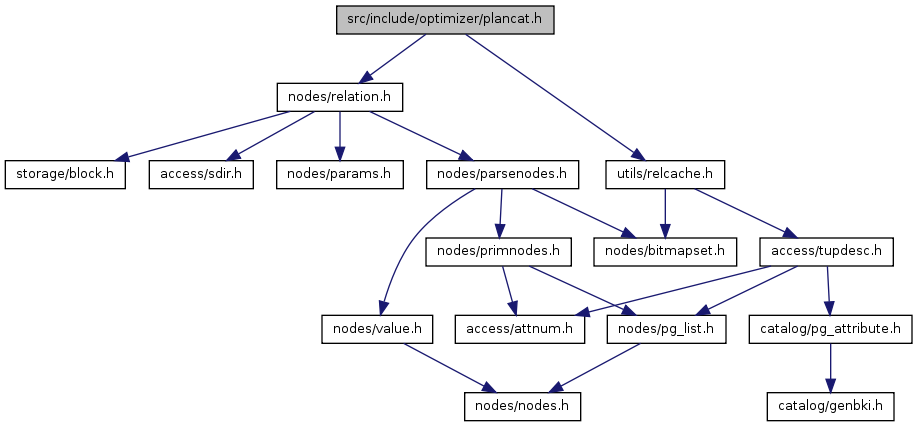

Go to the source code of this file.
Typedefs | |
| typedef void(* | get_relation_info_hook_type )(PlannerInfo *root, Oid relationObjectId, bool inhparent, RelOptInfo *rel) |
Functions | |
| void | get_relation_info (PlannerInfo *root, Oid relationObjectId, bool inhparent, RelOptInfo *rel) |
| void | estimate_rel_size (Relation rel, int32 *attr_widths, BlockNumber *pages, double *tuples, double *allvisfrac) |
| int32 | get_relation_data_width (Oid relid, int32 *attr_widths) |
| bool | relation_excluded_by_constraints (PlannerInfo *root, RelOptInfo *rel, RangeTblEntry *rte) |
| List * | build_physical_tlist (PlannerInfo *root, RelOptInfo *rel) |
| bool | has_unique_index (RelOptInfo *rel, AttrNumber attno) |
| Selectivity | restriction_selectivity (PlannerInfo *root, Oid operatorid, List *args, Oid inputcollid, int varRelid) |
| Selectivity | join_selectivity (PlannerInfo *root, Oid operatorid, List *args, Oid inputcollid, JoinType jointype, SpecialJoinInfo *sjinfo) |
Variables | |
| PGDLLIMPORT get_relation_info_hook_type | get_relation_info_hook |
| typedef void(* get_relation_info_hook_type)(PlannerInfo *root, Oid relationObjectId, bool inhparent, RelOptInfo *rel) |
| List* build_physical_tlist | ( | PlannerInfo * | root, | |
| RelOptInfo * | rel | |||
| ) |
Definition at line 848 of file plancat.c.
References tupleDesc::attrs, elog, ERROR, expandRTE(), heap_close, heap_open(), IsA, lappend(), lfirst, makeTargetEntry(), makeVar(), makeVarFromTargetEntry(), NoLock, NULL, planner_rt_fetch, RelationData::rd_att, RelationGetNumberOfAttributes, RangeTblEntry::relid, RelOptInfo::relid, TargetEntry::resjunk, TargetEntry::resno, RTE_CTE, RTE_FUNCTION, RTE_RELATION, RTE_SUBQUERY, RTE_VALUES, RangeTblEntry::rtekind, RangeTblEntry::subquery, and Query::targetList.
Referenced by create_scan_plan().
{
    List       *tlist = NIL;
    Index       varno = rel->relid;
    RangeTblEntry *rte = planner_rt_fetch(varno, root);
    Relation    relation;
    Query      *subquery;
    Var        *var;
    ListCell   *l;
    int         attrno,
                numattrs;
    List       *colvars;

    switch (rte->rtekind)
    {
        case RTE_RELATION:
            /* Assume we already have adequate lock */
            relation = heap_open(rte->relid, NoLock);

            numattrs = RelationGetNumberOfAttributes(relation);
            for (attrno = 1; attrno <= numattrs; attrno++)
            {
                Form_pg_attribute att_tup = relation->rd_att->attrs[attrno - 1];

                if (att_tup->attisdropped)
                {
                    /* found a dropped col, so punt */
                    tlist = NIL;
                    break;
                }

                var = makeVar(varno,
                              attrno,
                              att_tup->atttypid,
                              att_tup->atttypmod,
                              att_tup->attcollation,
                              0);

                tlist = lappend(tlist,
                                makeTargetEntry((Expr *) var,
                                                attrno,
                                                NULL,
                                                false));
            }

            heap_close(relation, NoLock);
            break;

        case RTE_SUBQUERY:
            subquery = rte->subquery;
            foreach(l, subquery->targetList)
            {
                TargetEntry *tle = (TargetEntry *) lfirst(l);

                /*
                 * A resjunk column of the subquery can be reflected as
                 * resjunk in the physical tlist; we need not punt.
                 */
                var = makeVarFromTargetEntry(varno, tle);

                tlist = lappend(tlist,
                                makeTargetEntry((Expr *) var,
                                                tle->resno,
                                                NULL,
                                                tle->resjunk));
            }
            break;

        case RTE_FUNCTION:
        case RTE_VALUES:
        case RTE_CTE:
            /* Not all of these can have dropped cols, but share code anyway */
            expandRTE(rte, varno, 0, -1, true /* include dropped */ ,
                      NULL, &colvars);
            foreach(l, colvars)
            {
                var = (Var *) lfirst(l);

                /*
                 * A non-Var in expandRTE's output means a dropped column;
                 * must punt.
                 */
                if (!IsA(var, Var))
                {
                    tlist = NIL;
                    break;
                }

                tlist = lappend(tlist,
                                makeTargetEntry((Expr *) var,
                                                var->varattno,
                                                NULL,
                                                false));
            }
            break;

        default:
            /* caller error */
            elog(ERROR, "unsupported RTE kind %d in build_physical_tlist",
                 (int) rte->rtekind);
            break;
    }

    return tlist;
}
| void estimate_rel_size | ( | Relation | rel, | |
| int32 * | attr_widths, | |||
| BlockNumber * | pages, | |||
| double * | tuples, | |||
| double * | allvisfrac | |||
| ) |
Definition at line 407 of file plancat.c.
References get_rel_data_width(), RelationData::rd_rel, RelationGetNumberOfBlocks, RELKIND_FOREIGN_TABLE, RELKIND_INDEX, RELKIND_MATVIEW, RELKIND_RELATION, RELKIND_SEQUENCE, RELKIND_TOASTVALUE, and rint().
Referenced by get_relation_info(), and hashbuild().
{
    BlockNumber curpages;
    BlockNumber relpages;
    double      reltuples;
    BlockNumber relallvisible;
    double      density;

    switch (rel->rd_rel->relkind)
    {
        case RELKIND_RELATION:
        case RELKIND_INDEX:
        case RELKIND_MATVIEW:
        case RELKIND_TOASTVALUE:
            /* it has storage, ok to call the smgr */
            curpages = RelationGetNumberOfBlocks(rel);

            /*
             * HACK: if the relation has never yet been vacuumed, use a
             * minimum size estimate of 10 pages.  The idea here is to avoid
             * assuming a newly-created table is really small, even if it
             * currently is, because that may not be true once some data gets
             * loaded into it.  Once a vacuum or analyze cycle has been done
             * on it, it's more reasonable to believe the size is somewhat
             * stable.
             *
             * (Note that this is only an issue if the plan gets cached and
             * used again after the table has been filled.  What we're trying
             * to avoid is using a nestloop-type plan on a table that has
             * grown substantially since the plan was made.  Normally,
             * autovacuum/autoanalyze will occur once enough inserts have
             * happened and cause cached-plan invalidation; but that doesn't
             * happen instantaneously, and it won't happen at all for cases
             * such as temporary tables.)
             *
             * We approximate "never vacuumed" by "has relpages = 0", which
             * means this will also fire on genuinely empty relations.  Not
             * great, but fortunately that's a seldom-seen case in the real
             * world, and it shouldn't degrade the quality of the plan too
             * much anyway to err in this direction.
             *
             * There are two exceptions wherein we don't apply this heuristic.
             * One is if the table has inheritance children.  Totally empty
             * parent tables are quite common, so we should be willing to
             * believe that they are empty.  Also, we don't apply the 10-page
             * minimum to indexes.
             */
            if (curpages < 10 &&
                rel->rd_rel->relpages == 0 &&
                !rel->rd_rel->relhassubclass &&
                rel->rd_rel->relkind != RELKIND_INDEX)
                curpages = 10;

            /* report estimated # pages */
            *pages = curpages;
            /* quick exit if rel is clearly empty */
            if (curpages == 0)
            {
                *tuples = 0;
                *allvisfrac = 0;
                break;
            }
            /* coerce values in pg_class to more desirable types */
            relpages = (BlockNumber) rel->rd_rel->relpages;
            reltuples = (double) rel->rd_rel->reltuples;
            relallvisible = (BlockNumber) rel->rd_rel->relallvisible;

            /*
             * If it's an index, discount the metapage while estimating the
             * number of tuples.  This is a kluge because it assumes more than
             * it ought to about index structure.  Currently it's OK for
             * btree, hash, and GIN indexes but suspect for GiST indexes.
             */
            if (rel->rd_rel->relkind == RELKIND_INDEX &&
                relpages > 0)
            {
                curpages--;
                relpages--;
            }

            /* estimate number of tuples from previous tuple density */
            if (relpages > 0)
                density = reltuples / (double) relpages;
            else
            {
                /*
                 * When we have no data because the relation was truncated,
                 * estimate tuple width from attribute datatypes.  We assume
                 * here that the pages are completely full, which is OK for
                 * tables (since they've presumably not been VACUUMed yet) but
                 * is probably an overestimate for indexes.  Fortunately
                 * get_relation_info() can clamp the overestimate to the
                 * parent table's size.
                 *
                 * Note: this code intentionally disregards alignment
                 * considerations, because (a) that would be gilding the lily
                 * considering how crude the estimate is, and (b) it creates
                 * platform dependencies in the default plans which are kind
                 * of a headache for regression testing.
                 */
                int32       tuple_width;

                tuple_width = get_rel_data_width(rel, attr_widths);
                tuple_width += sizeof(HeapTupleHeaderData);
                tuple_width += sizeof(ItemPointerData);
                /* note: integer division is intentional here */
                density = (BLCKSZ - SizeOfPageHeaderData) / tuple_width;
            }
            *tuples = rint(density * (double) curpages);

            /*
             * We use relallvisible as-is, rather than scaling it up like we
             * do for the pages and tuples counts, on the theory that any
             * pages added since the last VACUUM are most likely not marked
             * all-visible.  But costsize.c wants it converted to a fraction.
             */
            if (relallvisible == 0 || curpages <= 0)
                *allvisfrac = 0;
            else if ((double) relallvisible >= curpages)
                *allvisfrac = 1;
            else
                *allvisfrac = (double) relallvisible / curpages;
            break;
        case RELKIND_SEQUENCE:
            /* Sequences always have a known size */
            *pages = 1;
            *tuples = 1;
            *allvisfrac = 0;
            break;
        case RELKIND_FOREIGN_TABLE:
            /* Just use whatever's in pg_class */
            *pages = rel->rd_rel->relpages;
            *tuples = rel->rd_rel->reltuples;
            *allvisfrac = 0;
            break;
        default:
            /* else it has no disk storage; probably shouldn't get here? */
            *pages = 0;
            *tuples = 0;
            *allvisfrac = 0;
            break;
    }
}
Definition at line 609 of file plancat.c.
References get_rel_data_width(), heap_close, heap_open(), and NoLock.
Referenced by plan_cluster_use_sort(), and set_rel_width().
{
    int32       result;
    Relation    relation;

    /* As above, assume relation is already locked */
    relation = heap_open(relid, NoLock);

    result = get_rel_data_width(relation, attr_widths);

    heap_close(relation, NoLock);

    return result;
}
| void get_relation_info | ( | PlannerInfo * | root, | |
| Oid | relationObjectId, | |||
| bool | inhparent, | |||
| RelOptInfo * | rel | |||
| ) |
Definition at line 85 of file plancat.c.
References _bt_getrootheight(), RelOptInfo::allvisfrac, IndexOptInfo::amcanorderbyop, IndexOptInfo::amcostestimate, IndexOptInfo::amhasgetbitmap, IndexOptInfo::amhasgettuple, IndexOptInfo::amoptionalkey, IndexOptInfo::amsearcharray, IndexOptInfo::amsearchnulls, Assert, RelOptInfo::attr_needed, RelOptInfo::attr_widths, BTLessStrategyNumber, BTREE_AM_OID, build_index_tlist(), IndexOptInfo::canreturn, ChangeVarNodes(), ereport, errcode(), errmsg(), ERROR, estimate_rel_size(), RelOptInfo::fdwroutine, FirstLowInvalidHeapAttributeNumber, get_opfamily_member(), get_ordering_op_properties(), get_relation_info_hook, GetFdwRoutineForRelation(), PlannerInfo::glob, heap_close, heap_open(), HeapTupleHeaderGetXmin, IndexOptInfo::hypothetical, i, IgnoreSystemIndexes, IndexOptInfo::immediate, index_can_return(), index_close(), index_open(), IndexOptInfo::indexcollations, IndexIsValid, IndexOptInfo::indexkeys, RelOptInfo::indexlist, IndexOptInfo::indexoid, IndexOptInfo::indexprs, IndexOptInfo::indextlist, IndexOptInfo::indpred, IsSystemClass(), lcons(), lfirst_oid, list_free(), makeNode, RelOptInfo::max_attr, RelOptInfo::min_attr, IndexOptInfo::ncolumns, NIL, NoLock, NULL, IndexOptInfo::nulls_first, OidIsValid, IndexOptInfo::opcintype, IndexOptInfo::opfamily, IndexOptInfo::pages, RelOptInfo::pages, palloc(), palloc0(), PlannerInfo::parse, IndexOptInfo::predOK, RelationData::rd_am, RelationData::rd_indcollation, RelationData::rd_index, RelationData::rd_indextuple, RelationData::rd_indoption, RelationData::rd_opcintype, RelationData::rd_opfamily, RelationData::rd_rel, RecoveryInProgress(), IndexOptInfo::rel, IndexOptInfo::relam, RelationGetForm, RelationGetIndexExpressions(), RelationGetIndexList(), RelationGetIndexPredicate(), RelationGetNumberOfAttributes, RelationGetNumberOfBlocks, RelationNeedsWAL, RelOptInfo::relid, RELKIND_FOREIGN_TABLE, IndexOptInfo::reltablespace, RelOptInfo::reltablespace, Query::resultRelation, IndexOptInfo::reverse_sort, IndexOptInfo::sortopfamily, HeapTupleData::t_data, TransactionIdPrecedes(), TransactionXmin, PlannerGlobal::transientPlan, IndexOptInfo::tree_height, IndexOptInfo::tuples, RelOptInfo::tuples, and IndexOptInfo::unique.
Referenced by build_simple_rel().
{
    Index       varno = rel->relid;
    Relation    relation;
    bool        hasindex;
    List       *indexinfos = NIL;

    /*
     * We need not lock the relation since it was already locked, either by
     * the rewriter or when expand_inherited_rtentry() added it to the query's
     * rangetable.
     */
    relation = heap_open(relationObjectId, NoLock);

    /* Temporary and unlogged relations are inaccessible during recovery. */
    if (!RelationNeedsWAL(relation) && RecoveryInProgress())
        ereport(ERROR,
                (errcode(ERRCODE_FEATURE_NOT_SUPPORTED),
                 errmsg("cannot access temporary or unlogged relations during recovery")));

    rel->min_attr = FirstLowInvalidHeapAttributeNumber + 1;
    rel->max_attr = RelationGetNumberOfAttributes(relation);
    rel->reltablespace = RelationGetForm(relation)->reltablespace;

    Assert(rel->max_attr >= rel->min_attr);
    rel->attr_needed = (Relids *)
        palloc0((rel->max_attr - rel->min_attr + 1) * sizeof(Relids));
    rel->attr_widths = (int32 *)
        palloc0((rel->max_attr - rel->min_attr + 1) * sizeof(int32));

    /*
     * Estimate relation size --- unless it's an inheritance parent, in which
     * case the size will be computed later in set_append_rel_pathlist, and we
     * must leave it zero for now to avoid bollixing the total_table_pages
     * calculation.
     */
    if (!inhparent)
        estimate_rel_size(relation, rel->attr_widths - rel->min_attr,
                          &rel->pages, &rel->tuples, &rel->allvisfrac);

    /*
     * Make list of indexes.  Ignore indexes on system catalogs if told to.
     * Don't bother with indexes for an inheritance parent, either.
     */
    if (inhparent ||
        (IgnoreSystemIndexes && IsSystemClass(relation->rd_rel)))
        hasindex = false;
    else
        hasindex = relation->rd_rel->relhasindex;

    if (hasindex)
    {
        List       *indexoidlist;
        ListCell   *l;
        LOCKMODE    lmode;

        indexoidlist = RelationGetIndexList(relation);

        /*
         * For each index, we get the same type of lock that the executor will
         * need, and do not release it.  This saves a couple of trips to the
         * shared lock manager while not creating any real loss of
         * concurrency, because no schema changes could be happening on the
         * index while we hold lock on the parent rel, and neither lock type
         * blocks any other kind of index operation.
         */
        if (rel->relid == root->parse->resultRelation)
            lmode = RowExclusiveLock;
        else
            lmode = AccessShareLock;

        foreach(l, indexoidlist)
        {
            Oid         indexoid = lfirst_oid(l);
            Relation    indexRelation;
            Form_pg_index index;
            IndexOptInfo *info;
            int         ncolumns;
            int         i;

            /*
             * Extract info from the relation descriptor for the index.
             */
            indexRelation = index_open(indexoid, lmode);
            index = indexRelation->rd_index;

            /*
             * Ignore invalid indexes, since they can't safely be used for
             * queries.  Note that this is OK because the data structure we
             * are constructing is only used by the planner --- the executor
             * still needs to insert into "invalid" indexes, if they're marked
             * IndexIsReady.
             */
            if (!IndexIsValid(index))
            {
                index_close(indexRelation, NoLock);
                continue;
            }

            /*
             * If the index is valid, but cannot yet be used, ignore it; but
             * mark the plan we are generating as transient. See
             * src/backend/access/heap/README.HOT for discussion.
             */
            if (index->indcheckxmin &&
                !TransactionIdPrecedes(HeapTupleHeaderGetXmin(indexRelation->rd_indextuple->t_data),
                                       TransactionXmin))
            {
                root->glob->transientPlan = true;
                index_close(indexRelation, NoLock);
                continue;
            }

            info = makeNode(IndexOptInfo);

            info->indexoid = index->indexrelid;
            info->reltablespace =
                RelationGetForm(indexRelation)->reltablespace;
            info->rel = rel;
            info->ncolumns = ncolumns = index->indnatts;
            info->indexkeys = (int *) palloc(sizeof(int) * ncolumns);
            info->indexcollations = (Oid *) palloc(sizeof(Oid) * ncolumns);
            info->opfamily = (Oid *) palloc(sizeof(Oid) * ncolumns);
            info->opcintype = (Oid *) palloc(sizeof(Oid) * ncolumns);

            for (i = 0; i < ncolumns; i++)
            {
                info->indexkeys[i] = index->indkey.values[i];
                info->indexcollations[i] = indexRelation->rd_indcollation[i];
                info->opfamily[i] = indexRelation->rd_opfamily[i];
                info->opcintype[i] = indexRelation->rd_opcintype[i];
            }

            info->relam = indexRelation->rd_rel->relam;
            info->amcostestimate = indexRelation->rd_am->amcostestimate;
            info->canreturn = index_can_return(indexRelation);
            info->amcanorderbyop = indexRelation->rd_am->amcanorderbyop;
            info->amoptionalkey = indexRelation->rd_am->amoptionalkey;
            info->amsearcharray = indexRelation->rd_am->amsearcharray;
            info->amsearchnulls = indexRelation->rd_am->amsearchnulls;
            info->amhasgettuple = OidIsValid(indexRelation->rd_am->amgettuple);
            info->amhasgetbitmap = OidIsValid(indexRelation->rd_am->amgetbitmap);

            /*
             * Fetch the ordering information for the index, if any.
             */
            if (info->relam == BTREE_AM_OID)
            {
                /*
                 * If it's a btree index, we can use its opfamily OIDs
                 * directly as the sort ordering opfamily OIDs.
                 */
                Assert(indexRelation->rd_am->amcanorder);

                info->sortopfamily = info->opfamily;
                info->reverse_sort = (bool *) palloc(sizeof(bool) * ncolumns);
                info->nulls_first = (bool *) palloc(sizeof(bool) * ncolumns);

                for (i = 0; i < ncolumns; i++)
                {
                    int16       opt = indexRelation->rd_indoption[i];

                    info->reverse_sort[i] = (opt & INDOPTION_DESC) != 0;
                    info->nulls_first[i] = (opt & INDOPTION_NULLS_FIRST) != 0;
                }
            }
            else if (indexRelation->rd_am->amcanorder)
            {
                /*
                 * Otherwise, identify the corresponding btree opfamilies by
                 * trying to map this index's "<" operators into btree.  Since
                 * "<" uniquely defines the behavior of a sort order, this is
                 * a sufficient test.
                 *
                 * XXX This method is rather slow and also requires the
                 * undesirable assumption that the other index AM numbers its
                 * strategies the same as btree.  It'd be better to have a way
                 * to explicitly declare the corresponding btree opfamily for
                 * each opfamily of the other index type.  But given the lack
                 * of current or foreseeable amcanorder index types, it's not
                 * worth expending more effort on now.
                 */
                info->sortopfamily = (Oid *) palloc(sizeof(Oid) * ncolumns);
                info->reverse_sort = (bool *) palloc(sizeof(bool) * ncolumns);
                info->nulls_first = (bool *) palloc(sizeof(bool) * ncolumns);

                for (i = 0; i < ncolumns; i++)
                {
                    int16       opt = indexRelation->rd_indoption[i];
                    Oid         ltopr;
                    Oid         btopfamily;
                    Oid         btopcintype;
                    int16       btstrategy;

                    info->reverse_sort[i] = (opt & INDOPTION_DESC) != 0;
                    info->nulls_first[i] = (opt & INDOPTION_NULLS_FIRST) != 0;

                    ltopr = get_opfamily_member(info->opfamily[i],
                                                info->opcintype[i],
                                                info->opcintype[i],
                                                BTLessStrategyNumber);
                    if (OidIsValid(ltopr) &&
                        get_ordering_op_properties(ltopr,
                                                   &btopfamily,
                                                   &btopcintype,
                                                   &btstrategy) &&
                        btopcintype == info->opcintype[i] &&
                        btstrategy == BTLessStrategyNumber)
                    {
                        /* Successful mapping */
                        info->sortopfamily[i] = btopfamily;
                    }
                    else
                    {
                        /* Fail ... quietly treat index as unordered */
                        info->sortopfamily = NULL;
                        info->reverse_sort = NULL;
                        info->nulls_first = NULL;
                        break;
                    }
                }
            }
            else
            {
                info->sortopfamily = NULL;
                info->reverse_sort = NULL;
                info->nulls_first = NULL;
            }

            /*
             * Fetch the index expressions and predicate, if any.  We must
             * modify the copies we obtain from the relcache to have the
             * correct varno for the parent relation, so that they match up
             * correctly against qual clauses.
             */
            info->indexprs = RelationGetIndexExpressions(indexRelation);
            info->indpred = RelationGetIndexPredicate(indexRelation);
            if (info->indexprs && varno != 1)
                ChangeVarNodes((Node *) info->indexprs, 1, varno, 0);
            if (info->indpred && varno != 1)
                ChangeVarNodes((Node *) info->indpred, 1, varno, 0);

            /* Build targetlist using the completed indexprs data */
            info->indextlist = build_index_tlist(root, info, relation);

            info->predOK = false;       /* set later in indxpath.c */
            info->unique = index->indisunique;
            info->immediate = index->indimmediate;
            info->hypothetical = false;

            /*
             * Estimate the index size.  If it's not a partial index, we lock
             * the number-of-tuples estimate to equal the parent table; if it
             * is partial then we have to use the same methods as we would for
             * a table, except we can be sure that the index is not larger
             * than the table.
             */
            if (info->indpred == NIL)
            {
                info->pages = RelationGetNumberOfBlocks(indexRelation);
                info->tuples = rel->tuples;
            }
            else
            {
                double      allvisfrac; /* dummy */

                estimate_rel_size(indexRelation, NULL,
                                  &info->pages, &info->tuples, &allvisfrac);
                if (info->tuples > rel->tuples)
                    info->tuples = rel->tuples;
            }

            if (info->relam == BTREE_AM_OID)
            {
                /* For btrees, get tree height while we have the index open */
                info->tree_height = _bt_getrootheight(indexRelation);
            }
            else
            {
                /* For other index types, just set it to "unknown" for now */
                info->tree_height = -1;
            }

            index_close(indexRelation, NoLock);

            indexinfos = lcons(info, indexinfos);
        }

        list_free(indexoidlist);
    }

    rel->indexlist = indexinfos;

    /* Grab the fdwroutine info using the relcache, while we have it */
    if (relation->rd_rel->relkind == RELKIND_FOREIGN_TABLE)
        rel->fdwroutine = GetFdwRoutineForRelation(relation, true);
    else
        rel->fdwroutine = NULL;

    heap_close(relation, NoLock);

    /*
     * Allow a plugin to editorialize on the info we obtained from the
     * catalogs.  Actions might include altering the assumed relation size,
     * removing an index, or adding a hypothetical index to the indexlist.
     */
    if (get_relation_info_hook)
        (*get_relation_info_hook) (root, relationObjectId, inhparent, rel);
}
| bool has_unique_index | ( | RelOptInfo * | rel, | |
| AttrNumber | attno | |||
| ) |
Definition at line 1109 of file plancat.c.
References IndexOptInfo::indexkeys, RelOptInfo::indexlist, IndexOptInfo::indpred, lfirst, IndexOptInfo::ncolumns, NIL, IndexOptInfo::predOK, and IndexOptInfo::unique.
Referenced by examine_variable().
{
    ListCell   *ilist;

    foreach(ilist, rel->indexlist)
    {
        IndexOptInfo *index = (IndexOptInfo *) lfirst(ilist);

        /*
         * Note: ignore partial indexes, since they don't allow us to conclude
         * that all attr values are distinct, *unless* they are marked predOK
         * which means we know the index's predicate is satisfied by the
         * query. We don't take any interest in expressional indexes either.
         * Also, a multicolumn unique index doesn't allow us to conclude that
         * just the specified attr is unique.
         */
        if (index->unique &&
            index->ncolumns == 1 &&
            index->indexkeys[0] == attno &&
            (index->indpred == NIL || index->predOK))
            return true;
    }
    return false;
}
| Selectivity join_selectivity | ( | PlannerInfo * | root, | |
| Oid | operatorid, | |||
| List * | args, | |||
| Oid | inputcollid, | |||
| JoinType | jointype, | |||
| SpecialJoinInfo * | sjinfo | |||
| ) |
Definition at line 1065 of file plancat.c.
References DatumGetFloat8, elog, ERROR, get_oprjoin(), Int16GetDatum, ObjectIdGetDatum, OidFunctionCall5Coll(), and PointerGetDatum.
Referenced by clause_selectivity(), and rowcomparesel().
{
    RegProcedure oprjoin = get_oprjoin(operatorid);
    float8      result;

    /*
     * if the oprjoin procedure is missing for whatever reason, use a
     * selectivity of 0.5
     */
    if (!oprjoin)
        return (Selectivity) 0.5;

    result = DatumGetFloat8(OidFunctionCall5Coll(oprjoin,
                                                 inputcollid,
                                                 PointerGetDatum(root),
                                                 ObjectIdGetDatum(operatorid),
                                                 PointerGetDatum(args),
                                                 Int16GetDatum(jointype),
                                                 PointerGetDatum(sjinfo)));

    if (result < 0.0 || result > 1.0)
        elog(ERROR, "invalid join selectivity: %f", result);

    return (Selectivity) result;
}
| bool relation_excluded_by_constraints | ( | PlannerInfo * | root, | |
| RelOptInfo * | rel, | |||
| RangeTblEntry * | rte | |||
| ) |
Definition at line 747 of file plancat.c.
References RelOptInfo::baserestrictinfo, RestrictInfo::clause, constraint_exclusion, CONSTRAINT_EXCLUSION_OFF, CONSTRAINT_EXCLUSION_PARTITION, contain_mutable_functions(), get_relation_constraints(), PlannerInfo::hasInheritedTarget, RangeTblEntry::inh, lappend(), lfirst, PlannerInfo::parse, predicate_refuted_by(), RangeTblEntry::relid, RelOptInfo::relid, RELOPT_BASEREL, RELOPT_OTHER_MEMBER_REL, RelOptInfo::reloptkind, Query::resultRelation, RTE_RELATION, and RangeTblEntry::rtekind.
Referenced by set_append_rel_size(), and set_rel_size().
{
    List       *safe_restrictions;
    List       *constraint_pred;
    List       *safe_constraints;
    ListCell   *lc;

    /* Skip the test if constraint exclusion is disabled for the rel */
    if (constraint_exclusion == CONSTRAINT_EXCLUSION_OFF ||
        (constraint_exclusion == CONSTRAINT_EXCLUSION_PARTITION &&
         !(rel->reloptkind == RELOPT_OTHER_MEMBER_REL ||
           (root->hasInheritedTarget &&
            rel->reloptkind == RELOPT_BASEREL &&
            rel->relid == root->parse->resultRelation))))
        return false;

    /*
     * Check for self-contradictory restriction clauses.  We dare not make
     * deductions with non-immutable functions, but any immutable clauses that
     * are self-contradictory allow us to conclude the scan is unnecessary.
     *
     * Note: strip off RestrictInfo because predicate_refuted_by() isn't
     * expecting to see any in its predicate argument.
     */
    safe_restrictions = NIL;
    foreach(lc, rel->baserestrictinfo)
    {
        RestrictInfo *rinfo = (RestrictInfo *) lfirst(lc);

        if (!contain_mutable_functions((Node *) rinfo->clause))
            safe_restrictions = lappend(safe_restrictions, rinfo->clause);
    }

    if (predicate_refuted_by(safe_restrictions, safe_restrictions))
        return true;

    /* Only plain relations have constraints */
    if (rte->rtekind != RTE_RELATION || rte->inh)
        return false;

    /*
     * OK to fetch the constraint expressions.  Include "col IS NOT NULL"
     * expressions for attnotnull columns, in case we can refute those.
     */
    constraint_pred = get_relation_constraints(root, rte->relid, rel, true);

    /*
     * We do not currently enforce that CHECK constraints contain only
     * immutable functions, so it's necessary to check here. We daren't draw
     * conclusions from plan-time evaluation of non-immutable functions. Since
     * they're ANDed, we can just ignore any mutable constraints in the list,
     * and reason about the rest.
     */
    safe_constraints = NIL;
    foreach(lc, constraint_pred)
    {
        Node       *pred = (Node *) lfirst(lc);

        if (!contain_mutable_functions(pred))
            safe_constraints = lappend(safe_constraints, pred);
    }

    /*
     * The constraints are effectively ANDed together, so we can just try to
     * refute the entire collection at once.  This may allow us to make proofs
     * that would fail if we took them individually.
     *
     * Note: we use rel->baserestrictinfo, not safe_restrictions as might seem
     * an obvious optimization.  Some of the clauses might be OR clauses that
     * have volatile and nonvolatile subclauses, and it's OK to make
     * deductions with the nonvolatile parts.
     */
    if (predicate_refuted_by(safe_constraints, rel->baserestrictinfo))
        return true;

    return false;
}
| Selectivity restriction_selectivity | ( | PlannerInfo * | root, | |
| Oid | operatorid, | |||
| List * | args, | |||
| Oid | inputcollid, | |||
| int | varRelid | |||
| ) |
Definition at line 1028 of file plancat.c.
References DatumGetFloat8, elog, ERROR, get_oprrest(), Int32GetDatum, ObjectIdGetDatum, OidFunctionCall4Coll(), and PointerGetDatum.
Referenced by clause_selectivity(), and rowcomparesel().
{
    RegProcedure oprrest = get_oprrest(operatorid);
    float8      result;

    /*
     * if the oprrest procedure is missing for whatever reason, use a
     * selectivity of 0.5
     */
    if (!oprrest)
        return (Selectivity) 0.5;

    result = DatumGetFloat8(OidFunctionCall4Coll(oprrest,
                                                 inputcollid,
                                                 PointerGetDatum(root),
                                                 ObjectIdGetDatum(operatorid),
                                                 PointerGetDatum(args),
                                                 Int32GetDatum(varRelid)));

    if (result < 0.0 || result > 1.0)
        elog(ERROR, "invalid restriction selectivity: %f", result);

    return (Selectivity) result;
}
| PGDLLIMPORT get_relation_info_hook_type get_relation_info_hook |
Definition at line 50 of file plancat.c.
Referenced by get_relation_info().
 1.7.1
1.7.1