Header And Logo

|

#include "access/sdir.h"#include "access/skey.h"#include "nodes/primnodes.h"#include "storage/bufpage.h"#include "storage/lock.h"#include "utils/relcache.h"#include "utils/snapshot.h"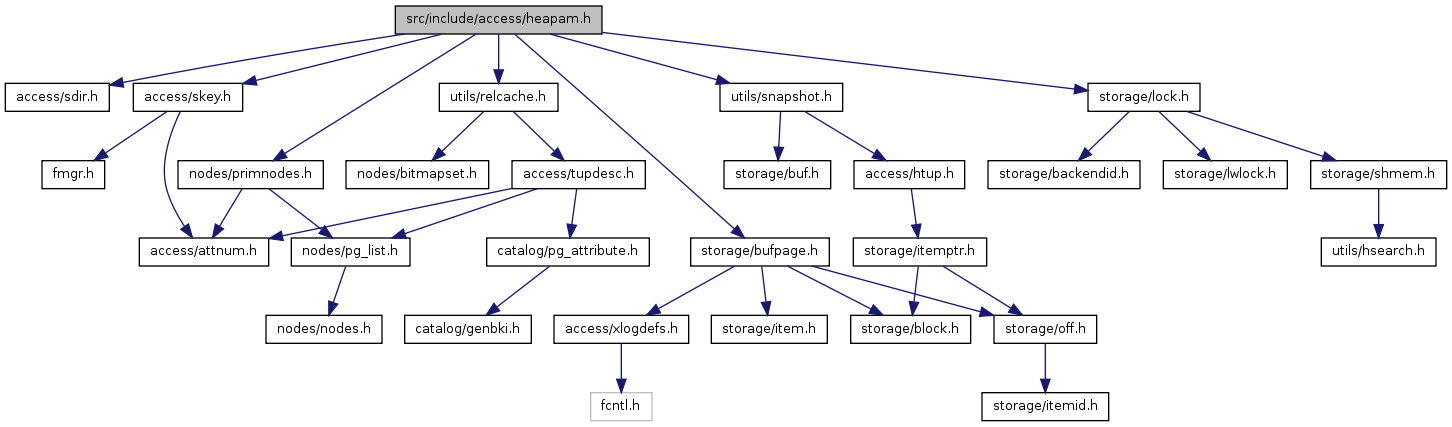
Go to the source code of this file.
| #define heap_close | ( | r, | ||
| l | ||||
| ) | relation_close(r,l) |
Definition at line 95 of file heapam.h.
Referenced by acquire_inherited_sample_rows(), AcquireRewriteLocks(), AddEnumLabel(), AddNewAttributeTuples(), addRangeTableEntry(), AddRoleMems(), afterTriggerInvokeEvents(), AfterTriggerSetState(), AggregateCreate(), AlterConstraintNamespaces(), AlterDatabase(), AlterDatabaseOwner(), AlterDomainAddConstraint(), AlterDomainDefault(), AlterDomainDropConstraint(), AlterDomainNotNull(), AlterDomainValidateConstraint(), AlterEventTrigger(), AlterEventTriggerOwner(), AlterEventTriggerOwner_oid(), AlterExtensionNamespace(), AlterForeignDataWrapper(), AlterForeignDataWrapperOwner(), AlterForeignDataWrapperOwner_oid(), AlterForeignServer(), AlterForeignServerOwner(), AlterForeignServerOwner_oid(), AlterFunction(), AlterObjectNamespace_oid(), AlterRole(), AlterSchemaOwner(), AlterSchemaOwner_oid(), AlterSetting(), AlterTableCreateToastTable(), AlterTableNamespaceInternal(), AlterTableSpaceOptions(), AlterTSConfiguration(), AlterTSDictionary(), AlterTypeNamespaceInternal(), AlterTypeOwner(), AlterTypeOwnerInternal(), AlterUserMapping(), AppendAttributeTuples(), ApplyExtensionUpdates(), AssignTypeArrayOid(), ATAddCheckConstraint(), ATAddForeignKeyConstraint(), ATExecAddColumn(), ATExecAddInherit(), ATExecAddOf(), ATExecAlterColumnGenericOptions(), ATExecAlterColumnType(), ATExecChangeOwner(), ATExecDropColumn(), ATExecDropConstraint(), ATExecDropInherit(), ATExecDropNotNull(), ATExecDropOf(), ATExecGenericOptions(), ATExecSetNotNull(), ATExecSetOptions(), ATExecSetRelOptions(), ATExecSetStatistics(), ATExecSetStorage(), ATExecSetTableSpace(), ATExecValidateConstraint(), ATRewriteTable(), ATRewriteTables(), AttrDefaultFetch(), boot_openrel(), BootstrapToastTable(), build_indices(), build_physical_tlist(), CatalogCacheInitializeCache(), change_owner_fix_column_acls(), changeDependencyFor(), changeDependencyOnOwner(), check_db_file_conflict(), check_functional_grouping(), check_selective_binary_conversion(), CheckConstraintFetch(), checkSharedDependencies(), ChooseConstraintName(), close_lo_relation(), closerel(), cluster(), CollationCreate(), ConstraintNameIsUsed(), ConversionCreate(), copy_heap_data(), copyTemplateDependencies(), create_proc_lang(), create_toast_table(), CreateCast(), CreateComments(), CreateConstraintEntry(), createdb(), CreateForeignDataWrapper(), CreateForeignServer(), CreateForeignTable(), CreateOpFamily(), CreateRole(), CreateSharedComments(), CreateTableSpace(), CreateTrigger(), CreateUserMapping(), currtid_byrelname(), currtid_byreloid(), currtid_for_view(), database_to_xmlschema_internal(), DefineIndex(), DefineOpClass(), DefineQueryRewrite(), DefineSequence(), DefineTSConfiguration(), DefineTSDictionary(), DefineTSParser(), DefineTSTemplate(), DeleteAttributeTuples(), DeleteComments(), deleteDependencyRecordsFor(), deleteDependencyRecordsForClass(), deleteOneObject(), DeleteRelationTuple(), DeleteSecurityLabel(), DeleteSharedComments(), deleteSharedDependencyRecordsFor(), DeleteSharedSecurityLabel(), DeleteSystemAttributeTuples(), deleteWhatDependsOn(), DelRoleMems(), deparseSelectSql(), do_autovacuum(), DoCopy(), drop_parent_dependency(), DropCastById(), dropDatabaseDependencies(), dropdb(), DropProceduralLanguageById(), DropRole(), DropSetting(), DropTableSpace(), EnableDisableRule(), EnableDisableTrigger(), enum_endpoint(), enum_range_internal(), EnumValuesCreate(), EnumValuesDelete(), EvalPlanQualEnd(), EventTriggerSQLDropAddObject(), exec_object_restorecon(), ExecAlterExtensionStmt(), ExecAlterObjectSchemaStmt(), ExecAlterOwnerStmt(), ExecCloseScanRelation(), ExecEndPlan(), ExecGrant_Database(), ExecGrant_Fdw(), ExecGrant_ForeignServer(), ExecGrant_Function(), ExecGrant_Language(), ExecGrant_Largeobject(), ExecGrant_Namespace(), ExecGrant_Relation(), ExecGrant_Tablespace(), ExecGrant_Type(), ExecRefreshMatView(), ExecRenameStmt(), ExecuteTruncate(), expand_inherited_rtentry(), expand_targetlist(), extension_config_remove(), find_inheritance_children(), find_language_template(), find_typed_table_dependencies(), fireRIRrules(), free_parsestate(), get_actual_variable_range(), get_constraint_index(), get_database_list(), get_database_oid(), get_db_info(), get_domain_constraint_oid(), get_extension_name(), get_extension_oid(), get_extension_schema(), get_file_fdw_attribute_options(), get_index_constraint(), get_object_address_relobject(), get_pkey_attnames(), get_rel_oids(), get_relation_constraint_oid(), get_relation_constraints(), get_relation_data_width(), get_relation_info(), get_rewrite_oid_without_relid(), get_tablespace_name(), get_tablespace_oid(), get_trigger_oid(), GetComment(), getConstraintTypeDescription(), GetDatabaseTuple(), GetDatabaseTupleByOid(), GetDefaultOpClass(), GetDomainConstraints(), getExtensionOfObject(), getObjectDescription(), getObjectIdentity(), getOwnedSequences(), getRelationsInNamespace(), GetSecurityLabel(), GetSharedSecurityLabel(), gettype(), GrantRole(), heap_create_with_catalog(), heap_drop_with_catalog(), heap_sync(), heap_truncate(), heap_truncate_find_FKs(), heap_truncate_one_rel(), index_build(), index_constraint_create(), index_create(), index_drop(), index_set_state_flags(), index_update_stats(), insert_event_trigger_tuple(), InsertExtensionTuple(), InsertRule(), intorel_shutdown(), isQueryUsingTempRelation_walker(), LargeObjectCreate(), LargeObjectDrop(), LargeObjectExists(), load_enum_cache_data(), lookup_ts_config_cache(), LookupOpclassInfo(), make_new_heap(), make_viewdef(), makeArrayTypeName(), mark_index_clustered(), MergeAttributes(), MergeAttributesIntoExisting(), MergeConstraintsIntoExisting(), MergeWithExistingConstraint(), movedb(), myLargeObjectExists(), NamespaceCreate(), objectsInSchemaToOids(), OperatorCreate(), OperatorShellMake(), OperatorUpd(), performDeletion(), performMultipleDeletions(), pg_extension_config_dump(), pg_extension_ownercheck(), pg_get_serial_sequence(), pg_get_triggerdef_worker(), pg_identify_object(), pg_largeobject_aclmask_snapshot(), pg_largeobject_ownercheck(), pgrowlocks(), pgstat_collect_oids(), postgresPlanForeignModify(), ProcedureCreate(), process_settings(), RangeCreate(), RangeDelete(), rebuild_relation(), recordMultipleDependencies(), recordSharedDependencyOn(), regclassin(), regoperin(), regprocin(), regtypein(), reindex_index(), reindex_relation(), ReindexDatabase(), RelationBuildRuleLock(), RelationBuildTriggers(), RelationBuildTupleDesc(), RelationGetExclusionInfo(), RelationGetIndexList(), RelationRemoveInheritance(), RelationSetNewRelfilenode(), remove_dbtablespaces(), RemoveAmOpEntryById(), RemoveAmProcEntryById(), RemoveAttrDefault(), RemoveAttrDefaultById(), RemoveAttributeById(), RemoveCollationById(), RemoveConstraintById(), RemoveConversionById(), RemoveDefaultACLById(), RemoveEventTriggerById(), RemoveExtensionById(), RemoveForeignDataWrapperById(), RemoveForeignServerById(), RemoveFunctionById(), RemoveObjects(), RemoveOpClassById(), RemoveOperatorById(), RemoveOpFamilyById(), RemoveRewriteRuleById(), RemoveRoleFromObjectACL(), RemoveSchemaById(), RemoveStatistics(), RemoveTriggerById(), RemoveTSConfigurationById(), RemoveTSDictionaryById(), RemoveTSParserById(), RemoveTSTemplateById(), RemoveTypeById(), RemoveUserMappingById(), renameatt_internal(), RenameConstraint(), RenameConstraintById(), RenameDatabase(), RenameRelationInternal(), RenameRewriteRule(), RenameRole(), RenameSchema(), RenameTableSpace(), renametrig(), RenameType(), RenameTypeInternal(), RewriteQuery(), rewriteTargetView(), RI_FKey_cascade_del(), RI_FKey_cascade_upd(), RI_FKey_check(), RI_FKey_setdefault_del(), RI_FKey_setdefault_upd(), RI_FKey_setnull_del(), RI_FKey_setnull_upd(), ri_restrict_del(), ri_restrict_upd(), ScanPgRelation(), schema_to_xmlschema_internal(), SearchCatCache(), SearchCatCacheList(), sepgsql_attribute_post_create(), sepgsql_database_post_create(), sepgsql_index_modify(), sepgsql_proc_post_create(), sepgsql_proc_setattr(), sepgsql_relation_post_create(), sepgsql_relation_setattr(), sepgsql_schema_post_create(), sequenceIsOwned(), SetDefaultACL(), SetFunctionArgType(), SetFunctionReturnType(), SetRelationHasSubclass(), SetRelationNumChecks(), SetRelationRuleStatus(), SetSecurityLabel(), SetSharedSecurityLabel(), setTargetTable(), shdepDropOwned(), shdepReassignOwned(), StoreAttrDefault(), StoreCatalogInheritance(), storeOperators(), storeProcedures(), swap_relation_files(), table_to_xml_and_xmlschema(), table_to_xmlschema(), ThereIsAtLeastOneRole(), toast_delete_datum(), toast_fetch_datum(), toast_fetch_datum_slice(), toast_save_datum(), toastid_valueid_exists(), transformIndexConstraint(), transformIndexStmt(), transformRuleStmt(), transformTableLikeClause(), transientrel_shutdown(), TypeCreate(), typeInheritsFrom(), TypeShellMake(), update_attstats(), updateAclDependencies(), UpdateIndexRelation(), vac_truncate_clog(), vac_update_datfrozenxid(), vac_update_relstats(), validate_index(), and validateDomainConstraint().
| #define HEAP_INSERT_FROZEN 0x0004 |
Definition at line 29 of file heapam.h.
Referenced by heap_prepare_insert().
| #define HEAP_INSERT_SKIP_FSM 0x0002 |
Definition at line 28 of file heapam.h.
Referenced by intorel_startup(), raw_heap_insert(), and transientrel_startup().
| #define HEAP_INSERT_SKIP_WAL 0x0001 |
Definition at line 27 of file heapam.h.
Referenced by ATRewriteTable(), CopyFrom(), heap_insert(), intorel_shutdown(), raw_heap_insert(), and transientrel_shutdown().
| typedef struct BulkInsertStateData* BulkInsertState |
| typedef struct HeapScanDescData* HeapScanDesc |
| typedef struct HeapUpdateFailureData HeapUpdateFailureData |
| typedef enum LockTupleMode LockTupleMode |
| enum LockTupleMode |
Definition at line 36 of file heapam.h.
{
    /* SELECT FOR KEY SHARE */
    LockTupleKeyShare,
    /* SELECT FOR SHARE */
    LockTupleShare,
    /* SELECT FOR NO KEY UPDATE, and UPDATEs that don't modify key columns */
    LockTupleNoKeyExclusive,
    /* SELECT FOR UPDATE, UPDATEs that modify key columns, and DELETE */
    LockTupleExclusive
} LockTupleMode;
| void FreeBulkInsertState | ( | BulkInsertState | ) |
Definition at line 1969 of file heapam.c.
References BulkInsertStateData::current_buf, FreeAccessStrategy(), InvalidBuffer, pfree(), ReleaseBuffer(), and BulkInsertStateData::strategy.
Referenced by ATRewriteTable(), CopyFrom(), intorel_shutdown(), and transientrel_shutdown().
{
    if (bistate->current_buf != InvalidBuffer)
        ReleaseBuffer(bistate->current_buf);
    FreeAccessStrategy(bistate->strategy);
    pfree(bistate);
}
| BulkInsertState GetBulkInsertState | ( | void | ) |
Definition at line 1955 of file heapam.c.
References BAS_BULKWRITE, BulkInsertStateData::current_buf, GetAccessStrategy(), palloc(), and BulkInsertStateData::strategy.
Referenced by ATRewriteTable(), CopyFrom(), intorel_startup(), and transientrel_startup().
{
    BulkInsertState bistate;

    bistate = (BulkInsertState) palloc(sizeof(BulkInsertStateData));
    bistate->strategy = GetAccessStrategy(BAS_BULKWRITE);
    bistate->current_buf = InvalidBuffer;
    return bistate;
}
| HeapScanDesc heap_beginscan | ( | Relation | relation, | |
| Snapshot | snapshot, | |||
| int | nkeys, | |||
| ScanKey | key | |||
| ) |
Definition at line 1280 of file heapam.c.
References heap_beginscan_internal().
Referenced by AlterDomainNotNull(), AlterTableSpaceOptions(), ATRewriteTable(), boot_openrel(), check_db_file_conflict(), copy_heap_data(), CopyTo(), createdb(), DefineQueryRewrite(), do_autovacuum(), DropSetting(), DropTableSpace(), find_typed_table_dependencies(), get_database_list(), get_rel_oids(), get_rewrite_oid_without_relid(), get_tables_to_cluster(), get_tablespace_name(), get_tablespace_oid(), getRelationsInNamespace(), gettype(), index_update_stats(), InitScanRelation(), objectsInSchemaToOids(), pgrowlocks(), pgstat_collect_oids(), ReindexDatabase(), remove_dbtablespaces(), RemoveConversionById(), RenameTableSpace(), ThereIsAtLeastOneRole(), vac_truncate_clog(), validateCheckConstraint(), validateDomainConstraint(), and validateForeignKeyConstraint().
{
    return heap_beginscan_internal(relation, snapshot, nkeys, key,
                                   true, true, false);
}
| HeapScanDesc heap_beginscan_bm | ( | Relation | relation, | |
| Snapshot | snapshot, | |||
| int | nkeys, | |||
| ScanKey | key | |||
| ) |
Definition at line 1297 of file heapam.c.
References heap_beginscan_internal().
Referenced by ExecInitBitmapHeapScan().
{
    return heap_beginscan_internal(relation, snapshot, nkeys, key,
                                   false, false, true);
}
| HeapScanDesc heap_beginscan_strat | ( | Relation | relation, | |
| Snapshot | snapshot, | |||
| int | nkeys, | |||
| ScanKey | key, | |||
| bool | allow_strat, | |||
| bool | allow_sync | |||
| ) |
Definition at line 1288 of file heapam.c.
References heap_beginscan_internal().
Referenced by IndexBuildHeapScan(), IndexCheckExclusion(), pgstat_heap(), systable_beginscan(), and validate_index_heapscan().
{
    return heap_beginscan_internal(relation, snapshot, nkeys, key,
                                   allow_strat, allow_sync, false);
}
| HTSU_Result heap_delete | ( | Relation | relation, | |
| ItemPointer | tid, | |||
| CommandId | cid, | |||
| Snapshot | crosscheck, | |||
| bool | wait, | |||
| HeapUpdateFailureData * | hufd | |||
| ) |
Definition at line 2523 of file heapam.c.
References xl_heap_delete::all_visible_cleared, Assert, XLogRecData::buffer, BUFFER_LOCK_EXCLUSIVE, BUFFER_LOCK_UNLOCK, XLogRecData::buffer_std, BufferGetBlockNumber(), BufferGetPage, CacheInvalidateHeapTuple(), CheckForSerializableConflictIn(), HeapUpdateFailureData::cmax, compute_infobits(), compute_new_xmax_infomask(), HeapUpdateFailureData::ctid, XLogRecData::data, elog, END_CRIT_SECTION, ERROR, GetCurrentTransactionId(), HEAP_XMAX_BITS, HEAP_XMAX_INVALID, HEAP_XMAX_IS_LOCKED_ONLY, HEAP_XMAX_IS_MULTI, HeapTupleBeingUpdated, HeapTupleHasExternal, HeapTupleHeaderAdjustCmax(), HeapTupleHeaderClearHotUpdated, HeapTupleHeaderGetCmax(), HeapTupleHeaderGetRawXmax, HeapTupleHeaderGetUpdateXid, HeapTupleHeaderIsOnlyLocked(), HeapTupleHeaderSetCmax, HeapTupleHeaderSetXmax, HeapTupleInvisible, HeapTupleMayBeUpdated, HeapTupleSatisfiesUpdate(), HeapTupleSatisfiesVisibility, HeapTupleSelfUpdated, HeapTupleUpdated, xl_heap_delete::infobits_set, InvalidBuffer, InvalidSnapshot, ItemIdGetLength, ItemIdIsNormal, ItemPointerGetBlockNumber, ItemPointerGetOffsetNumber, ItemPointerIsValid, XLogRecData::len, LockBuffer(), LockTupleExclusive, LockTupleTuplock, MarkBufferDirty(), MultiXactIdSetOldestMember(), MultiXactIdWait(), MultiXactStatusUpdate, XLogRecData::next, xl_heaptid::node, PageClearAllVisible, PageGetItem, PageGetItemId, PageIsAllVisible, PageSetLSN, PageSetPrunable, pgstat_count_heap_delete(), RelationData::rd_node, RelationData::rd_rel, ReadBuffer(), RelationNeedsWAL, ReleaseBuffer(), RELKIND_MATVIEW, RELKIND_RELATION, START_CRIT_SECTION, HeapTupleHeaderData::t_ctid, HeapTupleData::t_data, HeapTupleHeaderData::t_infomask, HeapTupleHeaderData::t_infomask2, HeapTupleData::t_len, HeapTupleData::t_self, xl_heap_delete::target, xl_heaptid::tid, toast_delete(), TransactionIdEquals, UnlockReleaseBuffer(), UnlockTupleTuplock, UpdateXmaxHintBits(), visibilitymap_clear(), visibilitymap_pin(), XactLockTableWait(), XLOG_HEAP_DELETE, XLogInsert(), xl_heap_delete::xmax, and HeapUpdateFailureData::xmax.
Referenced by ExecDelete(), and simple_heap_delete().
{
    HTSU_Result result;
    TransactionId xid = GetCurrentTransactionId();
    ItemId      lp;
    HeapTupleData tp;
    Page        page;
    BlockNumber block;
    Buffer      buffer;
    Buffer      vmbuffer = InvalidBuffer;
    TransactionId new_xmax;
    uint16      new_infomask,
                new_infomask2;
    bool        have_tuple_lock = false;
    bool        iscombo;
    bool        all_visible_cleared = false;

    Assert(ItemPointerIsValid(tid));

    block = ItemPointerGetBlockNumber(tid);
    buffer = ReadBuffer(relation, block);
    page = BufferGetPage(buffer);

    /*
     * Before locking the buffer, pin the visibility map page if it appears to
     * be necessary.  Since we haven't got the lock yet, someone else might be
     * in the middle of changing this, so we'll need to recheck after we have
     * the lock.
     */
    if (PageIsAllVisible(page))
        visibilitymap_pin(relation, block, &vmbuffer);

    LockBuffer(buffer, BUFFER_LOCK_EXCLUSIVE);

    /*
     * If we didn't pin the visibility map page and the page has become all
     * visible while we were busy locking the buffer, we'll have to unlock and
     * re-lock, to avoid holding the buffer lock across an I/O.  That's a bit
     * unfortunate, but hopefully shouldn't happen often.
     */
    if (vmbuffer == InvalidBuffer && PageIsAllVisible(page))
    {
        LockBuffer(buffer, BUFFER_LOCK_UNLOCK);
        visibilitymap_pin(relation, block, &vmbuffer);
        LockBuffer(buffer, BUFFER_LOCK_EXCLUSIVE);
    }

    lp = PageGetItemId(page, ItemPointerGetOffsetNumber(tid));
    Assert(ItemIdIsNormal(lp));

    tp.t_data = (HeapTupleHeader) PageGetItem(page, lp);
    tp.t_len = ItemIdGetLength(lp);
    tp.t_self = *tid;

l1:
    result = HeapTupleSatisfiesUpdate(tp.t_data, cid, buffer);

    if (result == HeapTupleInvisible)
    {
        UnlockReleaseBuffer(buffer);
        elog(ERROR, "attempted to delete invisible tuple");
    }
    else if (result == HeapTupleBeingUpdated && wait)
    {
        TransactionId xwait;
        uint16      infomask;

        /* must copy state data before unlocking buffer */
        xwait = HeapTupleHeaderGetRawXmax(tp.t_data);
        infomask = tp.t_data->t_infomask;

        LockBuffer(buffer, BUFFER_LOCK_UNLOCK);

        /*
         * Acquire tuple lock to establish our priority for the tuple (see
         * heap_lock_tuple).  LockTuple will release us when we are
         * next-in-line for the tuple.
         *
         * If we are forced to "start over" below, we keep the tuple lock;
         * this arranges that we stay at the head of the line while rechecking
         * tuple state.
         */
        if (!have_tuple_lock)
        {
            LockTupleTuplock(relation, &(tp.t_self), LockTupleExclusive);
            have_tuple_lock = true;
        }

        /*
         * Sleep until concurrent transaction ends.  Note that we don't care
         * which lock mode the locker has, because we need the strongest one.
         */

        if (infomask & HEAP_XMAX_IS_MULTI)
        {
            /* wait for multixact */
            MultiXactIdWait((MultiXactId) xwait, MultiXactStatusUpdate,
                            NULL, infomask);
            LockBuffer(buffer, BUFFER_LOCK_EXCLUSIVE);

            /*
             * If xwait had just locked the tuple then some other xact could
             * update this tuple before we get to this point.  Check for xmax
             * change, and start over if so.
             */
            if (!(tp.t_data->t_infomask & HEAP_XMAX_IS_MULTI) ||
                !TransactionIdEquals(HeapTupleHeaderGetRawXmax(tp.t_data),
                                     xwait))
                goto l1;

            /*
             * You might think the multixact is necessarily done here, but not
             * so: it could have surviving members, namely our own xact or
             * other subxacts of this backend.  It is legal for us to delete
             * the tuple in either case, however (the latter case is
             * essentially a situation of upgrading our former shared lock to
             * exclusive).  We don't bother changing the on-disk hint bits
             * since we are about to overwrite the xmax altogether.
             */
        }
        else
        {
            /* wait for regular transaction to end */
            XactLockTableWait(xwait);
            LockBuffer(buffer, BUFFER_LOCK_EXCLUSIVE);

            /*
             * xwait is done, but if xwait had just locked the tuple then some
             * other xact could update this tuple before we get to this point.
             * Check for xmax change, and start over if so.
             */
            if ((tp.t_data->t_infomask & HEAP_XMAX_IS_MULTI) ||
                !TransactionIdEquals(HeapTupleHeaderGetRawXmax(tp.t_data),
                                     xwait))
                goto l1;

            /* Otherwise check if it committed or aborted */
            UpdateXmaxHintBits(tp.t_data, buffer, xwait);
        }

        /*
         * We may overwrite if previous xmax aborted, or if it committed but
         * only locked the tuple without updating it.
         */
        if ((tp.t_data->t_infomask & HEAP_XMAX_INVALID) ||
            HEAP_XMAX_IS_LOCKED_ONLY(tp.t_data->t_infomask) ||
            HeapTupleHeaderIsOnlyLocked(tp.t_data))
            result = HeapTupleMayBeUpdated;
        else
            result = HeapTupleUpdated;
    }

    if (crosscheck != InvalidSnapshot && result == HeapTupleMayBeUpdated)
    {
        /* Perform additional check for transaction-snapshot mode RI updates */
        if (!HeapTupleSatisfiesVisibility(&tp, crosscheck, buffer))
            result = HeapTupleUpdated;
    }

    if (result != HeapTupleMayBeUpdated)
    {
        Assert(result == HeapTupleSelfUpdated ||
               result == HeapTupleUpdated ||
               result == HeapTupleBeingUpdated);
        Assert(!(tp.t_data->t_infomask & HEAP_XMAX_INVALID));
        hufd->ctid = tp.t_data->t_ctid;
        hufd->xmax = HeapTupleHeaderGetUpdateXid(tp.t_data);
        if (result == HeapTupleSelfUpdated)
            hufd->cmax = HeapTupleHeaderGetCmax(tp.t_data);
        else
            hufd->cmax = 0;     /* for lack of an InvalidCommandId value */
        UnlockReleaseBuffer(buffer);
        if (have_tuple_lock)
            UnlockTupleTuplock(relation, &(tp.t_self), LockTupleExclusive);
        if (vmbuffer != InvalidBuffer)
            ReleaseBuffer(vmbuffer);
        return result;
    }

    /*
     * We're about to do the actual delete -- check for conflict first, to
     * avoid possibly having to roll back work we've just done.
     */
    CheckForSerializableConflictIn(relation, &tp, buffer);

    /* replace cid with a combo cid if necessary */
    HeapTupleHeaderAdjustCmax(tp.t_data, &cid, &iscombo);

    START_CRIT_SECTION();

    /*
     * If this transaction commits, the tuple will become DEAD sooner or
     * later.  Set flag that this page is a candidate for pruning once our xid
     * falls below the OldestXmin horizon.  If the transaction finally aborts,
     * the subsequent page pruning will be a no-op and the hint will be
     * cleared.
     */
    PageSetPrunable(page, xid);

    if (PageIsAllVisible(page))
    {
        all_visible_cleared = true;
        PageClearAllVisible(page);
        visibilitymap_clear(relation, BufferGetBlockNumber(buffer),
                            vmbuffer);
    }

    /*
     * If this is the first possibly-multixact-able operation in the
     * current transaction, set my per-backend OldestMemberMXactId setting.
     * We can be certain that the transaction will never become a member of
     * any older MultiXactIds than that.  (We have to do this even if we
     * end up just using our own TransactionId below, since some other
     * backend could incorporate our XID into a MultiXact immediately
     * afterwards.)
     */
    MultiXactIdSetOldestMember();

    compute_new_xmax_infomask(HeapTupleHeaderGetRawXmax(tp.t_data),
                              tp.t_data->t_infomask, tp.t_data->t_infomask2,
                              xid, LockTupleExclusive, true,
                              &new_xmax, &new_infomask, &new_infomask2);

    /* store transaction information of xact deleting the tuple */
    tp.t_data->t_infomask &= ~(HEAP_XMAX_BITS | HEAP_MOVED);
    tp.t_data->t_infomask2 &= ~HEAP_KEYS_UPDATED;
    tp.t_data->t_infomask |= new_infomask;
    tp.t_data->t_infomask2 |= new_infomask2;
    HeapTupleHeaderClearHotUpdated(tp.t_data);
    HeapTupleHeaderSetXmax(tp.t_data, new_xmax);
    HeapTupleHeaderSetCmax(tp.t_data, cid, iscombo);
    /* Make sure there is no forward chain link in t_ctid */
    tp.t_data->t_ctid = tp.t_self;

    MarkBufferDirty(buffer);

    /* XLOG stuff */
    if (RelationNeedsWAL(relation))
    {
        xl_heap_delete xlrec;
        XLogRecPtr  recptr;
        XLogRecData rdata[2];

        xlrec.all_visible_cleared = all_visible_cleared;
        xlrec.infobits_set = compute_infobits(tp.t_data->t_infomask,
                                              tp.t_data->t_infomask2);
        xlrec.target.node = relation->rd_node;
        xlrec.target.tid = tp.t_self;
        xlrec.xmax = new_xmax;
        rdata[0].data = (char *) &xlrec;
        rdata[0].len = SizeOfHeapDelete;
        rdata[0].buffer = InvalidBuffer;
        rdata[0].next = &(rdata[1]);

        rdata[1].data = NULL;
        rdata[1].len = 0;
        rdata[1].buffer = buffer;
        rdata[1].buffer_std = true;
        rdata[1].next = NULL;

        recptr = XLogInsert(RM_HEAP_ID, XLOG_HEAP_DELETE, rdata);

        PageSetLSN(page, recptr);
    }

    END_CRIT_SECTION();

    LockBuffer(buffer, BUFFER_LOCK_UNLOCK);

    if (vmbuffer != InvalidBuffer)
        ReleaseBuffer(vmbuffer);

    /*
     * If the tuple has toasted out-of-line attributes, we need to delete
     * those items too.  We have to do this before releasing the buffer
     * because we need to look at the contents of the tuple, but it's OK to
     * release the content lock on the buffer first.
     */
    if (relation->rd_rel->relkind != RELKIND_RELATION &&
        relation->rd_rel->relkind != RELKIND_MATVIEW)
    {
        /* toast table entries should never be recursively toasted */
        Assert(!HeapTupleHasExternal(&tp));
    }
    else if (HeapTupleHasExternal(&tp))
        toast_delete(relation, &tp);

    /*
     * Mark tuple for invalidation from system caches at next command
     * boundary. We have to do this before releasing the buffer because we
     * need to look at the contents of the tuple.
     */
    CacheInvalidateHeapTuple(relation, &tp, NULL);

    /* Now we can release the buffer */
    ReleaseBuffer(buffer);

    /*
     * Release the lmgr tuple lock, if we had it.
     */
    if (have_tuple_lock)
        UnlockTupleTuplock(relation, &(tp.t_self), LockTupleExclusive);

    pgstat_count_heap_delete(relation);

    return HeapTupleMayBeUpdated;
}
| void heap_endscan | ( | HeapScanDesc | scan | ) |
Definition at line 1398 of file heapam.c.
References BufferIsValid, FreeAccessStrategy(), pfree(), RelationDecrementReferenceCount(), ReleaseBuffer(), HeapScanDescData::rs_cbuf, HeapScanDescData::rs_key, HeapScanDescData::rs_rd, and HeapScanDescData::rs_strategy.
Referenced by AlterDomainNotNull(), AlterTableSpaceOptions(), ATRewriteTable(), boot_openrel(), check_db_file_conflict(), copy_heap_data(), CopyTo(), createdb(), DefineQueryRewrite(), do_autovacuum(), DropSetting(), DropTableSpace(), ExecEndBitmapHeapScan(), ExecEndSeqScan(), find_typed_table_dependencies(), get_database_list(), get_rel_oids(), get_rewrite_oid_without_relid(), get_tables_to_cluster(), get_tablespace_name(), get_tablespace_oid(), getRelationsInNamespace(), gettype(), index_update_stats(), IndexBuildHeapScan(), IndexCheckExclusion(), objectsInSchemaToOids(), pgrowlocks(), pgstat_collect_oids(), pgstat_heap(), ReindexDatabase(), remove_dbtablespaces(), RemoveConversionById(), RenameTableSpace(), systable_endscan(), ThereIsAtLeastOneRole(), vac_truncate_clog(), validate_index_heapscan(), validateCheckConstraint(), validateDomainConstraint(), and validateForeignKeyConstraint().
{
    /* Note: no locking manipulations needed */

    /*
     * unpin scan buffers
     */
    if (BufferIsValid(scan->rs_cbuf))
        ReleaseBuffer(scan->rs_cbuf);

    /*
     * decrement relation reference count and free scan descriptor storage
     */
    RelationDecrementReferenceCount(scan->rs_rd);

    if (scan->rs_key)
        pfree(scan->rs_key);

    if (scan->rs_strategy != NULL)
        FreeAccessStrategy(scan->rs_strategy);

    pfree(scan);
}
| bool heap_fetch | ( | Relation | relation, | |
| Snapshot | snapshot, | |||
| HeapTuple | tuple, | |||
| Buffer * | userbuf, | |||
| bool | keep_buf, | |||
| Relation | stats_relation | |||
| ) |
Definition at line 1515 of file heapam.c.
References BUFFER_LOCK_SHARE, BUFFER_LOCK_UNLOCK, BufferGetPage, CheckForSerializableConflictOut(), HeapTupleSatisfiesVisibility, ItemIdGetLength, ItemIdIsNormal, ItemPointerGetBlockNumber, ItemPointerGetOffsetNumber, LockBuffer(), PageGetItem, PageGetItemId, PageGetMaxOffsetNumber, pgstat_count_heap_fetch, PredicateLockTuple(), ReadBuffer(), RelationGetRelid, ReleaseBuffer(), HeapTupleData::t_data, HeapTupleData::t_len, HeapTupleData::t_self, and HeapTupleData::t_tableOid.
Referenced by AfterTriggerExecute(), EvalPlanQualFetch(), EvalPlanQualFetchRowMarks(), ExecDelete(), ExecLockRows(), heap_lock_updated_tuple_rec(), and TidNext().
{
    ItemPointer tid = &(tuple->t_self);
    ItemId      lp;
    Buffer      buffer;
    Page        page;
    OffsetNumber offnum;
    bool        valid;

    /*
     * Fetch and pin the appropriate page of the relation.
     */
    buffer = ReadBuffer(relation, ItemPointerGetBlockNumber(tid));

    /*
     * Need share lock on buffer to examine tuple commit status.
     */
    LockBuffer(buffer, BUFFER_LOCK_SHARE);
    page = BufferGetPage(buffer);

    /*
     * We'd better check for out-of-range offnum in case of VACUUM since the
     * TID was obtained.
     */
    offnum = ItemPointerGetOffsetNumber(tid);
    if (offnum < FirstOffsetNumber || offnum > PageGetMaxOffsetNumber(page))
    {
        LockBuffer(buffer, BUFFER_LOCK_UNLOCK);
        if (keep_buf)
            *userbuf = buffer;
        else
        {
            ReleaseBuffer(buffer);
            *userbuf = InvalidBuffer;
        }
        tuple->t_data = NULL;
        return false;
    }

    /*
     * get the item line pointer corresponding to the requested tid
     */
    lp = PageGetItemId(page, offnum);

    /*
     * Must check for deleted tuple.
     */
    if (!ItemIdIsNormal(lp))
    {
        LockBuffer(buffer, BUFFER_LOCK_UNLOCK);
        if (keep_buf)
            *userbuf = buffer;
        else
        {
            ReleaseBuffer(buffer);
            *userbuf = InvalidBuffer;
        }
        tuple->t_data = NULL;
        return false;
    }

    /*
     * fill in *tuple fields
     */
    tuple->t_data = (HeapTupleHeader) PageGetItem(page, lp);
    tuple->t_len = ItemIdGetLength(lp);
    tuple->t_tableOid = RelationGetRelid(relation);

    /*
     * check time qualification of tuple, then release lock
     */
    valid = HeapTupleSatisfiesVisibility(tuple, snapshot, buffer);

    if (valid)
        PredicateLockTuple(relation, tuple, snapshot);

    CheckForSerializableConflictOut(valid, relation, tuple, buffer, snapshot);

    LockBuffer(buffer, BUFFER_LOCK_UNLOCK);

    if (valid)
    {
        /*
         * All checks passed, so return the tuple as valid. Caller is now
         * responsible for releasing the buffer.
         */
        *userbuf = buffer;

        /* Count the successful fetch against appropriate rel, if any */
        if (stats_relation != NULL)
            pgstat_count_heap_fetch(stats_relation);

        return true;
    }

    /* Tuple failed time qual, but maybe caller wants to see it anyway. */
    if (keep_buf)
        *userbuf = buffer;
    else
    {
        ReleaseBuffer(buffer);
        *userbuf = InvalidBuffer;
    }

    return false;
}
| bool heap_freeze_tuple | ( | HeapTupleHeader | tuple, | |
| TransactionId | cutoff_xid, | |||
| TransactionId | cutoff_multi | |||
| ) |
| void heap_get_latest_tid | ( | Relation | relation, | |
| Snapshot | snapshot, | |||
| ItemPointer | tid | |||
| ) |
Definition at line 1805 of file heapam.c.
References BUFFER_LOCK_SHARE, BufferGetPage, CheckForSerializableConflictOut(), elog, ERROR, HEAP_XMAX_INVALID, HeapTupleHeaderGetUpdateXid, HeapTupleHeaderGetXmin, HeapTupleHeaderIsOnlyLocked(), HeapTupleSatisfiesVisibility, ItemIdGetLength, ItemIdIsNormal, ItemPointerEquals(), ItemPointerGetBlockNumber, ItemPointerGetOffsetNumber, ItemPointerIsValid, LockBuffer(), PageGetItem, PageGetItemId, PageGetMaxOffsetNumber, ReadBuffer(), RelationGetNumberOfBlocks, RelationGetRelationName, HeapTupleHeaderData::t_ctid, HeapTupleData::t_data, HeapTupleHeaderData::t_infomask, HeapTupleData::t_len, HeapTupleData::t_self, TransactionIdEquals, TransactionIdIsValid, and UnlockReleaseBuffer().
Referenced by currtid_byrelname(), currtid_byreloid(), and TidNext().
{
    BlockNumber blk;
    ItemPointerData ctid;
    TransactionId priorXmax;

    /* this is to avoid Assert failures on bad input */
    if (!ItemPointerIsValid(tid))
        return;

    /*
     * Since this can be called with user-supplied TID, don't trust the input
     * too much.  (RelationGetNumberOfBlocks is an expensive check, so we
     * don't check t_ctid links again this way.  Note that it would not do to
     * call it just once and save the result, either.)
     */
    blk = ItemPointerGetBlockNumber(tid);
    if (blk >= RelationGetNumberOfBlocks(relation))
        elog(ERROR, "block number %u is out of range for relation \"%s\"",
             blk, RelationGetRelationName(relation));

    /*
     * Loop to chase down t_ctid links.  At top of loop, ctid is the tuple we
     * need to examine, and *tid is the TID we will return if ctid turns out
     * to be bogus.
     *
     * Note that we will loop until we reach the end of the t_ctid chain.
     * Depending on the snapshot passed, there might be at most one visible
     * version of the row, but we don't try to optimize for that.
     */
    ctid = *tid;
    priorXmax = InvalidTransactionId;   /* cannot check first XMIN */
    for (;;)
    {
        Buffer      buffer;
        Page        page;
        OffsetNumber offnum;
        ItemId      lp;
        HeapTupleData tp;
        bool        valid;

        /*
         * Read, pin, and lock the page.
         */
        buffer = ReadBuffer(relation, ItemPointerGetBlockNumber(&ctid));
        LockBuffer(buffer, BUFFER_LOCK_SHARE);
        page = BufferGetPage(buffer);

        /*
         * Check for bogus item number.  This is not treated as an error
         * condition because it can happen while following a t_ctid link. We
         * just assume that the prior tid is OK and return it unchanged.
         */
        offnum = ItemPointerGetOffsetNumber(&ctid);
        if (offnum < FirstOffsetNumber || offnum > PageGetMaxOffsetNumber(page))
        {
            UnlockReleaseBuffer(buffer);
            break;
        }
        lp = PageGetItemId(page, offnum);
        if (!ItemIdIsNormal(lp))
        {
            UnlockReleaseBuffer(buffer);
            break;
        }

        /* OK to access the tuple */
        tp.t_self = ctid;
        tp.t_data = (HeapTupleHeader) PageGetItem(page, lp);
        tp.t_len = ItemIdGetLength(lp);

        /*
         * After following a t_ctid link, we might arrive at an unrelated
         * tuple.  Check for XMIN match.
         */
        if (TransactionIdIsValid(priorXmax) &&
            !TransactionIdEquals(priorXmax, HeapTupleHeaderGetXmin(tp.t_data)))
        {
            UnlockReleaseBuffer(buffer);
            break;
        }

        /*
         * Check time qualification of tuple; if visible, set it as the new
         * result candidate.
         */
        valid = HeapTupleSatisfiesVisibility(&tp, snapshot, buffer);
        CheckForSerializableConflictOut(valid, relation, &tp, buffer, snapshot);
        if (valid)
            *tid = ctid;

        /*
         * If there's a valid t_ctid link, follow it, else we're done.
         */
        if ((tp.t_data->t_infomask & HEAP_XMAX_INVALID) ||
            HeapTupleHeaderIsOnlyLocked(tp.t_data) ||
            ItemPointerEquals(&tp.t_self, &tp.t_data->t_ctid))
        {
            UnlockReleaseBuffer(buffer);
            break;
        }

        ctid = tp.t_data->t_ctid;
        priorXmax = HeapTupleHeaderGetUpdateXid(tp.t_data);
        UnlockReleaseBuffer(buffer);
    }                           /* end of loop */
}
| void heap_get_root_tuples | ( | Page | page, | |
| OffsetNumber * | root_offsets | |||
| ) |
Definition at line 705 of file pruneheap.c.
References Assert, FirstOffsetNumber, HeapTupleHeaderGetUpdateXid, HeapTupleHeaderGetXmin, HeapTupleHeaderIsHeapOnly, HeapTupleHeaderIsHotUpdated, ItemIdGetRedirect, ItemIdIsDead, ItemIdIsNormal, ItemIdIsRedirected, ItemIdIsUsed, ItemPointerGetOffsetNumber, MaxHeapTuplesPerPage, MemSet, OffsetNumberNext, PageGetItem, PageGetItemId, PageGetMaxOffsetNumber, HeapTupleHeaderData::t_ctid, TransactionIdEquals, and TransactionIdIsValid.
Referenced by IndexBuildHeapScan(), and validate_index_heapscan().
{
    OffsetNumber offnum,
                maxoff;

    MemSet(root_offsets, 0, MaxHeapTuplesPerPage * sizeof(OffsetNumber));

    maxoff = PageGetMaxOffsetNumber(page);
    for (offnum = FirstOffsetNumber; offnum <= maxoff; offnum = OffsetNumberNext(offnum))
    {
        ItemId      lp = PageGetItemId(page, offnum);
        HeapTupleHeader htup;
        OffsetNumber nextoffnum;
        TransactionId priorXmax;

        /* skip unused and dead items */
        if (!ItemIdIsUsed(lp) || ItemIdIsDead(lp))
            continue;

        if (ItemIdIsNormal(lp))
        {
            htup = (HeapTupleHeader) PageGetItem(page, lp);

            /*
             * Check if this tuple is part of a HOT-chain rooted at some other
             * tuple. If so, skip it for now; we'll process it when we find
             * its root.
             */
            if (HeapTupleHeaderIsHeapOnly(htup))
                continue;

            /*
             * This is either a plain tuple or the root of a HOT-chain.
             * Remember it in the mapping.
             */
            root_offsets[offnum - 1] = offnum;

            /* If it's not the start of a HOT-chain, we're done with it */
            if (!HeapTupleHeaderIsHotUpdated(htup))
                continue;

            /* Set up to scan the HOT-chain */
            nextoffnum = ItemPointerGetOffsetNumber(&htup->t_ctid);
            priorXmax = HeapTupleHeaderGetUpdateXid(htup);
        }
        else
        {
            /* Must be a redirect item. We do not set its root_offsets entry */
            Assert(ItemIdIsRedirected(lp));
            /* Set up to scan the HOT-chain */
            nextoffnum = ItemIdGetRedirect(lp);
            priorXmax = InvalidTransactionId;
        }

        /*
         * Now follow the HOT-chain and collect other tuples in the chain.
         *
         * Note: Even though this is a nested loop, the complexity of the
         * function is O(N) because a tuple in the page should be visited not
         * more than twice, once in the outer loop and once in HOT-chain
         * chases.
         */
        for (;;)
        {
            lp = PageGetItemId(page, nextoffnum);

            /* Check for broken chains */
            if (!ItemIdIsNormal(lp))
                break;

            htup = (HeapTupleHeader) PageGetItem(page, lp);

            if (TransactionIdIsValid(priorXmax) &&
                !TransactionIdEquals(priorXmax, HeapTupleHeaderGetXmin(htup)))
                break;

            /* Remember the root line pointer for this item */
            root_offsets[nextoffnum - 1] = offnum;

            /* Advance to next chain member, if any */
            if (!HeapTupleHeaderIsHotUpdated(htup))
                break;

            nextoffnum = ItemPointerGetOffsetNumber(&htup->t_ctid);
            priorXmax = HeapTupleHeaderGetUpdateXid(htup);
        }
    }
}
| HeapTuple heap_getnext | ( | HeapScanDesc | scan, | |
| ScanDirection | direction | |||
| ) |
Definition at line 1447 of file heapam.c.
References heapgettup(), heapgettup_pagemode(), pgstat_count_heap_getnext, HeapScanDescData::rs_ctup, HeapScanDescData::rs_key, HeapScanDescData::rs_nkeys, HeapScanDescData::rs_pageatatime, HeapScanDescData::rs_rd, and HeapTupleData::t_data.
Referenced by AlterDomainNotNull(), AlterTableSpaceOptions(), ATRewriteTable(), boot_openrel(), check_db_file_conflict(), copy_heap_data(), CopyTo(), createdb(), DefineQueryRewrite(), do_autovacuum(), DropSetting(), DropTableSpace(), find_typed_table_dependencies(), get_database_list(), get_rel_oids(), get_rewrite_oid_without_relid(), get_tables_to_cluster(), get_tablespace_name(), get_tablespace_oid(), getRelationsInNamespace(), gettype(), index_update_stats(), IndexBuildHeapScan(), IndexCheckExclusion(), objectsInSchemaToOids(), pgrowlocks(), pgstat_collect_oids(), pgstat_heap(), ReindexDatabase(), remove_dbtablespaces(), RemoveConversionById(), RenameTableSpace(), SeqNext(), systable_getnext(), ThereIsAtLeastOneRole(), vac_truncate_clog(), validate_index_heapscan(), validateCheckConstraint(), validateDomainConstraint(), and validateForeignKeyConstraint().
{
    /* Note: no locking manipulations needed */

    HEAPDEBUG_1;                /* heap_getnext( info ) */

    if (scan->rs_pageatatime)
        heapgettup_pagemode(scan, direction,
                            scan->rs_nkeys, scan->rs_key);
    else
        heapgettup(scan, direction, scan->rs_nkeys, scan->rs_key);

    if (scan->rs_ctup.t_data == NULL)
    {
        HEAPDEBUG_2;            /* heap_getnext returning EOS */
        return NULL;
    }

    /*
     * if we get here it means we have a new current scan tuple, so point to
     * the proper return buffer and return the tuple.
     */
    HEAPDEBUG_3;                /* heap_getnext returning tuple */

    pgstat_count_heap_getnext(scan->rs_rd);

    return &(scan->rs_ctup);
}
| bool heap_hot_search | ( | ItemPointer | tid, | |
| Relation | relation, | |||
| Snapshot | snapshot, | |||
| bool * | all_dead | |||
| ) |
Definition at line 1777 of file heapam.c.
References BUFFER_LOCK_SHARE, BUFFER_LOCK_UNLOCK, heap_hot_search_buffer(), ItemPointerGetBlockNumber, LockBuffer(), ReadBuffer(), and ReleaseBuffer().
Referenced by _bt_check_unique().
{
    bool        result;
    Buffer      buffer;
    HeapTupleData heapTuple;

    buffer = ReadBuffer(relation, ItemPointerGetBlockNumber(tid));
    LockBuffer(buffer, BUFFER_LOCK_SHARE);
    result = heap_hot_search_buffer(tid, relation, buffer, snapshot,
                                    &heapTuple, all_dead, true);
    LockBuffer(buffer, BUFFER_LOCK_UNLOCK);
    ReleaseBuffer(buffer);
    return result;
}
| bool heap_hot_search_buffer | ( | ItemPointer | tid, | |
| Relation | relation, | |||
| Buffer | buffer, | |||
| Snapshot | snapshot, | |||
| HeapTuple | heapTuple, | |||
| bool * | all_dead, | |||
| bool | first_call | |||
| ) |
Definition at line 1649 of file heapam.c.
References Assert, BufferGetBlockNumber(), BufferGetPage, CheckForSerializableConflictOut(), HeapTupleHeaderGetUpdateXid, HeapTupleHeaderGetXmin, HeapTupleIsHeapOnly, HeapTupleIsHotUpdated, HeapTupleIsSurelyDead(), HeapTupleSatisfiesVisibility, ItemIdGetLength, ItemIdGetRedirect, ItemIdIsNormal, ItemIdIsRedirected, ItemPointerGetBlockNumber, ItemPointerGetOffsetNumber, ItemPointerSetOffsetNumber, PageGetItem, PageGetItemId, PageGetMaxOffsetNumber, PredicateLockTuple(), RelationData::rd_id, RecentGlobalXmin, HeapTupleHeaderData::t_ctid, HeapTupleData::t_data, HeapTupleData::t_len, HeapTupleData::t_self, HeapTupleData::t_tableOid, TransactionIdEquals, and TransactionIdIsValid.
Referenced by bitgetpage(), heap_hot_search(), and index_fetch_heap().
{
    Page        dp = (Page) BufferGetPage(buffer);
    TransactionId prev_xmax = InvalidTransactionId;
    OffsetNumber offnum;
    bool        at_chain_start;
    bool        valid;
    bool        skip;

    /* If this is not the first call, previous call returned a (live!) tuple */
    if (all_dead)
        *all_dead = first_call;

    Assert(TransactionIdIsValid(RecentGlobalXmin));

    Assert(ItemPointerGetBlockNumber(tid) == BufferGetBlockNumber(buffer));
    offnum = ItemPointerGetOffsetNumber(tid);
    at_chain_start = first_call;
    skip = !first_call;

    /* Scan through possible multiple members of HOT-chain */
    for (;;)
    {
        ItemId      lp;

        /* check for bogus TID */
        if (offnum < FirstOffsetNumber || offnum > PageGetMaxOffsetNumber(dp))
            break;

        lp = PageGetItemId(dp, offnum);

        /* check for unused, dead, or redirected items */
        if (!ItemIdIsNormal(lp))
        {
            /* We should only see a redirect at start of chain */
            if (ItemIdIsRedirected(lp) && at_chain_start)
            {
                /* Follow the redirect */
                offnum = ItemIdGetRedirect(lp);
                at_chain_start = false;
                continue;
            }
            /* else must be end of chain */
            break;
        }

        heapTuple->t_data = (HeapTupleHeader) PageGetItem(dp, lp);
        heapTuple->t_len = ItemIdGetLength(lp);
        heapTuple->t_tableOid = relation->rd_id;
        heapTuple->t_self = *tid;

        /*
         * Shouldn't see a HEAP_ONLY tuple at chain start.
         */
        if (at_chain_start && HeapTupleIsHeapOnly(heapTuple))
            break;

        /*
         * The xmin should match the previous xmax value, else chain is
         * broken.
         */
        if (TransactionIdIsValid(prev_xmax) &&
            !TransactionIdEquals(prev_xmax,
                                 HeapTupleHeaderGetXmin(heapTuple->t_data)))
            break;

        /*
         * When first_call is true (and thus, skip is initially false) we'll
         * return the first tuple we find.  But on later passes, heapTuple
         * will initially be pointing to the tuple we returned last time.
         * Returning it again would be incorrect (and would loop forever), so
         * we skip it and return the next match we find.
         */
        if (!skip)
        {
            /* If it's visible per the snapshot, we must return it */
            valid = HeapTupleSatisfiesVisibility(heapTuple, snapshot, buffer);
            CheckForSerializableConflictOut(valid, relation, heapTuple,
                                            buffer, snapshot);
            if (valid)
            {
                ItemPointerSetOffsetNumber(tid, offnum);
                PredicateLockTuple(relation, heapTuple, snapshot);
                if (all_dead)
                    *all_dead = false;
                return true;
            }
        }
        skip = false;

        /*
         * If we can't see it, maybe no one else can either.  At caller
         * request, check whether all chain members are dead to all
         * transactions.
         */
        if (all_dead && *all_dead &&
            !HeapTupleIsSurelyDead(heapTuple->t_data, RecentGlobalXmin))
            *all_dead = false;

        /*
         * Check to see if HOT chain continues past this tuple; if so fetch
         * the next offnum and loop around.
         */
        if (HeapTupleIsHotUpdated(heapTuple))
        {
            Assert(ItemPointerGetBlockNumber(&heapTuple->t_data->t_ctid) ==
                   ItemPointerGetBlockNumber(tid));
            offnum = ItemPointerGetOffsetNumber(&heapTuple->t_data->t_ctid);
            at_chain_start = false;
            prev_xmax = HeapTupleHeaderGetUpdateXid(heapTuple->t_data);
        }
        else
            break;              /* end of chain */
    }

    return false;
}
Definition at line 4968 of file heapam.c.
References XLogRecData::buffer, BUFFER_LOCK_EXCLUSIVE, XLogRecData::buffer_std, BufferGetPage, CacheInvalidateHeapTuple(), XLogRecData::data, elog, END_CRIT_SECTION, ERROR, IsBootstrapProcessingMode, ItemIdGetLength, ItemIdIsNormal, ItemPointerGetBlockNumber, ItemPointerGetOffsetNumber, XLogRecData::len, LockBuffer(), MarkBufferDirty(), XLogRecData::next, xl_heaptid::node, PageGetItem, PageGetItemId, PageGetMaxOffsetNumber, PageSetLSN, RelationData::rd_node, ReadBuffer(), RelationNeedsWAL, START_CRIT_SECTION, HeapTupleData::t_data, HeapTupleHeaderData::t_hoff, HeapTupleData::t_len, HeapTupleData::t_self, xl_heap_inplace::target, xl_heaptid::tid, UnlockReleaseBuffer(), XLOG_HEAP_INPLACE, and XLogInsert().
Referenced by create_toast_table(), index_set_state_flags(), index_update_stats(), vac_update_datfrozenxid(), and vac_update_relstats().
{
    Buffer      buffer;
    Page        page;
    OffsetNumber offnum;
    ItemId      lp = NULL;
    HeapTupleHeader htup;
    uint32      oldlen;
    uint32      newlen;

    buffer = ReadBuffer(relation, ItemPointerGetBlockNumber(&(tuple->t_self)));
    LockBuffer(buffer, BUFFER_LOCK_EXCLUSIVE);
    page = (Page) BufferGetPage(buffer);

    offnum = ItemPointerGetOffsetNumber(&(tuple->t_self));
    if (PageGetMaxOffsetNumber(page) >= offnum)
        lp = PageGetItemId(page, offnum);

    if (PageGetMaxOffsetNumber(page) < offnum || !ItemIdIsNormal(lp))
        elog(ERROR, "heap_inplace_update: invalid lp");

    htup = (HeapTupleHeader) PageGetItem(page, lp);

    oldlen = ItemIdGetLength(lp) - htup->t_hoff;
    newlen = tuple->t_len - tuple->t_data->t_hoff;
    if (oldlen != newlen || htup->t_hoff != tuple->t_data->t_hoff)
        elog(ERROR, "heap_inplace_update: wrong tuple length");

    /* NO EREPORT(ERROR) from here till changes are logged */
    START_CRIT_SECTION();

    memcpy((char *) htup + htup->t_hoff,
           (char *) tuple->t_data + tuple->t_data->t_hoff,
           newlen);

    MarkBufferDirty(buffer);

    /* XLOG stuff */
    if (RelationNeedsWAL(relation))
    {
        xl_heap_inplace xlrec;
        XLogRecPtr  recptr;
        XLogRecData rdata[2];

        xlrec.target.node = relation->rd_node;
        xlrec.target.tid = tuple->t_self;

        rdata[0].data = (char *) &xlrec;
        rdata[0].len = SizeOfHeapInplace;
        rdata[0].buffer = InvalidBuffer;
        rdata[0].next = &(rdata[1]);

        rdata[1].data = (char *) htup + htup->t_hoff;
        rdata[1].len = newlen;
        rdata[1].buffer = buffer;
        rdata[1].buffer_std = true;
        rdata[1].next = NULL;

        recptr = XLogInsert(RM_HEAP_ID, XLOG_HEAP_INPLACE, rdata);

        PageSetLSN(page, recptr);
    }

    END_CRIT_SECTION();

    UnlockReleaseBuffer(buffer);

    /*
     * Send out shared cache inval if necessary.  Note that because we only
     * pass the new version of the tuple, this mustn't be used for any
     * operations that could change catcache lookup keys.  But we aren't
     * bothering with index updates either, so that's true a fortiori.
     */
    if (!IsBootstrapProcessingMode())
        CacheInvalidateHeapTuple(relation, tuple, NULL);
}
| Oid heap_insert | ( | Relation | relation, | |
| HeapTuple | tup, | |||
| CommandId | cid, | |||
| int | options, | |||
| BulkInsertState | bistate | |||
| ) |
Definition at line 2012 of file heapam.c.
References xl_heap_insert::all_visible_cleared, XLogRecData::buffer, XLogRecData::buffer_std, BufferGetPage, CacheInvalidateHeapTuple(), CheckForSerializableConflictIn(), XLogRecData::data, END_CRIT_SECTION, FirstOffsetNumber, GetCurrentTransactionId(), heap_freetuple(), HEAP_INSERT_SKIP_WAL, heap_prepare_insert(), HeapTupleGetOid, InvalidBuffer, ItemPointerGetBlockNumber, ItemPointerGetOffsetNumber, XLogRecData::len, MarkBufferDirty(), XLogRecData::next, xl_heaptid::node, offsetof, PageClearAllVisible, PageGetMaxOffsetNumber, PageIsAllVisible, PageSetLSN, pgstat_count_heap_insert(), RelationData::rd_node, RelationGetBufferForTuple(), RelationNeedsWAL, RelationPutHeapTuple(), ReleaseBuffer(), START_CRIT_SECTION, HeapTupleData::t_data, HeapTupleHeaderData::t_hoff, xl_heap_header::t_hoff, HeapTupleHeaderData::t_infomask, xl_heap_header::t_infomask, HeapTupleHeaderData::t_infomask2, xl_heap_header::t_infomask2, HeapTupleData::t_len, HeapTupleData::t_self, xl_heap_insert::target, xl_heaptid::tid, UnlockReleaseBuffer(), visibilitymap_clear(), and XLogInsert().
Referenced by ATRewriteTable(), CopyFrom(), ExecInsert(), intorel_receive(), simple_heap_insert(), toast_save_datum(), and transientrel_receive().
{
    TransactionId xid = GetCurrentTransactionId();
    HeapTuple   heaptup;
    Buffer      buffer;
    Buffer      vmbuffer = InvalidBuffer;
    bool        all_visible_cleared = false;

    /*
     * Fill in tuple header fields, assign an OID, and toast the tuple if
     * necessary.
     *
     * Note: below this point, heaptup is the data we actually intend to store
     * into the relation; tup is the caller's original untoasted data.
     */
    heaptup = heap_prepare_insert(relation, tup, xid, cid, options);

    /*
     * We're about to do the actual insert -- but check for conflict first, to
     * avoid possibly having to roll back work we've just done.
     *
     * For a heap insert, we only need to check for table-level SSI locks. Our
     * new tuple can't possibly conflict with existing tuple locks, and heap
     * page locks are only consolidated versions of tuple locks; they do not
     * lock "gaps" as index page locks do.  So we don't need to identify a
     * buffer before making the call.
     */
    CheckForSerializableConflictIn(relation, NULL, InvalidBuffer);

    /*
     * Find buffer to insert this tuple into.  If the page is all visible,
     * this will also pin the requisite visibility map page.
     */
    buffer = RelationGetBufferForTuple(relation, heaptup->t_len,
                                       InvalidBuffer, options, bistate,
                                       &vmbuffer, NULL);

    /* NO EREPORT(ERROR) from here till changes are logged */
    START_CRIT_SECTION();

    RelationPutHeapTuple(relation, buffer, heaptup);

    if (PageIsAllVisible(BufferGetPage(buffer)))
    {
        all_visible_cleared = true;
        PageClearAllVisible(BufferGetPage(buffer));
        visibilitymap_clear(relation,
                            ItemPointerGetBlockNumber(&(heaptup->t_self)),
                            vmbuffer);
    }

    /*
     * XXX Should we set PageSetPrunable on this page ?
     *
     * The inserting transaction may eventually abort thus making this tuple
     * DEAD and hence available for pruning. Though we don't want to optimize
     * for aborts, if no other tuple in this page is UPDATEd/DELETEd, the
     * aborted tuple will never be pruned until next vacuum is triggered.
     *
     * If you do add PageSetPrunable here, add it in heap_xlog_insert too.
     */

    MarkBufferDirty(buffer);

    /* XLOG stuff */
    if (!(options & HEAP_INSERT_SKIP_WAL) && RelationNeedsWAL(relation))
    {
        xl_heap_insert xlrec;
        xl_heap_header xlhdr;
        XLogRecPtr  recptr;
        XLogRecData rdata[3];
        Page        page = BufferGetPage(buffer);
        uint8       info = XLOG_HEAP_INSERT;

        xlrec.all_visible_cleared = all_visible_cleared;
        xlrec.target.node = relation->rd_node;
        xlrec.target.tid = heaptup->t_self;
        rdata[0].data = (char *) &xlrec;
        rdata[0].len = SizeOfHeapInsert;
        rdata[0].buffer = InvalidBuffer;
        rdata[0].next = &(rdata[1]);

        xlhdr.t_infomask2 = heaptup->t_data->t_infomask2;
        xlhdr.t_infomask = heaptup->t_data->t_infomask;
        xlhdr.t_hoff = heaptup->t_data->t_hoff;

        /*
         * note we mark rdata[1] as belonging to buffer; if XLogInsert decides
         * to write the whole page to the xlog, we don't need to store
         * xl_heap_header in the xlog.
         */
        rdata[1].data = (char *) &xlhdr;
        rdata[1].len = SizeOfHeapHeader;
        rdata[1].buffer = buffer;
        rdata[1].buffer_std = true;
        rdata[1].next = &(rdata[2]);

        /* PG73FORMAT: write bitmap [+ padding] [+ oid] + data */
        rdata[2].data = (char *) heaptup->t_data + offsetof(HeapTupleHeaderData, t_bits);
        rdata[2].len = heaptup->t_len - offsetof(HeapTupleHeaderData, t_bits);
        rdata[2].buffer = buffer;
        rdata[2].buffer_std = true;
        rdata[2].next = NULL;

        /*
         * If this is the single and first tuple on page, we can reinit the
         * page instead of restoring the whole thing.  Set flag, and hide
         * buffer references from XLogInsert.
         */
        if (ItemPointerGetOffsetNumber(&(heaptup->t_self)) == FirstOffsetNumber &&
            PageGetMaxOffsetNumber(page) == FirstOffsetNumber)
        {
            info |= XLOG_HEAP_INIT_PAGE;
            rdata[1].buffer = rdata[2].buffer = InvalidBuffer;
        }

        recptr = XLogInsert(RM_HEAP_ID, info, rdata);

        PageSetLSN(page, recptr);
    }

    END_CRIT_SECTION();

    UnlockReleaseBuffer(buffer);
    if (vmbuffer != InvalidBuffer)
        ReleaseBuffer(vmbuffer);

    /*
     * If tuple is cachable, mark it for invalidation from the caches in case
     * we abort.  Note it is OK to do this after releasing the buffer, because
     * the heaptup data structure is all in local memory, not in the shared
     * buffer.
     */
    CacheInvalidateHeapTuple(relation, heaptup, NULL);

    pgstat_count_heap_insert(relation, 1);

    /*
     * If heaptup is a private copy, release it.  Don't forget to copy t_self
     * back to the caller's image, too.
     */
    if (heaptup != tup)
    {
        tup->t_self = heaptup->t_self;
        heap_freetuple(heaptup);
    }

    return HeapTupleGetOid(tup);
}
| HTSU_Result heap_lock_tuple | ( | Relation | relation, | |
| HeapTuple | tuple, | |||
| CommandId | cid, | |||
| LockTupleMode | mode, | |||
| bool | nowait, | |||
| bool | follow_update, | |||
| Buffer * | buffer, | |||
| HeapUpdateFailureData * | hufd | |||
| ) |
Definition at line 3895 of file heapam.c.
References Assert, XLogRecData::buffer, BUFFER_LOCK_EXCLUSIVE, BUFFER_LOCK_UNLOCK, XLogRecData::buffer_std, BufferGetPage, HeapUpdateFailureData::cmax, compute_infobits(), compute_new_xmax_infomask(), ConditionalLockTupleTuplock, ConditionalMultiXactIdWait(), ConditionalXactLockTableWait(), HeapUpdateFailureData::ctid, XLogRecData::data, elog, END_CRIT_SECTION, ereport, errcode(), errmsg(), ERROR, get_mxact_status_for_lock(), GetCurrentTransactionId(), GetMultiXactIdMembers(), HEAP_KEYS_UPDATED, heap_lock_updated_tuple(), HEAP_XMAX_COMMITTED, HEAP_XMAX_INVALID, HEAP_XMAX_IS_EXCL_LOCKED, HEAP_XMAX_IS_KEYSHR_LOCKED, HEAP_XMAX_IS_LOCKED_ONLY, HEAP_XMAX_IS_MULTI, HEAP_XMAX_IS_SHR_LOCKED, HeapTupleBeingUpdated, HeapTupleHeaderClearHotUpdated, HeapTupleHeaderGetCmax(), HeapTupleHeaderGetRawXmax, HeapTupleHeaderGetUpdateXid, HeapTupleHeaderIsOnlyLocked(), HeapTupleHeaderSetXmax, HeapTupleInvisible, HeapTupleMayBeUpdated, HeapTupleSatisfiesUpdate(), HeapTupleSelfUpdated, HeapTupleUpdated, i, xl_heap_lock::infobits_set, ItemIdGetLength, ItemIdIsNormal, ItemPointerCopy, ItemPointerGetBlockNumber, ItemPointerGetOffsetNumber, XLogRecData::len, LockBuffer(), xl_heap_lock::locking_xid, LockTupleKeyShare, LockTupleNoKeyExclusive, LockTupleShare, LockTupleTuplock, MarkBufferDirty(), MultiXactIdSetOldestMember(), MultiXactIdWait(), MultiXactStatusForKeyShare, MultiXactStatusNoKeyUpdate, XLogRecData::next, xl_heaptid::node, PageGetItem, PageGetItemId, PageSetLSN, pfree(), RelationData::rd_node, ReadBuffer(), RelationGetRelationName, RelationGetRelid, RelationNeedsWAL, START_CRIT_SECTION, status(), HeapTupleHeaderData::t_ctid, HeapTupleData::t_data, HeapTupleHeaderData::t_infomask, HeapTupleHeaderData::t_infomask2, HeapTupleData::t_len, HeapTupleData::t_self, HeapTupleData::t_tableOid, xl_heap_lock::target, xl_heaptid::tid, TransactionIdEquals, TransactionIdIsCurrentTransactionId(), TUPLOCK_from_mxstatus, UnlockReleaseBuffer(), UnlockTupleTuplock, UpdateXmaxHintBits(), XactLockTableWait(), XLOG_HEAP_LOCK, XLogInsert(), and HeapUpdateFailureData::xmax.
Referenced by EvalPlanQualFetch(), ExecLockRows(), and GetTupleForTrigger().
{
HTSU_Result result;
ItemPointer tid = &(tuple->t_self);
ItemId lp;
Page page;
TransactionId xid,
xmax;
uint16 old_infomask,
new_infomask,
new_infomask2;
bool have_tuple_lock = false;
*buffer = ReadBuffer(relation, ItemPointerGetBlockNumber(tid));
LockBuffer(*buffer, BUFFER_LOCK_EXCLUSIVE);
page = BufferGetPage(*buffer);
lp = PageGetItemId(page, ItemPointerGetOffsetNumber(tid));
Assert(ItemIdIsNormal(lp));
tuple->t_data = (HeapTupleHeader) PageGetItem(page, lp);
tuple->t_len = ItemIdGetLength(lp);
tuple->t_tableOid = RelationGetRelid(relation);
l3:
result = HeapTupleSatisfiesUpdate(tuple->t_data, cid, *buffer);
if (result == HeapTupleInvisible)
{
UnlockReleaseBuffer(*buffer);
elog(ERROR, "attempted to lock invisible tuple");
}
else if (result == HeapTupleBeingUpdated)
{
TransactionId xwait;
uint16 infomask;
uint16 infomask2;
bool require_sleep;
ItemPointerData t_ctid;
/* must copy state data before unlocking buffer */
xwait = HeapTupleHeaderGetRawXmax(tuple->t_data);
infomask = tuple->t_data->t_infomask;
infomask2 = tuple->t_data->t_infomask2;
ItemPointerCopy(&tuple->t_data->t_ctid, &t_ctid);
LockBuffer(*buffer, BUFFER_LOCK_UNLOCK);
/*
* If any subtransaction of the current top transaction already holds a
* lock as strong or stronger than what we're requesting, we
* effectively hold the desired lock already. We *must* succeed
* without trying to take the tuple lock, else we will deadlock against
* anyone wanting to acquire a stronger lock.
*/
if (infomask & HEAP_XMAX_IS_MULTI)
{
int i;
int nmembers;
MultiXactMember *members;
/*
* We don't need to allow old multixacts here; if that had been the
* case, HeapTupleSatisfiesUpdate would have returned MayBeUpdated
* and we wouldn't be here.
*/
nmembers = GetMultiXactIdMembers(xwait, &members, false);
for (i = 0; i < nmembers; i++)
{
if (TransactionIdIsCurrentTransactionId(members[i].xid))
{
LockTupleMode membermode;
membermode = TUPLOCK_from_mxstatus(members[i].status);
if (membermode >= mode)
{
if (have_tuple_lock)
UnlockTupleTuplock(relation, tid, mode);
pfree(members);
return HeapTupleMayBeUpdated;
}
}
}
pfree(members);
}
/*
* Acquire tuple lock to establish our priority for the tuple.
* LockTuple will release us when we are next-in-line for the tuple.
* We must do this even if we are share-locking.
*
* If we are forced to "start over" below, we keep the tuple lock;
* this arranges that we stay at the head of the line while rechecking
* tuple state.
*/
if (!have_tuple_lock)
{
if (nowait)
{
if (!ConditionalLockTupleTuplock(relation, tid, mode))
ereport(ERROR,
(errcode(ERRCODE_LOCK_NOT_AVAILABLE),
errmsg("could not obtain lock on row in relation \"%s\"",
RelationGetRelationName(relation))));
}
else
LockTupleTuplock(relation, tid, mode);
have_tuple_lock = true;
}
/*
* Initially assume that we will have to wait for the locking
* transaction(s) to finish. We check various cases below in which
* this can be turned off.
*/
require_sleep = true;
if (mode == LockTupleKeyShare)
{
/*
* If we're requesting KeyShare, and there's no update present, we
* don't need to wait. Even if there is an update, we can still
* continue if the key hasn't been modified.
*
* However, if there are updates, we need to walk the update chain
* to mark future versions of the row as locked, too. That way, if
* somebody deletes that future version, we're protected against
* the key going away. This locking of future versions could block
* momentarily, if a concurrent transaction is deleting a key; or
* it could return a value to the effect that the transaction
* deleting the key has already committed. So we do this before
* re-locking the buffer; otherwise this would be prone to
* deadlocks.
*
* Note that the TID we're locking was grabbed before we unlocked
* the buffer. For it to change while we're not looking, the other
* properties we're testing for below after re-locking the buffer
* would also change, in which case we would restart this loop
* above.
*/
if (!(infomask2 & HEAP_KEYS_UPDATED))
{
bool updated;
updated = !HEAP_XMAX_IS_LOCKED_ONLY(infomask);
/*
* If there are updates, follow the update chain; bail out
* if that cannot be done.
*/
if (follow_updates && updated)
{
HTSU_Result res;
res = heap_lock_updated_tuple(relation, tuple, &t_ctid,
GetCurrentTransactionId(),
mode);
if (res != HeapTupleMayBeUpdated)
{
result = res;
/* recovery code expects to have buffer lock held */
LockBuffer(*buffer, BUFFER_LOCK_EXCLUSIVE);
goto failed;
}
}
LockBuffer(*buffer, BUFFER_LOCK_EXCLUSIVE);
/*
* Make sure it's still an appropriate lock, else start over.
* Also, if it wasn't updated before we released the lock, but
* is updated now, we start over too; the reason is that we now
* need to follow the update chain to lock the new versions.
*/
if (!HeapTupleHeaderIsOnlyLocked(tuple->t_data) &&
((tuple->t_data->t_infomask2 & HEAP_KEYS_UPDATED) ||
!updated))
goto l3;
/* Things look okay, so we can skip sleeping */
require_sleep = false;
/*
* Note we allow Xmax to change here; other updaters/lockers
* could have modified it before we grabbed the buffer lock.
* However, this is not a problem, because with the recheck we
* just did we ensure that they still don't conflict with the
* lock we want.
*/
}
}
else if (mode == LockTupleShare)
{
/*
* If we're requesting Share, we can similarly avoid sleeping if
* there's no update and no exclusive lock present.
*/
if (HEAP_XMAX_IS_LOCKED_ONLY(infomask) &&
!HEAP_XMAX_IS_EXCL_LOCKED(infomask))
{
LockBuffer(*buffer, BUFFER_LOCK_EXCLUSIVE);
/*
* Make sure it's still an appropriate lock, else start over.
* See above about allowing xmax to change.
*/
if (!HEAP_XMAX_IS_LOCKED_ONLY(tuple->t_data->t_infomask) ||
HEAP_XMAX_IS_EXCL_LOCKED(tuple->t_data->t_infomask))
goto l3;
require_sleep = false;
}
}
else if (mode == LockTupleNoKeyExclusive)
{
/*
* If we're requesting NoKeyExclusive, we might also be able to
* avoid sleeping; just ensure that there's no other lock type than
* KeyShare. Note that this is a bit more involved than just
* checking hint bits -- we need to expand the multixact to figure
* out lock modes for each one (unless there was only one such
* locker).
*/
if (infomask & HEAP_XMAX_IS_MULTI)
{
int nmembers;
MultiXactMember *members;
/*
* We don't need to allow old multixacts here; if that had been
* the case, HeapTupleSatisfiesUpdate would have returned
* MayBeUpdated and we wouldn't be here.
*/
nmembers = GetMultiXactIdMembers(xwait, &members, false);
if (nmembers <= 0)
{
/*
* No need to keep the previous xmax here. This is unlikely
* to happen.
*/
require_sleep = false;
}
else
{
int i;
bool allowed = true;
for (i = 0; i < nmembers; i++)
{
if (members[i].status != MultiXactStatusForKeyShare)
{
allowed = false;
break;
}
}
if (allowed)
{
/*
* if the xmax changed under us in the meantime, start
* over.
*/
LockBuffer(*buffer, BUFFER_LOCK_EXCLUSIVE);
if (!(tuple->t_data->t_infomask & HEAP_XMAX_IS_MULTI) ||
!TransactionIdEquals(HeapTupleHeaderGetRawXmax(tuple->t_data),
xwait))
{
pfree(members);
goto l3;
}
/* otherwise, we're good */
require_sleep = false;
}
pfree(members);
}
}
else if (HEAP_XMAX_IS_KEYSHR_LOCKED(infomask))
{
LockBuffer(*buffer, BUFFER_LOCK_EXCLUSIVE);
/* if the xmax changed in the meantime, start over */
if ((tuple->t_data->t_infomask & HEAP_XMAX_IS_MULTI) ||
!TransactionIdEquals(HeapTupleHeaderGetRawXmax(tuple->t_data),
xwait))
goto l3;
/* otherwise, we're good */
require_sleep = false;
}
}
/*
* By here, we either have already acquired the buffer exclusive lock,
* or we must wait for the locking transaction or multixact; so below
* we ensure that we grab buffer lock after the sleep.
*/
if (require_sleep)
{
if (infomask & HEAP_XMAX_IS_MULTI)
{
MultiXactStatus status = get_mxact_status_for_lock(mode, false);
/* We only ever lock tuples, never update them */
if (status >= MultiXactStatusNoKeyUpdate)
elog(ERROR, "invalid lock mode in heap_lock_tuple");
/* wait for multixact to end */
if (nowait)
{
if (!ConditionalMultiXactIdWait((MultiXactId) xwait,
status, NULL, infomask))
ereport(ERROR,
(errcode(ERRCODE_LOCK_NOT_AVAILABLE),
errmsg("could not obtain lock on row in relation \"%s\"",
RelationGetRelationName(relation))));
}
else
MultiXactIdWait((MultiXactId) xwait, status, NULL, infomask);
/* if there are updates, follow the update chain */
if (follow_updates &&
!HEAP_XMAX_IS_LOCKED_ONLY(infomask))
{
HTSU_Result res;
res = heap_lock_updated_tuple(relation, tuple, &t_ctid,
GetCurrentTransactionId(),
mode);
if (res != HeapTupleMayBeUpdated)
{
result = res;
/* recovery code expects to have buffer lock held */
LockBuffer(*buffer, BUFFER_LOCK_EXCLUSIVE);
goto failed;
}
}
LockBuffer(*buffer, BUFFER_LOCK_EXCLUSIVE);
/*
* If xwait had just locked the tuple then some other xact
* could update this tuple before we get to this point. Check
* for xmax change, and start over if so.
*/
if (!(tuple->t_data->t_infomask & HEAP_XMAX_IS_MULTI) ||
!TransactionIdEquals(HeapTupleHeaderGetRawXmax(tuple->t_data),
xwait))
goto l3;
/*
* Of course, the multixact might not be done here: if we're
* requesting a light lock mode, other transactions with light
* locks could still be alive, as well as locks owned by our
* own xact or other subxacts of this backend. We need to
* preserve the surviving MultiXact members. Note that it
* isn't absolutely necessary in the latter case, but doing so
* is simpler.
*/
}
else
{
/* wait for regular transaction to end */
if (nowait)
{
if (!ConditionalXactLockTableWait(xwait))
ereport(ERROR,
(errcode(ERRCODE_LOCK_NOT_AVAILABLE),
errmsg("could not obtain lock on row in relation \"%s\"",
RelationGetRelationName(relation))));
}
else
XactLockTableWait(xwait);
/* if there are updates, follow the update chain */
if (follow_updates &&
!HEAP_XMAX_IS_LOCKED_ONLY(infomask))
{
HTSU_Result res;
res = heap_lock_updated_tuple(relation, tuple, &t_ctid,
GetCurrentTransactionId(),
mode);
if (res != HeapTupleMayBeUpdated)
{
result = res;
/* recovery code expects to have buffer lock held */
LockBuffer(*buffer, BUFFER_LOCK_EXCLUSIVE);
goto failed;
}
}
LockBuffer(*buffer, BUFFER_LOCK_EXCLUSIVE);
/*
* xwait is done, but if xwait had just locked the tuple then
* some other xact could update this tuple before we get to
* this point. Check for xmax change, and start over if so.
*/
if ((tuple->t_data->t_infomask & HEAP_XMAX_IS_MULTI) ||
!TransactionIdEquals(HeapTupleHeaderGetRawXmax(tuple->t_data),
xwait))
goto l3;
/*
* Otherwise check if it committed or aborted. Note we cannot
* be here if the tuple was only locked by somebody who didn't
* conflict with us; that should have been handled above. So
* that transaction must necessarily be gone by now.
*/
UpdateXmaxHintBits(tuple->t_data, *buffer, xwait);
}
}
/* By here, we're certain that we hold buffer exclusive lock again */
/*
* We may lock if previous xmax aborted, or if it committed but only
* locked the tuple without updating it; or if we didn't have to wait
* at all for whatever reason.
*/
if (!require_sleep ||
(tuple->t_data->t_infomask & HEAP_XMAX_INVALID) ||
HEAP_XMAX_IS_LOCKED_ONLY(tuple->t_data->t_infomask) ||
HeapTupleHeaderIsOnlyLocked(tuple->t_data))
result = HeapTupleMayBeUpdated;
else
result = HeapTupleUpdated;
}
failed:
if (result != HeapTupleMayBeUpdated)
{
Assert(result == HeapTupleSelfUpdated || result == HeapTupleUpdated);
Assert(!(tuple->t_data->t_infomask & HEAP_XMAX_INVALID));
hufd->ctid = tuple->t_data->t_ctid;
hufd->xmax = HeapTupleHeaderGetUpdateXid(tuple->t_data);
if (result == HeapTupleSelfUpdated)
hufd->cmax = HeapTupleHeaderGetCmax(tuple->t_data);
else
hufd->cmax = 0; /* for lack of an InvalidCommandId value */
LockBuffer(*buffer, BUFFER_LOCK_UNLOCK);
if (have_tuple_lock)
UnlockTupleTuplock(relation, tid, mode);
return result;
}
xmax = HeapTupleHeaderGetRawXmax(tuple->t_data);
old_infomask = tuple->t_data->t_infomask;
/*
* We might already hold the desired lock (or stronger), possibly under a
* different subtransaction of the current top transaction. If so, there
* is no need to change state or issue a WAL record. We already handled
* the case where this is true for xmax being a MultiXactId, so now check
* for cases where it is a plain TransactionId.
*
* Note in particular that this covers the case where we already hold
* exclusive lock on the tuple and the caller only wants key share or share
* lock. It would certainly not do to give up the exclusive lock.
*/
if (!(old_infomask & (HEAP_XMAX_INVALID |
HEAP_XMAX_COMMITTED |
HEAP_XMAX_IS_MULTI)) &&
(mode == LockTupleKeyShare ?
(HEAP_XMAX_IS_KEYSHR_LOCKED(old_infomask) ||
HEAP_XMAX_IS_SHR_LOCKED(old_infomask) ||
HEAP_XMAX_IS_EXCL_LOCKED(old_infomask)) :
mode == LockTupleShare ?
(HEAP_XMAX_IS_SHR_LOCKED(old_infomask) ||
HEAP_XMAX_IS_EXCL_LOCKED(old_infomask)) :
(HEAP_XMAX_IS_EXCL_LOCKED(old_infomask))) &&
TransactionIdIsCurrentTransactionId(xmax))
{
LockBuffer(*buffer, BUFFER_LOCK_UNLOCK);
/* Probably can't hold tuple lock here, but may as well check */
if (have_tuple_lock)
UnlockTupleTuplock(relation, tid, mode);
return HeapTupleMayBeUpdated;
}
/*
* If this is the first possibly-multixact-able operation in the
* current transaction, set my per-backend OldestMemberMXactId setting.
* We can be certain that the transaction will never become a member of
* any older MultiXactIds than that. (We have to do this even if we
* end up just using our own TransactionId below, since some other
* backend could incorporate our XID into a MultiXact immediately
* afterwards.)
*/
MultiXactIdSetOldestMember();
/*
* Compute the new xmax and infomask to store into the tuple. Note we do
* not modify the tuple just yet, because that would leave it in the wrong
* state if multixact.c elogs.
*/
compute_new_xmax_infomask(xmax, old_infomask, tuple->t_data->t_infomask2,
GetCurrentTransactionId(), mode, false,
&xid, &new_infomask, &new_infomask2);
START_CRIT_SECTION();
/*
* Store transaction information of xact locking the tuple.
*
* Note: Cmax is meaningless in this context, so don't set it; this avoids
* possibly generating a useless combo CID. Moreover, if we're locking a
* previously updated tuple, it's important to preserve the Cmax.
*
* Also reset the HOT UPDATE bit, but only if there's no update; otherwise
* we would break the HOT chain.
*/
tuple->t_data->t_infomask &= ~HEAP_XMAX_BITS;
tuple->t_data->t_infomask2 &= ~HEAP_KEYS_UPDATED;
tuple->t_data->t_infomask |= new_infomask;
tuple->t_data->t_infomask2 |= new_infomask2;
if (HEAP_XMAX_IS_LOCKED_ONLY(new_infomask))
HeapTupleHeaderClearHotUpdated(tuple->t_data);
HeapTupleHeaderSetXmax(tuple->t_data, xid);
/*
* Make sure there is no forward chain link in t_ctid. Note that in the
* cases where the tuple has been updated, we must not overwrite t_ctid,
* because it was set by the updater. Moreover, if the tuple has been
* updated, we need to follow the update chain to lock the new versions
* of the tuple as well.
*/
if (HEAP_XMAX_IS_LOCKED_ONLY(new_infomask))
tuple->t_data->t_ctid = *tid;
MarkBufferDirty(*buffer);
/*
* XLOG stuff. You might think that we don't need an XLOG record because
* there is no state change worth restoring after a crash. You would be
* wrong however: we have just written either a TransactionId or a
* MultiXactId that may never have been seen on disk before, and we need
* to make sure that there are XLOG entries covering those ID numbers.
* Else the same IDs might be re-used after a crash, which would be
* disastrous if this page made it to disk before the crash. Essentially
* we have to enforce the WAL log-before-data rule even in this case.
* (Also, in a PITR log-shipping or 2PC environment, we have to have XLOG
* entries for everything anyway.)
*/
if (RelationNeedsWAL(relation))
{
xl_heap_lock xlrec;
XLogRecPtr recptr;
XLogRecData rdata[2];
xlrec.target.node = relation->rd_node;
xlrec.target.tid = tuple->t_self;
xlrec.locking_xid = xid;
xlrec.infobits_set = compute_infobits(new_infomask,
tuple->t_data->t_infomask2);
rdata[0].data = (char *) &xlrec;
rdata[0].len = SizeOfHeapLock;
rdata[0].buffer = InvalidBuffer;
rdata[0].next = &(rdata[1]);
rdata[1].data = NULL;
rdata[1].len = 0;
rdata[1].buffer = *buffer;
rdata[1].buffer_std = true;
rdata[1].next = NULL;
recptr = XLogInsert(RM_HEAP_ID, XLOG_HEAP_LOCK, rdata);
PageSetLSN(page, recptr);
}
END_CRIT_SECTION();
LockBuffer(*buffer, BUFFER_LOCK_UNLOCK);
/*
* Don't update the visibility map here. Locking a tuple doesn't change
* visibility info.
*/
/*
* Now that we have successfully marked the tuple as locked, we can
* release the lmgr tuple lock, if we had it.
*/
if (have_tuple_lock)
UnlockTupleTuplock(relation, tid, mode);
return HeapTupleMayBeUpdated;
}
| void heap_markpos | ( | HeapScanDesc | scan | ) |
Definition at line 5486 of file heapam.c.
References ItemPointerSetInvalid, HeapScanDescData::rs_cindex, HeapScanDescData::rs_ctup, HeapScanDescData::rs_mctid, HeapScanDescData::rs_mindex, HeapScanDescData::rs_pageatatime, HeapTupleData::t_data, and HeapTupleData::t_self.
Referenced by ExecSeqMarkPos().
| void heap_multi_insert | ( | Relation | relation, | |
| HeapTuple * | tuples, | |||
| int | ntuples, | |||
| CommandId | cid, | |||
| int | options, | |||
| BulkInsertState | bistate | |||
| ) |
Definition at line 2241 of file heapam.c.
References xl_heap_multi_insert::all_visible_cleared, Assert, xl_heap_multi_insert::blkno, XLogRecData::buffer, XLogRecData::buffer_std, BufferGetBlockNumber(), BufferGetPage, CacheInvalidateHeapTuple(), CheckForSerializableConflictIn(), XLogRecData::data, xl_multi_insert_tuple::datalen, END_CRIT_SECTION, FirstOffsetNumber, GetCurrentTransactionId(), HEAP_DEFAULT_FILLFACTOR, heap_prepare_insert(), i, InvalidBuffer, IsSystemRelation(), ItemPointerGetOffsetNumber, XLogRecData::len, MarkBufferDirty(), MAXALIGN, XLogRecData::next, xl_heap_multi_insert::node, xl_heap_multi_insert::ntuples, offsetof, xl_heap_multi_insert::offsets, PageClearAllVisible, PageGetHeapFreeSpace(), PageGetMaxOffsetNumber, PageIsAllVisible, PageSetLSN, palloc(), pgstat_count_heap_insert(), RelationData::rd_node, RelationGetBufferForTuple(), RelationGetTargetPageFreeSpace, RelationNeedsWAL, RelationPutHeapTuple(), ReleaseBuffer(), SHORTALIGN, START_CRIT_SECTION, HeapTupleData::t_data, HeapTupleHeaderData::t_hoff, xl_multi_insert_tuple::t_hoff, HeapTupleHeaderData::t_infomask, xl_multi_insert_tuple::t_infomask, HeapTupleHeaderData::t_infomask2, xl_multi_insert_tuple::t_infomask2, HeapTupleData::t_len, HeapTupleData::t_self, UnlockReleaseBuffer(), visibilitymap_clear(), and XLogInsert().
Referenced by CopyFromInsertBatch().
{
    TransactionId xid = GetCurrentTransactionId();
    HeapTuple  *heaptuples;
    int         i;
    int         ndone;
    char       *scratch = NULL;
    Page        page;
    bool        needwal;
    Size        saveFreeSpace;

    needwal = !(options & HEAP_INSERT_SKIP_WAL) && RelationNeedsWAL(relation);
    saveFreeSpace = RelationGetTargetPageFreeSpace(relation,
                                                   HEAP_DEFAULT_FILLFACTOR);

    /* Toast and set header data in all the tuples */
    heaptuples = palloc(ntuples * sizeof(HeapTuple));
    for (i = 0; i < ntuples; i++)
        heaptuples[i] = heap_prepare_insert(relation, tuples[i],
                                            xid, cid, options);

    /*
     * Allocate some memory to use for constructing the WAL record. Using
     * palloc() within a critical section is not safe, so we allocate this
     * beforehand.
     */
    if (needwal)
        scratch = palloc(BLCKSZ);

    /*
     * We're about to do the actual inserts -- but check for conflict first,
     * to avoid possibly having to roll back work we've just done.
     *
     * For a heap insert, we only need to check for table-level SSI locks. Our
     * new tuple can't possibly conflict with existing tuple locks, and heap
     * page locks are only consolidated versions of tuple locks; they do not
     * lock "gaps" as index page locks do.  So we don't need to identify a
     * buffer before making the call.
     */
    CheckForSerializableConflictIn(relation, NULL, InvalidBuffer);

    ndone = 0;
    while (ndone < ntuples)
    {
        Buffer      buffer;
        Buffer      vmbuffer = InvalidBuffer;
        bool        all_visible_cleared = false;
        int         nthispage;

        /*
         * Find buffer where at least the next tuple will fit.  If the page is
         * all-visible, this will also pin the requisite visibility map page.
         */
        buffer = RelationGetBufferForTuple(relation, heaptuples[ndone]->t_len,
                                           InvalidBuffer, options, bistate,
                                           &vmbuffer, NULL);
        page = BufferGetPage(buffer);

        /* NO EREPORT(ERROR) from here till changes are logged */
        START_CRIT_SECTION();

        /*
         * RelationGetBufferForTuple has ensured that the first tuple fits.
         * Put that on the page, and then as many other tuples as fit.
         */
        RelationPutHeapTuple(relation, buffer, heaptuples[ndone]);
        for (nthispage = 1; ndone + nthispage < ntuples; nthispage++)
        {
            HeapTuple   heaptup = heaptuples[ndone + nthispage];

            if (PageGetHeapFreeSpace(page) < MAXALIGN(heaptup->t_len) + saveFreeSpace)
                break;

            RelationPutHeapTuple(relation, buffer, heaptup);
        }

        if (PageIsAllVisible(page))
        {
            all_visible_cleared = true;
            PageClearAllVisible(page);
            visibilitymap_clear(relation,
                                BufferGetBlockNumber(buffer),
                                vmbuffer);
        }

        /*
         * XXX Should we set PageSetPrunable on this page ? See heap_insert()
         */

        MarkBufferDirty(buffer);

        /* XLOG stuff */
        if (needwal)
        {
            XLogRecPtr  recptr;
            xl_heap_multi_insert *xlrec;
            XLogRecData rdata[2];
            uint8       info = XLOG_HEAP2_MULTI_INSERT;
            char       *tupledata;
            int         totaldatalen;
            char       *scratchptr = scratch;
            bool        init;

            /*
             * If the page was previously empty, we can reinit the page
             * instead of restoring the whole thing.
             */
            init = (ItemPointerGetOffsetNumber(&(heaptuples[ndone]->t_self)) == FirstOffsetNumber &&
                    PageGetMaxOffsetNumber(page) == FirstOffsetNumber + nthispage - 1);

            /* allocate xl_heap_multi_insert struct from the scratch area */
            xlrec = (xl_heap_multi_insert *) scratchptr;
            scratchptr += SizeOfHeapMultiInsert;

            /*
             * Allocate offsets array. Unless we're reinitializing the page,
             * in that case the tuples are stored in order starting at
             * FirstOffsetNumber and we don't need to store the offsets
             * explicitly.
             */
            if (!init)
                scratchptr += nthispage * sizeof(OffsetNumber);

            /* the rest of the scratch space is used for tuple data */
            tupledata = scratchptr;

            xlrec->all_visible_cleared = all_visible_cleared;
            xlrec->node = relation->rd_node;
            xlrec->blkno = BufferGetBlockNumber(buffer);
            xlrec->ntuples = nthispage;

            /*
             * Write out an xl_multi_insert_tuple and the tuple data itself
             * for each tuple.
             */
            for (i = 0; i < nthispage; i++)
            {
                HeapTuple   heaptup = heaptuples[ndone + i];
                xl_multi_insert_tuple *tuphdr;
                int         datalen;

                if (!init)
                    xlrec->offsets[i] = ItemPointerGetOffsetNumber(&heaptup->t_self);
                /* xl_multi_insert_tuple needs two-byte alignment. */
                tuphdr = (xl_multi_insert_tuple *) SHORTALIGN(scratchptr);
                scratchptr = ((char *) tuphdr) + SizeOfMultiInsertTuple;

                tuphdr->t_infomask2 = heaptup->t_data->t_infomask2;
                tuphdr->t_infomask = heaptup->t_data->t_infomask;
                tuphdr->t_hoff = heaptup->t_data->t_hoff;

                /* write bitmap [+ padding] [+ oid] + data */
                datalen = heaptup->t_len - offsetof(HeapTupleHeaderData, t_bits);
                memcpy(scratchptr,
                       (char *) heaptup->t_data + offsetof(HeapTupleHeaderData, t_bits),
                       datalen);
                tuphdr->datalen = datalen;
                scratchptr += datalen;
            }
            totaldatalen = scratchptr - tupledata;
            Assert((scratchptr - scratch) < BLCKSZ);

            rdata[0].data = (char *) xlrec;
            rdata[0].len = tupledata - scratch;
            rdata[0].buffer = InvalidBuffer;
            rdata[0].next = &rdata[1];

            rdata[1].data = tupledata;
            rdata[1].len = totaldatalen;
            rdata[1].buffer = buffer;
            rdata[1].buffer_std = true;
            rdata[1].next = NULL;

            /*
             * If we're going to reinitialize the whole page using the WAL
             * record, hide buffer reference from XLogInsert.
             */
            if (init)
            {
                rdata[1].buffer = InvalidBuffer;
                info |= XLOG_HEAP_INIT_PAGE;
            }

            recptr = XLogInsert(RM_HEAP2_ID, info, rdata);

            PageSetLSN(page, recptr);
        }

        END_CRIT_SECTION();

        UnlockReleaseBuffer(buffer);
        if (vmbuffer != InvalidBuffer)
            ReleaseBuffer(vmbuffer);

        ndone += nthispage;
    }

    /*
     * If tuples are cachable, mark them for invalidation from the caches in
     * case we abort.  Note it is OK to do this after releasing the buffer,
     * because the heaptuples data structure is all in local memory, not in
     * the shared buffer.
     */
    if (IsSystemRelation(relation))
    {
        for (i = 0; i < ntuples; i++)
            CacheInvalidateHeapTuple(relation, heaptuples[i], NULL);
    }

    /*
     * Copy t_self fields back to the caller's original tuples. This does
     * nothing for untoasted tuples (tuples[i] == heaptuples[i)], but it's
     * probably faster to always copy than check.
     */
    for (i = 0; i < ntuples; i++)
        tuples[i]->t_self = heaptuples[i]->t_self;

    pgstat_count_heap_insert(relation, ntuples);
}
Definition at line 1183 of file heapam.c.
References ereport, errcode(), errmsg(), ERROR, RelationData::rd_rel, relation_open(), RelationGetRelationName, RELKIND_COMPOSITE_TYPE, and RELKIND_INDEX.
Referenced by acquire_inherited_sample_rows(), AcquireRewriteLocks(), AddEnumLabel(), AddNewAttributeTuples(), AddRoleMems(), AfterTriggerSetState(), AggregateCreate(), AlterConstraintNamespaces(), AlterDatabase(), AlterDatabaseOwner(), AlterDomainAddConstraint(), AlterDomainDefault(), AlterDomainDropConstraint(), AlterDomainNotNull(), AlterDomainValidateConstraint(), AlterEventTrigger(), AlterEventTriggerOwner(), AlterEventTriggerOwner_oid(), AlterExtensionNamespace(), AlterForeignDataWrapper(), AlterForeignDataWrapperOwner(), AlterForeignDataWrapperOwner_oid(), AlterForeignServer(), AlterForeignServerOwner(), AlterForeignServerOwner_oid(), AlterFunction(), AlterObjectNamespace_oid(), AlterRole(), AlterSchemaOwner(), AlterSchemaOwner_oid(), AlterSeqNamespaces(), AlterSetting(), AlterTableCreateToastTable(), AlterTableNamespaceInternal(), AlterTableSpaceOptions(), AlterTSConfiguration(), AlterTSDictionary(), AlterTypeNamespaceInternal(), AlterTypeOwner(), AlterTypeOwnerInternal(), AlterUserMapping(), AppendAttributeTuples(), ApplyExtensionUpdates(), AssignTypeArrayOid(), ATAddCheckConstraint(), ATExecAddColumn(), ATExecAddInherit(), ATExecAddOf(), ATExecAlterColumnGenericOptions(), ATExecAlterColumnType(), ATExecChangeOwner(), ATExecDropColumn(), ATExecDropConstraint(), ATExecDropInherit(), ATExecDropNotNull(), ATExecDropOf(), ATExecGenericOptions(), ATExecSetNotNull(), ATExecSetOptions(), ATExecSetRelOptions(), ATExecSetStatistics(), ATExecSetStorage(), ATExecSetTableSpace(), ATExecValidateConstraint(), ATRewriteTable(), ATRewriteTables(), AttrDefaultFetch(), boot_openrel(), build_indices(), build_physical_tlist(), CatalogCacheInitializeCache(), change_owner_fix_column_acls(), change_owner_recurse_to_sequences(), changeDependencyFor(), changeDependencyOnOwner(), check_db_file_conflict(), check_functional_grouping(), check_selective_binary_conversion(), CheckConstraintFetch(), checkSharedDependencies(), ChooseConstraintName(), cluster(), CollationCreate(), ConstraintNameIsUsed(), ConversionCreate(), copy_heap_data(), copyTemplateDependencies(), create_proc_lang(), create_toast_table(), CreateCast(), CreateComments(), CreateConstraintEntry(), createdb(), CreateForeignDataWrapper(), CreateForeignServer(), CreateForeignTable(), CreateOpFamily(), CreateRole(), CreateSharedComments(), CreateTableSpace(), CreateTrigger(), CreateUserMapping(), currtid_byreloid(), database_to_xmlschema_internal(), DefineOpClass(), DefineQueryRewrite(), DefineSequence(), DefineTSConfiguration(), DefineTSDictionary(), DefineTSParser(), DefineTSTemplate(), DeleteAttributeTuples(), DeleteComments(), deleteDependencyRecordsFor(), deleteDependencyRecordsForClass(), deleteOneObject(), DeleteRelationTuple(), DeleteSecurityLabel(), DeleteSharedComments(), deleteSharedDependencyRecordsFor(), DeleteSharedSecurityLabel(), DeleteSystemAttributeTuples(), deleteWhatDependsOn(), DelRoleMems(), deparseSelectSql(), do_autovacuum(), drop_parent_dependency(), DropCastById(), dropDatabaseDependencies(), dropdb(), DropProceduralLanguageById(), DropRole(), DropSetting(), DropTableSpace(), EnableDisableRule(), EnableDisableTrigger(), enum_endpoint(), enum_range_internal(), EnumValuesCreate(), EnumValuesDelete(), EventTriggerSQLDropAddObject(), exec_object_restorecon(), ExecAlterExtensionStmt(), ExecAlterObjectSchemaStmt(), ExecAlterOwnerStmt(), ExecGetTriggerResultRel(), ExecGrant_Database(), ExecGrant_Fdw(), ExecGrant_ForeignServer(), ExecGrant_Function(), ExecGrant_Language(), ExecGrant_Largeobject(), ExecGrant_Namespace(), ExecGrant_Relation(), ExecGrant_Tablespace(), ExecGrant_Type(), ExecOpenScanRelation(), ExecRefreshMatView(), ExecRenameStmt(), ExecuteTruncate(), expand_inherited_rtentry(), expand_targetlist(), extension_config_remove(), find_composite_type_dependencies(), find_inheritance_children(), find_language_template(), find_typed_table_dependencies(), finish_heap_swap(), fireRIRrules(), get_actual_variable_range(), get_constraint_index(), get_database_list(), get_database_oid(), get_db_info(), get_domain_constraint_oid(), get_extension_name(), get_extension_oid(), get_extension_schema(), get_file_fdw_attribute_options(), get_index_constraint(), get_object_address_relobject(), get_pkey_attnames(), get_rel_oids(), get_relation_constraint_oid(), get_relation_constraints(), get_relation_data_width(), get_relation_info(), get_rels_with_domain(), get_rewrite_oid_without_relid(), get_tables_to_cluster(), get_tablespace_name(), get_tablespace_oid(), get_trigger_oid(), GetComment(), getConstraintTypeDescription(), GetDatabaseTuple(), GetDatabaseTupleByOid(), GetDefaultOpClass(), GetDomainConstraints(), getExtensionOfObject(), getObjectDescription(), getObjectIdentity(), getOwnedSequences(), getRelationsInNamespace(), GetSecurityLabel(), GetSharedSecurityLabel(), gettype(), GrantRole(), heap_create_with_catalog(), heap_drop_with_catalog(), heap_sync(), heap_truncate(), heap_truncate_find_FKs(), heap_truncate_one_rel(), index_build(), index_constraint_create(), index_create(), index_drop(), index_set_state_flags(), index_update_stats(), InitPlan(), insert_event_trigger_tuple(), InsertExtensionTuple(), InsertRule(), intorel_startup(), isQueryUsingTempRelation_walker(), LargeObjectCreate(), LargeObjectDrop(), LargeObjectExists(), load_enum_cache_data(), lookup_ts_config_cache(), LookupOpclassInfo(), make_new_heap(), make_viewdef(), makeArrayTypeName(), mark_index_clustered(), MergeAttributesIntoExisting(), MergeConstraintsIntoExisting(), MergeWithExistingConstraint(), movedb(), myLargeObjectExists(), NamespaceCreate(), objectsInSchemaToOids(), open_lo_relation(), OperatorCreate(), OperatorShellMake(), OperatorUpd(), performDeletion(), performMultipleDeletions(), pg_extension_config_dump(), pg_extension_ownercheck(), pg_get_serial_sequence(), pg_get_triggerdef_worker(), pg_identify_object(), pg_largeobject_aclmask_snapshot(), pg_largeobject_ownercheck(), pgstat_collect_oids(), postgresPlanForeignModify(), ProcedureCreate(), process_settings(), RangeCreate(), RangeDelete(), recordMultipleDependencies(), recordSharedDependencyOn(), regclassin(), regoperin(), regprocin(), regtypein(), reindex_index(), reindex_relation(), ReindexDatabase(), RelationBuildRuleLock(), RelationBuildTriggers(), RelationBuildTupleDesc(), RelationGetExclusionInfo(), RelationGetIndexList(), RelationRemoveInheritance(), RelationSetNewRelfilenode(), remove_dbtablespaces(), RemoveAmOpEntryById(), RemoveAmProcEntryById(), RemoveAttrDefault(), RemoveAttrDefaultById(), RemoveAttributeById(), RemoveCollationById(), RemoveConstraintById(), RemoveConversionById(), RemoveDefaultACLById(), RemoveEventTriggerById(), RemoveExtensionById(), RemoveForeignDataWrapperById(), RemoveForeignServerById(), RemoveFunctionById(), RemoveOpClassById(), RemoveOperatorById(), RemoveOpFamilyById(), RemoveRewriteRuleById(), RemoveRoleFromObjectACL(), RemoveSchemaById(), RemoveStatistics(), RemoveTriggerById(), RemoveTSConfigurationById(), RemoveTSDictionaryById(), RemoveTSParserById(), RemoveTSTemplateById(), RemoveTypeById(), RemoveUserMappingById(), renameatt_internal(), RenameConstraint(), RenameConstraintById(), RenameDatabase(), RenameRelationInternal(), RenameRewriteRule(), RenameRole(), RenameSchema(), RenameTableSpace(), renametrig(), RenameType(), RenameTypeInternal(), RewriteQuery(), rewriteTargetView(), RI_FKey_cascade_del(), RI_FKey_cascade_upd(), RI_FKey_check(), RI_FKey_setdefault_del(), RI_FKey_setdefault_upd(), RI_FKey_setnull_del(), RI_FKey_setnull_upd(), ri_restrict_del(), ri_restrict_upd(), ScanPgRelation(), schema_to_xmlschema_internal(), SearchCatCache(), SearchCatCacheList(), sepgsql_attribute_post_create(), sepgsql_database_post_create(), sepgsql_index_modify(), sepgsql_proc_post_create(), sepgsql_proc_setattr(), sepgsql_relation_post_create(), sepgsql_relation_setattr(), sepgsql_schema_post_create(), sequenceIsOwned(), SetDefaultACL(), SetFunctionArgType(), SetFunctionReturnType(), SetRelationHasSubclass(), SetRelationNumChecks(), SetRelationRuleStatus(), SetSecurityLabel(), SetSharedSecurityLabel(), shdepDropOwned(), shdepReassignOwned(), StoreAttrDefault(), StoreCatalogInheritance(), storeOperators(), storeProcedures(), swap_relation_files(), table_to_xml_and_xmlschema(), table_to_xmlschema(), ThereIsAtLeastOneRole(), toast_delete_datum(), toast_fetch_datum(), toast_fetch_datum_slice(), toast_save_datum(), toastid_valueid_exists(), transientrel_startup(), TypeCreate(), typeInheritsFrom(), TypeShellMake(), update_attstats(), updateAclDependencies(), UpdateIndexRelation(), vac_truncate_clog(), vac_update_datfrozenxid(), vac_update_relstats(), and validate_index().
{
    Relation    r;

    r = relation_open(relationId, lockmode);

    if (r->rd_rel->relkind == RELKIND_INDEX)
        ereport(ERROR,
                (errcode(ERRCODE_WRONG_OBJECT_TYPE),
                 errmsg("\"%s\" is an index",
                        RelationGetRelationName(r))));
    else if (r->rd_rel->relkind == RELKIND_COMPOSITE_TYPE)
        ereport(ERROR,
                (errcode(ERRCODE_WRONG_OBJECT_TYPE),
                 errmsg("\"%s\" is a composite type",
                        RelationGetRelationName(r))));

    return r;
}
Definition at line 1211 of file heapam.c.
References ereport, errcode(), errmsg(), ERROR, RelationData::rd_rel, relation_openrv(), RelationGetRelationName, RELKIND_COMPOSITE_TYPE, and RELKIND_INDEX.
Referenced by ATAddForeignKeyConstraint(), ATExecAddInherit(), ATExecDropInherit(), boot_openrel(), BootstrapToastTable(), CreateTrigger(), currtid_byrelname(), DefineIndex(), DoCopy(), ExecuteTruncate(), get_object_address_relobject(), get_rel_from_relname(), MergeAttributes(), pgrowlocks(), transformIndexConstraint(), transformIndexStmt(), and transformRuleStmt().
{
    Relation    r;

    r = relation_openrv(relation, lockmode);

    if (r->rd_rel->relkind == RELKIND_INDEX)
        ereport(ERROR,
                (errcode(ERRCODE_WRONG_OBJECT_TYPE),
                 errmsg("\"%s\" is an index",
                        RelationGetRelationName(r))));
    else if (r->rd_rel->relkind == RELKIND_COMPOSITE_TYPE)
        ereport(ERROR,
                (errcode(ERRCODE_WRONG_OBJECT_TYPE),
                 errmsg("\"%s\" is a composite type",
                        RelationGetRelationName(r))));

    return r;
}
Definition at line 1240 of file heapam.c.
References ereport, errcode(), errmsg(), ERROR, RelationData::rd_rel, relation_openrv_extended(), RelationGetRelationName, RELKIND_COMPOSITE_TYPE, and RELKIND_INDEX.
Referenced by parserOpenTable().
{
    Relation    r;

    r = relation_openrv_extended(relation, lockmode, missing_ok);

    if (r)
    {
        if (r->rd_rel->relkind == RELKIND_INDEX)
            ereport(ERROR,
                    (errcode(ERRCODE_WRONG_OBJECT_TYPE),
                     errmsg("\"%s\" is an index",
                            RelationGetRelationName(r))));
        else if (r->rd_rel->relkind == RELKIND_COMPOSITE_TYPE)
            ereport(ERROR,
                    (errcode(ERRCODE_WRONG_OBJECT_TYPE),
                     errmsg("\"%s\" is a composite type",
                            RelationGetRelationName(r))));
    }

    return r;
}
| int heap_page_prune | ( | Relation | relation, | |
| Buffer | buffer, | |||
| TransactionId | OldestXmin, | |||
| bool | report_stats, | |||
| TransactionId * | latestRemovedXid | |||
| ) |
Definition at line 155 of file pruneheap.c.
References BufferGetPage, END_CRIT_SECTION, FirstOffsetNumber, heap_page_prune_execute(), heap_prune_chain(), ItemIdIsDead, ItemIdIsUsed, PruneState::latestRemovedXid, log_heap_clean(), MarkBufferDirty(), MarkBufferDirtyHint(), PruneState::marked, PruneState::ndead, PruneState::new_prune_xid, PruneState::nowdead, PruneState::nowunused, PruneState::nredirected, PruneState::nunused, OffsetNumberNext, PageClearFull, PageGetItemId, PageGetMaxOffsetNumber, PageIsFull, PageSetLSN, pgstat_update_heap_dead_tuples(), PruneState::redirected, RelationNeedsWAL, and START_CRIT_SECTION.
Referenced by heap_page_prune_opt(), and lazy_scan_heap().
{
    int         ndeleted = 0;
    Page        page = BufferGetPage(buffer);
    OffsetNumber offnum,
                maxoff;
    PruneState  prstate;

    /*
     * Our strategy is to scan the page and make lists of items to change,
     * then apply the changes within a critical section.  This keeps as much
     * logic as possible out of the critical section, and also ensures that
     * WAL replay will work the same as the normal case.
     *
     * First, initialize the new pd_prune_xid value to zero (indicating no
     * prunable tuples).  If we find any tuples which may soon become
     * prunable, we will save the lowest relevant XID in new_prune_xid. Also
     * initialize the rest of our working state.
     */
    prstate.new_prune_xid = InvalidTransactionId;
    prstate.latestRemovedXid = *latestRemovedXid;
    prstate.nredirected = prstate.ndead = prstate.nunused = 0;
    memset(prstate.marked, 0, sizeof(prstate.marked));

    /* Scan the page */
    maxoff = PageGetMaxOffsetNumber(page);
    for (offnum = FirstOffsetNumber;
         offnum <= maxoff;
         offnum = OffsetNumberNext(offnum))
    {
        ItemId      itemid;

        /* Ignore items already processed as part of an earlier chain */
        if (prstate.marked[offnum])
            continue;

        /* Nothing to do if slot is empty or already dead */
        itemid = PageGetItemId(page, offnum);
        if (!ItemIdIsUsed(itemid) || ItemIdIsDead(itemid))
            continue;

        /* Process this item or chain of items */
        ndeleted += heap_prune_chain(relation, buffer, offnum,
                                     OldestXmin,
                                     &prstate);
    }

    /* Any error while applying the changes is critical */
    START_CRIT_SECTION();

    /* Have we found any prunable items? */
    if (prstate.nredirected > 0 || prstate.ndead > 0 || prstate.nunused > 0)
    {
        /*
         * Apply the planned item changes, then repair page fragmentation, and
         * update the page's hint bit about whether it has free line pointers.
         */
        heap_page_prune_execute(buffer,
                                prstate.redirected, prstate.nredirected,
                                prstate.nowdead, prstate.ndead,
                                prstate.nowunused, prstate.nunused);

        /*
         * Update the page's pd_prune_xid field to either zero, or the lowest
         * XID of any soon-prunable tuple.
         */
        ((PageHeader) page)->pd_prune_xid = prstate.new_prune_xid;

        /*
         * Also clear the "page is full" flag, since there's no point in
         * repeating the prune/defrag process until something else happens to
         * the page.
         */
        PageClearFull(page);

        MarkBufferDirty(buffer);

        /*
         * Emit a WAL HEAP_CLEAN record showing what we did
         */
        if (RelationNeedsWAL(relation))
        {
            XLogRecPtr  recptr;

            recptr = log_heap_clean(relation, buffer,
                                    prstate.redirected, prstate.nredirected,
                                    prstate.nowdead, prstate.ndead,
                                    prstate.nowunused, prstate.nunused,
                                    prstate.latestRemovedXid);

            PageSetLSN(BufferGetPage(buffer), recptr);
        }
    }
    else
    {
        /*
         * If we didn't prune anything, but have found a new value for the
         * pd_prune_xid field, update it and mark the buffer dirty. This is
         * treated as a non-WAL-logged hint.
         *
         * Also clear the "page is full" flag if it is set, since there's no
         * point in repeating the prune/defrag process until something else
         * happens to the page.
         */
        if (((PageHeader) page)->pd_prune_xid != prstate.new_prune_xid ||
            PageIsFull(page))
        {
            ((PageHeader) page)->pd_prune_xid = prstate.new_prune_xid;
            PageClearFull(page);
            MarkBufferDirtyHint(buffer);
        }
    }

    END_CRIT_SECTION();

    /*
     * If requested, report the number of tuples reclaimed to pgstats. This is
     * ndeleted minus ndead, because we don't want to count a now-DEAD root
     * item as a deletion for this purpose.
     */
    if (report_stats && ndeleted > prstate.ndead)
        pgstat_update_heap_dead_tuples(relation, ndeleted - prstate.ndead);

    *latestRemovedXid = prstate.latestRemovedXid;

    /*
     * XXX Should we update the FSM information of this page ?
     *
     * There are two schools of thought here. We may not want to update FSM
     * information so that the page is not used for unrelated UPDATEs/INSERTs
     * and any free space in this page will remain available for further
     * UPDATEs in *this* page, thus improving chances for doing HOT updates.
     *
     * But for a large table and where a page does not receive further UPDATEs
     * for a long time, we might waste this space by not updating the FSM
     * information. The relation may get extended and fragmented further.
     *
     * One possibility is to leave "fillfactor" worth of space in this page
     * and update FSM with the remaining space.
     */

    return ndeleted;
}
| void heap_page_prune_execute | ( | Buffer | buffer, | |
| OffsetNumber * | redirected, | |||
| int | nredirected, | |||
| OffsetNumber * | nowdead, | |||
| int | ndead, | |||
| OffsetNumber * | nowunused, | |||
| int | nunused | |||
| ) |
Definition at line 641 of file pruneheap.c.
References BufferGetPage, i, ItemIdSetDead, ItemIdSetRedirect, ItemIdSetUnused, PageGetItemId, and PageRepairFragmentation().
Referenced by heap_page_prune(), and heap_xlog_clean().
{
    Page        page = (Page) BufferGetPage(buffer);
    OffsetNumber *offnum;
    int         i;

    /* Update all redirected line pointers */
    offnum = redirected;
    for (i = 0; i < nredirected; i++)
    {
        OffsetNumber fromoff = *offnum++;
        OffsetNumber tooff = *offnum++;
        ItemId      fromlp = PageGetItemId(page, fromoff);

        ItemIdSetRedirect(fromlp, tooff);
    }

    /* Update all now-dead line pointers */
    offnum = nowdead;
    for (i = 0; i < ndead; i++)
    {
        OffsetNumber off = *offnum++;
        ItemId      lp = PageGetItemId(page, off);

        ItemIdSetDead(lp);
    }

    /* Update all now-unused line pointers */
    offnum = nowunused;
    for (i = 0; i < nunused; i++)
    {
        OffsetNumber off = *offnum++;
        ItemId      lp = PageGetItemId(page, off);

        ItemIdSetUnused(lp);
    }

    /*
     * Finally, repair any fragmentation, and update the page's hint bit about
     * whether it has free pointers.
     */
    PageRepairFragmentation(page);
}
| void heap_page_prune_opt | ( | Relation | relation, | |
| Buffer | buffer, | |||
| TransactionId | OldestXmin | |||
| ) |
Definition at line 73 of file pruneheap.c.
References BUFFER_LOCK_UNLOCK, BufferGetPage, ConditionalLockBufferForCleanup(), HEAP_DEFAULT_FILLFACTOR, heap_page_prune(), LockBuffer(), Max, PageGetHeapFreeSpace(), PageIsFull, PageIsPrunable, RecoveryInProgress(), and RelationGetTargetPageFreeSpace.
Referenced by bitgetpage(), heapgetpage(), and index_fetch_heap().
{
    Page        page = BufferGetPage(buffer);
    Size        minfree;

    /*
     * Let's see if we really need pruning.
     *
     * Forget it if page is not hinted to contain something prunable that's
     * older than OldestXmin.
     */
    if (!PageIsPrunable(page, OldestXmin))
        return;

    /*
     * We can't write WAL in recovery mode, so there's no point trying to
     * clean the page. The master will likely issue a cleaning WAL record soon
     * anyway, so this is no particular loss.
     */
    if (RecoveryInProgress())
        return;

    /*
     * We prune when a previous UPDATE failed to find enough space on the page
     * for a new tuple version, or when free space falls below the relation's
     * fill-factor target (but not less than 10%).
     *
     * Checking free space here is questionable since we aren't holding any
     * lock on the buffer; in the worst case we could get a bogus answer. It's
     * unlikely to be *seriously* wrong, though, since reading either pd_lower
     * or pd_upper is probably atomic.  Avoiding taking a lock seems more
     * important than sometimes getting a wrong answer in what is after all
     * just a heuristic estimate.
     */
    minfree = RelationGetTargetPageFreeSpace(relation,
                                             HEAP_DEFAULT_FILLFACTOR);
    minfree = Max(minfree, BLCKSZ / 10);

    if (PageIsFull(page) || PageGetHeapFreeSpace(page) < minfree)
    {
        /* OK, try to get exclusive buffer lock */
        if (!ConditionalLockBufferForCleanup(buffer))
            return;

        /*
         * Now that we have buffer lock, get accurate information about the
         * page's free space, and recheck the heuristic about whether to
         * prune. (We needn't recheck PageIsPrunable, since no one else could
         * have pruned while we hold pin.)
         */
        if (PageIsFull(page) || PageGetHeapFreeSpace(page) < minfree)
        {
            TransactionId ignore = InvalidTransactionId;        /* return value not
                                                                 * needed */

            /* OK to prune */
            (void) heap_page_prune(relation, buffer, OldestXmin, true, &ignore);
        }

        /* And release buffer lock */
        LockBuffer(buffer, BUFFER_LOCK_UNLOCK);
    }
}
| void heap_rescan | ( | HeapScanDesc | scan, | |
| ScanKey | key | |||
| ) |
Definition at line 1375 of file heapam.c.
References BufferIsValid, initscan(), ReleaseBuffer(), and HeapScanDescData::rs_cbuf.
Referenced by ExecReScanBitmapHeapScan(), and ExecReScanSeqScan().
{
    /*
     * unpin scan buffers
     */
    if (BufferIsValid(scan->rs_cbuf))
        ReleaseBuffer(scan->rs_cbuf);

    /*
     * reinitialize scan descriptor
     */
    initscan(scan, key, true);
}
| void heap_restrpos | ( | HeapScanDesc | scan | ) |
Definition at line 5505 of file heapam.c.
References BufferIsValid, heapgettup(), heapgettup_pagemode(), ItemPointerIsValid, NoMovementScanDirection, ReleaseBuffer(), HeapScanDescData::rs_cblock, HeapScanDescData::rs_cbuf, HeapScanDescData::rs_cindex, HeapScanDescData::rs_ctup, HeapScanDescData::rs_inited, HeapScanDescData::rs_mctid, HeapScanDescData::rs_mindex, HeapScanDescData::rs_pageatatime, HeapTupleData::t_data, and HeapTupleData::t_self.
Referenced by ExecSeqRestrPos().
{
    /* XXX no amrestrpos checking that ammarkpos called */

    if (!ItemPointerIsValid(&scan->rs_mctid))
    {
        scan->rs_ctup.t_data = NULL;

        /*
         * unpin scan buffers
         */
        if (BufferIsValid(scan->rs_cbuf))
            ReleaseBuffer(scan->rs_cbuf);
        scan->rs_cbuf = InvalidBuffer;
        scan->rs_cblock = InvalidBlockNumber;
        scan->rs_inited = false;
    }
    else
    {
        /*
         * If we reached end of scan, rs_inited will now be false.  We must
         * reset it to true to keep heapgettup from doing the wrong thing.
         */
        scan->rs_inited = true;
        scan->rs_ctup.t_self = scan->rs_mctid;
        if (scan->rs_pageatatime)
        {
            scan->rs_cindex = scan->rs_mindex;
            heapgettup_pagemode(scan,
                                NoMovementScanDirection,
                                0,      /* needn't recheck scan keys */
                                NULL);
        }
        else
            heapgettup(scan,
                       NoMovementScanDirection,
                       0,       /* needn't recheck scan keys */
                       NULL);
    }
}
| void heap_sync | ( | Relation | relation | ) |
Definition at line 7148 of file heapam.c.
References AccessShareLock, FlushRelationBuffers(), heap_close, heap_open(), MAIN_FORKNUM, OidIsValid, RelationData::rd_rel, RelationData::rd_smgr, RelationNeedsWAL, and smgrimmedsync().
Referenced by ATRewriteTable(), CopyFrom(), end_heap_rewrite(), intorel_shutdown(), and transientrel_shutdown().
{
    /* non-WAL-logged tables never need fsync */
    if (!RelationNeedsWAL(rel))
        return;

    /* main heap */
    FlushRelationBuffers(rel);
    /* FlushRelationBuffers will have opened rd_smgr */
    smgrimmedsync(rel->rd_smgr, MAIN_FORKNUM);

    /* FSM is not critical, don't bother syncing it */

    /* toast heap, if any */
    if (OidIsValid(rel->rd_rel->reltoastrelid))
    {
        Relation    toastrel;

        toastrel = heap_open(rel->rd_rel->reltoastrelid, AccessShareLock);
        FlushRelationBuffers(toastrel);
        smgrimmedsync(toastrel->rd_smgr, MAIN_FORKNUM);
        heap_close(toastrel, AccessShareLock);
    }
}
| bool heap_tuple_needs_freeze | ( | HeapTupleHeader | tuple, | |
| TransactionId | cutoff_xid, | |||
| MultiXactId | cutoff_multi, | |||
| Buffer | buf | |||
| ) |
Definition at line 5441 of file heapam.c.
References HEAP_MOVED, HEAP_XMAX_INVALID, HEAP_XMAX_IS_MULTI, HeapTupleHeaderGetRawXmax, HeapTupleHeaderGetXmin, HeapTupleHeaderGetXvac, MultiXactIdPrecedes(), HeapTupleHeaderData::t_infomask, TransactionIdIsNormal, and TransactionIdPrecedes().
Referenced by lazy_check_needs_freeze().
{
    TransactionId xid;

    xid = HeapTupleHeaderGetXmin(tuple);
    if (TransactionIdIsNormal(xid) &&
        TransactionIdPrecedes(xid, cutoff_xid))
        return true;

    if (!(tuple->t_infomask & HEAP_XMAX_INVALID))
    {
        if (!(tuple->t_infomask & HEAP_XMAX_IS_MULTI))
        {
            xid = HeapTupleHeaderGetRawXmax(tuple);
            if (TransactionIdIsNormal(xid) &&
                TransactionIdPrecedes(xid, cutoff_xid))
                return true;
        }
        else
        {
            MultiXactId multi;

            multi = HeapTupleHeaderGetRawXmax(tuple);
            if (MultiXactIdPrecedes(multi, cutoff_multi))
                return true;
        }
    }

    if (tuple->t_infomask & HEAP_MOVED)
    {
        xid = HeapTupleHeaderGetXvac(tuple);
        if (TransactionIdIsNormal(xid) &&
            TransactionIdPrecedes(xid, cutoff_xid))
            return true;
    }

    return false;
}
| HTSU_Result heap_update | ( | Relation | relation, | |
| ItemPointer | otid, | |||
| HeapTuple | newtup, | |||
| CommandId | cid, | |||
| Snapshot | crosscheck, | |||
| bool | wait, | |||
| HeapUpdateFailureData * | hufd, | |||
| LockTupleMode * | lockmode | |||
| ) |
Definition at line 2906 of file heapam.c.
References Assert, bms_free(), BUFFER_LOCK_EXCLUSIVE, BUFFER_LOCK_UNLOCK, BufferGetBlockNumber(), BufferGetPage, BufferIsValid, CacheInvalidateHeapTuple(), CheckForSerializableConflictIn(), HeapUpdateFailureData::cmax, compute_new_xmax_infomask(), HeapUpdateFailureData::ctid, elog, END_CRIT_SECTION, ERROR, GetCurrentTransactionId(), GetMultiXactIdHintBits(), heap_freetuple(), HEAP_HASOID, HEAP_UPDATED, HEAP_XMAX_BITS, HEAP_XMAX_INVALID, HEAP_XMAX_IS_KEYSHR_LOCKED, HEAP_XMAX_IS_LOCKED_ONLY, HEAP_XMAX_IS_MULTI, HEAP_XMAX_KEYSHR_LOCK, HeapSatisfiesHOTandKeyUpdate(), HeapTupleBeingUpdated, HeapTupleClearHeapOnly, HeapTupleClearHotUpdated, HeapTupleGetOid, HeapTupleGetUpdateXid(), HeapTupleHasExternal, HeapTupleHeaderAdjustCmax(), HeapTupleHeaderGetCmax(), HeapTupleHeaderGetRawXmax, HeapTupleHeaderGetUpdateXid, HeapTupleHeaderSetCmax, HeapTupleHeaderSetCmin, HeapTupleHeaderSetXmax, HeapTupleHeaderSetXmin, HeapTupleInvisible, HeapTupleMayBeUpdated, HeapTupleSatisfiesUpdate(), HeapTupleSatisfiesVisibility, HeapTupleSelfUpdated, HeapTupleSetHeapOnly, HeapTupleSetHotUpdated, HeapTupleSetOid, HeapTupleUpdated, InvalidBuffer, InvalidSnapshot, ItemIdGetLength, ItemIdIsNormal, ItemPointerGetBlockNumber, ItemPointerGetOffsetNumber, ItemPointerIsValid, LockBuffer(), LockTupleTuplock, log_heap_update(), MarkBufferDirty(), MAXALIGN, MultiXactIdSetOldestMember(), MultiXactIdWait(), PageClearAllVisible, PageGetHeapFreeSpace(), PageGetItem, PageGetItemId, PageIsAllVisible, PageSetFull, PageSetLSN, PageSetPrunable, pgstat_count_heap_update(), RelationData::rd_rel, ReadBuffer(), RelationGetBufferForTuple(), RelationGetIndexAttrBitmap(), RelationGetRelid, RelationNeedsWAL, RelationPutHeapTuple(), ReleaseBuffer(), RELKIND_MATVIEW, RELKIND_RELATION, START_CRIT_SECTION, HeapTupleHeaderData::t_ctid, HeapTupleData::t_data, HeapTupleHeaderData::t_infomask, HeapTupleHeaderData::t_infomask2, HeapTupleData::t_len, HeapTupleData::t_self, HeapTupleData::t_tableOid, toast_insert_or_update(), TransactionIdDidAbort(), TransactionIdEquals, TransactionIdIsValid, UnlockReleaseBuffer(), UnlockTupleTuplock, UpdateXmaxHintBits(), visibilitymap_clear(), visibilitymap_pin(), XactLockTableWait(), and HeapUpdateFailureData::xmax.
Referenced by ExecUpdate(), and simple_heap_update().
{
HTSU_Result result;
TransactionId xid = GetCurrentTransactionId();
Bitmapset *hot_attrs;
Bitmapset *key_attrs;
ItemId lp;
HeapTupleData oldtup;
HeapTuple heaptup;
Page page;
BlockNumber block;
MultiXactStatus mxact_status;
Buffer buffer,
newbuf,
vmbuffer = InvalidBuffer,
vmbuffer_new = InvalidBuffer;
bool need_toast,
already_marked;
Size newtupsize,
pagefree;
bool have_tuple_lock = false;
bool iscombo;
bool satisfies_hot;
bool satisfies_key;
bool use_hot_update = false;
bool key_intact;
bool all_visible_cleared = false;
bool all_visible_cleared_new = false;
bool checked_lockers;
bool locker_remains;
TransactionId xmax_new_tuple,
xmax_old_tuple;
uint16 infomask_old_tuple,
infomask2_old_tuple,
infomask_new_tuple,
infomask2_new_tuple;
Assert(ItemPointerIsValid(otid));
/*
* Fetch the list of attributes to be checked for HOT update. This is
* wasted effort if we fail to update or have to put the new tuple on a
* different page. But we must compute the list before obtaining buffer
* lock --- in the worst case, if we are doing an update on one of the
* relevant system catalogs, we could deadlock if we try to fetch the list
* later. In any case, the relcache caches the data so this is usually
* pretty cheap.
*
* Note that we get a copy here, so we need not worry about relcache flush
* happening midway through.
*/
hot_attrs = RelationGetIndexAttrBitmap(relation, false);
key_attrs = RelationGetIndexAttrBitmap(relation, true);
block = ItemPointerGetBlockNumber(otid);
buffer = ReadBuffer(relation, block);
page = BufferGetPage(buffer);
/*
* Before locking the buffer, pin the visibility map page if it appears to
* be necessary. Since we haven't got the lock yet, someone else might be
* in the middle of changing this, so we'll need to recheck after we have
* the lock.
*/
if (PageIsAllVisible(page))
visibilitymap_pin(relation, block, &vmbuffer);
LockBuffer(buffer, BUFFER_LOCK_EXCLUSIVE);
lp = PageGetItemId(page, ItemPointerGetOffsetNumber(otid));
Assert(ItemIdIsNormal(lp));
/*
* Fill in enough data in oldtup for HeapSatisfiesHOTandKeyUpdate to work
* properly.
*/
oldtup.t_tableOid = RelationGetRelid(relation);
oldtup.t_data = (HeapTupleHeader) PageGetItem(page, lp);
oldtup.t_len = ItemIdGetLength(lp);
oldtup.t_self = *otid;
/* the new tuple is ready, except for this: */
newtup->t_tableOid = RelationGetRelid(relation);
/* Fill in OID for newtup */
if (relation->rd_rel->relhasoids)
{
#ifdef NOT_USED
/* this is redundant with an Assert in HeapTupleSetOid */
Assert(newtup->t_data->t_infomask & HEAP_HASOID);
#endif
HeapTupleSetOid(newtup, HeapTupleGetOid(&oldtup));
}
else
{
/* check there is not space for an OID */
Assert(!(newtup->t_data->t_infomask & HEAP_HASOID));
}
/*
* If we're not updating any "key" column, we can grab a weaker lock type.
* This allows for more concurrency when we are running simultaneously with
* foreign key checks.
*
* Note that if a column gets detoasted while executing the update, but the
* value ends up being the same, this test will fail and we will use the
* stronger lock. This is acceptable; the important case to optimize is
* updates that don't manipulate key columns, not those that
* serendipitiously arrive at the same key values.
*/
HeapSatisfiesHOTandKeyUpdate(relation, hot_attrs, key_attrs,
&satisfies_hot, &satisfies_key,
&oldtup, newtup);
if (satisfies_key)
{
*lockmode = LockTupleNoKeyExclusive;
mxact_status = MultiXactStatusNoKeyUpdate;
key_intact = true;
/*
* If this is the first possibly-multixact-able operation in the
* current transaction, set my per-backend OldestMemberMXactId setting.
* We can be certain that the transaction will never become a member of
* any older MultiXactIds than that. (We have to do this even if we
* end up just using our own TransactionId below, since some other
* backend could incorporate our XID into a MultiXact immediately
* afterwards.)
*/
MultiXactIdSetOldestMember();
}
else
{
*lockmode = LockTupleExclusive;
mxact_status = MultiXactStatusUpdate;
key_intact = false;
}
/*
* Note: beyond this point, use oldtup not otid to refer to old tuple.
* otid may very well point at newtup->t_self, which we will overwrite
* with the new tuple's location, so there's great risk of confusion if we
* use otid anymore.
*/
l2:
checked_lockers = false;
locker_remains = false;
result = HeapTupleSatisfiesUpdate(oldtup.t_data, cid, buffer);
/* see below about the "no wait" case */
Assert(result != HeapTupleBeingUpdated || wait);
if (result == HeapTupleInvisible)
{
UnlockReleaseBuffer(buffer);
elog(ERROR, "attempted to update invisible tuple");
}
else if (result == HeapTupleBeingUpdated && wait)
{
TransactionId xwait;
uint16 infomask;
bool can_continue = false;
checked_lockers = true;
/*
* XXX note that we don't consider the "no wait" case here. This
* isn't a problem currently because no caller uses that case, but it
* should be fixed if such a caller is introduced. It wasn't a problem
* previously because this code would always wait, but now that some
* tuple locks do not conflict with one of the lock modes we use, it is
* possible that this case is interesting to handle specially.
*
* This may cause failures with third-party code that calls heap_update
* directly.
*/
/* must copy state data before unlocking buffer */
xwait = HeapTupleHeaderGetRawXmax(oldtup.t_data);
infomask = oldtup.t_data->t_infomask;
LockBuffer(buffer, BUFFER_LOCK_UNLOCK);
/*
* Acquire tuple lock to establish our priority for the tuple (see
* heap_lock_tuple). LockTuple will release us when we are
* next-in-line for the tuple.
*
* If we are forced to "start over" below, we keep the tuple lock;
* this arranges that we stay at the head of the line while rechecking
* tuple state.
*/
if (!have_tuple_lock)
{
LockTupleTuplock(relation, &(oldtup.t_self), *lockmode);
have_tuple_lock = true;
}
/*
* Now we have to do something about the existing locker. If it's a
* multi, sleep on it; we might be awakened before it is completely
* gone (or even not sleep at all in some cases); we need to preserve
* it as locker, unless it is gone completely.
*
* If it's not a multi, we need to check for sleeping conditions before
* actually going to sleep. If the update doesn't conflict with the
* locks, we just continue without sleeping (but making sure it is
* preserved).
*/
if (infomask & HEAP_XMAX_IS_MULTI)
{
TransactionId update_xact;
int remain;
/* wait for multixact */
MultiXactIdWait((MultiXactId) xwait, mxact_status, &remain,
infomask);
LockBuffer(buffer, BUFFER_LOCK_EXCLUSIVE);
/*
* If xwait had just locked the tuple then some other xact could
* update this tuple before we get to this point. Check for xmax
* change, and start over if so.
*/
if (!(oldtup.t_data->t_infomask & HEAP_XMAX_IS_MULTI) ||
!TransactionIdEquals(HeapTupleHeaderGetRawXmax(oldtup.t_data),
xwait))
goto l2;
/*
* Note that the multixact may not be done by now. It could have
* surviving members; our own xact or other subxacts of this
* backend, and also any other concurrent transaction that locked
* the tuple with KeyShare if we only got TupleLockUpdate. If this
* is the case, we have to be careful to mark the updated tuple
* with the surviving members in Xmax.
*
* Note that there could have been another update in the MultiXact.
* In that case, we need to check whether it committed or aborted.
* If it aborted we are safe to update it again; otherwise there is
* an update conflict, and we have to return HeapTupleUpdated
* below.
*
* In the LockTupleExclusive case, we still need to preserve the
* surviving members: those would include the tuple locks we had
* before this one, which are important to keep in case this
* subxact aborts.
*/
update_xact = InvalidTransactionId;
if (!HEAP_XMAX_IS_LOCKED_ONLY(oldtup.t_data->t_infomask))
update_xact = HeapTupleGetUpdateXid(oldtup.t_data);
/* there was no UPDATE in the MultiXact; or it aborted. */
if (!TransactionIdIsValid(update_xact) ||
TransactionIdDidAbort(update_xact))
can_continue = true;
locker_remains = remain != 0;
}
else
{
/*
* If it's just a key-share locker, and we're not changing the
* key columns, we don't need to wait for it to end; but we
* need to preserve it as locker.
*/
if (HEAP_XMAX_IS_KEYSHR_LOCKED(infomask) && key_intact)
{
LockBuffer(buffer, BUFFER_LOCK_EXCLUSIVE);
/*
* recheck the locker; if someone else changed the tuple while we
* weren't looking, start over.
*/
if ((oldtup.t_data->t_infomask & HEAP_XMAX_IS_MULTI) ||
!TransactionIdEquals(HeapTupleHeaderGetRawXmax(oldtup.t_data),
xwait))
goto l2;
can_continue = true;
locker_remains = true;
}
else
{
/* wait for regular transaction to end */
XactLockTableWait(xwait);
LockBuffer(buffer, BUFFER_LOCK_EXCLUSIVE);
/*
* xwait is done, but if xwait had just locked the tuple then some
* other xact could update this tuple before we get to this point.
* Check for xmax change, and start over if so.
*/
if ((oldtup.t_data->t_infomask & HEAP_XMAX_IS_MULTI) ||
!TransactionIdEquals(HeapTupleHeaderGetRawXmax(oldtup.t_data),
xwait))
goto l2;
/* Otherwise check if it committed or aborted */
UpdateXmaxHintBits(oldtup.t_data, buffer, xwait);
if (oldtup.t_data->t_infomask & HEAP_XMAX_INVALID)
can_continue = true;
}
}
result = can_continue ? HeapTupleMayBeUpdated : HeapTupleUpdated;
}
if (crosscheck != InvalidSnapshot && result == HeapTupleMayBeUpdated)
{
/* Perform additional check for transaction-snapshot mode RI updates */
if (!HeapTupleSatisfiesVisibility(&oldtup, crosscheck, buffer))
result = HeapTupleUpdated;
}
if (result != HeapTupleMayBeUpdated)
{
Assert(result == HeapTupleSelfUpdated ||
result == HeapTupleUpdated ||
result == HeapTupleBeingUpdated);
Assert(!(oldtup.t_data->t_infomask & HEAP_XMAX_INVALID));
hufd->ctid = oldtup.t_data->t_ctid;
hufd->xmax = HeapTupleHeaderGetUpdateXid(oldtup.t_data);
if (result == HeapTupleSelfUpdated)
hufd->cmax = HeapTupleHeaderGetCmax(oldtup.t_data);
else
hufd->cmax = 0; /* for lack of an InvalidCommandId value */
UnlockReleaseBuffer(buffer);
if (have_tuple_lock)
UnlockTupleTuplock(relation, &(oldtup.t_self), *lockmode);
if (vmbuffer != InvalidBuffer)
ReleaseBuffer(vmbuffer);
bms_free(hot_attrs);
bms_free(key_attrs);
return result;
}
/*
* If we didn't pin the visibility map page and the page has become all
* visible while we were busy locking the buffer, or during some
* subsequent window during which we had it unlocked, we'll have to unlock
* and re-lock, to avoid holding the buffer lock across an I/O. That's a
* bit unfortunate, especially since we'll now have to recheck whether
* the tuple has been locked or updated under us, but hopefully it won't
* happen very often.
*/
if (vmbuffer == InvalidBuffer && PageIsAllVisible(page))
{
LockBuffer(buffer, BUFFER_LOCK_UNLOCK);
visibilitymap_pin(relation, block, &vmbuffer);
LockBuffer(buffer, BUFFER_LOCK_EXCLUSIVE);
goto l2;
}
/*
* We're about to do the actual update -- check for conflict first, to
* avoid possibly having to roll back work we've just done.
*/
CheckForSerializableConflictIn(relation, &oldtup, buffer);
/* Fill in transaction status data */
/*
* If the tuple we're updating is locked, we need to preserve the locking
* info in the old tuple's Xmax. Prepare a new Xmax value for this.
*/
compute_new_xmax_infomask(HeapTupleHeaderGetRawXmax(oldtup.t_data),
oldtup.t_data->t_infomask,
oldtup.t_data->t_infomask2,
xid, *lockmode, true,
&xmax_old_tuple, &infomask_old_tuple,
&infomask2_old_tuple);
/*
* And also prepare an Xmax value for the new copy of the tuple. If there
* was no xmax previously, or there was one but all lockers are now gone,
* then use InvalidXid; otherwise, get the xmax from the old tuple. (In
* rare cases that might also be InvalidXid and yet not have the
* HEAP_XMAX_INVALID bit set; that's fine.)
*/
if ((oldtup.t_data->t_infomask & HEAP_XMAX_INVALID) ||
(checked_lockers && !locker_remains))
xmax_new_tuple = InvalidTransactionId;
else
xmax_new_tuple = HeapTupleHeaderGetRawXmax(oldtup.t_data);
if (!TransactionIdIsValid(xmax_new_tuple))
{
infomask_new_tuple = HEAP_XMAX_INVALID;
infomask2_new_tuple = 0;
}
else
{
/*
* If we found a valid Xmax for the new tuple, then the infomask bits
* to use on the new tuple depend on what was there on the old one.
* Note that since we're doing an update, the only possibility is that
* the lockers had FOR KEY SHARE lock.
*/
if (oldtup.t_data->t_infomask & HEAP_XMAX_IS_MULTI)
{
GetMultiXactIdHintBits(xmax_new_tuple, &infomask_new_tuple,
&infomask2_new_tuple);
}
else
{
infomask_new_tuple = HEAP_XMAX_KEYSHR_LOCK | HEAP_XMAX_LOCK_ONLY;
infomask2_new_tuple = 0;
}
}
/*
* Prepare the new tuple with the appropriate initial values of Xmin and
* Xmax, as well as initial infomask bits as computed above.
*/
newtup->t_data->t_infomask &= ~(HEAP_XACT_MASK);
newtup->t_data->t_infomask2 &= ~(HEAP2_XACT_MASK);
HeapTupleHeaderSetXmin(newtup->t_data, xid);
HeapTupleHeaderSetCmin(newtup->t_data, cid);
newtup->t_data->t_infomask |= HEAP_UPDATED | infomask_new_tuple;
newtup->t_data->t_infomask2 |= infomask2_new_tuple;
HeapTupleHeaderSetXmax(newtup->t_data, xmax_new_tuple);
/*
* Replace cid with a combo cid if necessary. Note that we already put
* the plain cid into the new tuple.
*/
HeapTupleHeaderAdjustCmax(oldtup.t_data, &cid, &iscombo);
/*
* If the toaster needs to be activated, OR if the new tuple will not fit
* on the same page as the old, then we need to release the content lock
* (but not the pin!) on the old tuple's buffer while we are off doing
* TOAST and/or table-file-extension work. We must mark the old tuple to
* show that it's already being updated, else other processes may try to
* update it themselves.
*
* We need to invoke the toaster if there are already any out-of-line
* toasted values present, or if the new tuple is over-threshold.
*/
if (relation->rd_rel->relkind != RELKIND_RELATION &&
relation->rd_rel->relkind != RELKIND_MATVIEW)
{
/* toast table entries should never be recursively toasted */
Assert(!HeapTupleHasExternal(&oldtup));
Assert(!HeapTupleHasExternal(newtup));
need_toast = false;
}
else
need_toast = (HeapTupleHasExternal(&oldtup) ||
HeapTupleHasExternal(newtup) ||
newtup->t_len > TOAST_TUPLE_THRESHOLD);
pagefree = PageGetHeapFreeSpace(page);
newtupsize = MAXALIGN(newtup->t_len);
if (need_toast || newtupsize > pagefree)
{
/* Clear obsolete visibility flags ... */
oldtup.t_data->t_infomask &= ~(HEAP_XMAX_BITS | HEAP_MOVED);
oldtup.t_data->t_infomask2 &= ~HEAP_KEYS_UPDATED;
HeapTupleClearHotUpdated(&oldtup);
/* ... and store info about transaction updating this tuple */
Assert(TransactionIdIsValid(xmax_old_tuple));
HeapTupleHeaderSetXmax(oldtup.t_data, xmax_old_tuple);
oldtup.t_data->t_infomask |= infomask_old_tuple;
oldtup.t_data->t_infomask2 |= infomask2_old_tuple;
HeapTupleHeaderSetCmax(oldtup.t_data, cid, iscombo);
/* temporarily make it look not-updated */
oldtup.t_data->t_ctid = oldtup.t_self;
already_marked = true;
LockBuffer(buffer, BUFFER_LOCK_UNLOCK);
/*
* Let the toaster do its thing, if needed.
*
* Note: below this point, heaptup is the data we actually intend to
* store into the relation; newtup is the caller's original untoasted
* data.
*/
if (need_toast)
{
/* Note we always use WAL and FSM during updates */
heaptup = toast_insert_or_update(relation, newtup, &oldtup, 0);
newtupsize = MAXALIGN(heaptup->t_len);
}
else
heaptup = newtup;
/*
* Now, do we need a new page for the tuple, or not? This is a bit
* tricky since someone else could have added tuples to the page while
* we weren't looking. We have to recheck the available space after
* reacquiring the buffer lock. But don't bother to do that if the
* former amount of free space is still not enough; it's unlikely
* there's more free now than before.
*
* What's more, if we need to get a new page, we will need to acquire
* buffer locks on both old and new pages. To avoid deadlock against
* some other backend trying to get the same two locks in the other
* order, we must be consistent about the order we get the locks in.
* We use the rule "lock the lower-numbered page of the relation
* first". To implement this, we must do RelationGetBufferForTuple
* while not holding the lock on the old page, and we must rely on it
* to get the locks on both pages in the correct order.
*/
if (newtupsize > pagefree)
{
/* Assume there's no chance to put heaptup on same page. */
newbuf = RelationGetBufferForTuple(relation, heaptup->t_len,
buffer, 0, NULL,
&vmbuffer_new, &vmbuffer);
}
else
{
/* Re-acquire the lock on the old tuple's page. */
LockBuffer(buffer, BUFFER_LOCK_EXCLUSIVE);
/* Re-check using the up-to-date free space */
pagefree = PageGetHeapFreeSpace(page);
if (newtupsize > pagefree)
{
/*
* Rats, it doesn't fit anymore. We must now unlock and
* relock to avoid deadlock. Fortunately, this path should
* seldom be taken.
*/
LockBuffer(buffer, BUFFER_LOCK_UNLOCK);
newbuf = RelationGetBufferForTuple(relation, heaptup->t_len,
buffer, 0, NULL,
&vmbuffer_new, &vmbuffer);
}
else
{
/* OK, it fits here, so we're done. */
newbuf = buffer;
}
}
}
else
{
/* No TOAST work needed, and it'll fit on same page */
already_marked = false;
newbuf = buffer;
heaptup = newtup;
}
/*
* We're about to create the new tuple -- check for conflict first, to
* avoid possibly having to roll back work we've just done.
*
* NOTE: For a tuple insert, we only need to check for table locks, since
* predicate locking at the index level will cover ranges for anything
* except a table scan. Therefore, only provide the relation.
*/
CheckForSerializableConflictIn(relation, NULL, InvalidBuffer);
/*
* At this point newbuf and buffer are both pinned and locked, and newbuf
* has enough space for the new tuple. If they are the same buffer, only
* one pin is held.
*/
if (newbuf == buffer)
{
/*
* Since the new tuple is going into the same page, we might be able
* to do a HOT update. Check if any of the index columns have been
* changed. If not, then HOT update is possible.
*/
if (satisfies_hot)
use_hot_update = true;
}
else
{
/* Set a hint that the old page could use prune/defrag */
PageSetFull(page);
}
/* NO EREPORT(ERROR) from here till changes are logged */
START_CRIT_SECTION();
/*
* If this transaction commits, the old tuple will become DEAD sooner or
* later. Set flag that this page is a candidate for pruning once our xid
* falls below the OldestXmin horizon. If the transaction finally aborts,
* the subsequent page pruning will be a no-op and the hint will be
* cleared.
*
* XXX Should we set hint on newbuf as well? If the transaction aborts,
* there would be a prunable tuple in the newbuf; but for now we choose
* not to optimize for aborts. Note that heap_xlog_update must be kept in
* sync if this decision changes.
*/
PageSetPrunable(page, xid);
if (use_hot_update)
{
/* Mark the old tuple as HOT-updated */
HeapTupleSetHotUpdated(&oldtup);
/* And mark the new tuple as heap-only */
HeapTupleSetHeapOnly(heaptup);
/* Mark the caller's copy too, in case different from heaptup */
HeapTupleSetHeapOnly(newtup);
}
else
{
/* Make sure tuples are correctly marked as not-HOT */
HeapTupleClearHotUpdated(&oldtup);
HeapTupleClearHeapOnly(heaptup);
HeapTupleClearHeapOnly(newtup);
}
RelationPutHeapTuple(relation, newbuf, heaptup); /* insert new tuple */
if (!already_marked)
{
/* Clear obsolete visibility flags ... */
oldtup.t_data->t_infomask &= ~(HEAP_XMAX_BITS | HEAP_MOVED);
oldtup.t_data->t_infomask2 &= ~HEAP_KEYS_UPDATED;
/* ... and store info about transaction updating this tuple */
Assert(TransactionIdIsValid(xmax_old_tuple));
HeapTupleHeaderSetXmax(oldtup.t_data, xmax_old_tuple);
oldtup.t_data->t_infomask |= infomask_old_tuple;
oldtup.t_data->t_infomask2 |= infomask2_old_tuple;
HeapTupleHeaderSetCmax(oldtup.t_data, cid, iscombo);
}
/* record address of new tuple in t_ctid of old one */
oldtup.t_data->t_ctid = heaptup->t_self;
/* clear PD_ALL_VISIBLE flags */
if (PageIsAllVisible(BufferGetPage(buffer)))
{
all_visible_cleared = true;
PageClearAllVisible(BufferGetPage(buffer));
visibilitymap_clear(relation, BufferGetBlockNumber(buffer),
vmbuffer);
}
if (newbuf != buffer && PageIsAllVisible(BufferGetPage(newbuf)))
{
all_visible_cleared_new = true;
PageClearAllVisible(BufferGetPage(newbuf));
visibilitymap_clear(relation, BufferGetBlockNumber(newbuf),
vmbuffer_new);
}
if (newbuf != buffer)
MarkBufferDirty(newbuf);
MarkBufferDirty(buffer);
/* XLOG stuff */
if (RelationNeedsWAL(relation))
{
XLogRecPtr recptr = log_heap_update(relation, buffer,
newbuf, &oldtup, heaptup,
all_visible_cleared,
all_visible_cleared_new);
if (newbuf != buffer)
{
PageSetLSN(BufferGetPage(newbuf), recptr);
}
PageSetLSN(BufferGetPage(buffer), recptr);
}
END_CRIT_SECTION();
if (newbuf != buffer)
LockBuffer(newbuf, BUFFER_LOCK_UNLOCK);
LockBuffer(buffer, BUFFER_LOCK_UNLOCK);
/*
* Mark old tuple for invalidation from system caches at next command
* boundary, and mark the new tuple for invalidation in case we abort. We
* have to do this before releasing the buffer because oldtup is in the
* buffer. (heaptup is all in local memory, but it's necessary to process
* both tuple versions in one call to inval.c so we can avoid redundant
* sinval messages.)
*/
CacheInvalidateHeapTuple(relation, &oldtup, heaptup);
/* Now we can release the buffer(s) */
if (newbuf != buffer)
ReleaseBuffer(newbuf);
ReleaseBuffer(buffer);
if (BufferIsValid(vmbuffer_new))
ReleaseBuffer(vmbuffer_new);
if (BufferIsValid(vmbuffer))
ReleaseBuffer(vmbuffer);
/*
* Release the lmgr tuple lock, if we had it.
*/
if (have_tuple_lock)
UnlockTupleTuplock(relation, &(oldtup.t_self), *lockmode);
pgstat_count_heap_update(relation, use_hot_update);
/*
* If heaptup is a private copy, release it. Don't forget to copy t_self
* back to the caller's image, too.
*/
if (heaptup != newtup)
{
newtup->t_self = heaptup->t_self;
heap_freetuple(heaptup);
}
bms_free(hot_attrs);
bms_free(key_attrs);
return HeapTupleMayBeUpdated;
}
Definition at line 1159 of file heapam.c.
References Assert, LockInfoData::lockRelId, MAX_LOCKMODES, NoLock, RelationData::rd_lockInfo, RelationClose(), and UnlockRelationId().
Referenced by AlterExtensionNamespace(), AlterObjectNamespace_oid(), AlterSeqNamespaces(), AlterSequence(), AlterTableNamespace(), analyze_rel(), ATController(), ATExecChangeOwner(), ATExecSetTableSpace(), ATPostAlterTypeParse(), ATRewriteCatalogs(), ATSimpleRecursion(), ATTypedTableRecursion(), bt_metap(), bt_page_items(), bt_page_stats(), build_row_from_class(), BuildEventTriggerCache(), calculate_indexes_size(), calculate_toast_table_size(), change_owner_recurse_to_sequences(), check_of_type(), CheckAttributeType(), cluster_rel(), CommentObject(), currval_oid(), dblink_build_sql_delete(), dblink_build_sql_insert(), dblink_build_sql_update(), dblink_get_pkey(), DefineRelation(), DefineVirtualRelation(), do_setval(), ExecAlterExtensionContentsStmt(), ExecSecLabelStmt(), ExecuteTruncate(), expandRelation(), find_composite_type_dependencies(), finish_heap_swap(), get_raw_page_internal(), get_rels_with_domain(), get_tables_to_cluster(), heap_drop_with_catalog(), lastval(), load_typcache_tupdesc(), nextval_internal(), pg_freespace(), pg_indexes_size(), pg_relation_is_scannable(), pg_relation_size(), pg_relpages(), pg_sequence_parameters(), pg_table_size(), pg_total_relation_size(), pgstat_heap(), pgstat_index(), pgstatginindex(), pgstatindex(), pltcl_init_load_unknown(), process_owned_by(), relation_is_updatable(), RelationNameGetTupleDesc(), RemoveAttrDefaultById(), RemoveAttributeById(), rename_constraint_internal(), renameatt_internal(), RenameRelationInternal(), RenameRewriteRule(), renametrig(), ResetSequence(), set_relation_column_names(), transformAlterTableStmt(), transformIndexConstraint(), UpdateRangeTableOfViewParse(), and vacuum_rel().
{
    LockRelId   relid = relation->rd_lockInfo.lockRelId;

    Assert(lockmode >= NoLock && lockmode < MAX_LOCKMODES);

    /* The relcache does the real work... */
    RelationClose(relation);

    if (lockmode != NoLock)
        UnlockRelationId(&relid, lockmode);
}
Definition at line 1013 of file heapam.c.
References Assert, elog, ERROR, LockRelationOid(), MAX_LOCKMODES, MyXactAccessedTempRel, NoLock, pgstat_initstats(), RelationIdGetRelation(), RelationIsValid, and RelationUsesLocalBuffers.
Referenced by AlterObjectNamespace_oid(), AlterSeqNamespaces(), AlterTable(), AlterTableInternal(), AlterTableNamespace(), ATExecChangeOwner(), ATExecSetTableSpace(), ATRewriteCatalogs(), ATSimpleRecursion(), ATTypedTableRecursion(), build_row_from_class(), BuildEventTriggerCache(), calculate_indexes_size(), calculate_toast_table_size(), change_owner_recurse_to_sequences(), check_of_type(), CheckAttributeType(), DefineRelation(), DefineVirtualRelation(), ExecuteTruncate(), expandRelation(), find_composite_type_dependencies(), finish_heap_swap(), get_rels_with_domain(), heap_drop_with_catalog(), heap_open(), index_open(), load_typcache_tupdesc(), open_share_lock(), pg_freespace(), pgstatginindex(), pgstattuplebyid(), relation_openrv(), relation_openrv_extended(), RemoveAttrDefaultById(), RemoveAttributeById(), rename_constraint_internal(), renameatt_internal(), RenameRelationInternal(), RenameRewriteRule(), renametrig(), set_relation_column_names(), and UpdateRangeTableOfViewParse().
{
    Relation    r;

    Assert(lockmode >= NoLock && lockmode < MAX_LOCKMODES);

    /* Get the lock before trying to open the relcache entry */
    if (lockmode != NoLock)
        LockRelationOid(relationId, lockmode);

    /* The relcache does all the real work... */
    r = RelationIdGetRelation(relationId);

    if (!RelationIsValid(r))
        elog(ERROR, "could not open relation with OID %u", relationId);

    /* Make note that we've accessed a temporary relation */
    if (RelationUsesLocalBuffers(r))
        MyXactAccessedTempRel = true;

    pgstat_initstats(r);

    return r;
}
Definition at line 1091 of file heapam.c.
References AcceptInvalidationMessages(), NoLock, RangeVarGetRelid, and relation_open().
Referenced by ATPostAlterTypeParse(), bt_metap(), bt_page_items(), bt_page_stats(), get_object_address_attribute(), get_raw_page_internal(), heap_openrv(), pg_relpages(), pgstatindex(), pgstattuple(), process_owned_by(), RelationNameGetTupleDesc(), and transformTableLikeClause().
{
    Oid         relOid;

    /*
     * Check for shared-cache-inval messages before trying to open the
     * relation.  This is needed even if we already hold a lock on the
     * relation, because GRANT/REVOKE are executed without taking any lock on
     * the target relation, and we want to be sure we see current ACL
     * information.  We can skip this if asked for NoLock, on the assumption
     * that such a call is not the first one in the current command, and so we
     * should be reasonably up-to-date already.  (XXX this all could stand to
     * be redesigned, but for the moment we'll keep doing this like it's been
     * done historically.)
     */
    if (lockmode != NoLock)
        AcceptInvalidationMessages();

    /* Look up and lock the appropriate relation using namespace search */
    relOid = RangeVarGetRelid(relation, lockmode, false);

    /* Let relation_open do the rest */
    return relation_open(relOid, NoLock);
}
Definition at line 1126 of file heapam.c.
References AcceptInvalidationMessages(), NoLock, OidIsValid, RangeVarGetRelid, and relation_open().
Referenced by get_relation_by_qualified_name(), heap_openrv_extended(), pltcl_init_load_unknown(), and transformAlterTableStmt().
{
    Oid         relOid;

    /*
     * Check for shared-cache-inval messages before trying to open the
     * relation.  See comments in relation_openrv().
     */
    if (lockmode != NoLock)
        AcceptInvalidationMessages();

    /* Look up and lock the appropriate relation using namespace search */
    relOid = RangeVarGetRelid(relation, lockmode, missing_ok);

    /* Return NULL on not-found */
    if (!OidIsValid(relOid))
        return NULL;

    /* Let relation_open do the rest */
    return relation_open(relOid, NoLock);
}
| void setLastTid | ( | const ItemPointer | tid | ) |
| void simple_heap_delete | ( | Relation | relation, | |
| ItemPointer | tid | |||
| ) |
Definition at line 2842 of file heapam.c.
References elog, ERROR, GetCurrentCommandId(), heap_delete(), HeapTupleMayBeUpdated, HeapTupleSelfUpdated, HeapTupleUpdated, and InvalidSnapshot.
Referenced by AlterSetting(), ATExecAlterColumnType(), ATExecDropInherit(), changeDependencyFor(), CreateComments(), CreateSharedComments(), DeleteAttributeTuples(), DeleteComments(), deleteDependencyRecordsFor(), deleteDependencyRecordsForClass(), deleteOneObject(), DeleteRelationTuple(), DeleteSecurityLabel(), DeleteSharedComments(), DeleteSharedSecurityLabel(), DeleteSystemAttributeTuples(), DelRoleMems(), drop_parent_dependency(), DropCastById(), DropConfigurationMapping(), dropDatabaseDependencies(), dropdb(), DropProceduralLanguageById(), DropRole(), DropSetting(), DropTableSpace(), EnumValuesDelete(), heap_drop_with_catalog(), index_drop(), inv_truncate(), LargeObjectDrop(), MakeConfigurationMapping(), RangeDelete(), RelationRemoveInheritance(), RemoveAmOpEntryById(), RemoveAmProcEntryById(), RemoveAttrDefaultById(), RemoveAttributeById(), RemoveCollationById(), RemoveConstraintById(), RemoveConversionById(), RemoveDefaultACLById(), RemoveEventTriggerById(), RemoveExtensionById(), RemoveForeignDataWrapperById(), RemoveForeignServerById(), RemoveFunctionById(), RemoveOpClassById(), RemoveOperatorById(), RemoveOpFamilyById(), RemoveRewriteRuleById(), RemoveSchemaById(), RemoveStatistics(), RemoveTriggerById(), RemoveTSConfigurationById(), RemoveTSDictionaryById(), RemoveTSParserById(), RemoveTSTemplateById(), RemoveTypeById(), RemoveUserMappingById(), SetSecurityLabel(), SetSharedSecurityLabel(), shdepChangeDep(), shdepDropDependency(), and toast_delete_datum().
{
    HTSU_Result result;
    HeapUpdateFailureData hufd;

    result = heap_delete(relation, tid,
                         GetCurrentCommandId(true), InvalidSnapshot,
                         true /* wait for commit */,
                         &hufd);
    switch (result)
    {
        case HeapTupleSelfUpdated:
            /* Tuple was already updated in current command? */
            elog(ERROR, "tuple already updated by self");
            break;

        case HeapTupleMayBeUpdated:
            /* done successfully */
            break;

        case HeapTupleUpdated:
            elog(ERROR, "tuple concurrently updated");
            break;

        default:
            elog(ERROR, "unrecognized heap_delete status: %u", result);
            break;
    }
}
Definition at line 2472 of file heapam.c.
References GetCurrentCommandId(), and heap_insert().
Referenced by AddEnumLabel(), AddRoleMems(), AggregateCreate(), AlterSetting(), CollationCreate(), ConversionCreate(), copyTemplateDependencies(), create_proc_lang(), CreateCast(), CreateComments(), CreateConstraintEntry(), createdb(), CreateForeignDataWrapper(), CreateForeignServer(), CreateForeignTable(), CreateOpFamily(), CreateRole(), CreateSharedComments(), CreateTableSpace(), CreateTrigger(), CreateUserMapping(), DefineOpClass(), DefineTSConfiguration(), DefineTSDictionary(), DefineTSParser(), DefineTSTemplate(), EnumValuesCreate(), fill_seq_with_data(), insert_event_trigger_tuple(), InsertExtensionTuple(), InsertOneTuple(), InsertPgAttributeTuple(), InsertPgClassTuple(), InsertRule(), inv_truncate(), inv_write(), LargeObjectCreate(), MakeConfigurationMapping(), NamespaceCreate(), ProcedureCreate(), RangeCreate(), recordMultipleDependencies(), SetDefaultACL(), SetSecurityLabel(), SetSharedSecurityLabel(), shdepAddDependency(), shdepChangeDep(), StoreAttrDefault(), StoreCatalogInheritance1(), storeOperators(), storeProcedures(), TypeCreate(), TypeShellMake(), update_attstats(), and UpdateIndexRelation().
{
    return heap_insert(relation, tup, GetCurrentCommandId(true), 0, NULL);
}
| void simple_heap_update | ( | Relation | relation, | |
| ItemPointer | otid, | |||
| HeapTuple | tup | |||
| ) |
Definition at line 3808 of file heapam.c.
References elog, ERROR, GetCurrentCommandId(), heap_update(), HeapTupleMayBeUpdated, HeapTupleSelfUpdated, HeapTupleUpdated, and InvalidSnapshot.
Referenced by AddRoleMems(), AlterConstraintNamespaces(), AlterDatabase(), AlterDatabaseOwner(), AlterDomainDefault(), AlterDomainNotNull(), AlterDomainValidateConstraint(), AlterEventTrigger(), AlterEventTriggerOwner_internal(), AlterExtensionNamespace(), AlterForeignDataWrapper(), AlterForeignDataWrapperOwner_internal(), AlterForeignServer(), AlterForeignServerOwner_internal(), AlterFunction(), AlterObjectNamespace_internal(), AlterObjectOwner_internal(), AlterObjectRename_internal(), AlterRelationNamespaceInternal(), AlterRole(), AlterSchemaOwner_internal(), AlterSetting(), AlterTableSpaceOptions(), AlterTSDictionary(), AlterTypeNamespaceInternal(), AlterTypeOwner(), AlterTypeOwnerInternal(), AlterUserMapping(), ApplyExtensionUpdates(), ATExecAddColumn(), ATExecAddOf(), ATExecAlterColumnGenericOptions(), ATExecAlterColumnType(), ATExecChangeOwner(), ATExecDropColumn(), ATExecDropConstraint(), ATExecDropInherit(), ATExecDropNotNull(), ATExecDropOf(), ATExecGenericOptions(), ATExecSetNotNull(), ATExecSetOptions(), ATExecSetRelOptions(), ATExecSetStatistics(), ATExecSetStorage(), ATExecSetTableSpace(), ATExecValidateConstraint(), change_owner_fix_column_acls(), changeDependencyFor(), create_proc_lang(), create_toast_table(), CreateComments(), CreateSharedComments(), CreateTrigger(), DefineQueryRewrite(), DelRoleMems(), EnableDisableRule(), EnableDisableTrigger(), ExecGrant_Attribute(), ExecGrant_Database(), ExecGrant_Fdw(), ExecGrant_ForeignServer(), ExecGrant_Function(), ExecGrant_Language(), ExecGrant_Largeobject(), ExecGrant_Namespace(), ExecGrant_Relation(), ExecGrant_Tablespace(), ExecGrant_Type(), extension_config_remove(), index_build(), index_constraint_create(), InsertRule(), inv_truncate(), inv_write(), MakeConfigurationMapping(), mark_index_clustered(), MergeAttributesIntoExisting(), MergeConstraintsIntoExisting(), MergeWithExistingConstraint(), movedb(), OperatorCreate(), OperatorUpd(), pg_extension_config_dump(), ProcedureCreate(), reindex_index(), RelationSetNewRelfilenode(), RemoveAttrDefaultById(), RemoveAttributeById(), RemoveConstraintById(), renameatt_internal(), RenameConstraintById(), RenameDatabase(), RenameRelationInternal(), RenameRewriteRule(), RenameRole(), RenameSchema(), RenameTableSpace(), renametrig(), RenameTypeInternal(), RenumberEnumType(), SetDefaultACL(), SetFunctionArgType(), SetFunctionReturnType(), SetRelationHasSubclass(), SetRelationNumChecks(), SetRelationRuleStatus(), SetSecurityLabel(), SetSharedSecurityLabel(), shdepChangeDep(), StoreAttrDefault(), swap_relation_files(), TypeCreate(), and update_attstats().
{
    HTSU_Result result;
    HeapUpdateFailureData hufd;
    LockTupleMode lockmode;

    result = heap_update(relation, otid, tup,
                         GetCurrentCommandId(true), InvalidSnapshot,
                         true /* wait for commit */,
                         &hufd, &lockmode);
    switch (result)
    {
        case HeapTupleSelfUpdated:
            /* Tuple was already updated in current command? */
            elog(ERROR, "tuple already updated by self");
            break;

        case HeapTupleMayBeUpdated:
            /* done successfully */
            break;

        case HeapTupleUpdated:
            elog(ERROR, "tuple concurrently updated");
            break;

        default:
            elog(ERROR, "unrecognized heap_update status: %u", result);
            break;
    }
}
| BlockNumber ss_get_location | ( | Relation | rel, | |
| BlockNumber | relnblocks | |||
| ) |
Definition at line 250 of file syncscan.c.
References elog, LOG, LW_EXCLUSIVE, LWLockAcquire(), LWLockRelease(), RelationData::rd_node, RelationGetRelationName, ss_search(), and SyncScanLock.
Referenced by initscan().
{
    BlockNumber startloc;

    LWLockAcquire(SyncScanLock, LW_EXCLUSIVE);
    startloc = ss_search(rel->rd_node, 0, false);
    LWLockRelease(SyncScanLock);

    /*
     * If the location is not a valid block number for this scan, start at 0.
     *
     * This can happen if for instance a VACUUM truncated the table since the
     * location was saved.
     */
    if (startloc >= relnblocks)
        startloc = 0;

#ifdef TRACE_SYNCSCAN
    if (trace_syncscan)
        elog(LOG,
             "SYNC_SCAN: start \"%s\" (size %u) at %u",
             RelationGetRelationName(rel), relnblocks, startloc);
#endif

    return startloc;
}
| void ss_report_location | ( | Relation | rel, | |
| BlockNumber | location | |||
| ) |
Definition at line 285 of file syncscan.c.
References elog, LOG, LW_EXCLUSIVE, LWLockConditionalAcquire(), LWLockRelease(), RelationData::rd_node, RelationGetRelationName, ss_search(), SYNC_SCAN_REPORT_INTERVAL, and SyncScanLock.
Referenced by heapgettup(), and heapgettup_pagemode().
{
#ifdef TRACE_SYNCSCAN
    if (trace_syncscan)
    {
        if ((location % 1024) == 0)
            elog(LOG,
                 "SYNC_SCAN: scanning \"%s\" at %u",
                 RelationGetRelationName(rel), location);
    }
#endif

    /*
     * To reduce lock contention, only report scan progress every N pages. For
     * the same reason, don't block if the lock isn't immediately available.
     * Missing a few updates isn't critical, it just means that a new scan
     * that wants to join the pack will start a little bit behind the head of
     * the scan.  Hopefully the pages are still in OS cache and the scan
     * catches up quickly.
     */
    if ((location % SYNC_SCAN_REPORT_INTERVAL) == 0)
    {
        if (LWLockConditionalAcquire(SyncScanLock, LW_EXCLUSIVE))
        {
            (void) ss_search(rel->rd_node, location, true);
            LWLockRelease(SyncScanLock);
        }
#ifdef TRACE_SYNCSCAN
        else if (trace_syncscan)
            elog(LOG,
                 "SYNC_SCAN: missed update for \"%s\" at %u",
                 RelationGetRelationName(rel), location);
#endif
    }
}
| void SyncScanShmemInit | ( | void | ) |
Definition at line 132 of file syncscan.c.
References Assert, RelFileNode::dbNode, ss_scan_locations_t::head, i, IsUnderPostmaster, ss_scan_locations_t::items, ss_scan_location_t::location, ss_lru_item_t::location, ss_lru_item_t::next, ss_lru_item_t::prev, ss_scan_location_t::relfilenode, RelFileNode::relNode, ShmemInitStruct(), SizeOfScanLocations, RelFileNode::spcNode, SYNC_SCAN_NELEM, and ss_scan_locations_t::tail.
Referenced by CreateSharedMemoryAndSemaphores().
{
    int         i;
    bool        found;

    scan_locations = (ss_scan_locations_t *)
        ShmemInitStruct("Sync Scan Locations List",
                        SizeOfScanLocations(SYNC_SCAN_NELEM),
                        &found);

    if (!IsUnderPostmaster)
    {
        /* Initialize shared memory area */
        Assert(!found);

        scan_locations->head = &scan_locations->items[0];
        scan_locations->tail = &scan_locations->items[SYNC_SCAN_NELEM - 1];

        for (i = 0; i < SYNC_SCAN_NELEM; i++)
        {
            ss_lru_item_t *item = &scan_locations->items[i];

            /*
             * Initialize all slots with invalid values. As scans are started,
             * these invalid entries will fall off the LRU list and get
             * replaced with real entries.
             */
            item->location.relfilenode.spcNode = InvalidOid;
            item->location.relfilenode.dbNode = InvalidOid;
            item->location.relfilenode.relNode = InvalidOid;
            item->location.location = InvalidBlockNumber;

            item->prev = (i > 0) ?
                (&scan_locations->items[i - 1]) : NULL;
            item->next = (i < SYNC_SCAN_NELEM - 1) ?
                (&scan_locations->items[i + 1]) : NULL;
        }
    }
    else
        Assert(found);
}
| Size SyncScanShmemSize | ( | void | ) |
Definition at line 123 of file syncscan.c.
References SizeOfScanLocations, and SYNC_SCAN_NELEM.
Referenced by CreateSharedMemoryAndSemaphores().
{
    return SizeOfScanLocations(SYNC_SCAN_NELEM);
}
Definition at line 1046 of file heapam.c.
References Assert, elog, ERROR, LockRelationOid(), MAX_LOCKMODES, MyXactAccessedTempRel, NoLock, ObjectIdGetDatum, pgstat_initstats(), RelationIdGetRelation(), RelationIsValid, RelationUsesLocalBuffers, RELOID, SearchSysCacheExists1, and UnlockRelationOid().
Referenced by analyze_rel(), cluster_rel(), pg_indexes_size(), pg_relation_is_scannable(), pg_relation_size(), pg_table_size(), pg_total_relation_size(), relation_is_updatable(), and vacuum_rel().
{
    Relation    r;

    Assert(lockmode >= NoLock && lockmode < MAX_LOCKMODES);

    /* Get the lock first */
    if (lockmode != NoLock)
        LockRelationOid(relationId, lockmode);

    /*
     * Now that we have the lock, probe to see if the relation really exists
     * or not.
     */
    if (!SearchSysCacheExists1(RELOID, ObjectIdGetDatum(relationId)))
    {
        /* Release useless lock */
        if (lockmode != NoLock)
            UnlockRelationOid(relationId, lockmode);

        return NULL;
    }

    /* Should be safe to do a relcache load */
    r = RelationIdGetRelation(relationId);

    if (!RelationIsValid(r))
        elog(ERROR, "could not open relation with OID %u", relationId);

    /* Make note that we've accessed a temporary relation */
    if (RelationUsesLocalBuffers(r))
        MyXactAccessedTempRel = true;

    pgstat_initstats(r);

    return r;
}
 1.7.1
1.7.1