Header And Logo

|

#include "access/xlog.h"#include "nodes/parsenodes.h"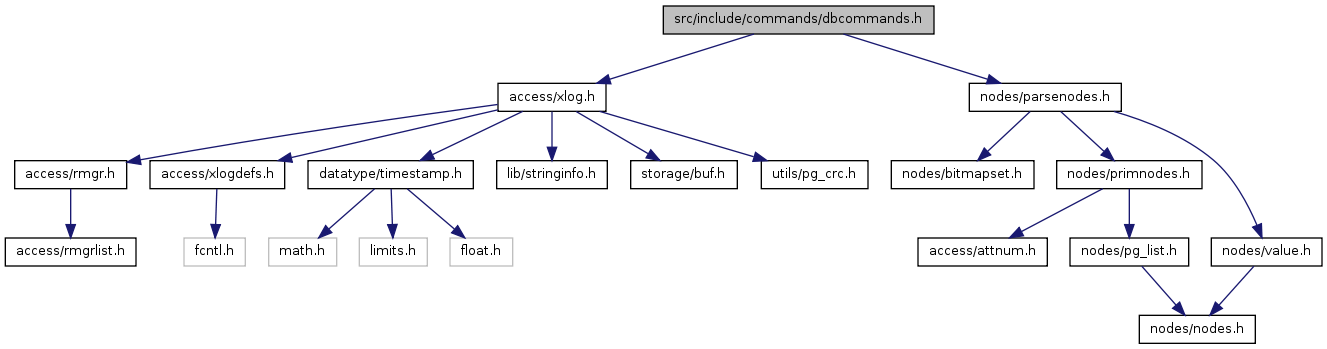

Go to the source code of this file.
| #define XLOG_DBASE_CREATE 0x00 |
Definition at line 21 of file dbcommands.h.
Referenced by createdb(), dbase_desc(), dbase_redo(), and movedb().
| #define XLOG_DBASE_DROP 0x10 |
Definition at line 22 of file dbcommands.h.
Referenced by dbase_desc(), dbase_redo(), movedb(), and remove_dbtablespaces().
| typedef struct xl_dbase_create_rec xl_dbase_create_rec |
| typedef struct xl_dbase_create_rec_old xl_dbase_create_rec_old |
| typedef struct xl_dbase_drop_rec xl_dbase_drop_rec |
| typedef struct xl_dbase_drop_rec_old xl_dbase_drop_rec_old |
| Oid AlterDatabase | ( | AlterDatabaseStmt * | stmt, | |
| bool | isTopLevel | |||
| ) |
Definition at line 1334 of file dbcommands.c.
References ACL_KIND_DATABASE, aclcheck_error(), ACLCHECK_NOT_OWNER, Anum_pg_database_datconnlimit, Anum_pg_database_datname, DefElem::arg, Assert, BTEqualStrategyNumber, CatalogUpdateIndexes(), DatabaseNameIndexId, DatabaseRelationId, AlterDatabaseStmt::dbname, DefElem::defname, elog, ereport, errcode(), errmsg(), ERROR, GetUserId(), heap_close, heap_modify_tuple(), heap_open(), HeapTupleGetOid, HeapTupleIsValid, Int32GetDatum, intVal, InvokeObjectPostAlterHook, lfirst, MemSet, movedb(), NameGetDatum, NoLock, AlterDatabaseStmt::options, pg_database_ownercheck(), PreventTransactionChain(), RelationGetDescr, RowExclusiveLock, ScanKeyInit(), simple_heap_update(), SnapshotNow, strVal, systable_beginscan(), systable_endscan(), systable_getnext(), and HeapTupleData::t_self.
Referenced by standard_ProcessUtility().
{
    Relation    rel;
    Oid         dboid;
    HeapTuple   tuple,
                newtuple;
    ScanKeyData scankey;
    SysScanDesc scan;
    ListCell   *option;
    int         connlimit = -1;
    DefElem    *dconnlimit = NULL;
    DefElem    *dtablespace = NULL;
    Datum       new_record[Natts_pg_database];
    bool        new_record_nulls[Natts_pg_database];
    bool        new_record_repl[Natts_pg_database];

    /* Extract options from the statement node tree */
    foreach(option, stmt->options)
    {
        DefElem    *defel = (DefElem *) lfirst(option);

        if (strcmp(defel->defname, "connectionlimit") == 0)
        {
            if (dconnlimit)
                ereport(ERROR,
                        (errcode(ERRCODE_SYNTAX_ERROR),
                         errmsg("conflicting or redundant options")));
            dconnlimit = defel;
        }
        else if (strcmp(defel->defname, "tablespace") == 0)
        {
            if (dtablespace)
                ereport(ERROR,
                        (errcode(ERRCODE_SYNTAX_ERROR),
                         errmsg("conflicting or redundant options")));
            dtablespace = defel;
        }
        else
            elog(ERROR, "option \"%s\" not recognized",
                 defel->defname);
    }

    if (dtablespace)
    {
        /* currently, can't be specified along with any other options */
        Assert(!dconnlimit);
        /* this case isn't allowed within a transaction block */
        PreventTransactionChain(isTopLevel, "ALTER DATABASE SET TABLESPACE");
        movedb(stmt->dbname, strVal(dtablespace->arg));
        return InvalidOid;
    }

    if (dconnlimit)
    {
        connlimit = intVal(dconnlimit->arg);
        if (connlimit < -1)
            ereport(ERROR,
                    (errcode(ERRCODE_INVALID_PARAMETER_VALUE),
                     errmsg("invalid connection limit: %d", connlimit)));
    }

    /*
     * Get the old tuple.  We don't need a lock on the database per se,
     * because we're not going to do anything that would mess up incoming
     * connections.
     */
    rel = heap_open(DatabaseRelationId, RowExclusiveLock);
    ScanKeyInit(&scankey,
                Anum_pg_database_datname,
                BTEqualStrategyNumber, F_NAMEEQ,
                NameGetDatum(stmt->dbname));
    scan = systable_beginscan(rel, DatabaseNameIndexId, true,
                              SnapshotNow, 1, &scankey);
    tuple = systable_getnext(scan);
    if (!HeapTupleIsValid(tuple))
        ereport(ERROR,
                (errcode(ERRCODE_UNDEFINED_DATABASE),
                 errmsg("database \"%s\" does not exist", stmt->dbname)));

    dboid = HeapTupleGetOid(tuple);

    if (!pg_database_ownercheck(HeapTupleGetOid(tuple), GetUserId()))
        aclcheck_error(ACLCHECK_NOT_OWNER, ACL_KIND_DATABASE,
                       stmt->dbname);

    /*
     * Build an updated tuple, perusing the information just obtained
     */
    MemSet(new_record, 0, sizeof(new_record));
    MemSet(new_record_nulls, false, sizeof(new_record_nulls));
    MemSet(new_record_repl, false, sizeof(new_record_repl));

    if (dconnlimit)
    {
        new_record[Anum_pg_database_datconnlimit - 1] = Int32GetDatum(connlimit);
        new_record_repl[Anum_pg_database_datconnlimit - 1] = true;
    }

    newtuple = heap_modify_tuple(tuple, RelationGetDescr(rel), new_record,
                                 new_record_nulls, new_record_repl);
    simple_heap_update(rel, &tuple->t_self, newtuple);

    /* Update indexes */
    CatalogUpdateIndexes(rel, newtuple);

    InvokeObjectPostAlterHook(DatabaseRelationId,
                              HeapTupleGetOid(newtuple), 0);

    systable_endscan(scan);

    /* Close pg_database, but keep lock till commit */
    heap_close(rel, NoLock);

    return dboid;
}
Definition at line 1481 of file dbcommands.c.
References ACL_KIND_DATABASE, aclcheck_error(), ACLCHECK_NOT_OWNER, aclnewowner(), Anum_pg_database_datacl, Anum_pg_database_datdba, Anum_pg_database_datname, BTEqualStrategyNumber, CatalogUpdateIndexes(), changeDependencyOnOwner(), check_is_member_of_role(), DatabaseNameIndexId, DatabaseRelationId, DatumGetAclP, ereport, errcode(), errmsg(), ERROR, GETSTRUCT, GetUserId(), have_createdb_privilege(), heap_close, heap_freetuple(), heap_getattr, heap_modify_tuple(), heap_open(), HeapTupleGetOid, HeapTupleIsValid, InvokeObjectPostAlterHook, NameGetDatum, NoLock, ObjectIdGetDatum, pg_database_ownercheck(), PointerGetDatum, RelationGetDescr, RowExclusiveLock, ScanKeyInit(), simple_heap_update(), SnapshotNow, systable_beginscan(), systable_endscan(), systable_getnext(), and HeapTupleData::t_self.
Referenced by ExecAlterOwnerStmt().
{
    Oid         db_id;
    HeapTuple   tuple;
    Relation    rel;
    ScanKeyData scankey;
    SysScanDesc scan;
    Form_pg_database datForm;

    /*
     * Get the old tuple.  We don't need a lock on the database per se,
     * because we're not going to do anything that would mess up incoming
     * connections.
     */
    rel = heap_open(DatabaseRelationId, RowExclusiveLock);
    ScanKeyInit(&scankey,
                Anum_pg_database_datname,
                BTEqualStrategyNumber, F_NAMEEQ,
                NameGetDatum(dbname));
    scan = systable_beginscan(rel, DatabaseNameIndexId, true,
                              SnapshotNow, 1, &scankey);
    tuple = systable_getnext(scan);
    if (!HeapTupleIsValid(tuple))
        ereport(ERROR,
                (errcode(ERRCODE_UNDEFINED_DATABASE),
                 errmsg("database \"%s\" does not exist", dbname)));

    db_id = HeapTupleGetOid(tuple);
    datForm = (Form_pg_database) GETSTRUCT(tuple);

    /*
     * If the new owner is the same as the existing owner, consider the
     * command to have succeeded.  This is to be consistent with other
     * objects.
     */
    if (datForm->datdba != newOwnerId)
    {
        Datum       repl_val[Natts_pg_database];
        bool        repl_null[Natts_pg_database];
        bool        repl_repl[Natts_pg_database];
        Acl        *newAcl;
        Datum       aclDatum;
        bool        isNull;
        HeapTuple   newtuple;

        /* Otherwise, must be owner of the existing object */
        if (!pg_database_ownercheck(HeapTupleGetOid(tuple), GetUserId()))
            aclcheck_error(ACLCHECK_NOT_OWNER, ACL_KIND_DATABASE,
                           dbname);

        /* Must be able to become new owner */
        check_is_member_of_role(GetUserId(), newOwnerId);

        /*
         * must have createdb rights
         *
         * NOTE: This is different from other alter-owner checks in that the
         * current user is checked for createdb privileges instead of the
         * destination owner.  This is consistent with the CREATE case for
         * databases.  Because superusers will always have this right, we need
         * no special case for them.
         */
        if (!have_createdb_privilege())
            ereport(ERROR,
                    (errcode(ERRCODE_INSUFFICIENT_PRIVILEGE),
                   errmsg("permission denied to change owner of database")));

        memset(repl_null, false, sizeof(repl_null));
        memset(repl_repl, false, sizeof(repl_repl));

        repl_repl[Anum_pg_database_datdba - 1] = true;
        repl_val[Anum_pg_database_datdba - 1] = ObjectIdGetDatum(newOwnerId);

        /*
         * Determine the modified ACL for the new owner.  This is only
         * necessary when the ACL is non-null.
         */
        aclDatum = heap_getattr(tuple,
                                Anum_pg_database_datacl,
                                RelationGetDescr(rel),
                                &isNull);
        if (!isNull)
        {
            newAcl = aclnewowner(DatumGetAclP(aclDatum),
                                 datForm->datdba, newOwnerId);
            repl_repl[Anum_pg_database_datacl - 1] = true;
            repl_val[Anum_pg_database_datacl - 1] = PointerGetDatum(newAcl);
        }

        newtuple = heap_modify_tuple(tuple, RelationGetDescr(rel), repl_val, repl_null, repl_repl);
        simple_heap_update(rel, &newtuple->t_self, newtuple);
        CatalogUpdateIndexes(rel, newtuple);

        heap_freetuple(newtuple);

        /* Update owner dependency reference */
        changeDependencyOnOwner(DatabaseRelationId, HeapTupleGetOid(tuple),
                                newOwnerId);
    }

    InvokeObjectPostAlterHook(DatabaseRelationId, HeapTupleGetOid(tuple), 0);

    systable_endscan(scan);

    /* Close pg_database, but keep lock till commit */
    heap_close(rel, NoLock);

    return db_id;
}
| Oid AlterDatabaseSet | ( | AlterDatabaseSetStmt * | stmt | ) |
Definition at line 1455 of file dbcommands.c.
References AccessShareLock, ACL_KIND_DATABASE, aclcheck_error(), ACLCHECK_NOT_OWNER, AlterSetting(), DatabaseRelationId, AlterDatabaseSetStmt::dbname, get_database_oid(), GetUserId(), InvalidOid, pg_database_ownercheck(), AlterDatabaseSetStmt::setstmt, shdepLockAndCheckObject(), and UnlockSharedObject().
Referenced by standard_ProcessUtility().
{
    Oid         datid = get_database_oid(stmt->dbname, false);

    /*
     * Obtain a lock on the database and make sure it didn't go away in the
     * meantime.
     */
    shdepLockAndCheckObject(DatabaseRelationId, datid);

    if (!pg_database_ownercheck(datid, GetUserId()))
        aclcheck_error(ACLCHECK_NOT_OWNER, ACL_KIND_DATABASE,
                       stmt->dbname);

    AlterSetting(datid, InvalidOid, stmt->setstmt);

    UnlockSharedObject(DatabaseRelationId, datid, 0, AccessShareLock);

    return datid;
}
| void check_encoding_locale_matches | ( | int | encoding, | |
| const char * | collate, | |||
| const char * | ctype | |||
| ) |
Definition at line 714 of file dbcommands.c.
References ereport, errcode(), errdetail(), errmsg(), ERROR, pg_encoding_to_char(), pg_get_encoding_from_locale(), PG_SQL_ASCII, PG_UTF8, and superuser().
Referenced by createdb(), and DefineCollation().
{
    int         ctype_encoding = pg_get_encoding_from_locale(ctype, true);
    int         collate_encoding = pg_get_encoding_from_locale(collate, true);

    if (!(ctype_encoding == encoding ||
          ctype_encoding == PG_SQL_ASCII ||
          ctype_encoding == -1 ||
#ifdef WIN32
          encoding == PG_UTF8 ||
#endif
          (encoding == PG_SQL_ASCII && superuser())))
        ereport(ERROR,
                (errcode(ERRCODE_INVALID_PARAMETER_VALUE),
                 errmsg("encoding \"%s\" does not match locale \"%s\"",
                        pg_encoding_to_char(encoding),
                        ctype),
           errdetail("The chosen LC_CTYPE setting requires encoding \"%s\".",
                     pg_encoding_to_char(ctype_encoding))));

    if (!(collate_encoding == encoding ||
          collate_encoding == PG_SQL_ASCII ||
          collate_encoding == -1 ||
#ifdef WIN32
          encoding == PG_UTF8 ||
#endif
          (encoding == PG_SQL_ASCII && superuser())))
        ereport(ERROR,
                (errcode(ERRCODE_INVALID_PARAMETER_VALUE),
                 errmsg("encoding \"%s\" does not match locale \"%s\"",
                        pg_encoding_to_char(encoding),
                        collate),
         errdetail("The chosen LC_COLLATE setting requires encoding \"%s\".",
                   pg_encoding_to_char(collate_encoding))));
}
| Oid createdb | ( | const CreatedbStmt * | stmt | ) |
Definition at line 95 of file dbcommands.c.
References AccessShareLock, ACL_CREATE, ACL_KIND_TABLESPACE, aclcheck_error(), ACLCHECK_OK, Anum_pg_database_datacl, Anum_pg_database_datallowconn, Anum_pg_database_datcollate, Anum_pg_database_datconnlimit, Anum_pg_database_datctype, Anum_pg_database_datdba, Anum_pg_database_datfrozenxid, Anum_pg_database_datistemplate, Anum_pg_database_datlastsysoid, Anum_pg_database_datminmxid, Anum_pg_database_datname, Anum_pg_database_dattablespace, Anum_pg_database_encoding, DefElem::arg, BoolGetDatum, XLogRecData::buffer, CatalogUpdateIndexes(), check_db_file_conflict(), check_encoding_locale_matches(), check_is_member_of_role(), check_locale(), CHECKPOINT_FORCE, CHECKPOINT_IMMEDIATE, CHECKPOINT_WAIT, copydir(), copyTemplateDependencies(), CountOtherDBBackends(), createdb_failure_callback(), CStringGetDatum, XLogRecData::data, DatabaseRelationId, xl_dbase_create_rec::db_id, CreatedbStmt::dbname, DefElem::defname, createdb_failure_params::dest_dboid, DirectFunctionCall1, directory_is_empty(), elog, encoding, ereport, errcode(), errdetail(), errdetail_busy_db(), errhint(), errmsg(), ERROR, ForceSyncCommit(), ForwardScanDirection, get_database_oid(), get_db_info(), get_role_oid(), get_tablespace_oid(), GetDatabasePath(), GetLatestSnapshot(), GetNewOid(), GetUserId(), GLOBALTABLESPACE_OID, have_createdb_privilege(), heap_beginscan(), heap_close, heap_endscan(), heap_form_tuple(), heap_getnext(), heap_open(), HeapTupleGetOid, HeapTupleSetOid, Int32GetDatum, intVal, InvokeObjectPostCreateHook, IsA, XLogRecData::len, lfirst, MemSet, namein(), XLogRecData::next, nodeTag, NoLock, NULL, ObjectIdGetDatum, OidIsValid, CreatedbStmt::options, pfree(), pg_database_ownercheck(), pg_encoding_to_char(), PG_END_ENSURE_ERROR_CLEANUP, PG_ENSURE_ERROR_CLEANUP, pg_tablespace_aclcheck(), PG_VALID_BE_ENCODING, pg_valid_server_encoding(), PointerGetDatum, recordDependencyOnOwner(), RegisterSnapshot(), RelationGetDescr, RequestCheckpoint(), RowExclusiveLock, ShareLock, simple_heap_insert(), xl_dbase_create_rec::src_db_id, createdb_failure_params::src_dboid, xl_dbase_create_rec::src_tablespace_id, strVal, xl_dbase_create_rec::tablespace_id, TableSpaceRelationId, TransactionIdGetDatum, UnregisterSnapshot(), WARNING, XLOG_DBASE_CREATE, and XLogInsert().
Referenced by AlterRole(), CreateRole(), main(), and standard_ProcessUtility().
{
HeapScanDesc scan;
Relation rel;
Oid src_dboid;
Oid src_owner;
int src_encoding;
char *src_collate;
char *src_ctype;
bool src_istemplate;
bool src_allowconn;
Oid src_lastsysoid;
TransactionId src_frozenxid;
MultiXactId src_minmxid;
Oid src_deftablespace;
volatile Oid dst_deftablespace;
Relation pg_database_rel;
HeapTuple tuple;
Datum new_record[Natts_pg_database];
bool new_record_nulls[Natts_pg_database];
Oid dboid;
Oid datdba;
ListCell *option;
DefElem *dtablespacename = NULL;
DefElem *downer = NULL;
DefElem *dtemplate = NULL;
DefElem *dencoding = NULL;
DefElem *dcollate = NULL;
DefElem *dctype = NULL;
DefElem *dconnlimit = NULL;
char *dbname = stmt->dbname;
char *dbowner = NULL;
const char *dbtemplate = NULL;
char *dbcollate = NULL;
char *dbctype = NULL;
char *canonname;
int encoding = -1;
int dbconnlimit = -1;
int notherbackends;
int npreparedxacts;
createdb_failure_params fparms;
Snapshot snapshot;
/* Extract options from the statement node tree */
foreach(option, stmt->options)
{
DefElem *defel = (DefElem *) lfirst(option);
if (strcmp(defel->defname, "tablespace") == 0)
{
if (dtablespacename)
ereport(ERROR,
(errcode(ERRCODE_SYNTAX_ERROR),
errmsg("conflicting or redundant options")));
dtablespacename = defel;
}
else if (strcmp(defel->defname, "owner") == 0)
{
if (downer)
ereport(ERROR,
(errcode(ERRCODE_SYNTAX_ERROR),
errmsg("conflicting or redundant options")));
downer = defel;
}
else if (strcmp(defel->defname, "template") == 0)
{
if (dtemplate)
ereport(ERROR,
(errcode(ERRCODE_SYNTAX_ERROR),
errmsg("conflicting or redundant options")));
dtemplate = defel;
}
else if (strcmp(defel->defname, "encoding") == 0)
{
if (dencoding)
ereport(ERROR,
(errcode(ERRCODE_SYNTAX_ERROR),
errmsg("conflicting or redundant options")));
dencoding = defel;
}
else if (strcmp(defel->defname, "lc_collate") == 0)
{
if (dcollate)
ereport(ERROR,
(errcode(ERRCODE_SYNTAX_ERROR),
errmsg("conflicting or redundant options")));
dcollate = defel;
}
else if (strcmp(defel->defname, "lc_ctype") == 0)
{
if (dctype)
ereport(ERROR,
(errcode(ERRCODE_SYNTAX_ERROR),
errmsg("conflicting or redundant options")));
dctype = defel;
}
else if (strcmp(defel->defname, "connectionlimit") == 0)
{
if (dconnlimit)
ereport(ERROR,
(errcode(ERRCODE_SYNTAX_ERROR),
errmsg("conflicting or redundant options")));
dconnlimit = defel;
}
else if (strcmp(defel->defname, "location") == 0)
{
ereport(WARNING,
(errcode(ERRCODE_FEATURE_NOT_SUPPORTED),
errmsg("LOCATION is not supported anymore"),
errhint("Consider using tablespaces instead.")));
}
else
elog(ERROR, "option \"%s\" not recognized",
defel->defname);
}
if (downer && downer->arg)
dbowner = strVal(downer->arg);
if (dtemplate && dtemplate->arg)
dbtemplate = strVal(dtemplate->arg);
if (dencoding && dencoding->arg)
{
const char *encoding_name;
if (IsA(dencoding->arg, Integer))
{
encoding = intVal(dencoding->arg);
encoding_name = pg_encoding_to_char(encoding);
if (strcmp(encoding_name, "") == 0 ||
pg_valid_server_encoding(encoding_name) < 0)
ereport(ERROR,
(errcode(ERRCODE_UNDEFINED_OBJECT),
errmsg("%d is not a valid encoding code",
encoding)));
}
else if (IsA(dencoding->arg, String))
{
encoding_name = strVal(dencoding->arg);
encoding = pg_valid_server_encoding(encoding_name);
if (encoding < 0)
ereport(ERROR,
(errcode(ERRCODE_UNDEFINED_OBJECT),
errmsg("%s is not a valid encoding name",
encoding_name)));
}
else
elog(ERROR, "unrecognized node type: %d",
nodeTag(dencoding->arg));
}
if (dcollate && dcollate->arg)
dbcollate = strVal(dcollate->arg);
if (dctype && dctype->arg)
dbctype = strVal(dctype->arg);
if (dconnlimit && dconnlimit->arg)
{
dbconnlimit = intVal(dconnlimit->arg);
if (dbconnlimit < -1)
ereport(ERROR,
(errcode(ERRCODE_INVALID_PARAMETER_VALUE),
errmsg("invalid connection limit: %d", dbconnlimit)));
}
/* obtain OID of proposed owner */
if (dbowner)
datdba = get_role_oid(dbowner, false);
else
datdba = GetUserId();
/*
* To create a database, must have createdb privilege and must be able to
* become the target role (this does not imply that the target role itself
* must have createdb privilege). The latter provision guards against
* "giveaway" attacks. Note that a superuser will always have both of
* these privileges a fortiori.
*/
if (!have_createdb_privilege())
ereport(ERROR,
(errcode(ERRCODE_INSUFFICIENT_PRIVILEGE),
errmsg("permission denied to create database")));
check_is_member_of_role(GetUserId(), datdba);
/*
* Lookup database (template) to be cloned, and obtain share lock on it.
* ShareLock allows two CREATE DATABASEs to work from the same template
* concurrently, while ensuring no one is busy dropping it in parallel
* (which would be Very Bad since we'd likely get an incomplete copy
* without knowing it). This also prevents any new connections from being
* made to the source until we finish copying it, so we can be sure it
* won't change underneath us.
*/
if (!dbtemplate)
dbtemplate = "template1"; /* Default template database name */
if (!get_db_info(dbtemplate, ShareLock,
&src_dboid, &src_owner, &src_encoding,
&src_istemplate, &src_allowconn, &src_lastsysoid,
&src_frozenxid, &src_minmxid, &src_deftablespace,
&src_collate, &src_ctype))
ereport(ERROR,
(errcode(ERRCODE_UNDEFINED_DATABASE),
errmsg("template database \"%s\" does not exist",
dbtemplate)));
/*
* Permission check: to copy a DB that's not marked datistemplate, you
* must be superuser or the owner thereof.
*/
if (!src_istemplate)
{
if (!pg_database_ownercheck(src_dboid, GetUserId()))
ereport(ERROR,
(errcode(ERRCODE_INSUFFICIENT_PRIVILEGE),
errmsg("permission denied to copy database \"%s\"",
dbtemplate)));
}
/* If encoding or locales are defaulted, use source's setting */
if (encoding < 0)
encoding = src_encoding;
if (dbcollate == NULL)
dbcollate = src_collate;
if (dbctype == NULL)
dbctype = src_ctype;
/* Some encodings are client only */
if (!PG_VALID_BE_ENCODING(encoding))
ereport(ERROR,
(errcode(ERRCODE_WRONG_OBJECT_TYPE),
errmsg("invalid server encoding %d", encoding)));
/* Check that the chosen locales are valid, and get canonical spellings */
if (!check_locale(LC_COLLATE, dbcollate, &canonname))
ereport(ERROR,
(errcode(ERRCODE_WRONG_OBJECT_TYPE),
errmsg("invalid locale name: \"%s\"", dbcollate)));
dbcollate = canonname;
if (!check_locale(LC_CTYPE, dbctype, &canonname))
ereport(ERROR,
(errcode(ERRCODE_WRONG_OBJECT_TYPE),
errmsg("invalid locale name: \"%s\"", dbctype)));
dbctype = canonname;
check_encoding_locale_matches(encoding, dbcollate, dbctype);
/*
* Check that the new encoding and locale settings match the source
* database. We insist on this because we simply copy the source data ---
* any non-ASCII data would be wrongly encoded, and any indexes sorted
* according to the source locale would be wrong.
*
* However, we assume that template0 doesn't contain any non-ASCII data
* nor any indexes that depend on collation or ctype, so template0 can be
* used as template for creating a database with any encoding or locale.
*/
if (strcmp(dbtemplate, "template0") != 0)
{
if (encoding != src_encoding)
ereport(ERROR,
(errcode(ERRCODE_INVALID_PARAMETER_VALUE),
errmsg("new encoding (%s) is incompatible with the encoding of the template database (%s)",
pg_encoding_to_char(encoding),
pg_encoding_to_char(src_encoding)),
errhint("Use the same encoding as in the template database, or use template0 as template.")));
if (strcmp(dbcollate, src_collate) != 0)
ereport(ERROR,
(errcode(ERRCODE_INVALID_PARAMETER_VALUE),
errmsg("new collation (%s) is incompatible with the collation of the template database (%s)",
dbcollate, src_collate),
errhint("Use the same collation as in the template database, or use template0 as template.")));
if (strcmp(dbctype, src_ctype) != 0)
ereport(ERROR,
(errcode(ERRCODE_INVALID_PARAMETER_VALUE),
errmsg("new LC_CTYPE (%s) is incompatible with the LC_CTYPE of the template database (%s)",
dbctype, src_ctype),
errhint("Use the same LC_CTYPE as in the template database, or use template0 as template.")));
}
/* Resolve default tablespace for new database */
if (dtablespacename && dtablespacename->arg)
{
char *tablespacename;
AclResult aclresult;
tablespacename = strVal(dtablespacename->arg);
dst_deftablespace = get_tablespace_oid(tablespacename, false);
/* check permissions */
aclresult = pg_tablespace_aclcheck(dst_deftablespace, GetUserId(),
ACL_CREATE);
if (aclresult != ACLCHECK_OK)
aclcheck_error(aclresult, ACL_KIND_TABLESPACE,
tablespacename);
/* pg_global must never be the default tablespace */
if (dst_deftablespace == GLOBALTABLESPACE_OID)
ereport(ERROR,
(errcode(ERRCODE_INVALID_PARAMETER_VALUE),
errmsg("pg_global cannot be used as default tablespace")));
/*
* If we are trying to change the default tablespace of the template,
* we require that the template not have any files in the new default
* tablespace. This is necessary because otherwise the copied
* database would contain pg_class rows that refer to its default
* tablespace both explicitly (by OID) and implicitly (as zero), which
* would cause problems. For example another CREATE DATABASE using
* the copied database as template, and trying to change its default
* tablespace again, would yield outright incorrect results (it would
* improperly move tables to the new default tablespace that should
* stay in the same tablespace).
*/
if (dst_deftablespace != src_deftablespace)
{
char *srcpath;
struct stat st;
srcpath = GetDatabasePath(src_dboid, dst_deftablespace);
if (stat(srcpath, &st) == 0 &&
S_ISDIR(st.st_mode) &&
!directory_is_empty(srcpath))
ereport(ERROR,
(errcode(ERRCODE_FEATURE_NOT_SUPPORTED),
errmsg("cannot assign new default tablespace \"%s\"",
tablespacename),
errdetail("There is a conflict because database \"%s\" already has some tables in this tablespace.",
dbtemplate)));
pfree(srcpath);
}
}
else
{
/* Use template database's default tablespace */
dst_deftablespace = src_deftablespace;
/* Note there is no additional permission check in this path */
}
/*
* Check for db name conflict. This is just to give a more friendly error
* message than "unique index violation". There's a race condition but
* we're willing to accept the less friendly message in that case.
*/
if (OidIsValid(get_database_oid(dbname, true)))
ereport(ERROR,
(errcode(ERRCODE_DUPLICATE_DATABASE),
errmsg("database \"%s\" already exists", dbname)));
/*
* The source DB can't have any active backends, except this one
* (exception is to allow CREATE DB while connected to template1).
* Otherwise we might copy inconsistent data.
*
* This should be last among the basic error checks, because it involves
* potential waiting; we may as well throw an error first if we're gonna
* throw one.
*/
if (CountOtherDBBackends(src_dboid, ¬herbackends, &npreparedxacts))
ereport(ERROR,
(errcode(ERRCODE_OBJECT_IN_USE),
errmsg("source database \"%s\" is being accessed by other users",
dbtemplate),
errdetail_busy_db(notherbackends, npreparedxacts)));
/*
* Select an OID for the new database, checking that it doesn't have a
* filename conflict with anything already existing in the tablespace
* directories.
*/
pg_database_rel = heap_open(DatabaseRelationId, RowExclusiveLock);
do
{
dboid = GetNewOid(pg_database_rel);
} while (check_db_file_conflict(dboid));
/*
* Insert a new tuple into pg_database. This establishes our ownership of
* the new database name (anyone else trying to insert the same name will
* block on the unique index, and fail after we commit).
*/
/* Form tuple */
MemSet(new_record, 0, sizeof(new_record));
MemSet(new_record_nulls, false, sizeof(new_record_nulls));
new_record[Anum_pg_database_datname - 1] =
DirectFunctionCall1(namein, CStringGetDatum(dbname));
new_record[Anum_pg_database_datdba - 1] = ObjectIdGetDatum(datdba);
new_record[Anum_pg_database_encoding - 1] = Int32GetDatum(encoding);
new_record[Anum_pg_database_datcollate - 1] =
DirectFunctionCall1(namein, CStringGetDatum(dbcollate));
new_record[Anum_pg_database_datctype - 1] =
DirectFunctionCall1(namein, CStringGetDatum(dbctype));
new_record[Anum_pg_database_datistemplate - 1] = BoolGetDatum(false);
new_record[Anum_pg_database_datallowconn - 1] = BoolGetDatum(true);
new_record[Anum_pg_database_datconnlimit - 1] = Int32GetDatum(dbconnlimit);
new_record[Anum_pg_database_datlastsysoid - 1] = ObjectIdGetDatum(src_lastsysoid);
new_record[Anum_pg_database_datfrozenxid - 1] = TransactionIdGetDatum(src_frozenxid);
new_record[Anum_pg_database_datminmxid - 1] = TransactionIdGetDatum(src_minmxid);
new_record[Anum_pg_database_dattablespace - 1] = ObjectIdGetDatum(dst_deftablespace);
/*
* We deliberately set datacl to default (NULL), rather than copying it
* from the template database. Copying it would be a bad idea when the
* owner is not the same as the template's owner.
*/
new_record_nulls[Anum_pg_database_datacl - 1] = true;
tuple = heap_form_tuple(RelationGetDescr(pg_database_rel),
new_record, new_record_nulls);
HeapTupleSetOid(tuple, dboid);
simple_heap_insert(pg_database_rel, tuple);
/* Update indexes */
CatalogUpdateIndexes(pg_database_rel, tuple);
/*
* Now generate additional catalog entries associated with the new DB
*/
/* Register owner dependency */
recordDependencyOnOwner(DatabaseRelationId, dboid, datdba);
/* Create pg_shdepend entries for objects within database */
copyTemplateDependencies(src_dboid, dboid);
/* Post creation hook for new database */
InvokeObjectPostCreateHook(DatabaseRelationId, dboid, 0);
/*
* Force a checkpoint before starting the copy. This will force dirty
* buffers out to disk, to ensure source database is up-to-date on disk
* for the copy. FlushDatabaseBuffers() would suffice for that, but we
* also want to process any pending unlink requests. Otherwise, if a
* checkpoint happened while we're copying files, a file might be deleted
* just when we're about to copy it, causing the lstat() call in copydir()
* to fail with ENOENT.
*/
RequestCheckpoint(CHECKPOINT_IMMEDIATE | CHECKPOINT_FORCE | CHECKPOINT_WAIT);
/*
* Take an MVCC snapshot to use while scanning through pg_tablespace. For
* safety, register the snapshot (this prevents it from changing if
* something else were to request a snapshot during the loop).
*
* Traversing pg_tablespace with an MVCC snapshot is necessary to provide
* us with a consistent view of the tablespaces that exist. Using
* SnapshotNow here would risk seeing the same tablespace multiple times,
* or worse not seeing a tablespace at all, if its tuple is moved around
* by a concurrent update (eg an ACL change).
*
* Inconsistency of this sort is inherent to all SnapshotNow scans, unless
* some lock is held to prevent concurrent updates of the rows being
* sought. There should be a generic fix for that, but in the meantime
* it's worth fixing this case in particular because we are doing very
* heavyweight operations within the scan, so that the elapsed time for
* the scan is vastly longer than for most other catalog scans. That
* means there's a much wider window for concurrent updates to cause
* trouble here than anywhere else. XXX this code should be changed
* whenever a generic fix is implemented.
*/
snapshot = RegisterSnapshot(GetLatestSnapshot());
/*
* Once we start copying subdirectories, we need to be able to clean 'em
* up if we fail. Use an ENSURE block to make sure this happens. (This
* is not a 100% solution, because of the possibility of failure during
* transaction commit after we leave this routine, but it should handle
* most scenarios.)
*/
fparms.src_dboid = src_dboid;
fparms.dest_dboid = dboid;
PG_ENSURE_ERROR_CLEANUP(createdb_failure_callback,
PointerGetDatum(&fparms));
{
/*
* Iterate through all tablespaces of the template database, and copy
* each one to the new database.
*/
rel = heap_open(TableSpaceRelationId, AccessShareLock);
scan = heap_beginscan(rel, snapshot, 0, NULL);
while ((tuple = heap_getnext(scan, ForwardScanDirection)) != NULL)
{
Oid srctablespace = HeapTupleGetOid(tuple);
Oid dsttablespace;
char *srcpath;
char *dstpath;
struct stat st;
/* No need to copy global tablespace */
if (srctablespace == GLOBALTABLESPACE_OID)
continue;
srcpath = GetDatabasePath(src_dboid, srctablespace);
if (stat(srcpath, &st) < 0 || !S_ISDIR(st.st_mode) ||
directory_is_empty(srcpath))
{
/* Assume we can ignore it */
pfree(srcpath);
continue;
}
if (srctablespace == src_deftablespace)
dsttablespace = dst_deftablespace;
else
dsttablespace = srctablespace;
dstpath = GetDatabasePath(dboid, dsttablespace);
/*
* Copy this subdirectory to the new location
*
* We don't need to copy subdirectories
*/
copydir(srcpath, dstpath, false);
/* Record the filesystem change in XLOG */
{
xl_dbase_create_rec xlrec;
XLogRecData rdata[1];
xlrec.db_id = dboid;
xlrec.tablespace_id = dsttablespace;
xlrec.src_db_id = src_dboid;
xlrec.src_tablespace_id = srctablespace;
rdata[0].data = (char *) &xlrec;
rdata[0].len = sizeof(xl_dbase_create_rec);
rdata[0].buffer = InvalidBuffer;
rdata[0].next = NULL;
(void) XLogInsert(RM_DBASE_ID, XLOG_DBASE_CREATE, rdata);
}
}
heap_endscan(scan);
heap_close(rel, AccessShareLock);
/*
* We force a checkpoint before committing. This effectively means
* that committed XLOG_DBASE_CREATE operations will never need to be
* replayed (at least not in ordinary crash recovery; we still have to
* make the XLOG entry for the benefit of PITR operations). This
* avoids two nasty scenarios:
*
* #1: When PITR is off, we don't XLOG the contents of newly created
* indexes; therefore the drop-and-recreate-whole-directory behavior
* of DBASE_CREATE replay would lose such indexes.
*
* #2: Since we have to recopy the source database during DBASE_CREATE
* replay, we run the risk of copying changes in it that were
* committed after the original CREATE DATABASE command but before the
* system crash that led to the replay. This is at least unexpected
* and at worst could lead to inconsistencies, eg duplicate table
* names.
*
* (Both of these were real bugs in releases 8.0 through 8.0.3.)
*
* In PITR replay, the first of these isn't an issue, and the second
* is only a risk if the CREATE DATABASE and subsequent template
* database change both occur while a base backup is being taken.
* There doesn't seem to be much we can do about that except document
* it as a limitation.
*
* Perhaps if we ever implement CREATE DATABASE in a less cheesy way,
* we can avoid this.
*/
RequestCheckpoint(CHECKPOINT_IMMEDIATE | CHECKPOINT_FORCE | CHECKPOINT_WAIT);
/*
* Close pg_database, but keep lock till commit.
*/
heap_close(pg_database_rel, NoLock);
/*
* Force synchronous commit, thus minimizing the window between
* creation of the database files and commital of the transaction. If
* we crash before committing, we'll have a DB that's taking up disk
* space but is not in pg_database, which is not good.
*/
ForceSyncCommit();
}
PG_END_ENSURE_ERROR_CLEANUP(createdb_failure_callback,
PointerGetDatum(&fparms));
/* Free our snapshot */
UnregisterSnapshot(snapshot);
return dboid;
}
| void dbase_desc | ( | StringInfo | buf, | |
| uint8 | xl_info, | |||
| char * | rec | |||
| ) |
Definition at line 22 of file dbasedesc.c.
References appendStringInfo(), xl_dbase_drop_rec::db_id, xl_dbase_create_rec::db_id, xl_dbase_create_rec::src_db_id, xl_dbase_create_rec::src_tablespace_id, xl_dbase_drop_rec::tablespace_id, xl_dbase_create_rec::tablespace_id, XLOG_DBASE_CREATE, and XLOG_DBASE_DROP.
{
    uint8       info = xl_info & ~XLR_INFO_MASK;

    if (info == XLOG_DBASE_CREATE)
    {
        xl_dbase_create_rec *xlrec = (xl_dbase_create_rec *) rec;

        appendStringInfo(buf, "create db: copy dir %u/%u to %u/%u",
                         xlrec->src_db_id, xlrec->src_tablespace_id,
                         xlrec->db_id, xlrec->tablespace_id);
    }
    else if (info == XLOG_DBASE_DROP)
    {
        xl_dbase_drop_rec *xlrec = (xl_dbase_drop_rec *) rec;

        appendStringInfo(buf, "drop db: dir %u/%u",
                         xlrec->db_id, xlrec->tablespace_id);
    }
    else
        appendStringInfo(buf, "UNKNOWN");
}
| void dbase_redo | ( | XLogRecPtr | lsn, | |
| XLogRecord * | rptr | |||
| ) |
Definition at line 1977 of file dbcommands.c.
References AccessExclusiveLock, Assert, copydir(), DatabaseRelationId, xl_dbase_drop_rec::db_id, xl_dbase_create_rec::db_id, DropDatabaseBuffers(), elog, ereport, errmsg(), FlushDatabaseBuffers(), ForgetDatabaseFsyncRequests(), GetDatabasePath(), InHotStandby, LockSharedObjectForSession(), PANIC, ResolveRecoveryConflictWithDatabase(), rmtree(), xl_dbase_create_rec::src_db_id, xl_dbase_create_rec::src_tablespace_id, xl_dbase_drop_rec::tablespace_id, xl_dbase_create_rec::tablespace_id, UnlockSharedObjectForSession(), WARNING, XLogRecord::xl_info, XLOG_DBASE_CREATE, XLOG_DBASE_DROP, XLogDropDatabase(), XLogRecGetData, and XLR_BKP_BLOCK_MASK.
{
    uint8       info = record->xl_info & ~XLR_INFO_MASK;

    /* Backup blocks are not used in dbase records */
    Assert(!(record->xl_info & XLR_BKP_BLOCK_MASK));

    if (info == XLOG_DBASE_CREATE)
    {
        xl_dbase_create_rec *xlrec = (xl_dbase_create_rec *) XLogRecGetData(record);
        char       *src_path;
        char       *dst_path;
        struct stat st;

        src_path = GetDatabasePath(xlrec->src_db_id, xlrec->src_tablespace_id);
        dst_path = GetDatabasePath(xlrec->db_id, xlrec->tablespace_id);

        /*
         * Our theory for replaying a CREATE is to forcibly drop the target
         * subdirectory if present, then re-copy the source data. This may be
         * more work than needed, but it is simple to implement.
         */
        if (stat(dst_path, &st) == 0 && S_ISDIR(st.st_mode))
        {
            if (!rmtree(dst_path, true))
                /* If this failed, copydir() below is going to error. */
                ereport(WARNING,
                        (errmsg("some useless files may be left behind in old database directory \"%s\"",
                                dst_path)));
        }

        /*
         * Force dirty buffers out to disk, to ensure source database is
         * up-to-date for the copy.
         */
        FlushDatabaseBuffers(xlrec->src_db_id);

        /*
         * Copy this subdirectory to the new location
         *
         * We don't need to copy subdirectories
         */
        copydir(src_path, dst_path, false);
    }
    else if (info == XLOG_DBASE_DROP)
    {
        xl_dbase_drop_rec *xlrec = (xl_dbase_drop_rec *) XLogRecGetData(record);
        char       *dst_path;

        dst_path = GetDatabasePath(xlrec->db_id, xlrec->tablespace_id);

        if (InHotStandby)
        {
            /*
             * Lock database while we resolve conflicts to ensure that
             * InitPostgres() cannot fully re-execute concurrently. This
             * avoids backends re-connecting automatically to same database,
             * which can happen in some cases.
             */
            LockSharedObjectForSession(DatabaseRelationId, xlrec->db_id, 0, AccessExclusiveLock);
            ResolveRecoveryConflictWithDatabase(xlrec->db_id);
        }

        /* Drop pages for this database that are in the shared buffer cache */
        DropDatabaseBuffers(xlrec->db_id);

        /* Also, clean out any fsync requests that might be pending in md.c */
        ForgetDatabaseFsyncRequests(xlrec->db_id);

        /* Clean out the xlog relcache too */
        XLogDropDatabase(xlrec->db_id);

        /* And remove the physical files */
        if (!rmtree(dst_path, true))
            ereport(WARNING,
                    (errmsg("some useless files may be left behind in old database directory \"%s\"",
                            dst_path)));

        if (InHotStandby)
        {
            /*
             * Release locks prior to commit. XXX There is a race condition
             * here that may allow backends to reconnect, but the window for
             * this is small because the gap between here and commit is mostly
             * fairly small and it is unlikely that people will be dropping
             * databases that we are trying to connect to anyway.
             */
            UnlockSharedObjectForSession(DatabaseRelationId, xlrec->db_id, 0, AccessExclusiveLock);
        }
    }
    else
        elog(PANIC, "dbase_redo: unknown op code %u", info);
}
| void dropdb | ( | const char * | dbname, | |
| bool | missing_ok | |||
| ) |
Definition at line 772 of file dbcommands.c.
References AccessExclusiveLock, ACL_KIND_DATABASE, aclcheck_error(), ACLCHECK_NOT_OWNER, CHECKPOINT_FORCE, CHECKPOINT_IMMEDIATE, CHECKPOINT_WAIT, CountOtherDBBackends(), DATABASEOID, DatabaseRelationId, DeleteSharedComments(), DeleteSharedSecurityLabel(), DropDatabaseBuffers(), dropDatabaseDependencies(), DropSetting(), elog, ereport, errcode(), errdetail_busy_db(), errmsg(), ERROR, ForceSyncCommit(), ForgetDatabaseFsyncRequests(), get_db_info(), GetUserId(), heap_close, heap_open(), HeapTupleIsValid, InvalidOid, InvokeObjectDropHook, MyDatabaseId, NoLock, NOTICE, NULL, ObjectIdGetDatum, pg_database_ownercheck(), pgstat_drop_database(), ReleaseSysCache(), remove_dbtablespaces(), RequestCheckpoint(), RowExclusiveLock, SearchSysCache1, simple_heap_delete(), and HeapTupleData::t_self.
Referenced by standard_ProcessUtility().
{
Oid db_id;
bool db_istemplate;
Relation pgdbrel;
HeapTuple tup;
int notherbackends;
int npreparedxacts;
/*
* Look up the target database's OID, and get exclusive lock on it. We
* need this to ensure that no new backend starts up in the target
* database while we are deleting it (see postinit.c), and that no one is
* using it as a CREATE DATABASE template or trying to delete it for
* themselves.
*/
pgdbrel = heap_open(DatabaseRelationId, RowExclusiveLock);
if (!get_db_info(dbname, AccessExclusiveLock, &db_id, NULL, NULL,
&db_istemplate, NULL, NULL, NULL, NULL, NULL, NULL, NULL))
{
if (!missing_ok)
{
ereport(ERROR,
(errcode(ERRCODE_UNDEFINED_DATABASE),
errmsg("database \"%s\" does not exist", dbname)));
}
else
{
/* Close pg_database, release the lock, since we changed nothing */
heap_close(pgdbrel, RowExclusiveLock);
ereport(NOTICE,
(errmsg("database \"%s\" does not exist, skipping",
dbname)));
return;
}
}
/*
* Permission checks
*/
if (!pg_database_ownercheck(db_id, GetUserId()))
aclcheck_error(ACLCHECK_NOT_OWNER, ACL_KIND_DATABASE,
dbname);
/* DROP hook for the database being removed */
InvokeObjectDropHook(DatabaseRelationId, db_id, 0);
/*
* Disallow dropping a DB that is marked istemplate. This is just to
* prevent people from accidentally dropping template0 or template1; they
* can do so if they're really determined ...
*/
if (db_istemplate)
ereport(ERROR,
(errcode(ERRCODE_WRONG_OBJECT_TYPE),
errmsg("cannot drop a template database")));
/* Obviously can't drop my own database */
if (db_id == MyDatabaseId)
ereport(ERROR,
(errcode(ERRCODE_OBJECT_IN_USE),
errmsg("cannot drop the currently open database")));
/*
* Check for other backends in the target database. (Because we hold the
* database lock, no new ones can start after this.)
*
* As in CREATE DATABASE, check this after other error conditions.
*/
if (CountOtherDBBackends(db_id, ¬herbackends, &npreparedxacts))
ereport(ERROR,
(errcode(ERRCODE_OBJECT_IN_USE),
errmsg("database \"%s\" is being accessed by other users",
dbname),
errdetail_busy_db(notherbackends, npreparedxacts)));
/*
* Remove the database's tuple from pg_database.
*/
tup = SearchSysCache1(DATABASEOID, ObjectIdGetDatum(db_id));
if (!HeapTupleIsValid(tup))
elog(ERROR, "cache lookup failed for database %u", db_id);
simple_heap_delete(pgdbrel, &tup->t_self);
ReleaseSysCache(tup);
/*
* Delete any comments or security labels associated with the database.
*/
DeleteSharedComments(db_id, DatabaseRelationId);
DeleteSharedSecurityLabel(db_id, DatabaseRelationId);
/*
* Remove settings associated with this database
*/
DropSetting(db_id, InvalidOid);
/*
* Remove shared dependency references for the database.
*/
dropDatabaseDependencies(db_id);
/*
* Drop pages for this database that are in the shared buffer cache. This
* is important to ensure that no remaining backend tries to write out a
* dirty buffer to the dead database later...
*/
DropDatabaseBuffers(db_id);
/*
* Tell the stats collector to forget it immediately, too.
*/
pgstat_drop_database(db_id);
/*
* Tell checkpointer to forget any pending fsync and unlink requests for
* files in the database; else the fsyncs will fail at next checkpoint, or
* worse, it will delete files that belong to a newly created database
* with the same OID.
*/
ForgetDatabaseFsyncRequests(db_id);
/*
* Force a checkpoint to make sure the checkpointer has received the
* message sent by ForgetDatabaseFsyncRequests. On Windows, this also
* ensures that background procs don't hold any open files, which would
* cause rmdir() to fail.
*/
RequestCheckpoint(CHECKPOINT_IMMEDIATE | CHECKPOINT_FORCE | CHECKPOINT_WAIT);
/*
* Remove all tablespace subdirs belonging to the database.
*/
remove_dbtablespaces(db_id);
/*
* Close pg_database, but keep lock till commit.
*/
heap_close(pgdbrel, NoLock);
/*
* Force synchronous commit, thus minimizing the window between removal of
* the database files and commital of the transaction. If we crash before
* committing, we'll have a DB that's gone on disk but still there
* according to pg_database, which is not good.
*/
ForceSyncCommit();
}
| char* get_database_name | ( | Oid | dbid | ) |
Definition at line 1956 of file dbcommands.c.
References DATABASEOID, GETSTRUCT, HeapTupleIsValid, NameStr, ObjectIdGetDatum, pstrdup(), ReleaseSysCache(), and SearchSysCache1.
Referenced by AfterTriggerSetState(), AlterSchemaOwner_internal(), calculate_database_size(), CreateProceduralLanguage(), CreateSchemaCommand(), current_database(), database_to_xml_internal(), DeconstructQualifiedName(), do_analyze_rel(), do_autovacuum(), exec_object_restorecon(), ExpandColumnRefStar(), GetNewMultiXactId(), GetNewTransactionId(), getObjectDescription(), getObjectIdentity(), InitTempTableNamespace(), lazy_vacuum_rel(), map_sql_catalog_to_xmlschema_types(), map_sql_schema_to_xmlschema_types(), map_sql_table_to_xmlschema(), map_sql_type_to_xml_name(), RangeVarGetAndCheckCreationNamespace(), RangeVarGetCreationNamespace(), RangeVarGetRelidExtended(), ReindexDatabase(), RenameSchema(), SetMultiXactIdLimit(), SetTransactionIdLimit(), shdepLockAndCheckObject(), and transformColumnRef().
{
    HeapTuple   dbtuple;
    char       *result;

    dbtuple = SearchSysCache1(DATABASEOID, ObjectIdGetDatum(dbid));
    if (HeapTupleIsValid(dbtuple))
    {
        result = pstrdup(NameStr(((Form_pg_database) GETSTRUCT(dbtuple))->datname));
        ReleaseSysCache(dbtuple);
    }
    else
        result = NULL;

    return result;
}
Definition at line 1909 of file dbcommands.c.
References AccessShareLock, Anum_pg_database_datname, BTEqualStrategyNumber, CStringGetDatum, DatabaseNameIndexId, DatabaseRelationId, ereport, errcode(), errmsg(), ERROR, heap_close, heap_open(), HeapTupleGetOid, HeapTupleIsValid, OidIsValid, ScanKeyInit(), SnapshotNow, systable_beginscan(), systable_endscan(), and systable_getnext().
Referenced by AlterDatabaseSet(), AlterRoleSet(), CommentObject(), convert_database_name(), createdb(), get_object_address_unqualified(), objectNamesToOids(), pg_database_size_name(), RenameDatabase(), and sepgsql_database_post_create().
{
    Relation    pg_database;
    ScanKeyData entry[1];
    SysScanDesc scan;
    HeapTuple   dbtuple;
    Oid         oid;

    /*
     * There's no syscache for pg_database indexed by name, so we must look
     * the hard way.
     */
    pg_database = heap_open(DatabaseRelationId, AccessShareLock);
    ScanKeyInit(&entry[0],
                Anum_pg_database_datname,
                BTEqualStrategyNumber, F_NAMEEQ,
                CStringGetDatum(dbname));
    scan = systable_beginscan(pg_database, DatabaseNameIndexId, true,
                              SnapshotNow, 1, entry);

    dbtuple = systable_getnext(scan);

    /* We assume that there can be at most one matching tuple */
    if (HeapTupleIsValid(dbtuple))
        oid = HeapTupleGetOid(dbtuple);
    else
        oid = InvalidOid;

    systable_endscan(scan);
    heap_close(pg_database, AccessShareLock);

    if (!OidIsValid(oid) && !missing_ok)
        ereport(ERROR,
                (errcode(ERRCODE_UNDEFINED_DATABASE),
                 errmsg("database \"%s\" does not exist",
                        dbname)));

    return oid;
}
| Oid RenameDatabase | ( | const char * | oldname, | |
| const char * | newname | |||
| ) |
Definition at line 928 of file dbcommands.c.
References AccessExclusiveLock, ACL_KIND_DATABASE, aclcheck_error(), ACLCHECK_NOT_OWNER, CatalogUpdateIndexes(), CountOtherDBBackends(), DATABASEOID, DatabaseRelationId, elog, ereport, errcode(), errdetail_busy_db(), errmsg(), ERROR, get_database_oid(), get_db_info(), GETSTRUCT, GetUserId(), have_createdb_privilege(), heap_close, heap_open(), HeapTupleIsValid, InvokeObjectPostAlterHook, MyDatabaseId, namestrcpy(), NoLock, NULL, ObjectIdGetDatum, OidIsValid, pg_database_ownercheck(), RowExclusiveLock, SearchSysCacheCopy1, simple_heap_update(), and HeapTupleData::t_self.
Referenced by ExecRenameStmt().
{
Oid db_id;
HeapTuple newtup;
Relation rel;
int notherbackends;
int npreparedxacts;
/*
* Look up the target database's OID, and get exclusive lock on it. We
* need this for the same reasons as DROP DATABASE.
*/
rel = heap_open(DatabaseRelationId, RowExclusiveLock);
if (!get_db_info(oldname, AccessExclusiveLock, &db_id, NULL, NULL,
NULL, NULL, NULL, NULL, NULL, NULL, NULL, NULL))
ereport(ERROR,
(errcode(ERRCODE_UNDEFINED_DATABASE),
errmsg("database \"%s\" does not exist", oldname)));
/* must be owner */
if (!pg_database_ownercheck(db_id, GetUserId()))
aclcheck_error(ACLCHECK_NOT_OWNER, ACL_KIND_DATABASE,
oldname);
/* must have createdb rights */
if (!have_createdb_privilege())
ereport(ERROR,
(errcode(ERRCODE_INSUFFICIENT_PRIVILEGE),
errmsg("permission denied to rename database")));
/*
* Make sure the new name doesn't exist. See notes for same error in
* CREATE DATABASE.
*/
if (OidIsValid(get_database_oid(newname, true)))
ereport(ERROR,
(errcode(ERRCODE_DUPLICATE_DATABASE),
errmsg("database \"%s\" already exists", newname)));
/*
* XXX Client applications probably store the current database somewhere,
* so renaming it could cause confusion. On the other hand, there may not
* be an actual problem besides a little confusion, so think about this
* and decide.
*/
if (db_id == MyDatabaseId)
ereport(ERROR,
(errcode(ERRCODE_FEATURE_NOT_SUPPORTED),
errmsg("current database cannot be renamed")));
/*
* Make sure the database does not have active sessions. This is the same
* concern as above, but applied to other sessions.
*
* As in CREATE DATABASE, check this after other error conditions.
*/
if (CountOtherDBBackends(db_id, ¬herbackends, &npreparedxacts))
ereport(ERROR,
(errcode(ERRCODE_OBJECT_IN_USE),
errmsg("database \"%s\" is being accessed by other users",
oldname),
errdetail_busy_db(notherbackends, npreparedxacts)));
/* rename */
newtup = SearchSysCacheCopy1(DATABASEOID, ObjectIdGetDatum(db_id));
if (!HeapTupleIsValid(newtup))
elog(ERROR, "cache lookup failed for database %u", db_id);
namestrcpy(&(((Form_pg_database) GETSTRUCT(newtup))->datname), newname);
simple_heap_update(rel, &newtup->t_self, newtup);
CatalogUpdateIndexes(rel, newtup);
InvokeObjectPostAlterHook(DatabaseRelationId, db_id, 0);
/*
* Close pg_database, but keep lock till commit.
*/
heap_close(rel, NoLock);
return db_id;
}
 1.7.1
1.7.1