Header And Logo

|

#include "nodes/execnodes.h"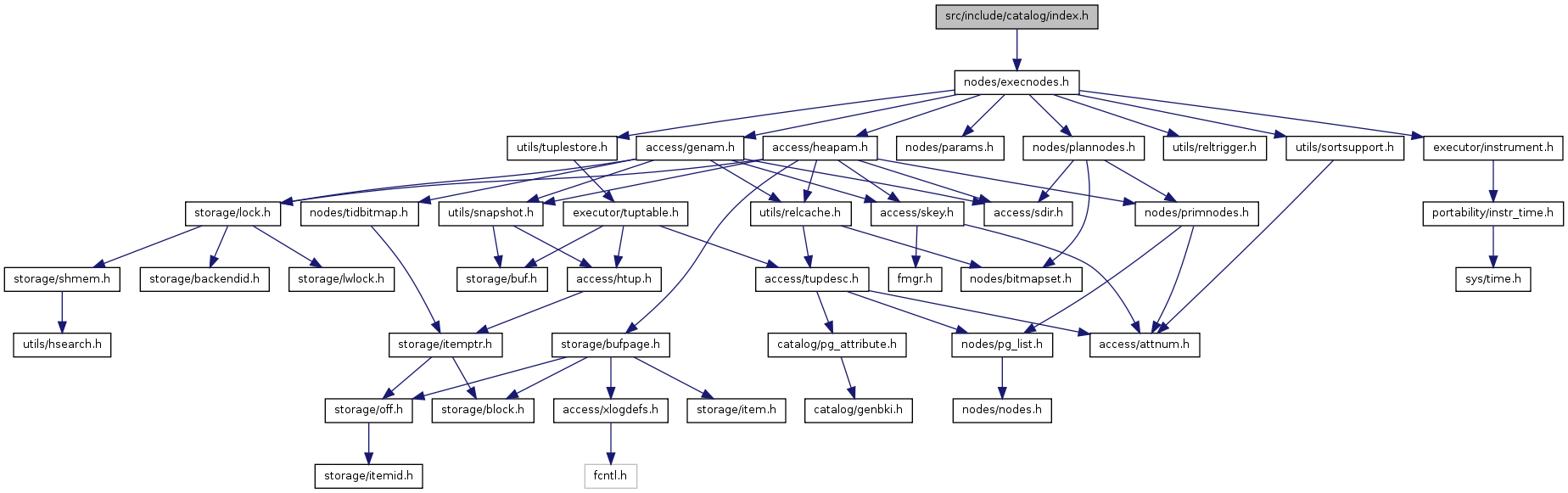

Go to the source code of this file.
Defines | |
| #define | DEFAULT_INDEX_TYPE "btree" |
| #define | REINDEX_REL_PROCESS_TOAST 0x01 |
| #define | REINDEX_REL_SUPPRESS_INDEX_USE 0x02 |
| #define | REINDEX_REL_CHECK_CONSTRAINTS 0x04 |
Typedefs | |
| typedef void(* | IndexBuildCallback )(Relation index, HeapTuple htup, Datum *values, bool *isnull, bool tupleIsAlive, void *state) |
Enumerations | |
| enum | IndexStateFlagsAction { INDEX_CREATE_SET_READY, INDEX_CREATE_SET_VALID, INDEX_DROP_CLEAR_VALID, INDEX_DROP_SET_DEAD } |
Functions | |
| void | index_check_primary_key (Relation heapRel, IndexInfo *indexInfo, bool is_alter_table) |
| Oid | index_create (Relation heapRelation, const char *indexRelationName, Oid indexRelationId, Oid relFileNode, IndexInfo *indexInfo, List *indexColNames, Oid accessMethodObjectId, Oid tableSpaceId, Oid *collationObjectId, Oid *classObjectId, int16 *coloptions, Datum reloptions, bool isprimary, bool isconstraint, bool deferrable, bool initdeferred, bool allow_system_table_mods, bool skip_build, bool concurrent, bool is_internal) |
| void | index_constraint_create (Relation heapRelation, Oid indexRelationId, IndexInfo *indexInfo, const char *constraintName, char constraintType, bool deferrable, bool initdeferred, bool mark_as_primary, bool update_pgindex, bool remove_old_dependencies, bool allow_system_table_mods, bool is_internal) |
| void | index_drop (Oid indexId, bool concurrent) |
| IndexInfo * | BuildIndexInfo (Relation index) |
| void | FormIndexDatum (IndexInfo *indexInfo, TupleTableSlot *slot, EState *estate, Datum *values, bool *isnull) |
| void | index_build (Relation heapRelation, Relation indexRelation, IndexInfo *indexInfo, bool isprimary, bool isreindex) |
| double | IndexBuildHeapScan (Relation heapRelation, Relation indexRelation, IndexInfo *indexInfo, bool allow_sync, IndexBuildCallback callback, void *callback_state) |
| void | validate_index (Oid heapId, Oid indexId, Snapshot snapshot) |
| void | index_set_state_flags (Oid indexId, IndexStateFlagsAction action) |
| void | reindex_index (Oid indexId, bool skip_constraint_checks) |
| bool | reindex_relation (Oid relid, int flags) |
| bool | ReindexIsProcessingHeap (Oid heapOid) |
| bool | ReindexIsProcessingIndex (Oid indexOid) |
| Oid | IndexGetRelation (Oid indexId, bool missing_ok) |
| #define DEFAULT_INDEX_TYPE "btree" |
Definition at line 20 of file index.h.
Referenced by transformIndexConstraint().
| #define REINDEX_REL_CHECK_CONSTRAINTS 0x04 |
Definition at line 110 of file index.h.
Referenced by reindex_relation().
| #define REINDEX_REL_PROCESS_TOAST 0x01 |
Definition at line 108 of file index.h.
Referenced by ExecuteTruncate(), reindex_relation(), ReindexDatabase(), and ReindexTable().
| #define REINDEX_REL_SUPPRESS_INDEX_USE 0x02 |
Definition at line 109 of file index.h.
Referenced by reindex_relation().
| INDEX_CREATE_SET_READY | |
| INDEX_CREATE_SET_VALID | |
| INDEX_DROP_CLEAR_VALID | |
| INDEX_DROP_SET_DEAD |
Definition at line 31 of file index.h.
{
    INDEX_CREATE_SET_READY,
    INDEX_CREATE_SET_VALID,
    INDEX_DROP_CLEAR_VALID,
    INDEX_DROP_SET_DEAD
} IndexStateFlagsAction;
Definition at line 1630 of file index.c.
References elog, ERROR, i, IndexInfo::ii_BrokenHotChain, IndexInfo::ii_Concurrent, IndexInfo::ii_ExclusionOps, IndexInfo::ii_ExclusionProcs, IndexInfo::ii_ExclusionStrats, IndexInfo::ii_Expressions, IndexInfo::ii_ExpressionsState, IndexInfo::ii_KeyAttrNumbers, IndexInfo::ii_NumIndexAttrs, IndexInfo::ii_Predicate, IndexInfo::ii_PredicateState, IndexInfo::ii_ReadyForInserts, IndexInfo::ii_Unique, INDEX_MAX_KEYS, IndexIsReady, makeNode, RelationData::rd_index, RelationGetExclusionInfo(), RelationGetIndexExpressions(), RelationGetIndexPredicate(), and RelationGetRelid.
Referenced by ATExecAddIndexConstraint(), DefineIndex(), do_analyze_rel(), ExecOpenIndices(), get_actual_variable_range(), reindex_index(), RelationGetIndexAttrBitmap(), RelationTruncateIndexes(), tuplesort_begin_cluster(), and validate_index().
{
    IndexInfo  *ii = makeNode(IndexInfo);
    Form_pg_index indexStruct = index->rd_index;
    int         i;
    int         numKeys;

    /* check the number of keys, and copy attr numbers into the IndexInfo */
    numKeys = indexStruct->indnatts;
    if (numKeys < 1 || numKeys > INDEX_MAX_KEYS)
        elog(ERROR, "invalid indnatts %d for index %u",
             numKeys, RelationGetRelid(index));
    ii->ii_NumIndexAttrs = numKeys;
    for (i = 0; i < numKeys; i++)
        ii->ii_KeyAttrNumbers[i] = indexStruct->indkey.values[i];

    /* fetch any expressions needed for expressional indexes */
    ii->ii_Expressions = RelationGetIndexExpressions(index);
    ii->ii_ExpressionsState = NIL;

    /* fetch index predicate if any */
    ii->ii_Predicate = RelationGetIndexPredicate(index);
    ii->ii_PredicateState = NIL;

    /* fetch exclusion constraint info if any */
    if (indexStruct->indisexclusion)
    {
        RelationGetExclusionInfo(index,
                                 &ii->ii_ExclusionOps,
                                 &ii->ii_ExclusionProcs,
                                 &ii->ii_ExclusionStrats);
    }
    else
    {
        ii->ii_ExclusionOps = NULL;
        ii->ii_ExclusionProcs = NULL;
        ii->ii_ExclusionStrats = NULL;
    }

    /* other info */
    ii->ii_Unique = indexStruct->indisunique;
    ii->ii_ReadyForInserts = IndexIsReady(indexStruct);

    /* initialize index-build state to default */
    ii->ii_Concurrent = false;
    ii->ii_BrokenHotChain = false;

    return ii;
}
| void FormIndexDatum | ( | IndexInfo * | indexInfo, | |
| TupleTableSlot * | slot, | |||
| EState * | estate, | |||
| Datum * | values, | |||
| bool * | isnull | |||
| ) |
Definition at line 1700 of file index.c.
References Assert, elog, ERROR, ExecEvalExprSwitchContext(), ExecPrepareExpr(), GetPerTupleExprContext, i, IndexInfo::ii_Expressions, IndexInfo::ii_ExpressionsState, IndexInfo::ii_KeyAttrNumbers, IndexInfo::ii_NumIndexAttrs, lfirst, list_head(), lnext, NIL, NULL, and slot_getattr().
Referenced by CatalogIndexInsert(), check_exclusion_constraint(), comparetup_cluster(), compute_index_stats(), ExecInsertIndexTuples(), get_actual_variable_range(), IndexBuildHeapScan(), IndexCheckExclusion(), and validate_index_heapscan().
{
    ListCell   *indexpr_item;
    int         i;

    if (indexInfo->ii_Expressions != NIL &&
        indexInfo->ii_ExpressionsState == NIL)
    {
        /* First time through, set up expression evaluation state */
        indexInfo->ii_ExpressionsState = (List *)
            ExecPrepareExpr((Expr *) indexInfo->ii_Expressions,
                            estate);
        /* Check caller has set up context correctly */
        Assert(GetPerTupleExprContext(estate)->ecxt_scantuple == slot);
    }
    indexpr_item = list_head(indexInfo->ii_ExpressionsState);

    for (i = 0; i < indexInfo->ii_NumIndexAttrs; i++)
    {
        int         keycol = indexInfo->ii_KeyAttrNumbers[i];
        Datum       iDatum;
        bool        isNull;

        if (keycol != 0)
        {
            /*
             * Plain index column; get the value we need directly from the
             * heap tuple.
             */
            iDatum = slot_getattr(slot, keycol, &isNull);
        }
        else
        {
            /*
             * Index expression --- need to evaluate it.
             */
            if (indexpr_item == NULL)
                elog(ERROR, "wrong number of index expressions");
            iDatum = ExecEvalExprSwitchContext((ExprState *) lfirst(indexpr_item),
                                               GetPerTupleExprContext(estate),
                                               &isNull,
                                               NULL);
            indexpr_item = lnext(indexpr_item);
        }
        values[i] = iDatum;
        isnull[i] = isNull;
    }

    if (indexpr_item != NULL)
        elog(ERROR, "wrong number of index expressions");
}
| void index_build | ( | Relation | heapRelation, | |
| Relation | indexRelation, | |||
| IndexInfo * | indexInfo, | |||
| bool | isprimary, | |||
| bool | isreindex | |||
| ) |
Definition at line 1955 of file index.c.
References Assert, AtEOXact_GUC(), CatalogUpdateIndexes(), CommandCounterIncrement(), DatumGetPointer, DEBUG1, elog, ereport, errmsg(), ERROR, GETSTRUCT, GetUserIdAndSecContext(), heap_close, heap_freetuple(), heap_open(), IndexBuildResult::heap_tuples, HeapTupleIsValid, IndexInfo::ii_BrokenHotChain, IndexInfo::ii_Concurrent, IndexInfo::ii_ExclusionOps, IndexBuildResult::index_tuples, index_update_stats(), IndexCheckExclusion(), IndexRelationId, INDEXRELID, INIT_FORKNUM, InvalidOid, NewGUCNestLevel(), NULL, ObjectIdGetDatum, OidFunctionCall1, OidFunctionCall3, PointerGetDatum, PointerIsValid, RelationData::rd_am, RelationData::rd_rel, RelationData::rd_smgr, RegProcedureIsValid, RelationGetRelationName, RelationGetRelid, RelationIsValid, RelationOpenSmgr, RELKIND_TOASTVALUE, RELPERSISTENCE_UNLOGGED, RowExclusiveLock, SearchSysCacheCopy1, SECURITY_RESTRICTED_OPERATION, SetUserIdAndSecContext(), simple_heap_update(), smgrcreate(), smgrexists(), and HeapTupleData::t_self.
Referenced by build_indices(), DefineIndex(), index_create(), reindex_index(), and RelationTruncateIndexes().
{
    RegProcedure procedure;
    IndexBuildResult *stats;
    Oid         save_userid;
    int         save_sec_context;
    int         save_nestlevel;

    /*
     * sanity checks
     */
    Assert(RelationIsValid(indexRelation));
    Assert(PointerIsValid(indexRelation->rd_am));

    procedure = indexRelation->rd_am->ambuild;
    Assert(RegProcedureIsValid(procedure));

    ereport(DEBUG1,
            (errmsg("building index \"%s\" on table \"%s\"",
                    RelationGetRelationName(indexRelation),
                    RelationGetRelationName(heapRelation))));

    /*
     * Switch to the table owner's userid, so that any index functions are run
     * as that user.  Also lock down security-restricted operations and
     * arrange to make GUC variable changes local to this command.
     */
    GetUserIdAndSecContext(&save_userid, &save_sec_context);
    SetUserIdAndSecContext(heapRelation->rd_rel->relowner,
                           save_sec_context | SECURITY_RESTRICTED_OPERATION);
    save_nestlevel = NewGUCNestLevel();

    /*
     * Call the access method's build procedure
     */
    stats = (IndexBuildResult *)
        DatumGetPointer(OidFunctionCall3(procedure,
                                         PointerGetDatum(heapRelation),
                                         PointerGetDatum(indexRelation),
                                         PointerGetDatum(indexInfo)));
    Assert(PointerIsValid(stats));

    /*
     * If this is an unlogged index, we may need to write out an init fork for
     * it -- but we must first check whether one already exists.  If, for
     * example, an unlogged relation is truncated in the transaction that
     * created it, or truncated twice in a subsequent transaction, the
     * relfilenode won't change, and nothing needs to be done here.
     */
    if (heapRelation->rd_rel->relpersistence == RELPERSISTENCE_UNLOGGED &&
        !smgrexists(indexRelation->rd_smgr, INIT_FORKNUM))
    {
        RegProcedure ambuildempty = indexRelation->rd_am->ambuildempty;

        RelationOpenSmgr(indexRelation);
        smgrcreate(indexRelation->rd_smgr, INIT_FORKNUM, false);
        OidFunctionCall1(ambuildempty, PointerGetDatum(indexRelation));
    }

    /*
     * If we found any potentially broken HOT chains, mark the index as not
     * being usable until the current transaction is below the event horizon.
     * See src/backend/access/heap/README.HOT for discussion.
     *
     * However, when reindexing an existing index, we should do nothing here.
     * Any HOT chains that are broken with respect to the index must predate
     * the index's original creation, so there is no need to change the
     * index's usability horizon.  Moreover, we *must not* try to change the
     * index's pg_index entry while reindexing pg_index itself, and this
     * optimization nicely prevents that.
     *
     * We also need not set indcheckxmin during a concurrent index build,
     * because we won't set indisvalid true until all transactions that care
     * about the broken HOT chains are gone.
     *
     * Therefore, this code path can only be taken during non-concurrent
     * CREATE INDEX.  Thus the fact that heap_update will set the pg_index
     * tuple's xmin doesn't matter, because that tuple was created in the
     * current transaction anyway.  That also means we don't need to worry
     * about any concurrent readers of the tuple; no other transaction can see
     * it yet.
     */
    if (indexInfo->ii_BrokenHotChain && !isreindex &&
        !indexInfo->ii_Concurrent)
    {
        Oid         indexId = RelationGetRelid(indexRelation);
        Relation    pg_index;
        HeapTuple   indexTuple;
        Form_pg_index indexForm;

        pg_index = heap_open(IndexRelationId, RowExclusiveLock);

        indexTuple = SearchSysCacheCopy1(INDEXRELID,
                                         ObjectIdGetDatum(indexId));
        if (!HeapTupleIsValid(indexTuple))
            elog(ERROR, "cache lookup failed for index %u", indexId);
        indexForm = (Form_pg_index) GETSTRUCT(indexTuple);

        /* If it's a new index, indcheckxmin shouldn't be set ... */
        Assert(!indexForm->indcheckxmin);

        indexForm->indcheckxmin = true;
        simple_heap_update(pg_index, &indexTuple->t_self, indexTuple);
        CatalogUpdateIndexes(pg_index, indexTuple);

        heap_freetuple(indexTuple);
        heap_close(pg_index, RowExclusiveLock);
    }

    /*
     * Update heap and index pg_class rows
     */
    index_update_stats(heapRelation,
                       true,
                       isprimary,
                       (heapRelation->rd_rel->relkind == RELKIND_TOASTVALUE) ?
                       RelationGetRelid(indexRelation) : InvalidOid,
                       stats->heap_tuples);

    index_update_stats(indexRelation,
                       false,
                       false,
                       InvalidOid,
                       stats->index_tuples);

    /* Make the updated catalog row versions visible */
    CommandCounterIncrement();

    /*
     * If it's for an exclusion constraint, make a second pass over the heap
     * to verify that the constraint is satisfied.  We must not do this until
     * the index is fully valid.  (Broken HOT chains shouldn't matter, though;
     * see comments for IndexCheckExclusion.)
     */
    if (indexInfo->ii_ExclusionOps != NULL)
        IndexCheckExclusion(heapRelation, indexRelation, indexInfo);

    /* Roll back any GUC changes executed by index functions */
    AtEOXact_GUC(false, save_nestlevel);

    /* Restore userid and security context */
    SetUserIdAndSecContext(save_userid, save_sec_context);
}
Definition at line 185 of file index.c.
References AlterTableInternal(), ATTNUM, elog, ereport, errcode(), errmsg(), ERROR, GETSTRUCT, HeapTupleIsValid, i, IndexInfo::ii_KeyAttrNumbers, IndexInfo::ii_NumIndexAttrs, Int16GetDatum, lappend(), makeNode, AlterTableCmd::name, NameStr, ObjectIdGetDatum, pstrdup(), RelationGetRelationName, RelationGetRelid, relationHasPrimaryKey(), ReleaseSysCache(), SearchSysCache2, and AlterTableCmd::subtype.
Referenced by ATExecAddIndexConstraint(), and DefineIndex().
{
    List       *cmds;
    int         i;

    /*
     * If ALTER TABLE, check that there isn't already a PRIMARY KEY. In CREATE
     * TABLE, we have faith that the parser rejected multiple pkey clauses;
     * and CREATE INDEX doesn't have a way to say PRIMARY KEY, so it's no
     * problem either.
     */
    if (is_alter_table &&
        relationHasPrimaryKey(heapRel))
    {
        ereport(ERROR,
                (errcode(ERRCODE_INVALID_TABLE_DEFINITION),
             errmsg("multiple primary keys for table \"%s\" are not allowed",
                    RelationGetRelationName(heapRel))));
    }

    /*
     * Check that all of the attributes in a primary key are marked as not
     * null, otherwise attempt to ALTER TABLE .. SET NOT NULL
     */
    cmds = NIL;
    for (i = 0; i < indexInfo->ii_NumIndexAttrs; i++)
    {
        AttrNumber  attnum = indexInfo->ii_KeyAttrNumbers[i];
        HeapTuple   atttuple;
        Form_pg_attribute attform;

        if (attnum == 0)
            ereport(ERROR,
                    (errcode(ERRCODE_FEATURE_NOT_SUPPORTED),
                     errmsg("primary keys cannot be expressions")));

        /* System attributes are never null, so no need to check */
        if (attnum < 0)
            continue;

        atttuple = SearchSysCache2(ATTNUM,
                                 ObjectIdGetDatum(RelationGetRelid(heapRel)),
                                   Int16GetDatum(attnum));
        if (!HeapTupleIsValid(atttuple))
            elog(ERROR, "cache lookup failed for attribute %d of relation %u",
                 attnum, RelationGetRelid(heapRel));
        attform = (Form_pg_attribute) GETSTRUCT(atttuple);

        if (!attform->attnotnull)
        {
            /* Add a subcommand to make this one NOT NULL */
            AlterTableCmd *cmd = makeNode(AlterTableCmd);

            cmd->subtype = AT_SetNotNull;
            cmd->name = pstrdup(NameStr(attform->attname));
            cmds = lappend(cmds, cmd);
        }

        ReleaseSysCache(atttuple);
    }

    /*
     * XXX: Shouldn't the ALTER TABLE .. SET NOT NULL cascade to child tables?
     * Currently, since the PRIMARY KEY itself doesn't cascade, we don't
     * cascade the notnull constraint(s) either; but this is pretty debatable.
     *
     * XXX: possible future improvement: when being called from ALTER TABLE,
     * it would be more efficient to merge this with the outer ALTER TABLE, so
     * as to avoid two scans.  But that seems to complicate DefineIndex's API
     * unduly.
     */
    if (cmds)
        AlterTableInternal(RelationGetRelid(heapRel), cmds, false);
}
| void index_constraint_create | ( | Relation | heapRelation, | |
| Oid | indexRelationId, | |||
| IndexInfo * | indexInfo, | |||
| const char * | constraintName, | |||
| char | constraintType, | |||
| bool | deferrable, | |||
| bool | initdeferred, | |||
| bool | mark_as_primary, | |||
| bool | update_pgindex, | |||
| bool | remove_old_dependencies, | |||
| bool | allow_system_table_mods, | |||
| bool | is_internal | |||
| ) |
Definition at line 1114 of file index.c.
References CreateTrigStmt::args, Assert, CatalogUpdateIndexes(), ObjectAddress::classId, CreateTrigStmt::columns, CONSTRAINT_EXCLUSION, CreateTrigStmt::constrrel, CreateConstraintEntry(), CreateTrigger(), CreateTrigStmt::deferrable, deleteDependencyRecordsForClass(), DEPENDENCY_AUTO, DEPENDENCY_INTERNAL, elog, ereport, errcode(), errmsg(), ERROR, CreateTrigStmt::events, CreateTrigStmt::funcname, get_namespace_name(), GETSTRUCT, heap_close, heap_freetuple(), heap_open(), HeapTupleIsValid, IndexInfo::ii_ExclusionOps, IndexInfo::ii_Expressions, IndexInfo::ii_KeyAttrNumbers, IndexInfo::ii_NumIndexAttrs, index_update_stats(), IndexRelationId, INDEXRELID, CreateTrigStmt::initdeferred, InvalidOid, InvokeObjectPostAlterHookArg, IsBootstrapProcessingMode, CreateTrigStmt::isconstraint, IsNormalProcessingMode, IsSystemRelation(), makeNode, makeRangeVar(), NULL, ObjectAddress::objectId, ObjectIdGetDatum, ObjectAddress::objectSubId, pstrdup(), recordDependencyOn(), CreateTrigStmt::relation, RelationGetNamespace, RelationGetRelationName, RelationGetRelid, RelationRelationId, CreateTrigStmt::row, RowExclusiveLock, SearchSysCacheCopy1, simple_heap_update(), SystemFuncName(), HeapTupleData::t_self, CreateTrigStmt::timing, TRIGGER_TYPE_INSERT, CreateTrigStmt::trigname, and CreateTrigStmt::whenClause.
Referenced by ATExecAddIndexConstraint(), and index_create().
{
    Oid         namespaceId = RelationGetNamespace(heapRelation);
    ObjectAddress myself,
                referenced;
    Oid         conOid;

    /* constraint creation support doesn't work while bootstrapping */
    Assert(!IsBootstrapProcessingMode());

    /* enforce system-table restriction */
    if (!allow_system_table_mods &&
        IsSystemRelation(heapRelation) &&
        IsNormalProcessingMode())
        ereport(ERROR,
                (errcode(ERRCODE_FEATURE_NOT_SUPPORTED),
                 errmsg("user-defined indexes on system catalog tables are not supported")));

    /* primary/unique constraints shouldn't have any expressions */
    if (indexInfo->ii_Expressions &&
        constraintType != CONSTRAINT_EXCLUSION)
        elog(ERROR, "constraints cannot have index expressions");

    /*
     * If we're manufacturing a constraint for a pre-existing index, we need
     * to get rid of the existing auto dependencies for the index (the ones
     * that index_create() would have made instead of calling this function).
     *
     * Note: this code would not necessarily do the right thing if the index
     * has any expressions or predicate, but we'd never be turning such an
     * index into a UNIQUE or PRIMARY KEY constraint.
     */
    if (remove_old_dependencies)
        deleteDependencyRecordsForClass(RelationRelationId, indexRelationId,
                                        RelationRelationId, DEPENDENCY_AUTO);

    /*
     * Construct a pg_constraint entry.
     */
    conOid = CreateConstraintEntry(constraintName,
                                   namespaceId,
                                   constraintType,
                                   deferrable,
                                   initdeferred,
                                   true,
                                   RelationGetRelid(heapRelation),
                                   indexInfo->ii_KeyAttrNumbers,
                                   indexInfo->ii_NumIndexAttrs,
                                   InvalidOid,  /* no domain */
                                   indexRelationId,     /* index OID */
                                   InvalidOid,  /* no foreign key */
                                   NULL,
                                   NULL,
                                   NULL,
                                   NULL,
                                   0,
                                   ' ',
                                   ' ',
                                   ' ',
                                   indexInfo->ii_ExclusionOps,
                                   NULL,        /* no check constraint */
                                   NULL,
                                   NULL,
                                   true,        /* islocal */
                                   0,   /* inhcount */
                                   true,        /* noinherit */
                                   is_internal);

    /*
     * Register the index as internally dependent on the constraint.
     *
     * Note that the constraint has a dependency on the table, so we don't
     * need (or want) any direct dependency from the index to the table.
     */
    myself.classId = RelationRelationId;
    myself.objectId = indexRelationId;
    myself.objectSubId = 0;

    referenced.classId = ConstraintRelationId;
    referenced.objectId = conOid;
    referenced.objectSubId = 0;

    recordDependencyOn(&myself, &referenced, DEPENDENCY_INTERNAL);

    /*
     * If the constraint is deferrable, create the deferred uniqueness
     * checking trigger.  (The trigger will be given an internal dependency on
     * the constraint by CreateTrigger.)
     */
    if (deferrable)
    {
        RangeVar   *heapRel;
        CreateTrigStmt *trigger;

        heapRel = makeRangeVar(get_namespace_name(namespaceId),
                               pstrdup(RelationGetRelationName(heapRelation)),
                               -1);

        trigger = makeNode(CreateTrigStmt);
        trigger->trigname = (constraintType == CONSTRAINT_PRIMARY) ?
            "PK_ConstraintTrigger" :
            "Unique_ConstraintTrigger";
        trigger->relation = heapRel;
        trigger->funcname = SystemFuncName("unique_key_recheck");
        trigger->args = NIL;
        trigger->row = true;
        trigger->timing = TRIGGER_TYPE_AFTER;
        trigger->events = TRIGGER_TYPE_INSERT | TRIGGER_TYPE_UPDATE;
        trigger->columns = NIL;
        trigger->whenClause = NULL;
        trigger->isconstraint = true;
        trigger->deferrable = true;
        trigger->initdeferred = initdeferred;
        trigger->constrrel = NULL;

        (void) CreateTrigger(trigger, NULL, conOid, indexRelationId, true);
    }

    /*
     * If needed, mark the table as having a primary key.  We assume it can't
     * have been so marked already, so no need to clear the flag in the other
     * case.
     *
     * Note: this might better be done by callers.  We do it here to avoid
     * exposing index_update_stats() globally, but that wouldn't be necessary
     * if relhaspkey went away.
     */
    if (mark_as_primary)
        index_update_stats(heapRelation,
                           true,
                           true,
                           InvalidOid,
                           -1.0);

    /*
     * If needed, mark the index as primary and/or deferred in pg_index.
     *
     * Note: since this is a transactional update, it's unsafe against
     * concurrent SnapshotNow scans of pg_index.  When making an existing
     * index into a constraint, caller must have a table lock that prevents
     * concurrent table updates; if it's less than a full exclusive lock,
     * there is a risk that concurrent readers of the table will miss seeing
     * this index at all.
     */
    if (update_pgindex && (mark_as_primary || deferrable))
    {
        Relation    pg_index;
        HeapTuple   indexTuple;
        Form_pg_index indexForm;
        bool        dirty = false;

        pg_index = heap_open(IndexRelationId, RowExclusiveLock);

        indexTuple = SearchSysCacheCopy1(INDEXRELID,
                                         ObjectIdGetDatum(indexRelationId));
        if (!HeapTupleIsValid(indexTuple))
            elog(ERROR, "cache lookup failed for index %u", indexRelationId);
        indexForm = (Form_pg_index) GETSTRUCT(indexTuple);

        if (mark_as_primary && !indexForm->indisprimary)
        {
            indexForm->indisprimary = true;
            dirty = true;
        }

        if (deferrable && indexForm->indimmediate)
        {
            indexForm->indimmediate = false;
            dirty = true;
        }

        if (dirty)
        {
            simple_heap_update(pg_index, &indexTuple->t_self, indexTuple);
            CatalogUpdateIndexes(pg_index, indexTuple);

            InvokeObjectPostAlterHookArg(IndexRelationId, indexRelationId, 0,
                                         InvalidOid, is_internal);
        }

        heap_freetuple(indexTuple);
        heap_close(pg_index, RowExclusiveLock);
    }
}
| Oid index_create | ( | Relation | heapRelation, | |
| const char * | indexRelationName, | |||
| Oid | indexRelationId, | |||
| Oid | relFileNode, | |||
| IndexInfo * | indexInfo, | |||
| List * | indexColNames, | |||
| Oid | accessMethodObjectId, | |||
| Oid | tableSpaceId, | |||
| Oid * | collationObjectId, | |||
| Oid * | classObjectId, | |||
| int16 * | coloptions, | |||
| Datum | reloptions, | |||
| bool | isprimary, | |||
| bool | isconstraint, | |||
| bool | deferrable, | |||
| bool | initdeferred, | |||
| bool | allow_system_table_mods, | |||
| bool | skip_build, | |||
| bool | concurrent, | |||
| bool | is_internal | |||
| ) |
Definition at line 679 of file index.c.
References AccessExclusiveLock, AppendAttributeTuples(), Assert, binary_upgrade_next_index_pg_class_oid, ObjectAddress::classId, CommandCounterIncrement(), ConstructTupleDescriptor(), DEFAULT_COLLATION_OID, DEPENDENCY_AUTO, DEPENDENCY_NORMAL, elog, ereport, errcode(), errmsg(), errmsg_internal(), ERROR, get_relname_relid(), GetNewRelFileNode(), GLOBALTABLESPACE_OID, heap_close, heap_create(), heap_open(), i, IndexInfo::ii_ExclusionOps, IndexInfo::ii_Expressions, IndexInfo::ii_KeyAttrNumbers, IndexInfo::ii_NumIndexAttrs, IndexInfo::ii_Predicate, IndexInfo::ii_Unique, index_build(), index_close(), index_constraint_create(), index_register(), index_update_stats(), InitializeAttributeOids(), InsertPgClassTuple(), InvalidOid, InvokeObjectPostCreateHookArg, IsBinaryUpgrade, IsBootstrapProcessingMode, IsNormalProcessingMode, IsSystemRelation(), LockRelation(), NoLock, NULL, ObjectAddress::objectId, ObjectAddress::objectSubId, OidIsValid, RelationData::rd_indexcxt, RelationData::rd_rel, recordDependencyOn(), recordDependencyOnSingleRelExpr(), RelationGetNamespace, RelationGetRelid, RelationInitIndexAccessInfo(), RelationIsMapped, RelationRelationId, RELKIND_INDEX, RowExclusiveLock, and UpdateIndexRelation().
Referenced by create_toast_table(), and DefineIndex().
{
    Oid         heapRelationId = RelationGetRelid(heapRelation);
    Relation    pg_class;
    Relation    indexRelation;
    TupleDesc   indexTupDesc;
    bool        shared_relation;
    bool        mapped_relation;
    bool        is_exclusion;
    Oid         namespaceId;
    int         i;
    char        relpersistence;

    is_exclusion = (indexInfo->ii_ExclusionOps != NULL);

    pg_class = heap_open(RelationRelationId, RowExclusiveLock);

    /*
     * The index will be in the same namespace as its parent table, and is
     * shared across databases if and only if the parent is.  Likewise, it
     * will use the relfilenode map if and only if the parent does; and it
     * inherits the parent's relpersistence.
     */
    namespaceId = RelationGetNamespace(heapRelation);
    shared_relation = heapRelation->rd_rel->relisshared;
    mapped_relation = RelationIsMapped(heapRelation);
    relpersistence = heapRelation->rd_rel->relpersistence;

    /*
     * check parameters
     */
    if (indexInfo->ii_NumIndexAttrs < 1)
        elog(ERROR, "must index at least one column");

    if (!allow_system_table_mods &&
        IsSystemRelation(heapRelation) &&
        IsNormalProcessingMode())
        ereport(ERROR,
                (errcode(ERRCODE_FEATURE_NOT_SUPPORTED),
                 errmsg("user-defined indexes on system catalog tables are not supported")));

    /*
     * concurrent index build on a system catalog is unsafe because we tend to
     * release locks before committing in catalogs
     */
    if (concurrent &&
        IsSystemRelation(heapRelation))
        ereport(ERROR,
                (errcode(ERRCODE_FEATURE_NOT_SUPPORTED),
                 errmsg("concurrent index creation on system catalog tables is not supported")));

    /*
     * This case is currently not supported, but there's no way to ask for it
     * in the grammar anyway, so it can't happen.
     */
    if (concurrent && is_exclusion)
        ereport(ERROR,
                (errcode(ERRCODE_FEATURE_NOT_SUPPORTED),
                 errmsg_internal("concurrent index creation for exclusion constraints is not supported")));

    /*
     * We cannot allow indexing a shared relation after initdb (because
     * there's no way to make the entry in other databases' pg_class).
     */
    if (shared_relation && !IsBootstrapProcessingMode())
        ereport(ERROR,
                (errcode(ERRCODE_OBJECT_NOT_IN_PREREQUISITE_STATE),
                 errmsg("shared indexes cannot be created after initdb")));

    /*
     * Shared relations must be in pg_global, too (last-ditch check)
     */
    if (shared_relation && tableSpaceId != GLOBALTABLESPACE_OID)
        elog(ERROR, "shared relations must be placed in pg_global tablespace");

    if (get_relname_relid(indexRelationName, namespaceId))
        ereport(ERROR,
                (errcode(ERRCODE_DUPLICATE_TABLE),
                 errmsg("relation \"%s\" already exists",
                        indexRelationName)));

    /*
     * construct tuple descriptor for index tuples
     */
    indexTupDesc = ConstructTupleDescriptor(heapRelation,
                                            indexInfo,
                                            indexColNames,
                                            accessMethodObjectId,
                                            collationObjectId,
                                            classObjectId);

    /*
     * Allocate an OID for the index, unless we were told what to use.
     *
     * The OID will be the relfilenode as well, so make sure it doesn't
     * collide with either pg_class OIDs or existing physical files.
     */
    if (!OidIsValid(indexRelationId))
    {
        /*
         * Use binary-upgrade override for pg_class.oid/relfilenode, if
         * supplied.
         */
        if (IsBinaryUpgrade &&
            OidIsValid(binary_upgrade_next_index_pg_class_oid))
        {
            indexRelationId = binary_upgrade_next_index_pg_class_oid;
            binary_upgrade_next_index_pg_class_oid = InvalidOid;
        }
        else
        {
            indexRelationId =
                GetNewRelFileNode(tableSpaceId, pg_class, relpersistence);
        }
    }

    /*
     * create the index relation's relcache entry and physical disk file. (If
     * we fail further down, it's the smgr's responsibility to remove the disk
     * file again.)
     */
    indexRelation = heap_create(indexRelationName,
                                namespaceId,
                                tableSpaceId,
                                indexRelationId,
                                relFileNode,
                                indexTupDesc,
                                RELKIND_INDEX,
                                relpersistence,
                                shared_relation,
                                mapped_relation);

    Assert(indexRelationId == RelationGetRelid(indexRelation));

    /*
     * Obtain exclusive lock on it.  Although no other backends can see it
     * until we commit, this prevents deadlock-risk complaints from lock
     * manager in cases such as CLUSTER.
     */
    LockRelation(indexRelation, AccessExclusiveLock);

    /*
     * Fill in fields of the index's pg_class entry that are not set correctly
     * by heap_create.
     *
     * XXX should have a cleaner way to create cataloged indexes
     */
    indexRelation->rd_rel->relowner = heapRelation->rd_rel->relowner;
    indexRelation->rd_rel->relam = accessMethodObjectId;
    indexRelation->rd_rel->relhasoids = false;

    /*
     * store index's pg_class entry
     */
    InsertPgClassTuple(pg_class, indexRelation,
                       RelationGetRelid(indexRelation),
                       (Datum) 0,
                       reloptions);

    /* done with pg_class */
    heap_close(pg_class, RowExclusiveLock);

    /*
     * now update the object id's of all the attribute tuple forms in the
     * index relation's tuple descriptor
     */
    InitializeAttributeOids(indexRelation,
                            indexInfo->ii_NumIndexAttrs,
                            indexRelationId);

    /*
     * append ATTRIBUTE tuples for the index
     */
    AppendAttributeTuples(indexRelation, indexInfo->ii_NumIndexAttrs);

    /* ----------------
     *    update pg_index
     *    (append INDEX tuple)
     *
     *    Note that this stows away a representation of "predicate".
     *    (Or, could define a rule to maintain the predicate) --Nels, Feb '92
     * ----------------
     */
    UpdateIndexRelation(indexRelationId, heapRelationId, indexInfo,
                        collationObjectId, classObjectId, coloptions,
                        isprimary, is_exclusion,
                        !deferrable,
                        !concurrent);

    /*
     * Register constraint and dependencies for the index.
     *
     * If the index is from a CONSTRAINT clause, construct a pg_constraint
     * entry.  The index will be linked to the constraint, which in turn is
     * linked to the table.  If it's not a CONSTRAINT, we need to make a
     * dependency directly on the table.
     *
     * We don't need a dependency on the namespace, because there'll be an
     * indirect dependency via our parent table.
     *
     * During bootstrap we can't register any dependencies, and we don't try
     * to make a constraint either.
     */
    if (!IsBootstrapProcessingMode())
    {
        ObjectAddress myself,
                    referenced;

        myself.classId = RelationRelationId;
        myself.objectId = indexRelationId;
        myself.objectSubId = 0;

        if (isconstraint)
        {
            char        constraintType;

            if (isprimary)
                constraintType = CONSTRAINT_PRIMARY;
            else if (indexInfo->ii_Unique)
                constraintType = CONSTRAINT_UNIQUE;
            else if (is_exclusion)
                constraintType = CONSTRAINT_EXCLUSION;
            else
            {
                elog(ERROR, "constraint must be PRIMARY, UNIQUE or EXCLUDE");
                constraintType = 0;     /* keep compiler quiet */
            }

            index_constraint_create(heapRelation,
                                    indexRelationId,
                                    indexInfo,
                                    indexRelationName,
                                    constraintType,
                                    deferrable,
                                    initdeferred,
                                    false,      /* already marked primary */
                                    false,      /* pg_index entry is OK */
                                    false,      /* no old dependencies */
                                    allow_system_table_mods,
                                    is_internal);
        }
        else
        {
            bool        have_simple_col = false;

            /* Create auto dependencies on simply-referenced columns */
            for (i = 0; i < indexInfo->ii_NumIndexAttrs; i++)
            {
                if (indexInfo->ii_KeyAttrNumbers[i] != 0)
                {
                    referenced.classId = RelationRelationId;
                    referenced.objectId = heapRelationId;
                    referenced.objectSubId = indexInfo->ii_KeyAttrNumbers[i];

                    recordDependencyOn(&myself, &referenced, DEPENDENCY_AUTO);

                    have_simple_col = true;
                }
            }

            /*
             * If there are no simply-referenced columns, give the index an
             * auto dependency on the whole table.  In most cases, this will
             * be redundant, but it might not be if the index expressions and
             * predicate contain no Vars or only whole-row Vars.
             */
            if (!have_simple_col)
            {
                referenced.classId = RelationRelationId;
                referenced.objectId = heapRelationId;
                referenced.objectSubId = 0;

                recordDependencyOn(&myself, &referenced, DEPENDENCY_AUTO);
            }

            /* Non-constraint indexes can't be deferrable */
            Assert(!deferrable);
            Assert(!initdeferred);
        }

        /* Store dependency on collations */
        /* The default collation is pinned, so don't bother recording it */
        for (i = 0; i < indexInfo->ii_NumIndexAttrs; i++)
        {
            if (OidIsValid(collationObjectId[i]) &&
                collationObjectId[i] != DEFAULT_COLLATION_OID)
            {
                referenced.classId = CollationRelationId;
                referenced.objectId = collationObjectId[i];
                referenced.objectSubId = 0;

                recordDependencyOn(&myself, &referenced, DEPENDENCY_NORMAL);
            }
        }

        /* Store dependency on operator classes */
        for (i = 0; i < indexInfo->ii_NumIndexAttrs; i++)
        {
            referenced.classId = OperatorClassRelationId;
            referenced.objectId = classObjectId[i];
            referenced.objectSubId = 0;

            recordDependencyOn(&myself, &referenced, DEPENDENCY_NORMAL);
        }

        /* Store dependencies on anything mentioned in index expressions */
        if (indexInfo->ii_Expressions)
        {
            recordDependencyOnSingleRelExpr(&myself,
                                          (Node *) indexInfo->ii_Expressions,
                                            heapRelationId,
                                            DEPENDENCY_NORMAL,
                                            DEPENDENCY_AUTO);
        }

        /* Store dependencies on anything mentioned in predicate */
        if (indexInfo->ii_Predicate)
        {
            recordDependencyOnSingleRelExpr(&myself,
                                            (Node *) indexInfo->ii_Predicate,
                                            heapRelationId,
                                            DEPENDENCY_NORMAL,
                                            DEPENDENCY_AUTO);
        }
    }
    else
    {
        /* Bootstrap mode - assert we weren't asked for constraint support */
        Assert(!isconstraint);
        Assert(!deferrable);
        Assert(!initdeferred);
    }

    /* Post creation hook for new index */
    InvokeObjectPostCreateHookArg(RelationRelationId,
                                  indexRelationId, 0, is_internal);

    /*
     * Advance the command counter so that we can see the newly-entered
     * catalog tuples for the index.
     */
    CommandCounterIncrement();

    /*
     * In bootstrap mode, we have to fill in the index strategy structure with
     * information from the catalogs.  If we aren't bootstrapping, then the
     * relcache entry has already been rebuilt thanks to sinval update during
     * CommandCounterIncrement.
     */
    if (IsBootstrapProcessingMode())
        RelationInitIndexAccessInfo(indexRelation);
    else
        Assert(indexRelation->rd_indexcxt != NULL);

    /*
     * If this is bootstrap (initdb) time, then we don't actually fill in the
     * index yet.  We'll be creating more indexes and classes later, so we
     * delay filling them in until just before we're done with bootstrapping.
     * Similarly, if the caller specified skip_build then filling the index is
     * delayed till later (ALTER TABLE can save work in some cases with this).
     * Otherwise, we call the AM routine that constructs the index.
     */
    if (IsBootstrapProcessingMode())
    {
        index_register(heapRelationId, indexRelationId, indexInfo);
    }
    else if (skip_build)
    {
        /*
         * Caller is responsible for filling the index later on.  However,
         * we'd better make sure that the heap relation is correctly marked as
         * having an index.
         */
        index_update_stats(heapRelation,
                           true,
                           isprimary,
                           InvalidOid,
                           -1.0);
        /* Make the above update visible */
        CommandCounterIncrement();
    }
    else
    {
        index_build(heapRelation, indexRelation, indexInfo, isprimary, false);
    }

    /*
     * Close the index; but we keep the lock that we acquired above until end
     * of transaction.  Closing the heap is caller's responsibility.
     */
    index_close(indexRelation, NoLock);

    return indexRelationId;
}
Definition at line 1317 of file index.c.
References AccessExclusiveLock, Anum_pg_index_indexprs, CacheInvalidateRelcache(), CheckTableNotInUse(), CommitTransactionCommand(), LockRelId::dbId, DeleteAttributeTuples(), DeleteRelationTuple(), elog, ereport, errcode(), errmsg(), ERROR, GetLockConflicts(), GetTopTransactionIdIfAny(), heap_attisnull(), heap_close, heap_open(), HeapTupleIsValid, index_close(), INDEX_DROP_CLEAR_VALID, INDEX_DROP_SET_DEAD, index_open(), index_set_state_flags(), IndexGetRelation(), IndexRelationId, INDEXRELID, InvalidTransactionId, LockRelationIdForSession(), LockInfoData::lockRelId, NoLock, ObjectIdGetDatum, PopActiveSnapshot(), RelationData::rd_lockInfo, RelationDropStorage(), RelationForgetRelation(), ReleaseSysCache(), LockRelId::relId, RemoveStatistics(), RowExclusiveLock, SearchSysCache1, SET_LOCKTAG_RELATION, ShareUpdateExclusiveLock, simple_heap_delete(), StartTransactionCommand(), HeapTupleData::t_self, TransferPredicateLocksToHeapRelation(), UnlockRelationIdForSession(), VirtualTransactionIdIsValid, and VirtualXactLock().
Referenced by doDeletion().
{
    Oid         heapId;
    Relation    userHeapRelation;
    Relation    userIndexRelation;
    Relation    indexRelation;
    HeapTuple   tuple;
    bool        hasexprs;
    LockRelId   heaprelid,
                indexrelid;
    LOCKTAG     heaplocktag;
    LOCKMODE    lockmode;
    VirtualTransactionId *old_lockholders;

    /*
     * To drop an index safely, we must grab exclusive lock on its parent
     * table.  Exclusive lock on the index alone is insufficient because
     * another backend might be about to execute a query on the parent table.
     * If it relies on a previously cached list of index OIDs, then it could
     * attempt to access the just-dropped index.  We must therefore take a
     * table lock strong enough to prevent all queries on the table from
     * proceeding until we commit and send out a shared-cache-inval notice
     * that will make them update their index lists.
     *
     * In the concurrent case we avoid this requirement by disabling index use
     * in multiple steps and waiting out any transactions that might be using
     * the index, so we don't need exclusive lock on the parent table. Instead
     * we take ShareUpdateExclusiveLock, to ensure that two sessions aren't
     * doing CREATE/DROP INDEX CONCURRENTLY on the same index.  (We will get
     * AccessExclusiveLock on the index below, once we're sure nobody else is
     * using it.)
     */
    heapId = IndexGetRelation(indexId, false);
    lockmode = concurrent ? ShareUpdateExclusiveLock : AccessExclusiveLock;
    userHeapRelation = heap_open(heapId, lockmode);
    userIndexRelation = index_open(indexId, lockmode);

    /*
     * We might still have open queries using it in our own session, which the
     * above locking won't prevent, so test explicitly.
     */
    CheckTableNotInUse(userIndexRelation, "DROP INDEX");

    /*
     * Drop Index Concurrently is more or less the reverse process of Create
     * Index Concurrently.
     *
     * First we unset indisvalid so queries starting afterwards don't use the
     * index to answer queries anymore.  We have to keep indisready = true so
     * transactions that are still scanning the index can continue to see
     * valid index contents.  For instance, if they are using READ COMMITTED
     * mode, and another transaction makes changes and commits, they need to
     * see those new tuples in the index.
     *
     * After all transactions that could possibly have used the index for
     * queries end, we can unset indisready and indislive, then wait till
     * nobody could be touching it anymore.  (Note: we need indislive because
     * this state must be distinct from the initial state during CREATE INDEX
     * CONCURRENTLY, which has indislive true while indisready and indisvalid
     * are false.  That's because in that state, transactions must examine the
     * index for HOT-safety decisions, while in this state we don't want them
     * to open it at all.)
     *
     * Since all predicate locks on the index are about to be made invalid, we
     * must promote them to predicate locks on the heap.  In the
     * non-concurrent case we can just do that now.  In the concurrent case
     * it's a bit trickier.  The predicate locks must be moved when there are
     * no index scans in progress on the index and no more can subsequently
     * start, so that no new predicate locks can be made on the index.  Also,
     * they must be moved before heap inserts stop maintaining the index, else
     * the conflict with the predicate lock on the index gap could be missed
     * before the lock on the heap relation is in place to detect a conflict
     * based on the heap tuple insert.
     */
    if (concurrent)
    {
        /*
         * We must commit our transaction in order to make the first pg_index
         * state update visible to other sessions.  If the DROP machinery has
         * already performed any other actions (removal of other objects,
         * pg_depend entries, etc), the commit would make those actions
         * permanent, which would leave us with inconsistent catalog state if
         * we fail partway through the following sequence.  Since DROP INDEX
         * CONCURRENTLY is restricted to dropping just one index that has no
         * dependencies, we should get here before anything's been done ---
         * but let's check that to be sure.  We can verify that the current
         * transaction has not executed any transactional updates by checking
         * that no XID has been assigned.
         */
        if (GetTopTransactionIdIfAny() != InvalidTransactionId)
            ereport(ERROR,
                    (errcode(ERRCODE_FEATURE_NOT_SUPPORTED),
                     errmsg("DROP INDEX CONCURRENTLY must be first action in transaction")));

        /*
         * Mark index invalid by updating its pg_index entry
         */
        index_set_state_flags(indexId, INDEX_DROP_CLEAR_VALID);

        /*
         * Invalidate the relcache for the table, so that after this commit
         * all sessions will refresh any cached plans that might reference the
         * index.
         */
        CacheInvalidateRelcache(userHeapRelation);

        /* save lockrelid and locktag for below, then close but keep locks */
        heaprelid = userHeapRelation->rd_lockInfo.lockRelId;
        SET_LOCKTAG_RELATION(heaplocktag, heaprelid.dbId, heaprelid.relId);
        indexrelid = userIndexRelation->rd_lockInfo.lockRelId;

        heap_close(userHeapRelation, NoLock);
        index_close(userIndexRelation, NoLock);

        /*
         * We must commit our current transaction so that the indisvalid
         * update becomes visible to other transactions; then start another.
         * Note that any previously-built data structures are lost in the
         * commit.  The only data we keep past here are the relation IDs.
         *
         * Before committing, get a session-level lock on the table, to ensure
         * that neither it nor the index can be dropped before we finish. This
         * cannot block, even if someone else is waiting for access, because
         * we already have the same lock within our transaction.
         */
        LockRelationIdForSession(&heaprelid, ShareUpdateExclusiveLock);
        LockRelationIdForSession(&indexrelid, ShareUpdateExclusiveLock);

        PopActiveSnapshot();
        CommitTransactionCommand();
        StartTransactionCommand();

        /*
         * Now we must wait until no running transaction could be using the
         * index for a query.  To do this, inquire which xacts currently would
         * conflict with AccessExclusiveLock on the table -- ie, which ones
         * have a lock of any kind on the table. Then wait for each of these
         * xacts to commit or abort. Note we do not need to worry about xacts
         * that open the table for reading after this point; they will see the
         * index as invalid when they open the relation.
         *
         * Note: the reason we use actual lock acquisition here, rather than
         * just checking the ProcArray and sleeping, is that deadlock is
         * possible if one of the transactions in question is blocked trying
         * to acquire an exclusive lock on our table.  The lock code will
         * detect deadlock and error out properly.
         *
         * Note: GetLockConflicts() never reports our own xid, hence we need
         * not check for that.  Also, prepared xacts are not reported, which
         * is fine since they certainly aren't going to do anything more.
         */
        old_lockholders = GetLockConflicts(&heaplocktag, AccessExclusiveLock);

        while (VirtualTransactionIdIsValid(*old_lockholders))
        {
            VirtualXactLock(*old_lockholders, true);
            old_lockholders++;
        }

        /*
         * No more predicate locks will be acquired on this index, and we're
         * about to stop doing inserts into the index which could show
         * conflicts with existing predicate locks, so now is the time to move
         * them to the heap relation.
         */
        userHeapRelation = heap_open(heapId, ShareUpdateExclusiveLock);
        userIndexRelation = index_open(indexId, ShareUpdateExclusiveLock);
        TransferPredicateLocksToHeapRelation(userIndexRelation);

        /*
         * Now we are sure that nobody uses the index for queries; they just
         * might have it open for updating it.  So now we can unset indisready
         * and indislive, then wait till nobody could be using it at all
         * anymore.
         */
        index_set_state_flags(indexId, INDEX_DROP_SET_DEAD);

        /*
         * Invalidate the relcache for the table, so that after this commit
         * all sessions will refresh the table's index list.  Forgetting just
         * the index's relcache entry is not enough.
         */
        CacheInvalidateRelcache(userHeapRelation);

        /*
         * Close the relations again, though still holding session lock.
         */
        heap_close(userHeapRelation, NoLock);
        index_close(userIndexRelation, NoLock);

        /*
         * Again, commit the transaction to make the pg_index update visible
         * to other sessions.
         */
        CommitTransactionCommand();
        StartTransactionCommand();

        /*
         * Wait till every transaction that saw the old index state has
         * finished.  The logic here is the same as above.
         */
        old_lockholders = GetLockConflicts(&heaplocktag, AccessExclusiveLock);

        while (VirtualTransactionIdIsValid(*old_lockholders))
        {
            VirtualXactLock(*old_lockholders, true);
            old_lockholders++;
        }

        /*
         * Re-open relations to allow us to complete our actions.
         *
         * At this point, nothing should be accessing the index, but lets
         * leave nothing to chance and grab AccessExclusiveLock on the index
         * before the physical deletion.
         */
        userHeapRelation = heap_open(heapId, ShareUpdateExclusiveLock);
        userIndexRelation = index_open(indexId, AccessExclusiveLock);
    }
    else
    {
        /* Not concurrent, so just transfer predicate locks and we're good */
        TransferPredicateLocksToHeapRelation(userIndexRelation);
    }

    /*
     * Schedule physical removal of the files
     */
    RelationDropStorage(userIndexRelation);

    /*
     * Close and flush the index's relcache entry, to ensure relcache doesn't
     * try to rebuild it while we're deleting catalog entries. We keep the
     * lock though.
     */
    index_close(userIndexRelation, NoLock);

    RelationForgetRelation(indexId);

    /*
     * fix INDEX relation, and check for expressional index
     */
    indexRelation = heap_open(IndexRelationId, RowExclusiveLock);

    tuple = SearchSysCache1(INDEXRELID, ObjectIdGetDatum(indexId));
    if (!HeapTupleIsValid(tuple))
        elog(ERROR, "cache lookup failed for index %u", indexId);

    hasexprs = !heap_attisnull(tuple, Anum_pg_index_indexprs);

    simple_heap_delete(indexRelation, &tuple->t_self);

    ReleaseSysCache(tuple);
    heap_close(indexRelation, RowExclusiveLock);

    /*
     * if it has any expression columns, we might have stored statistics about
     * them.
     */
    if (hasexprs)
        RemoveStatistics(indexId, 0);

    /*
     * fix ATTRIBUTE relation
     */
    DeleteAttributeTuples(indexId);

    /*
     * fix RELATION relation
     */
    DeleteRelationTuple(indexId);

    /*
     * We are presently too lazy to attempt to compute the new correct value
     * of relhasindex (the next VACUUM will fix it if necessary). So there is
     * no need to update the pg_class tuple for the owning relation. But we
     * must send out a shared-cache-inval notice on the owning relation to
     * ensure other backends update their relcache lists of indexes.  (In the
     * concurrent case, this is redundant but harmless.)
     */
    CacheInvalidateRelcache(userHeapRelation);

    /*
     * Close owning rel, but keep lock
     */
    heap_close(userHeapRelation, NoLock);

    /*
     * Release the session locks before we go.
     */
    if (concurrent)
    {
        UnlockRelationIdForSession(&heaprelid, ShareUpdateExclusiveLock);
        UnlockRelationIdForSession(&indexrelid, ShareUpdateExclusiveLock);
    }
}
| void index_set_state_flags | ( | Oid | indexId, | |
| IndexStateFlagsAction | action | |||
| ) |
Definition at line 3021 of file index.c.
References Assert, elog, ERROR, GETSTRUCT, GetTopTransactionIdIfAny(), heap_close, heap_inplace_update(), heap_open(), HeapTupleIsValid, INDEX_CREATE_SET_READY, INDEX_CREATE_SET_VALID, INDEX_DROP_CLEAR_VALID, INDEX_DROP_SET_DEAD, IndexRelationId, INDEXRELID, InvalidTransactionId, ObjectIdGetDatum, RowExclusiveLock, and SearchSysCacheCopy1.
Referenced by DefineIndex(), and index_drop().
{
    Relation    pg_index;
    HeapTuple   indexTuple;
    Form_pg_index indexForm;

    /* Assert that current xact hasn't done any transactional updates */
    Assert(GetTopTransactionIdIfAny() == InvalidTransactionId);

    /* Open pg_index and fetch a writable copy of the index's tuple */
    pg_index = heap_open(IndexRelationId, RowExclusiveLock);

    indexTuple = SearchSysCacheCopy1(INDEXRELID,
                                     ObjectIdGetDatum(indexId));
    if (!HeapTupleIsValid(indexTuple))
        elog(ERROR, "cache lookup failed for index %u", indexId);
    indexForm = (Form_pg_index) GETSTRUCT(indexTuple);

    /* Perform the requested state change on the copy */
    switch (action)
    {
        case INDEX_CREATE_SET_READY:
            /* Set indisready during a CREATE INDEX CONCURRENTLY sequence */
            Assert(indexForm->indislive);
            Assert(!indexForm->indisready);
            Assert(!indexForm->indisvalid);
            indexForm->indisready = true;
            break;
        case INDEX_CREATE_SET_VALID:
            /* Set indisvalid during a CREATE INDEX CONCURRENTLY sequence */
            Assert(indexForm->indislive);
            Assert(indexForm->indisready);
            Assert(!indexForm->indisvalid);
            indexForm->indisvalid = true;
            break;
        case INDEX_DROP_CLEAR_VALID:

            /*
             * Clear indisvalid during a DROP INDEX CONCURRENTLY sequence
             *
             * If indisready == true we leave it set so the index still gets
             * maintained by active transactions.  We only need to ensure that
             * indisvalid is false.  (We don't assert that either is initially
             * true, though, since we want to be able to retry a DROP INDEX
             * CONCURRENTLY that failed partway through.)
             *
             * Note: the CLUSTER logic assumes that indisclustered cannot be
             * set on any invalid index, so clear that flag too.
             */
            indexForm->indisvalid = false;
            indexForm->indisclustered = false;
            break;
        case INDEX_DROP_SET_DEAD:

            /*
             * Clear indisready/indislive during DROP INDEX CONCURRENTLY
             *
             * We clear both indisready and indislive, because we not only
             * want to stop updates, we want to prevent sessions from touching
             * the index at all.
             */
            Assert(!indexForm->indisvalid);
            indexForm->indisready = false;
            indexForm->indislive = false;
            break;
    }

    /* ... and write it back in-place */
    heap_inplace_update(pg_index, indexTuple);

    heap_close(pg_index, RowExclusiveLock);
}
| double IndexBuildHeapScan | ( | Relation | heapRelation, | |
| Relation | indexRelation, | |||
| IndexInfo * | indexInfo, | |||
| bool | allow_sync, | |||
| IndexBuildCallback | callback, | |||
| void * | callback_state | |||
| ) |
Definition at line 2128 of file index.c.
References Assert, BUFFER_LOCK_SHARE, BUFFER_LOCK_UNLOCK, BufferGetPage, callback(), CHECK_FOR_INTERRUPTS, CreateExecutorState(), ExprContext::ecxt_per_tuple_memory, ExprContext::ecxt_scantuple, elog, ERROR, ExecDropSingleTupleTableSlot(), ExecPrepareExpr(), ExecQual(), ExecStoreTuple(), FormIndexDatum(), ForwardScanDirection, FreeExecutorState(), GetOldestXmin(), GetPerTupleExprContext, GetTransactionSnapshot(), heap_beginscan_strat(), heap_endscan(), heap_get_root_tuples(), heap_getnext(), HEAPTUPLE_DEAD, HEAPTUPLE_DELETE_IN_PROGRESS, HEAPTUPLE_INSERT_IN_PROGRESS, HEAPTUPLE_LIVE, HEAPTUPLE_RECENTLY_DEAD, HeapTupleHeaderGetUpdateXid, HeapTupleHeaderGetXmin, HeapTupleIsHeapOnly, HeapTupleIsHotUpdated, HeapTupleSatisfiesVacuum(), IndexInfo::ii_BrokenHotChain, IndexInfo::ii_Concurrent, IndexInfo::ii_ExclusionOps, IndexInfo::ii_ExpressionsState, IndexInfo::ii_Predicate, IndexInfo::ii_PredicateState, IndexInfo::ii_Unique, InvalidBuffer, IsBootstrapProcessingMode, IsSystemRelation(), ItemPointerGetOffsetNumber, ItemPointerSetOffsetNumber, LockBuffer(), MakeSingleTupleTableSlot(), MemoryContextReset(), NIL, NULL, OffsetNumberIsValid, OidIsValid, OldestXmin, RelationData::rd_rel, RegisterSnapshot(), RelationGetDescr, RelationGetRelationName, HeapScanDescData::rs_cblock, HeapScanDescData::rs_cbuf, SnapshotAny, HeapTupleData::t_data, HeapTupleData::t_self, TransactionIdIsCurrentTransactionId(), UnregisterSnapshot(), values, WARNING, and XactLockTableWait().
Referenced by btbuild(), ginbuild(), gistbuild(), hashbuild(), and spgbuild().
{
bool is_system_catalog;
bool checking_uniqueness;
HeapScanDesc scan;
HeapTuple heapTuple;
Datum values[INDEX_MAX_KEYS];
bool isnull[INDEX_MAX_KEYS];
double reltuples;
List *predicate;
TupleTableSlot *slot;
EState *estate;
ExprContext *econtext;
Snapshot snapshot;
TransactionId OldestXmin;
BlockNumber root_blkno = InvalidBlockNumber;
OffsetNumber root_offsets[MaxHeapTuplesPerPage];
/*
* sanity checks
*/
Assert(OidIsValid(indexRelation->rd_rel->relam));
/* Remember if it's a system catalog */
is_system_catalog = IsSystemRelation(heapRelation);
/* See whether we're verifying uniqueness/exclusion properties */
checking_uniqueness = (indexInfo->ii_Unique ||
indexInfo->ii_ExclusionOps != NULL);
/*
* Need an EState for evaluation of index expressions and partial-index
* predicates. Also a slot to hold the current tuple.
*/
estate = CreateExecutorState();
econtext = GetPerTupleExprContext(estate);
slot = MakeSingleTupleTableSlot(RelationGetDescr(heapRelation));
/* Arrange for econtext's scan tuple to be the tuple under test */
econtext->ecxt_scantuple = slot;
/* Set up execution state for predicate, if any. */
predicate = (List *)
ExecPrepareExpr((Expr *) indexInfo->ii_Predicate,
estate);
/*
* Prepare for scan of the base relation. In a normal index build, we use
* SnapshotAny because we must retrieve all tuples and do our own time
* qual checks (because we have to index RECENTLY_DEAD tuples). In a
* concurrent build, we take a regular MVCC snapshot and index whatever's
* live according to that. During bootstrap we just use SnapshotNow.
*/
if (IsBootstrapProcessingMode())
{
snapshot = SnapshotNow;
OldestXmin = InvalidTransactionId; /* not used */
}
else if (indexInfo->ii_Concurrent)
{
snapshot = RegisterSnapshot(GetTransactionSnapshot());
OldestXmin = InvalidTransactionId; /* not used */
}
else
{
snapshot = SnapshotAny;
/* okay to ignore lazy VACUUMs here */
OldestXmin = GetOldestXmin(heapRelation->rd_rel->relisshared, true);
}
scan = heap_beginscan_strat(heapRelation, /* relation */
snapshot, /* snapshot */
0, /* number of keys */
NULL, /* scan key */
true, /* buffer access strategy OK */
allow_sync); /* syncscan OK? */
reltuples = 0;
/*
* Scan all tuples in the base relation.
*/
while ((heapTuple = heap_getnext(scan, ForwardScanDirection)) != NULL)
{
bool tupleIsAlive;
CHECK_FOR_INTERRUPTS();
/*
* When dealing with a HOT-chain of updated tuples, we want to index
* the values of the live tuple (if any), but index it under the TID
* of the chain's root tuple. This approach is necessary to preserve
* the HOT-chain structure in the heap. So we need to be able to find
* the root item offset for every tuple that's in a HOT-chain. When
* first reaching a new page of the relation, call
* heap_get_root_tuples() to build a map of root item offsets on the
* page.
*
* It might look unsafe to use this information across buffer
* lock/unlock. However, we hold ShareLock on the table so no
* ordinary insert/update/delete should occur; and we hold pin on the
* buffer continuously while visiting the page, so no pruning
* operation can occur either.
*
* Also, although our opinions about tuple liveness could change while
* we scan the page (due to concurrent transaction commits/aborts),
* the chain root locations won't, so this info doesn't need to be
* rebuilt after waiting for another transaction.
*
* Note the implied assumption that there is no more than one live
* tuple per HOT-chain --- else we could create more than one index
* entry pointing to the same root tuple.
*/
if (scan->rs_cblock != root_blkno)
{
Page page = BufferGetPage(scan->rs_cbuf);
LockBuffer(scan->rs_cbuf, BUFFER_LOCK_SHARE);
heap_get_root_tuples(page, root_offsets);
LockBuffer(scan->rs_cbuf, BUFFER_LOCK_UNLOCK);
root_blkno = scan->rs_cblock;
}
if (snapshot == SnapshotAny)
{
/* do our own time qual check */
bool indexIt;
TransactionId xwait;
recheck:
/*
* We could possibly get away with not locking the buffer here,
* since caller should hold ShareLock on the relation, but let's
* be conservative about it. (This remark is still correct even
* with HOT-pruning: our pin on the buffer prevents pruning.)
*/
LockBuffer(scan->rs_cbuf, BUFFER_LOCK_SHARE);
switch (HeapTupleSatisfiesVacuum(heapTuple->t_data, OldestXmin,
scan->rs_cbuf))
{
case HEAPTUPLE_DEAD:
/* Definitely dead, we can ignore it */
indexIt = false;
tupleIsAlive = false;
break;
case HEAPTUPLE_LIVE:
/* Normal case, index and unique-check it */
indexIt = true;
tupleIsAlive = true;
break;
case HEAPTUPLE_RECENTLY_DEAD:
/*
* If tuple is recently deleted then we must index it
* anyway to preserve MVCC semantics. (Pre-existing
* transactions could try to use the index after we finish
* building it, and may need to see such tuples.)
*
* However, if it was HOT-updated then we must only index
* the live tuple at the end of the HOT-chain. Since this
* breaks semantics for pre-existing snapshots, mark the
* index as unusable for them.
*/
if (HeapTupleIsHotUpdated(heapTuple))
{
indexIt = false;
/* mark the index as unsafe for old snapshots */
indexInfo->ii_BrokenHotChain = true;
}
else
indexIt = true;
/* In any case, exclude the tuple from unique-checking */
tupleIsAlive = false;
break;
case HEAPTUPLE_INSERT_IN_PROGRESS:
/*
* Since caller should hold ShareLock or better, normally
* the only way to see this is if it was inserted earlier
* in our own transaction. However, it can happen in
* system catalogs, since we tend to release write lock
* before commit there. Give a warning if neither case
* applies.
*/
xwait = HeapTupleHeaderGetXmin(heapTuple->t_data);
if (!TransactionIdIsCurrentTransactionId(xwait))
{
if (!is_system_catalog)
elog(WARNING, "concurrent insert in progress within table \"%s\"",
RelationGetRelationName(heapRelation));
/*
* If we are performing uniqueness checks, indexing
* such a tuple could lead to a bogus uniqueness
* failure. In that case we wait for the inserting
* transaction to finish and check again.
*/
if (checking_uniqueness)
{
/*
* Must drop the lock on the buffer before we wait
*/
LockBuffer(scan->rs_cbuf, BUFFER_LOCK_UNLOCK);
XactLockTableWait(xwait);
goto recheck;
}
}
/*
* We must index such tuples, since if the index build
* commits then they're good.
*/
indexIt = true;
tupleIsAlive = true;
break;
case HEAPTUPLE_DELETE_IN_PROGRESS:
/*
* As with INSERT_IN_PROGRESS case, this is unexpected
* unless it's our own deletion or a system catalog.
*/
xwait = HeapTupleHeaderGetUpdateXid(heapTuple->t_data);
if (!TransactionIdIsCurrentTransactionId(xwait))
{
if (!is_system_catalog)
elog(WARNING, "concurrent delete in progress within table \"%s\"",
RelationGetRelationName(heapRelation));
/*
* If we are performing uniqueness checks, assuming
* the tuple is dead could lead to missing a
* uniqueness violation. In that case we wait for the
* deleting transaction to finish and check again.
*
* Also, if it's a HOT-updated tuple, we should not
* index it but rather the live tuple at the end of
* the HOT-chain. However, the deleting transaction
* could abort, possibly leaving this tuple as live
* after all, in which case it has to be indexed. The
* only way to know what to do is to wait for the
* deleting transaction to finish and check again.
*/
if (checking_uniqueness ||
HeapTupleIsHotUpdated(heapTuple))
{
/*
* Must drop the lock on the buffer before we wait
*/
LockBuffer(scan->rs_cbuf, BUFFER_LOCK_UNLOCK);
XactLockTableWait(xwait);
goto recheck;
}
/*
* Otherwise index it but don't check for uniqueness,
* the same as a RECENTLY_DEAD tuple.
*/
indexIt = true;
}
else if (HeapTupleIsHotUpdated(heapTuple))
{
/*
* It's a HOT-updated tuple deleted by our own xact.
* We can assume the deletion will commit (else the
* index contents don't matter), so treat the same as
* RECENTLY_DEAD HOT-updated tuples.
*/
indexIt = false;
/* mark the index as unsafe for old snapshots */
indexInfo->ii_BrokenHotChain = true;
}
else
{
/*
* It's a regular tuple deleted by our own xact. Index
* it but don't check for uniqueness, the same as a
* RECENTLY_DEAD tuple.
*/
indexIt = true;
}
/* In any case, exclude the tuple from unique-checking */
tupleIsAlive = false;
break;
default:
elog(ERROR, "unexpected HeapTupleSatisfiesVacuum result");
indexIt = tupleIsAlive = false; /* keep compiler quiet */
break;
}
LockBuffer(scan->rs_cbuf, BUFFER_LOCK_UNLOCK);
if (!indexIt)
continue;
}
else
{
/* heap_getnext did the time qual check */
tupleIsAlive = true;
}
reltuples += 1;
MemoryContextReset(econtext->ecxt_per_tuple_memory);
/* Set up for predicate or expression evaluation */
ExecStoreTuple(heapTuple, slot, InvalidBuffer, false);
/*
* In a partial index, discard tuples that don't satisfy the
* predicate.
*/
if (predicate != NIL)
{
if (!ExecQual(predicate, econtext, false))
continue;
}
/*
* For the current heap tuple, extract all the attributes we use in
* this index, and note which are null. This also performs evaluation
* of any expressions needed.
*/
FormIndexDatum(indexInfo,
slot,
estate,
values,
isnull);
/*
* You'd think we should go ahead and build the index tuple here, but
* some index AMs want to do further processing on the data first. So
* pass the values[] and isnull[] arrays, instead.
*/
if (HeapTupleIsHeapOnly(heapTuple))
{
/*
* For a heap-only tuple, pretend its TID is that of the root. See
* src/backend/access/heap/README.HOT for discussion.
*/
HeapTupleData rootTuple;
OffsetNumber offnum;
rootTuple = *heapTuple;
offnum = ItemPointerGetOffsetNumber(&heapTuple->t_self);
Assert(OffsetNumberIsValid(root_offsets[offnum - 1]));
ItemPointerSetOffsetNumber(&rootTuple.t_self,
root_offsets[offnum - 1]);
/* Call the AM's callback routine to process the tuple */
callback(indexRelation, &rootTuple, values, isnull, tupleIsAlive,
callback_state);
}
else
{
/* Call the AM's callback routine to process the tuple */
callback(indexRelation, heapTuple, values, isnull, tupleIsAlive,
callback_state);
}
}
heap_endscan(scan);
/* we can now forget our snapshot, if set */
if (indexInfo->ii_Concurrent)
UnregisterSnapshot(snapshot);
ExecDropSingleTupleTableSlot(slot);
FreeExecutorState(estate);
/* These may have been pointing to the now-gone estate */
indexInfo->ii_ExpressionsState = NIL;
indexInfo->ii_PredicateState = NIL;
return reltuples;
}
Definition at line 3100 of file index.c.
References Assert, elog, ERROR, GETSTRUCT, HeapTupleIsValid, INDEXRELID, ObjectIdGetDatum, ReleaseSysCache(), and SearchSysCache1.
Referenced by index_drop(), RangeVarCallbackForDropRelation(), RangeVarCallbackForReindexIndex(), and reindex_index().
{
    HeapTuple   tuple;
    Form_pg_index index;
    Oid         result;

    tuple = SearchSysCache1(INDEXRELID, ObjectIdGetDatum(indexId));
    if (!HeapTupleIsValid(tuple))
    {
        if (missing_ok)
            return InvalidOid;
        elog(ERROR, "cache lookup failed for index %u", indexId);
    }
    index = (Form_pg_index) GETSTRUCT(tuple);
    Assert(index->indexrelid == indexId);

    result = index->indrelid;
    ReleaseSysCache(tuple);
    return result;
}
Definition at line 3125 of file index.c.
References AccessExclusiveLock, BuildIndexInfo(), CacheInvalidateRelcache(), CatalogUpdateIndexes(), CheckTableNotInUse(), elog, ereport, errcode(), errmsg(), ERROR, GETSTRUCT, heap_close, heap_open(), HeapTupleIsValid, IndexInfo::ii_BrokenHotChain, IndexInfo::ii_ExclusionOps, IndexInfo::ii_ExclusionProcs, IndexInfo::ii_ExclusionStrats, IndexInfo::ii_Unique, index_build(), index_close(), index_open(), IndexGetRelation(), IndexRelationId, INDEXRELID, InvalidMultiXactId, InvalidTransactionId, NoLock, NULL, ObjectIdGetDatum, PG_CATCH, PG_END_TRY, PG_RE_THROW, PG_TRY, RELATION_IS_OTHER_TEMP, RelationSetNewRelfilenode(), ResetReindexProcessing(), RowExclusiveLock, SearchSysCacheCopy1, SetReindexProcessing(), ShareLock, simple_heap_update(), HeapTupleData::t_self, and TransferPredicateLocksToHeapRelation().
Referenced by reindex_relation(), and ReindexIndex().
{
    Relation    iRel,
                heapRelation;
    Oid         heapId;
    IndexInfo  *indexInfo;
    volatile bool skipped_constraint = false;

    /*
     * Open and lock the parent heap relation.  ShareLock is sufficient since
     * we only need to be sure no schema or data changes are going on.
     */
    heapId = IndexGetRelation(indexId, false);
    heapRelation = heap_open(heapId, ShareLock);

    /*
     * Open the target index relation and get an exclusive lock on it, to
     * ensure that no one else is touching this particular index.
     */
    iRel = index_open(indexId, AccessExclusiveLock);

    /*
     * Don't allow reindex on temp tables of other backends ... their local
     * buffer manager is not going to cope.
     */
    if (RELATION_IS_OTHER_TEMP(iRel))
        ereport(ERROR,
                (errcode(ERRCODE_FEATURE_NOT_SUPPORTED),
               errmsg("cannot reindex temporary tables of other sessions")));

    /*
     * Also check for active uses of the index in the current transaction; we
     * don't want to reindex underneath an open indexscan.
     */
    CheckTableNotInUse(iRel, "REINDEX INDEX");

    /*
     * All predicate locks on the index are about to be made invalid. Promote
     * them to relation locks on the heap.
     */
    TransferPredicateLocksToHeapRelation(iRel);

    PG_TRY();
    {
        /* Suppress use of the target index while rebuilding it */
        SetReindexProcessing(heapId, indexId);

        /* Fetch info needed for index_build */
        indexInfo = BuildIndexInfo(iRel);

        /* If requested, skip checking uniqueness/exclusion constraints */
        if (skip_constraint_checks)
        {
            if (indexInfo->ii_Unique || indexInfo->ii_ExclusionOps != NULL)
                skipped_constraint = true;
            indexInfo->ii_Unique = false;
            indexInfo->ii_ExclusionOps = NULL;
            indexInfo->ii_ExclusionProcs = NULL;
            indexInfo->ii_ExclusionStrats = NULL;
        }

        /* We'll build a new physical relation for the index */
        RelationSetNewRelfilenode(iRel, InvalidTransactionId,
                                  InvalidMultiXactId);

        /* Initialize the index and rebuild */
        /* Note: we do not need to re-establish pkey setting */
        index_build(heapRelation, iRel, indexInfo, false, true);
    }
    PG_CATCH();
    {
        /* Make sure flag gets cleared on error exit */
        ResetReindexProcessing();
        PG_RE_THROW();
    }
    PG_END_TRY();
    ResetReindexProcessing();

    /*
     * If the index is marked invalid/not-ready/dead (ie, it's from a failed
     * CREATE INDEX CONCURRENTLY, or a DROP INDEX CONCURRENTLY failed midway),
     * and we didn't skip a uniqueness check, we can now mark it valid.  This
     * allows REINDEX to be used to clean up in such cases.
     *
     * We can also reset indcheckxmin, because we have now done a
     * non-concurrent index build, *except* in the case where index_build
     * found some still-broken HOT chains. If it did, and we don't have to
     * change any of the other flags, we just leave indcheckxmin alone (note
     * that index_build won't have changed it, because this is a reindex).
     * This is okay and desirable because not updating the tuple leaves the
     * index's usability horizon (recorded as the tuple's xmin value) the same
     * as it was.
     *
     * But, if the index was invalid/not-ready/dead and there were broken HOT
     * chains, we had better force indcheckxmin true, because the normal
     * argument that the HOT chains couldn't conflict with the index is
     * suspect for an invalid index.  (A conflict is definitely possible if
     * the index was dead.  It probably shouldn't happen otherwise, but let's
     * be conservative.)  In this case advancing the usability horizon is
     * appropriate.
     *
     * Note that if we have to update the tuple, there is a risk of concurrent
     * transactions not seeing it during their SnapshotNow scans of pg_index.
     * While not especially desirable, this is safe because no such
     * transaction could be trying to update the table (since we have
     * ShareLock on it).  The worst case is that someone might transiently
     * fail to use the index for a query --- but it was probably unusable
     * before anyway, if we are updating the tuple.
     *
     * Another reason for avoiding unnecessary updates here is that while
     * reindexing pg_index itself, we must not try to update tuples in it.
     * pg_index's indexes should always have these flags in their clean state,
     * so that won't happen.
     */
    if (!skipped_constraint)
    {
        Relation    pg_index;
        HeapTuple   indexTuple;
        Form_pg_index indexForm;
        bool        index_bad;

        pg_index = heap_open(IndexRelationId, RowExclusiveLock);

        indexTuple = SearchSysCacheCopy1(INDEXRELID,
                                         ObjectIdGetDatum(indexId));
        if (!HeapTupleIsValid(indexTuple))
            elog(ERROR, "cache lookup failed for index %u", indexId);
        indexForm = (Form_pg_index) GETSTRUCT(indexTuple);

        index_bad = (!indexForm->indisvalid ||
                     !indexForm->indisready ||
                     !indexForm->indislive);
        if (index_bad ||
            (indexForm->indcheckxmin && !indexInfo->ii_BrokenHotChain))
        {
            if (!indexInfo->ii_BrokenHotChain)
                indexForm->indcheckxmin = false;
            else if (index_bad)
                indexForm->indcheckxmin = true;
            indexForm->indisvalid = true;
            indexForm->indisready = true;
            indexForm->indislive = true;
            simple_heap_update(pg_index, &indexTuple->t_self, indexTuple);
            CatalogUpdateIndexes(pg_index, indexTuple);

            /*
             * Invalidate the relcache for the table, so that after we commit
             * all sessions will refresh the table's index list.  This ensures
             * that if anyone misses seeing the pg_index row during this
             * update, they'll refresh their list before attempting any update
             * on the table.
             */
            CacheInvalidateRelcache(heapRelation);
        }

        heap_close(pg_index, RowExclusiveLock);
    }

    /* Close rels, but keep locks */
    index_close(iRel, NoLock);
    heap_close(heapRelation, NoLock);
}
Definition at line 3318 of file index.c.
References Assert, ClassOidIndexId, CommandCounterIncrement(), heap_close, heap_open(), InvalidOid, lappend_oid(), lfirst_oid, NoLock, OidIsValid, PG_CATCH, PG_END_TRY, PG_RE_THROW, PG_TRY, RelationData::rd_rel, reindex_index(), REINDEX_REL_CHECK_CONSTRAINTS, REINDEX_REL_PROCESS_TOAST, REINDEX_REL_SUPPRESS_INDEX_USE, reindex_relation(), ReindexIsProcessingIndex(), RelationGetIndexAttrBitmap(), RelationGetIndexList(), RelationGetRelid, RelationSetIndexList(), ResetReindexPending(), SetReindexPending(), and ShareLock.
Referenced by ExecuteTruncate(), finish_heap_swap(), reindex_relation(), ReindexDatabase(), and ReindexTable().
{
    Relation    rel;
    Oid         toast_relid;
    List       *indexIds;
    bool        is_pg_class;
    bool        result;

    /*
     * Open and lock the relation.  ShareLock is sufficient since we only need
     * to prevent schema and data changes in it.  The lock level used here
     * should match ReindexTable().
     */
    rel = heap_open(relid, ShareLock);

    toast_relid = rel->rd_rel->reltoastrelid;

    /*
     * Get the list of index OIDs for this relation.  (We trust to the
     * relcache to get this with a sequential scan if ignoring system
     * indexes.)
     */
    indexIds = RelationGetIndexList(rel);

    /*
     * reindex_index will attempt to update the pg_class rows for the relation
     * and index.  If we are processing pg_class itself, we want to make sure
     * that the updates do not try to insert index entries into indexes we
     * have not processed yet.  (When we are trying to recover from corrupted
     * indexes, that could easily cause a crash.) We can accomplish this
     * because CatalogUpdateIndexes will use the relcache's index list to know
     * which indexes to update. We just force the index list to be only the
     * stuff we've processed.
     *
     * It is okay to not insert entries into the indexes we have not processed
     * yet because all of this is transaction-safe.  If we fail partway
     * through, the updated rows are dead and it doesn't matter whether they
     * have index entries.  Also, a new pg_class index will be created with a
     * correct entry for its own pg_class row because we do
     * RelationSetNewRelfilenode() before we do index_build().
     *
     * Note that we also clear pg_class's rd_oidindex until the loop is done,
     * so that that index can't be accessed either.  This means we cannot
     * safely generate new relation OIDs while in the loop; shouldn't be a
     * problem.
     */
    is_pg_class = (RelationGetRelid(rel) == RelationRelationId);

    /* Ensure rd_indexattr is valid; see comments for RelationSetIndexList */
    if (is_pg_class)
        (void) RelationGetIndexAttrBitmap(rel, false);

    PG_TRY();
    {
        List       *doneIndexes;
        ListCell   *indexId;

        if (flags & REINDEX_REL_SUPPRESS_INDEX_USE)
        {
            /* Suppress use of all the indexes until they are rebuilt */
            SetReindexPending(indexIds);

            /*
             * Make the new heap contents visible --- now things might be
             * inconsistent!
             */
            CommandCounterIncrement();
        }

        /* Reindex all the indexes. */
        doneIndexes = NIL;
        foreach(indexId, indexIds)
        {
            Oid         indexOid = lfirst_oid(indexId);

            if (is_pg_class)
                RelationSetIndexList(rel, doneIndexes, InvalidOid);

            reindex_index(indexOid, !(flags & REINDEX_REL_CHECK_CONSTRAINTS));

            CommandCounterIncrement();

            /* Index should no longer be in the pending list */
            Assert(!ReindexIsProcessingIndex(indexOid));

            if (is_pg_class)
                doneIndexes = lappend_oid(doneIndexes, indexOid);
        }
    }
    PG_CATCH();
    {
        /* Make sure list gets cleared on error exit */
        ResetReindexPending();
        PG_RE_THROW();
    }
    PG_END_TRY();
    ResetReindexPending();

    if (is_pg_class)
        RelationSetIndexList(rel, indexIds, ClassOidIndexId);

    /*
     * Close rel, but continue to hold the lock.
     */
    heap_close(rel, NoLock);

    result = (indexIds != NIL);

    /*
     * If the relation has a secondary toast rel, reindex that too while we
     * still hold the lock on the master table.
     */
    if ((flags & REINDEX_REL_PROCESS_TOAST) && OidIsValid(toast_relid))
        result |= reindex_relation(toast_relid, flags);

    return result;
}
Definition at line 3456 of file index.c.
References currentlyReindexedHeap.
Referenced by index_update_stats().
{
    return heapOid == currentlyReindexedHeap;
}
Definition at line 3477 of file index.c.
References currentlyReindexedIndex, and list_member_oid().
Referenced by reindex_relation(), systable_beginscan(), and systable_beginscan_ordered().
{
    return indexOid == currentlyReindexedIndex ||
        list_member_oid(pendingReindexedIndexes, indexOid);
}
Definition at line 2689 of file index.c.
References IndexVacuumInfo::analyze_only, AtEOXact_GUC(), BuildIndexInfo(), DEBUG2, elog, IndexVacuumInfo::estimated_count, GetUserIdAndSecContext(), heap_close, heap_open(), v_i_state::htups, IndexInfo::ii_Concurrent, IndexVacuumInfo::index, index_bulk_delete(), index_close(), index_open(), InvalidOid, v_i_state::itups, maintenance_work_mem, IndexVacuumInfo::message_level, NewGUCNestLevel(), NoLock, NULL, IndexVacuumInfo::num_heap_tuples, RelationData::rd_rel, RowExclusiveLock, SECURITY_RESTRICTED_OPERATION, SetUserIdAndSecContext(), ShareUpdateExclusiveLock, IndexVacuumInfo::strategy, TIDLessOperator, TIDOID, v_i_state::tuplesort, tuplesort_begin_datum(), tuplesort_end(), tuplesort_performsort(), v_i_state::tups_inserted, validate_index_callback(), and validate_index_heapscan().
Referenced by DefineIndex().
{
    Relation    heapRelation,
                indexRelation;
    IndexInfo  *indexInfo;
    IndexVacuumInfo ivinfo;
    v_i_state   state;
    Oid         save_userid;
    int         save_sec_context;
    int         save_nestlevel;

    /* Open and lock the parent heap relation */
    heapRelation = heap_open(heapId, ShareUpdateExclusiveLock);
    /* And the target index relation */
    indexRelation = index_open(indexId, RowExclusiveLock);

    /*
     * Fetch info needed for index_insert.  (You might think this should be
     * passed in from DefineIndex, but its copy is long gone due to having
     * been built in a previous transaction.)
     */
    indexInfo = BuildIndexInfo(indexRelation);

    /* mark build is concurrent just for consistency */
    indexInfo->ii_Concurrent = true;

    /*
     * Switch to the table owner's userid, so that any index functions are run
     * as that user.  Also lock down security-restricted operations and
     * arrange to make GUC variable changes local to this command.
     */
    GetUserIdAndSecContext(&save_userid, &save_sec_context);
    SetUserIdAndSecContext(heapRelation->rd_rel->relowner,
                           save_sec_context | SECURITY_RESTRICTED_OPERATION);
    save_nestlevel = NewGUCNestLevel();

    /*
     * Scan the index and gather up all the TIDs into a tuplesort object.
     */
    ivinfo.index = indexRelation;
    ivinfo.analyze_only = false;
    ivinfo.estimated_count = true;
    ivinfo.message_level = DEBUG2;
    ivinfo.num_heap_tuples = heapRelation->rd_rel->reltuples;
    ivinfo.strategy = NULL;

    state.tuplesort = tuplesort_begin_datum(TIDOID, TIDLessOperator,
                                            InvalidOid, false,
                                            maintenance_work_mem,
                                            false);
    state.htups = state.itups = state.tups_inserted = 0;

    (void) index_bulk_delete(&ivinfo, NULL,
                             validate_index_callback, (void *) &state);

    /* Execute the sort */
    tuplesort_performsort(state.tuplesort);

    /*
     * Now scan the heap and "merge" it with the index
     */
    validate_index_heapscan(heapRelation,
                            indexRelation,
                            indexInfo,
                            snapshot,
                            &state);

    /* Done with tuplesort object */
    tuplesort_end(state.tuplesort);

    elog(DEBUG2,
         "validate_index found %.0f heap tuples, %.0f index tuples; inserted %.0f missing tuples",
         state.htups, state.itups, state.tups_inserted);

    /* Roll back any GUC changes executed by index functions */
    AtEOXact_GUC(false, save_nestlevel);

    /* Restore userid and security context */
    SetUserIdAndSecContext(save_userid, save_sec_context);

    /* Close rels, but keep locks */
    index_close(indexRelation, NoLock);
    heap_close(heapRelation, NoLock);
}
 1.7.1
1.7.1