


The composed message processor pattern, as shown in Figure 7.11, allows you to process a composite message by splitting it up, routing the sub-messages to appropriate destinations, and then re-aggregating the responses back into a single message.
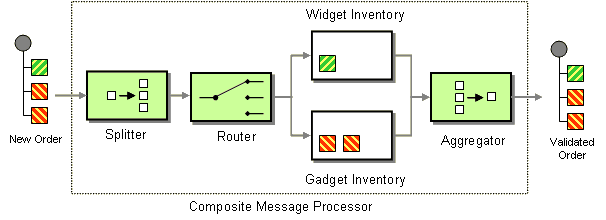
The following example checks that a multipart order can be filled, where each part of the order requires a check to be made at a different inventory:
// split up the order so individual OrderItems can be validated by the appropriate bean
from("direct:start")
    .split().body()
    .choice()
        .when().method("orderItemHelper", "isWidget")
            .to("bean:widgetInventory")
        .otherwise()
            .to("bean:gadgetInventory")
    .end()
    .to("seda:aggregate");

// collect and re-assemble the validated OrderItems into an order again
from("seda:aggregate")
    .aggregate(new MyOrderAggregationStrategy())
    .header("orderId")
    .completionTimeout(1000L)
.to("mock:result");The preceding route can also be written in XML DSL, as follows:
 <route>
   <from uri="direct:start"/>
   <split>
     <simple>body</simple>
     <choice>
       <when>
         <method bean="orderItemHelper" method="isWidget"/>
 	<to uri="bean:widgetInventory"/>
       </when>
       <otherwise>
 	<to uri="bean:gadgetInventory"/>
       </otherwise>
     </choice>
     <to uri="seda:aggregate"/>
   </split>
 </route>

 <route>
   <from uri="seda:aggregate"/>
   <aggregate strategyRef="myOrderAggregatorStrategy" completionTimeout="1000">
     <correlationExpression>
       <simple>header.orderId</simple>
     </correlationExpression>
     <to uri="mock:result"/>
   </aggregate>
 </route>
Processing starts by splitting the order, using a Splitter. The Splitter then sends individual
OrderItems to a Content Based Router, which routes messages based on
the item type. Widget items get sent for checking in the
widgetInventory bean and gadget items get
sent to the gadgetInventory bean. Once these
OrderItems have been validated by the appropriate bean, they are
sent on to the Aggregator which collects and re-assembles the validated
OrderItems into an order again.
Each received order has a header containing an order ID. We make
use of the order ID during the aggregation step: the
.header("orderId") qualifier on the aggregate() DSL
command instructs the aggregator to use the header with the key,
orderId, as the correlation expression.
For full details, check the example source here:
 |  |  |
 |

